Day 12
Japanese Alps II
Shirakawa and the Gassho-style houses, Takayama and its historic center, and Matsuyama with Castle of Crow.
castle area
The hotel in Kanazawa has standard rooms like the others, but it is very functional and equipped with amenities that make the stay comfortable. Today we begin a three-day trip within the Japanese Alps, along an ideal route that starts from the sea of Japan and runs to Tokyo, on the Pacific side. Despite being at 35 degrees north latitude, the ocean currents clash with the inland ones, causing abundant winter rains even without being at high altitudes. As a result, snow is a constant throughout the entire season and beyond.
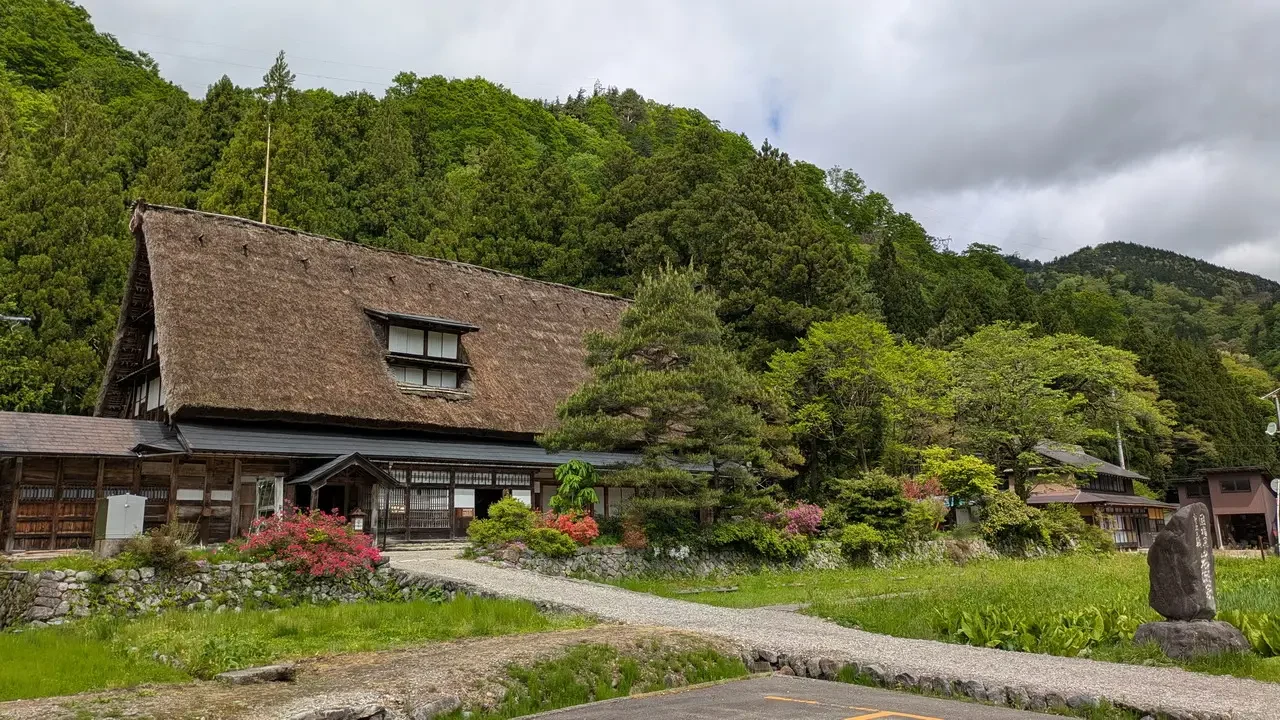
The first section of the highway passes through a predominantly agricultural region. rich in rice paddies and vegetable crops. As soon as we start to ascend slightly in altitude through green hills, in the background we begin to see snow-covered canals Despite the late season and low altitude. Long queues of snowplows in service areas confirm that during winter, the conditions must be excellent: in Nagano – which is only a few dozen kilometers from where we will spend tonight – the Winter Olympics were held in 1998. The first stop is Shirakawa, the village famous for its Gassho-zukuri houses, traditional farmhouses with steeply sloping roofs made of thick layers of dried grass, fixed in a unique local style. It's Sunday, an ideal time for excursions outside the city, so we need to be resourceful and avoid popular destinations and times; the main center of Shirakawa (Ogimachi) is also the most touristy one, with the bus queues arriving do not suggest a quiet visit. The 1,000 Yen (6.5€) required only for parking foreshadows intense exploitation of the place and its visitors. Following the directions in the Lonely Planet (old edition), we move a few kilometers to a more secluded village where the houses are identical and there are fewer people. We stop for a couple of photos, when... a traditional dwelling a kind lady greets us and gestures for us to enter; it's a house-museum where we don't see any other visitors, we approach and are welcomed with the usual Japanese courtesy. The owner invites us into a large, sparsely furnished room to sit on the cushions. on the tatami, around the fireplace... above which a tea and chestnut container was hanging, placed there to smoke. While we enjoyed the mixed tea made with 9 different types of leaves (including those from bamboo), she began to tell us the story of the house: it is about 300 years old and belongs to her husband's family for several generations. The house was built entirely of wood and ropes on multiple floors without using metal carpentry; the raw material is easily available in the surrounding area, although there have been periods when houses could not be built because the local lords prohibited the collection of wood for this type of construction. Currently, they use kerosene stoves to heat up, while downstairs there were two always-burning coal fireplaces; the heat and smoke also rose to the upper floors, the first to provide a minimum of warmth and the second to disinfect the beams against insects and parasites, as well as to dry the newly produced silk.
The accommodation could accommodate up to 30 people at once, including a portion of the family who owned it, as well as other workers, since the building also functioned as a silk production and dyeing facility, as well as for producing washi paper during suitable seasons. The roof of the house. It consists of a series of enormous piles of straw similar to pampas grass, which is collected and dried. There are approximately 9,000 on each of the two sides, and it is replaced every 20/25 years; initially, one side is completely renovated, followed by the opposite side about 5 years later. The winters are harsh and very snowy, despite being only at 340 meters above sea level; this year, the usual two meters of snow have been exceeded by at least 50 cm. We saw photos just a couple of months ago with a lot of snow on the ground, to such an extent that there is a problem with how to evacuate it and make it melt quickly; the solution is to throw it into a pond right behind the house where water flows constantly, but this is not an easy task. The pool also contains carp, which used to be a source of food. Currently, we can say that they provide a decorative element and are kept as pets.
The vegetation still has the pale green of when nature is just emerging from winter; the forests around are rich in chestnuts. We are offered to taste a sweet made with their flour mixed with wheat flour. At this time, the chestnut bunches are hung above the fire solely for decorative purposes and are only eaten after being boiled. In the past, these smoked chestnuts were also eaten. Two small temples are also present on the ground floor: one dedicated to Shinto for prayer to the universe, and another which is about 100 years old and dedicated to praying to ancestors, typically Buddhist. The house is also equipped with three separate entrances: one for the family, one for guests from which we entered, and a final one, particularly beautiful, in the area dedicated to accommodation, which was used during the time of the Haga Lords; here are some wonderful paintings whose subjects have been carved into wood. At some point, the owner arrives, shows us some tools that we have never seen before, including one that produces a dry sound, similar to that of gongs; at this point, the lady sings and he accompanies her with the tool (sasara(consisting of more than 100 pieces of wood attached together): although the melody we hear will not be exactly the main reason for coming to Japan or an unforgettable memory that we will take home, it nevertheless represents a deep feeling of local folklore and culture that we truly appreciate. We then climb steep and narrow wooden staircases towards the upper floors, where the first floor was used as a grain dryer, as well as sericulture. Currently, there are also a number of historical photos and objects related to agricultural activities here, which is fun to recognize similarities and differences compared to our rural tradition. The floors are made up of open slats so that the heat can rise with the smoke, which is useful for sanitizing anything organic that was stored there. We conclude the visit with a look at the entrance and the guest lounge, where the carpet is made from the skin of a large black bear. We buy a very original Christmas decoration that will enrich our next Christmas tree.
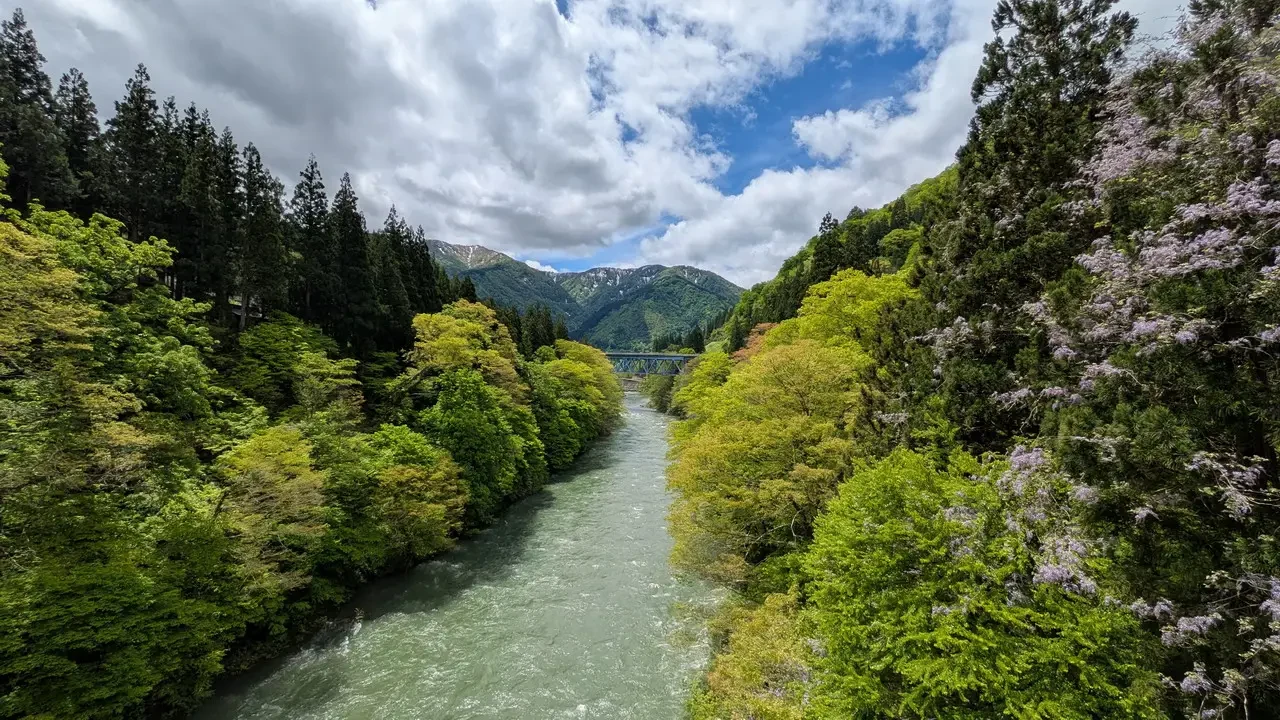
Even in Shirakawa, with the exception of the main village which was crowded with buses, you encounter very few people and have the opportunity to fully enjoy the place. Satisfied, even with the sun breaking through the clouds, after a coffee mid-morning at the eagle-shaped bar on the fast-flowing, crystal-clear river, we can still see from above the characteristic Saganuma village, which is also made up entirely of Gassho Zukuri houses. The road constantly shifts from one side to the other of the river, interrupted here and there by dams. We leave the Shirakawa area, heading towards the next destination, the town of Takayama. The highway from Gokayama is a succession of tunnels, with the longest reaching 11 km, interspersed with very short bridges.
The urban face of the Shinto shrine.
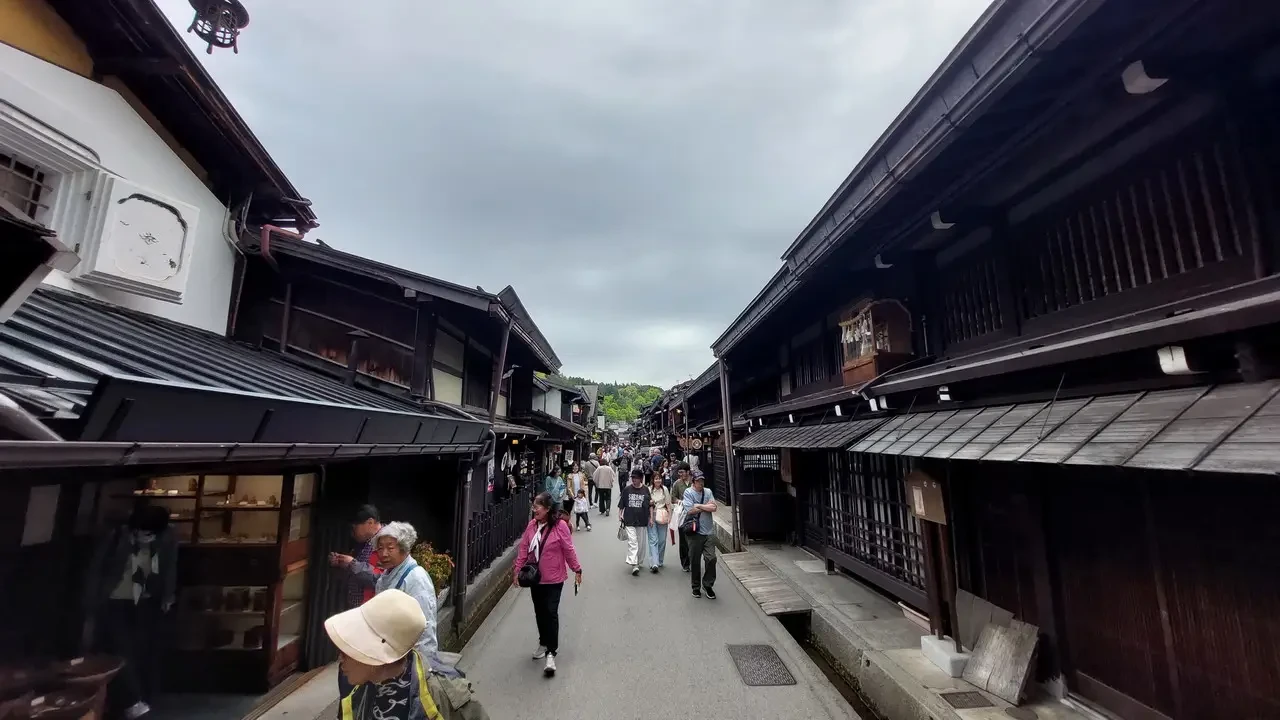
Entering the city, we try to refuel, but we encounter some difficulties deciphering Japanese at the self-service station. It's just a matter of asking for help, and a young couple is happy to assist us in completing the transaction without any problems: this is Japan! Takayama, which is more touristy but less interesting, is located in a beautiful valley surrounded by mountains, and you can clearly see the snow line, which is still very prominent. It has a nice center consisting of streets with the wooden houses' features (old private houses) formerly inhabited by samurai, but now a continuous display of shops invaded by tourists on holidays. It's a place to buy fine wooden crafts and good street food (hita beef). Absolutely worth a walk through the city center. a taste of mochi (inserted into a stick, they are made with rice and dipped in soy sauce), dango gohey mochi (basically the same recipe but the shape resembles that of an ice cream cone and is dipped in a sweet sauce) and good matcha ice cream (green tea). Among the most interesting shops we find the distilleries that sell sake They also organize courses in which the history and production of this delicious drink are explained, a beverage that we all know and regularly enjoy since we arrived in the Land of the Rising Sun; besides what they display in their shop, it is easily recognizable by its characteristic cryptomeria sphere (a type of cypress) hanging in front of the entrance, a classic symbol for sake producers, as well as by the distinctive barrels used to store it during transport.
Highway 158 is a true mountain road where you can still find some piles of snow and cherry blossoms; as you climb higher, the vegetation changes its appearance to take on completely winter colors and shapes, except for the return to spring along the subsequent descent after the pass. In this area, you can see ski resorts with slopes that appear very steep; further down there are several dams and a new road under construction where frequent tunnels bore into the mountain to connect valleys. The Japanese philosophy of building mountain roads differs from that of Europe: wherever possible, tunnels are built, which certainly has an advantage in terms of external maintenance, avoiding the construction of bridges upstream and downstream, as well as for snow removal, which in this area falls heavily for long months. On the other hand, both the construction and the upkeep of these tunnels require a lot of economic resources. We frequently encounter tunnels on the highway to Takayama and along the road leading to Matsumoto. The route winds through the slopes of steep valleys, whose forests seem to support them since ancient times, when members of clans who had lost in the feuds that plagued Japan were forced to hide in these rugged places. Forests that appear phosphorescent under the rays of the sun filtering through the clouds like beams of light illuminating a stage. It is only mid-afternoon but the Sunday return trip is starting to become visible on the road, with slow and orderly traffic frequented mainly by buses, allowing you to see (and enjoy) the beauty that unfolds before you. We arrive calmly at what will be our last destination for today, Matsumoto, where we arrive in the late afternoon; a fairly large city with intense traffic but always well-regulated.
Nawate Dori
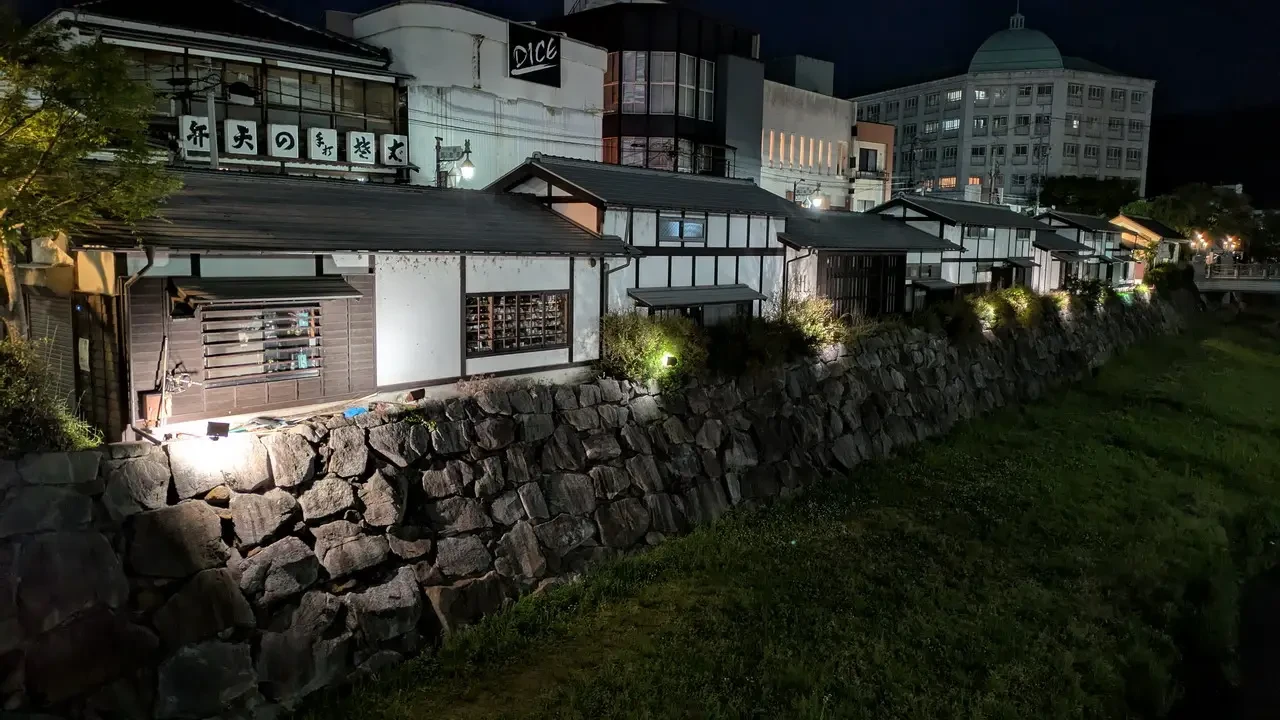
Today's ryokan is located in a quiet spot along a small stream and is run by an elderly couple. As always, efficiency is key, and attention to detail can be seen everywhere: the lady provides us with helpful instructions on what we can and cannot do. To avoid parking problems in the city center, we decide to walk for about half an hour through residential neighborhoods, giving us a glimpse into everyday life in Matsumoto. We arrive at the castle area... which presents the usual characteristics: imposing size, surrounding waterways, trees and bushes filling every space that the eye would tend to see as partially empty. Truly beautiful in its overall harmony, a creativity of decorations that place and highlight the ancient manor at the center. We move towards the river where there are a couple of historic streets for merchants and artisans ( Nawate Dori) as well as a quiet Shinto shrine, but especially the area with the highest concentration of restaurants. Inside one of them, we see locals entering and read (thanks again to Google Lens) an interesting menu posted outside. The interior is typical, and the dishes are equally so: we once again enjoy local cuisine, including raw horse meat. bamboo, trout, udon and tempura; strangely, they don't serve rice, perhaps because the prices of grains have increased enormously in recent times, to the point that even a minister had to resign. After exiting, the cool air is noticeable, but the long walk and a glass of sake once we arrive at the ryokan will help restore our body temperature. But first, we still need to see the castle at night and this image will be a feast for the eyes: carefully lit in a typical Japanese style, it reflects its image in the wide channels, effectively doubling it; the dark sky and oil-colored water meet to create a background worthy of the artistic subject, it feels like being in a theater. From this point on, it will be my legs' job to cover the remaining 2 km to the final destination...and the sake. When enjoyed fresh, with its 14/15° alcohol content, it makes an excellent digestive before going to bed, so much so that when we have a rental car or stay for several nights in the same location, we have developed the habit of buying a bottle of 0.75 cl., trying to make it last for three evenings. Beer during meals is also fine: Asahi, Sapporo and Kirin are the most common.