Day 1
Arrival in Tokyo
The easternmost capital of Asia.
Flight to Tokyo
Having arrived at Haneda Airport, which is preferable to Narita due to its closer proximity to the city center, we landed with an Airbus 350 from SAS and one hour behind schedule; we were disembarked by bus. Once cleared through customs with simple procedures, we proceeded to exchange Euros for Yen at a very acceptable rate for an airport, and left our luggage in the baggage storage at Terminal 1 of the domestic flights, from which we will depart tonight. This allows us to move easily between Terminals 3 and 1 using the Keikyu metro service that operates from the airport. At this point, we are relieved and can begin exploring Tokyo by purchasing a daily ticket that allows travel on a limited number of subway lines, but is more than sufficient for today; identifying exactly what we need isn't straightforward, but relying on the helpfulness of the information desk, we manage to get assistance. The journey takes approximately half an hour, with the trains on the elevated line passing between buildings, seemingly about to enter them. Evidently, privacy in Tokyo must be overridden in the interest of transit, and this is unavoidable: the windows of the subway often come very close to those of residential buildings.
Santuario Meji Jingu
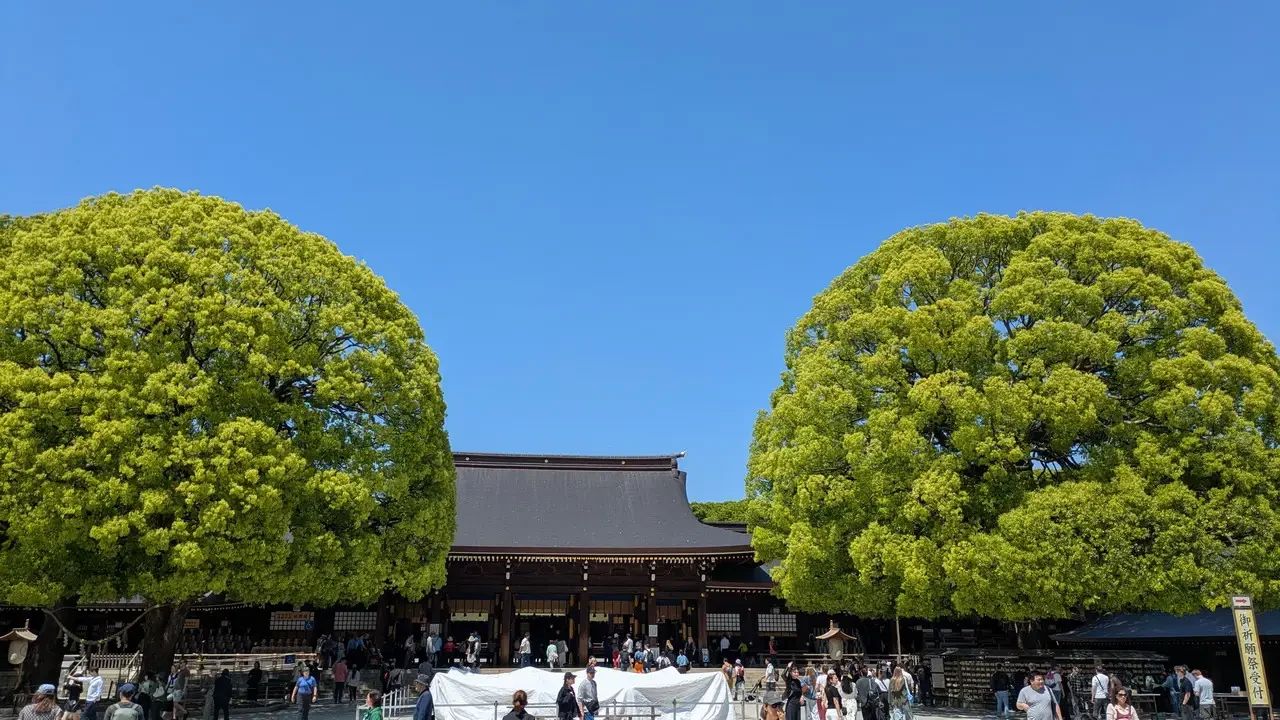
A chance encounter leads us to suspect that we need to change trains, even though we are still on the same KK line. Despite the tiredness ingrained in our minds, we ask a passenger just in time to exit and board the next train. We take the train towards Yoyogi Park; it's now midday, and when we step out of the subway, we find ourselves in a historic neighborhood with ideal places for lunch. We start with a nice... kaisen-don, a bowl of white rice with raw fish (sashimi) on top, replenishing energy for the visit to the Santuario Meji Jingu near the Park, consisting of 120,000 trees from all over Japan, displaying their lush green canopies in the springtime light with their massive size and variety. It's a warm day, but the tree-lined avenue create ideal conditions for walking and sightseeing. The first encounter with Japanese civilization, representative of what we will see everywhere in the coming two weeks: impressive wooden structures can be found within city parks, tall red-orange torii (gateways) stand proudly welcoming pilgrims or even simple visitors, carefully selected trees and shrubs contribute to creating the scene that only our imagination had dared to envision. Along the avenue stands a wall of sake barrels offered by producers in a clever combination of propitiatory devotion and marketing. The first contact with Shintoism is convincing, but we were not surprised that a religion devoted to natural elements could appeal to us. As it is an original Japanese belief, we had not yet had the opportunity to encounter it elsewhere in Asia; this will be different for Mahayana Buddhism, which has overlaid and integrated itself into the pre-existing religion in a peaceful form of syncretism. A Buddhism that arrived on the island around the middle of the 6th century and was already encountered in Nepal, China, and, in its tantric version, in Tibet; although its widespread dissemination only occurred in the 13th century. It seems that Shintoism and Buddhism divide tasks and missions: the former is more suitable for trying to obtain earthly favors and thanks, while the latter is more devoted to the worship of the dead and, in general, to the spiritual dimension beyond death. Following the rituals of a ceremony that we will see frequently from here on, the faithful approach and purify themselves by washing their hands at specially placed fountains near the temple, thus preparing their souls through hand washing and then their mouths (in the case of Buddhist temples) or their foreheads (in the case of Shinto shrines). Another difference is that at the entrance to Shinto shrines there is a torii, an ideal and physical gateway to demarcate the boundary between the sacred and profane world (similar functions have the intertwined ropes), while in Buddhist temples there is the sanmon, which is often a real building. Once reached the altar The faithful toss a symbolic coin, express a good wish, make a bow with arms parallel to the body, a double clap of hands, and then another bow before stepping back without turning their backs to the altar. This is an engaging ritual that seems natural to perform when approaching; we are not Shinto followers, but we show him the utmost respect. There are quite a few people (including several Westerners), but without any excesses, definitely less than what we expected during Golden Week.
Arrival in Tokyo
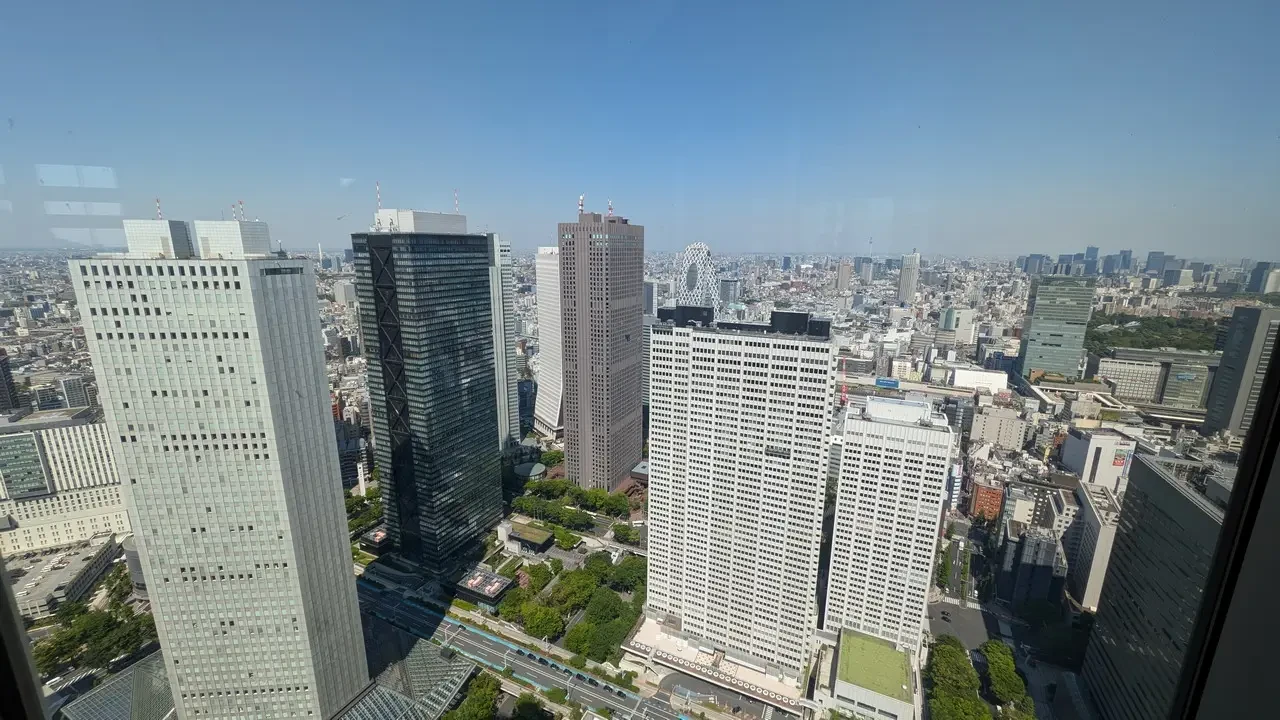
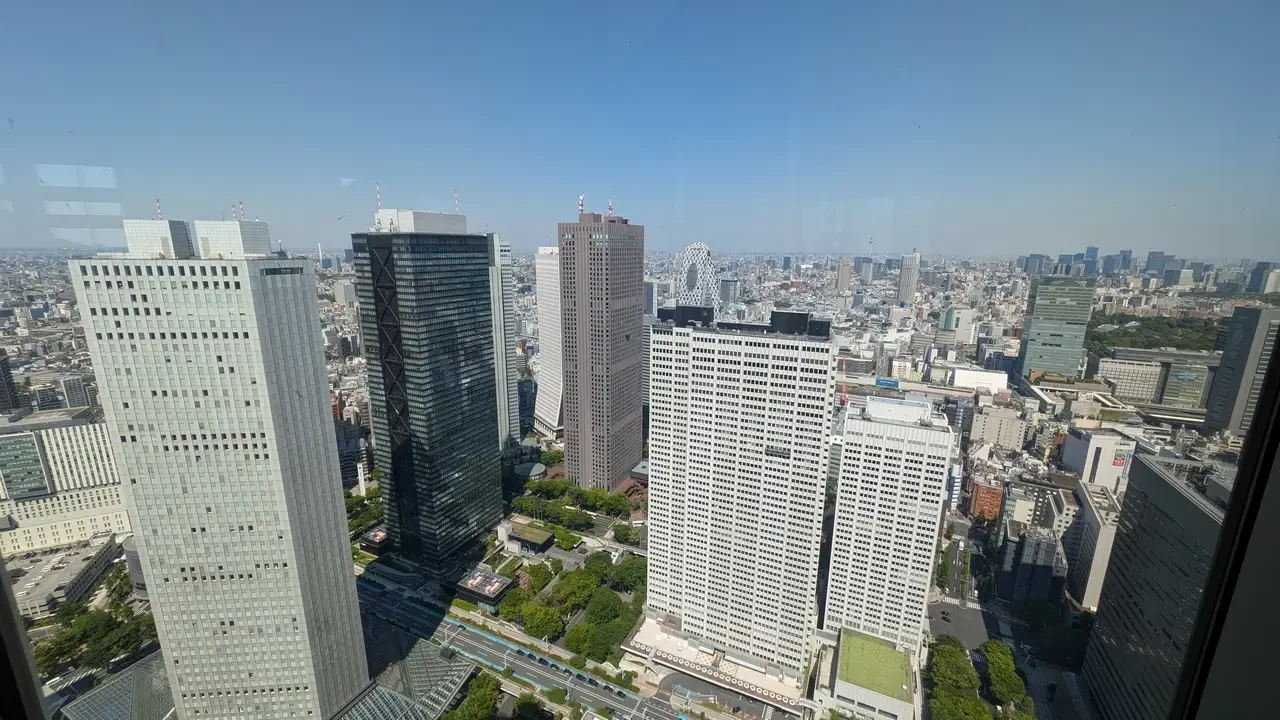
Here, as elsewhere, moving from the urban chaos to the peace of the temples in the green is just a moment, and with a half-hour walk we can visit the Government Building of the Metropolitan Municipality. It's interesting not so much for the building itself, but for the… wonderful views of the city enjoying the view from the top floor on this cloudless day; a short queue, a quick elevator ride and we find ourselves face to face with Tokyo. immense expanse. We take the subway again and finally visit the large Imperial Palace Park of Tokyo; There isn't much to see in terms of buildings because the one used for the emperor and his entourage is obviously closed to visitors, while the historical part only remains with some destroyed bastions from earthquakes and the last war. What is remarkable is the park, which is large and spectacular due to its central location along whose edges you can see... stained glass windows of the palaces. The stone defensive walls descend diagonally and The rocks are smooth. in such a way as to fit perfectly, if one hadn't yet seen the wonders built by the Incas in Peru: while also offering a better view due to the slope. It would be interesting to consult an expert in military engineering to find out how advantageous a diagonal wall system would have been for defense, which, on the surface, would facilitate its scaling. The sun is strong, let's go back and see the Nihonbashi bridge We then headed towards a metro station amidst groups of school children, where the students stood out with uniforms similar to those worn by our sailors. We returned to the airport via the Asakusa line to collect our luggage and purchase some onigiri (white rice balls filled with salmon or eel and seasoned with wasabi and radish), which we ate immediately, before boarding the 18:45 flight to Fukuoka, the southernmost island of Kyushu; it departed about twenty minutes late, but managed to make up for lost time upon arrival. We were surprised to find that the plane was an Airbus A350, a type typically used for intercontinental flights, even though the journey was only two hours long, but it was still full. It was evening in Fukuoka; the airport is close to the city center, and a short taxi ride took us to our hotel, conveniently located just a few hundred meters from the rental car company (which will be useful tomorrow) and the train station (two days from now). We were in the south, with temperatures still around 18 degrees Celsius. We completed the check-in process, and I would like to make a note about efficiency: the guest must enter their details on a touchscreen while the receptionist remains at her post and only intervenes if necessary; we will discover that this is the standard practice in hotels and it won't be difficult for us to adapt. The rooms are definitely small but very well-equipped. We always find kettles, coffee, tea, refrigerators, pajamas, slippers, and everything else needed for a good shower: high-quality shampoo, conditioner, and body wash are always available. If necessary, you can also use an iron and shoe cleaning supplies. With a few coins, you can do your laundry and use a high-performance dryer. Some stickers recommend placing your luggage under the bed to optimize space. It's almost 11 pm, and it's time to go to sleep; even on a small bed, lying down feels comfortable.