

Day 9
Kyoto II
The city of a thousand temples, and much more.
The Kyoto subway
Intense day, entirely dedicated to visiting Kyoto. However, first – around 7:30 am – we take the metro from our hotel located in the south-central area, which is convenient compared to what we saw yesterday towards the new location where we will be staying for two nights, just a short walk from the Gion district, lively and interesting, as well as convenient for public transport. It's a hostel unlike any we have ever seen before; one could easily describe it as a five-star hostel. In addition to the impeccable service, everything is clean, silence is guaranteed, and in the evening we can do laundry/drying with complete peace of mind for just a few hundred yen.
Otagi Buddhist Temple
For 1.100 Y (approx. 7€), we purchase a ticket that is valid for the entire day on urban public transport; afterwards, using a line of JR Rail, we begin our daily exploration in the Arashiyama Forest, the famous bamboo forest, where paved paths wind through plantations of these slender and tall trees; it's amazing how they manage to be so flexible and not break under the wind; in fact, they sound like an instrument when the breeze passes through them. There are people around, but the silence prevails even with the city nearby. The day is beautiful, and we decide to reach our next destination, the Otagi Buddhist Temple, with a half-hour walk along narrow streets lined with villas and forests. Right on the slopes of one of these, we find our temple, which is characterized by the presence of countless stone figures resembling monks, whose expressions vary from one another and sometimes in particular poses. The fact that many of them are partially covered in moss makes them completely unique when touched by sunlight filtering through the dense vegetation.
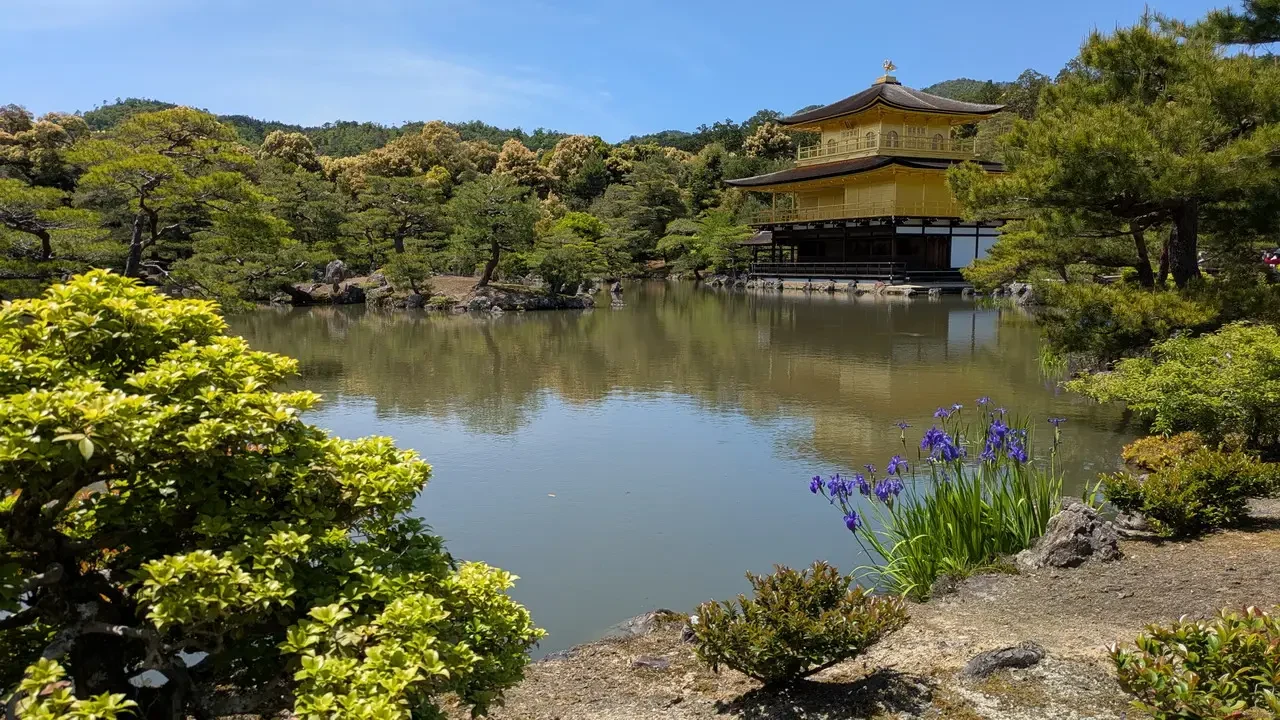
We are in a suburban area, and we wait about ten minutes for the bus to take us to visit the Kinkaku-ji (Golden Pavilion), one of the most valuable and, of course, tourist-filled temples in Kyoto. Also located in a hilly area, near the shores of a lake where beautiful irises bloom, it appears as a golden gem (the covering is truly made of gold leaf, obtained through a very refined artisanal process aimed at reducing the layer well below a millimeter), shining between the water and the clear sky.
The schedule would require a break for lunch, but the weather in Kyoto is much harsher than the emperors who ruled here for centuries: just outside the Pavilion we find a small shop that produces freshly made pastry rolls filled with chocolate. The heat and our hunger urge us to have another without even satisfying the intense feeling of hunger that overwhelms us. While enjoying them sitting on a bench, we see two workers nearby trimming the grass along the road: they are working together because while one operates the weed whacker, the other holds up a plexiglass shield to prevent any stones from falling onto the road.
The urban bus system is efficient, just like the rest of the country, and allows you to see a glimpse into everyday life. Near the busiest stops, we can observe the helpful work of volunteers (or perhaps not) who are tasked with directing passengers onto separate lines of two people depending on which bus they want to take. When they see that the vehicle is full, everyone stops without pushing, the doors close, and they wait patiently for the next one. Speaking of urban buses, the drivers handle everything perfectly: wearing a uniform, hat, and white gloves impeccably, they have a microphone with which they announce the stops, warn when the bus is about to depart, and thank each person as they get off. On board, the stops are clearly marked with illuminated signs that are easy for foreigners to understand; as the stop approaches, without crowding, passengers approach the front door and show their ticket or pay in cash by inserting coins (not cards) into the machine located next to the driver shortly before the door. As they exit, they greet the driver in a climate of perfect harmony and mutual respect: It goes without saying that you won't find any litter on the ground, even if you look carefully.
Next stop is the Nijo Castle surrounded by a wide moat where a heron peacefully sits; the massive stone walls symbolize the power of the shoguns, also erected to show their superiority towards the emperor himself, whose residence is located nearby. As it's a smaller replica of Himeji, we decided to see it only from the outside and proceed on foot under a strong sun towards the Imperial Palace The park is a large green rectangle compared to its location in the city center; it can be difficult to navigate and figure out exactly what to see. We walk as much as possible in the shade of the tall trees lining the main avenue to reach the Imperial Residence, where, among the well-restored historical buildings, the the garden Composed of the usual but tireless harmonious views of trees, bushes, water and paths. The buildings, despite their imposing and beautiful appearance due to recent restoration, have an aseptic and unimaginative look; a pushed-to-the-extreme essentialism, perhaps one of the rare negative characteristics found in some monuments. The fact that we are nearing closing time (monuments usually close very early) means there is little people around and the charm increases proportionally. Finally, but no less noteworthy, is the well-maintained and flowering Zen garden, despite its limited size. The sun is reducing its intensity, casting deeper rays and projecting longer shadows. The vegetation turns from a deep green to warmer tones, evoking yellow. Silence completes the picture, and eternity seems to merge with infinity, time and space become a single abstract concept.
The urban face of Kyoto
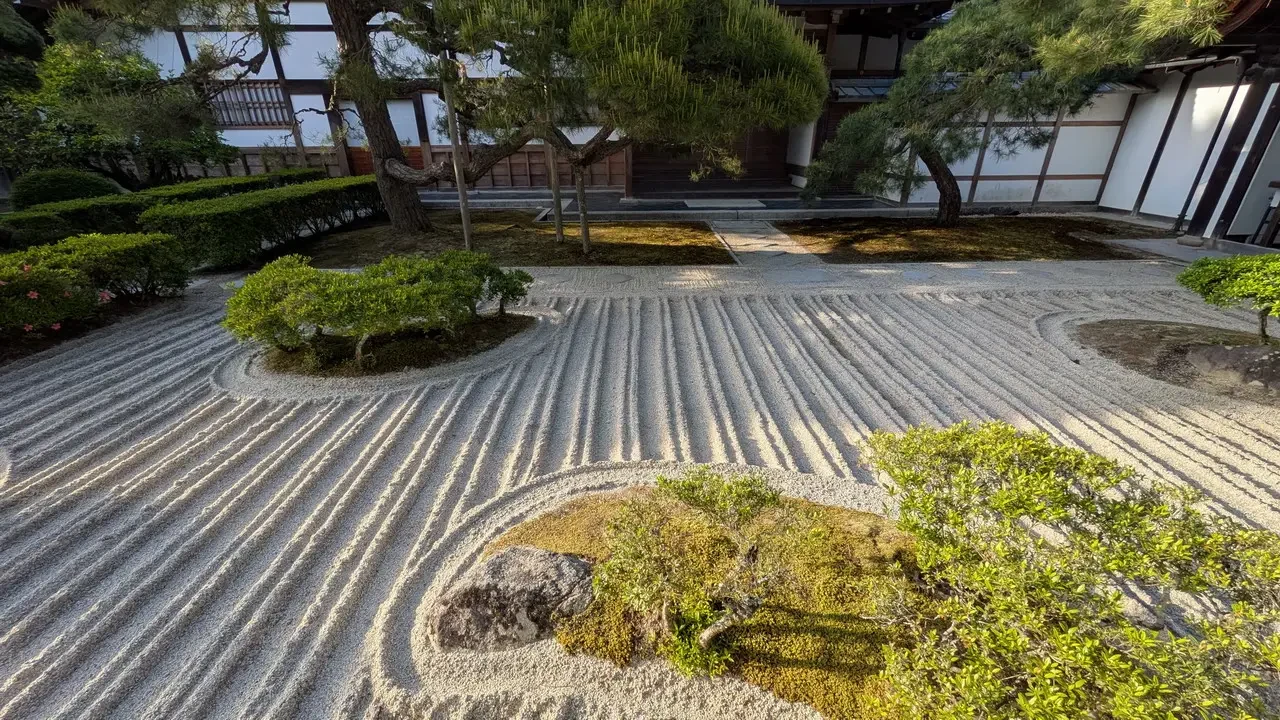
To break the spell, I wanted to see more of this city without limits. The Heian-Jingu It is a Shinto shrine that can be found along the walking route; we also don't mind taking a look at this monument with its vibrant red colors, which is located just a short distance away from a large torii gate. We arrive at... Ginkaku-ji (the Silver Pavilion), which also offers some interesting glimpses from above of the city. Visiting the Buddhist temple in the late evening allows you to find few people and fantastic light effects here as well: the garden of bushes, flowers, and tall trees is often interrupted by ponds along which rocks emerge, which certainly have a reason for being there, but one that is difficult for us to interpret. On one side, you will find the Zen garden: fine gravel measured in millimeters that surrounds stones and shrubs, giving them meanings that would require extensive study, but whose sight evokes absolutely relaxing sensations. This is the so-called dry garden (karesansui), as the sand and stones replace water to express movement. They originate from Buddhist religion, serving as elements useful for calming the mind and creating an atmosphere conducive to meditation. These gardens often surround Buddhist temples, contributing to creating a climate of peace and spiritual serenity. Even in this garden, the emphasis is not so much on floral colors (although azaleas and rhododendrons are present now), but rather on the harmony of the whole, as if everything should be placed in a certain position, predetermined by a higher power. Spiritual sensitivity translated into an orderly natural composition. The same play of light between trees, water, and shrubs is not left to chance; many plants are pruned, leaving wide spaces between branches, perfectly managing the growth of the leaves.
Philosopher's Path
Not far away is the Philosopher's Path A beautiful, paved path of 2 km that runs along a lively stream channeled between two grassy banks. It connects several temples located further south with the Ginkaku-ji. Perhaps it is more famous than it actually is, but walking this path in the quiet morning offers plenty of opportunities for reflection, both philosophical and otherwise. My legs, however, are telling me it's time to rest, so I can take a new bus ride to reach the bustling district of Gion, crossing the river that separates it from the adjacent area. Ponto-cho, search among the narrow alleys for an izakaya that inspires and cook using the Japanese barbecue system directly on a grill of succulent meat slices. Being accustomed to eating raw food, we simply let the outside turn slightly while keeping the inside a soft red. The area is extremely commercial, so it's interesting to take a walk along the covered galleries with food and craft shops, as well as enjoy some good matcha ice cream (green tea). It's a Kyoto neighborhood that contrasts but at the same time complements the historical and religious part of the city.
Kyoto is amazing: even just taking a short bus ride through the city center, you can see temples or monuments of great interest passing by, even though they are not mentioned in guidebooks. This is because the density of artworks present in the city is rare elsewhere in the world. Our accommodation is only a few hundred meters from the downtown area, which is very convenient given the scale of the city. As I have already said, it is a modern and high-class hostel where shared bathrooms at the end of the hallway and showers on the ground floor are not really an issue, thanks to the cleanliness and order that prevail there.


