

Day 8
Himeji and Kyoto
The Himeji Castle, rich in history, and my first encounter with Kyoto: we arrived at the Fushimi Inari Temple.
Morning in Himeji
Strange situation, today the alarm goes off early, and later on we will realize that we made a small mistake in overestimating the number of visitors to the Himeji Castle during the trip planning phase. Knowing that it is one of the favorite destinations for Japanese and international tourism, and being during peak season, we had planned to leave Okayama by Shinkansen at 6:30 (which meant waking up at 5:30) to arrive at our destination by 7:15. We walked the 500 meters separating us from the station, following the signs to the platform for the express trains, where we had a few more minutes to admire these beautiful " metallic running animals". In about fifteen minutes, we cover a distance of 75 km on the railway line, then we walk the remaining kilometer on foot. Otemae-dori which separates the Himeji station from the castle, thinking of patiently waiting in line behind the crowd expecting to open at 9 am. Instead, nothing of that sort: the road presents the usual weekday traffic, many shops are still closed, some bars are selling the first cups of green tea; even near the castle, you only see garbage collectors busy collecting the little trash. Happy not to find people, we also take advantage of this quiet morning to visit the surrounding park the castle, inside which diligent gardeners blow leaves and rake the paths. These activities, to be honest, are noisy and polluting, and sometimes they end up spoiling the relaxing and joyful atmosphere of parks and gardens that are always impeccable. When we arrive near the ticket office, there is only a quarter of an hour until opening, and there are just a couple of French teenagers. Visitors usually travel by organized tourist buses, and we manage to get ahead of them before disembarking. The feared crowds were not present; we can enter calmly to enjoy this masterpiece of military engineering, whose interior is essentially divided into two parts: the residential area set up as a museum and the actual castle, made of wood, where you can climb up narrow one-way staircases to the fifth and final floor, from which you have a great view of the city. We first pass through the beautiful rhododendron gardens, then on to the western bailey quarters, where the rooms of the female servants of the shogun's family were located, who lived within the main building. Like in Matsuyama, the medieval-era manor houses where the Daimyo (feudal lords) resided are all made of wood, which theoretically made them vulnerable to enemy fire, as well as accidental fires; it is interesting to note that the beams were not held together by nails... or other metal tools, only for fitting or wooden nails. The interiors are definitely more attractive than the corresponding European ones, which were strictly built of stone, although it is surprising to see the lack of heating systems, at least as far as we can see.
After two really interesting hours, we visited the charming Koko-en, the garden adjacent, a real feast for the eyes: flowering bushes, maples in various shades, small, painted lakes reflecting green of vegetation, where sparkling waterfalls cascade and fish swim. pacific carp koi Every glance is a painting, and every photo should be printed and framed. Finally, we walk back to the station, where at 12:59 we have a new Shinkansen booked that (doesn't) await us; but first, there's a brief stop in a shop (almost a boutique) selling gourmet delicacies, from which we choose an abundant portion of sushi to enjoy on a bench in the main street. Coffee at the station and then off to Kyoto in just 45 minutes via Kobe and Osaka, all in the same direction as this morning, towards the east. But before the cities, there are alternating villages interspersed with rice paddies, breaking up a landscape otherwise filled with palaces and industrial buildings.
We have finally arrived in the city that is the symbol of art, magnificence, and national tourism: essentially, the showcase of Japan. Kyoto presents itself with a splendid modern station which we will visit tomorrow. From here, we purchase a daily metro pass, which is useful for getting around to our hotel, where we leave our luggage and set off on foot towards the To-ji, a complex of temples From the large, sloping roofs, softened by their leaf-like shape. five-story pagoda that stands out against the blue sky.
Traditions and spirituality
With a quick bus ride, we arrived near the Tofuku-ji Temple... where other impressive Buddhist religious buildings stand; it seems that the religion wanted to manifest divine grandeur through large constructions. We don't know if this idea aimed at achieving the same goal of instilling reverence in the faithful, as was the case with the Catholic Church in South American colonies. In any case, the wooden structures shaped according to the Eastern style and the surrounding trees and gardens Maintaining these sites to perfection makes each impressive temple a worthwhile destination. It's a shame that, out of the thousands, only around 1,600 are located in Kyoto, and getting around requires more time than in other major cities, given the limited number of metropolitan lines that cross the city north-south and east-west. Otherwise, you need to use public buses, which don't have the same frequency and must adhere to surface traffic rules and schedules. Furthermore, the monuments are mainly located in the hilly areas northwest and east; we had created a list of what to see, and we will need to work hard to visit almost everything.
Fushimi Inari-taisha Temple
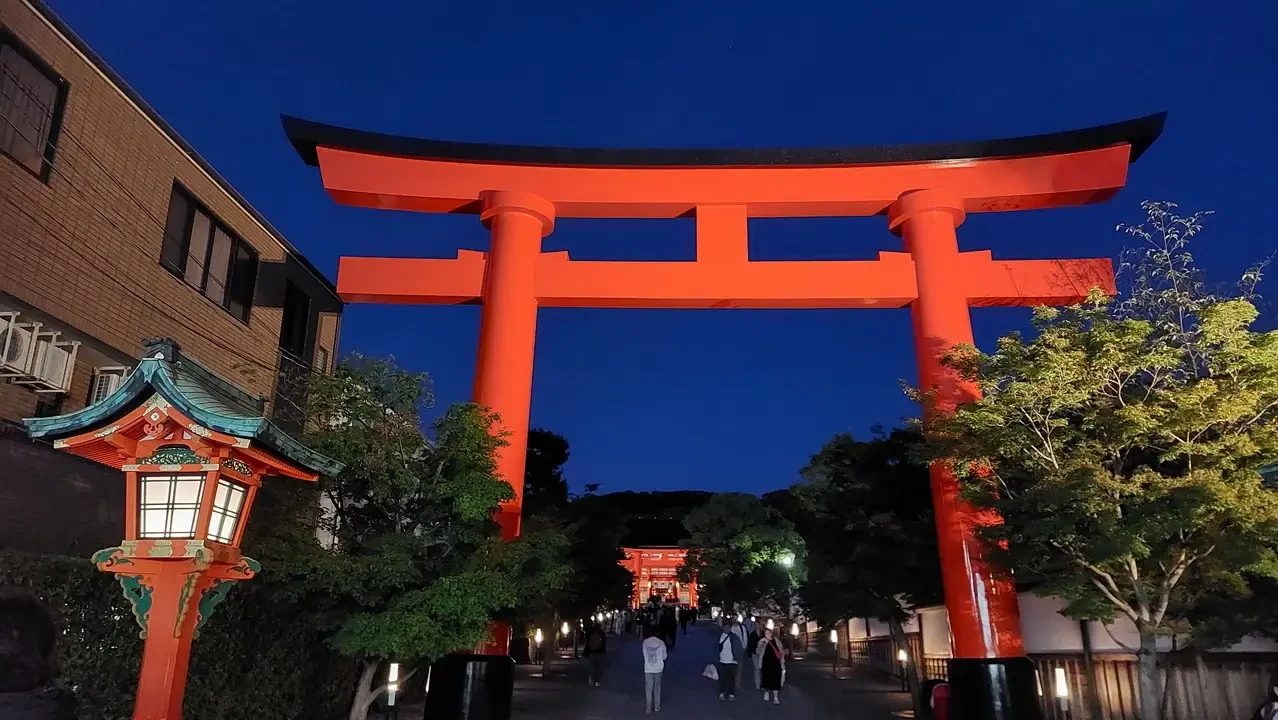
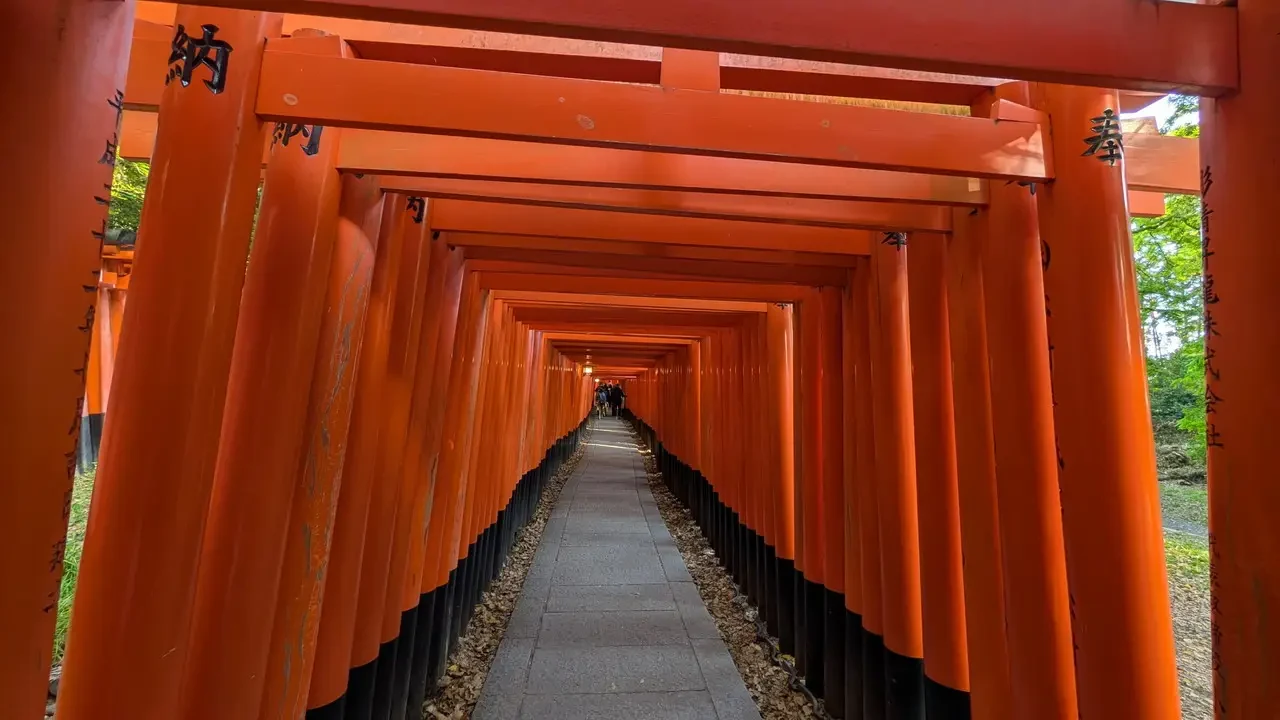
But the day is far from over since we still have one last surprise to enjoy, which we decided – quite deliberately – to do today and at this time. It's the perfect ending (and also a beautiful sight) and we had planned to experience it just as the sun was setting: the Fushimi Inari-taisha Temple with its a nearly endless series of torii red gates, to climb up the sacred mountain. After Mount Fuji, this is definitely the most iconic image of Japan. A walk from Tofuku-ji, about a kilometer long on quiet streets that you would never think could lead to such a monument, and we are standing before it. As easily understood, the base is full of tourists disembarked from buses. You will find temples of good quality and shops selling everything from ice cream to matcha (green tea) to souvenirs and religious garments; here as elsewhere, there are also booths offering amulets for a few yen, with which you can try to predict your future. The staircase runs under a continuous series of torii offered by companies and private individuals to appease the Divine and achieve success in their respective fields; they vary greatly, some are new, others have been restored, while others are dilapidated or even demolished for safety reasons. As always happens in these occasions, it is enough to make little effort to get rid of the crowds: as you climb, fewer people can be seen, so you can even take photos without any trace of human presence. In reality, we will discover that there are several "paths", all with the same characteristic of a gallery of torii, although the one leading towards the summit is clearly recognizable in terms of size. The signs are almost exclusively in Japanese, but there is little to learn: just keep going up. Until a point where the gates disappear and you have a great view of the city, but it's not the peak. We return, and from a square where altars can be found, we take another path that leads to what would be the summit, this time without breathtaking views. The path now descends in the opposite direction to where we should go, and it is already getting dark; we return on our steps, and with the magic of the blue hour, occasionally aided by the first headlights, we see this splendid red gallery from another perspective, alternating with areas featuring altars, lanterns and stone figurines of foxes (synonym of cleverness = success in life and business); on some altars, a multitude of small torii are placed, almost like gadgets, which could be considered as offerings. Looking at them from below, they have inscriptions, probably the names of people or companies who offered them. When we return to the base, there is still people around, but the crowd is decreasing and allows for better appreciation of the torii placed lower down. really impressive We return on foot and along the way we find a small restaurant that we decide to use for dinner: it's empty at the moment, so we enjoy a good meal prepared on the spot (salmon, grilled mackerel and chicken in sake), seasoned with the usual Japanese hospitality, although within the limits of linguistic incomprehension. We are not far from the hotel, so we decide to take one last walk on foot to return to our hotel instead of waiting for an unlikely bus.


