Day 10
Nara and Kyoto III
The first capital of Japan and my last visit to this endless city.
Nara
The forecast for today isn't great, and that's precisely why we decided to try Nara. We had already focused on a sunny day yesterday in Kyoto, and we weren't disappointed. However, yesterday the intense and demanding schedule, tight deadlines, heat, a light lunch, and constant travel by public transport left their mark on our sleep quality; we were already awake before 6:30 am, and we headed to the metro station to take the Karasawa line towards Kyoto Station. From there, with 720 Yen, we purchased a JR Nara train ticket that would take us to our destination in just 45 minutes, located south of Kyoto. We departed at 7:51 am, traveling slowly, stopping at each station and experiencing everyday Japanese life during these early morning hours. We left Kyoto, passing through its outskirts, continuing through an agricultural area with rivers of considerable size, and, as the train suggests, we could also see the back of houses and all the non-touristic aspects of a densely populated region like Kensai.
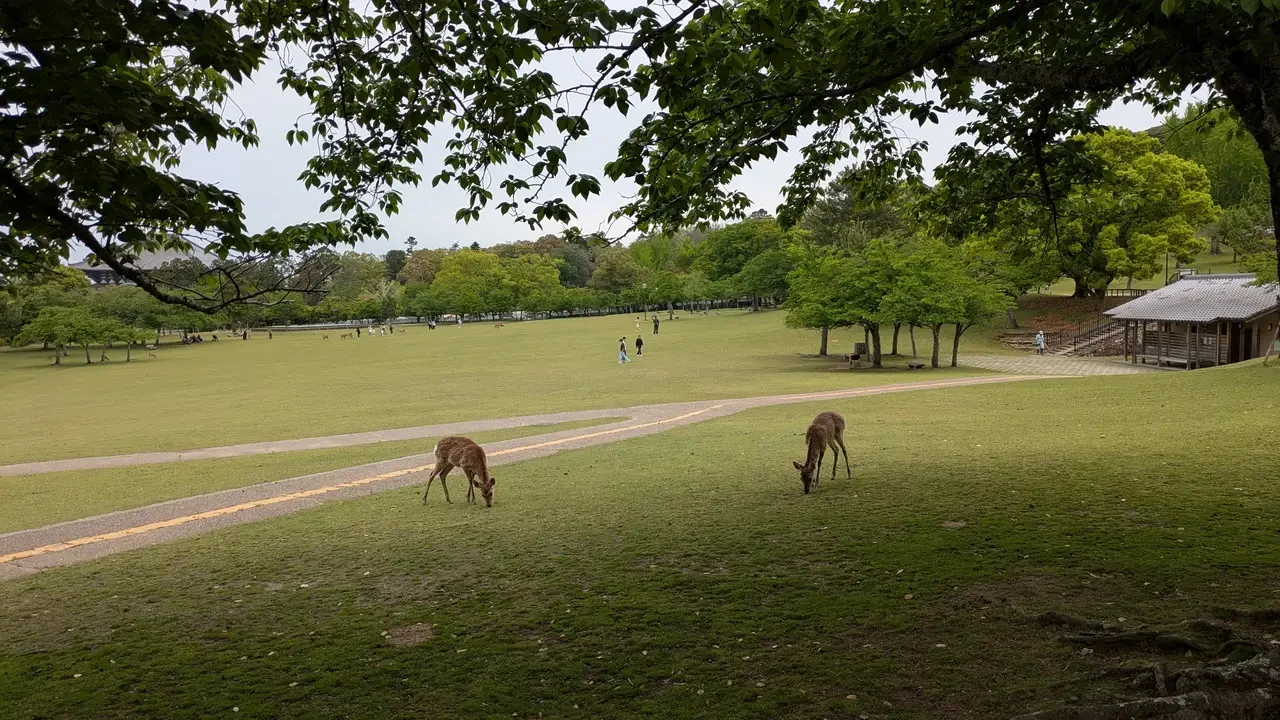
Nara is another must-see destination at the national level; the station itself is a beautiful landmark as the city essentially lives on tourism. As the first true capital of Japan, it features a large concentration of monuments within the famous park. This park actually enjoys somewhat fleeting but pleasant fame, due to... a large number of deer where we can stay and enjoy the scenery with temples and shrines in the background. We walk for just over 1 km along the main street from the station to the park, passing the first temple located in that area: it is called Kofuku-ji, with large pavilions and a tall pagoda (the second in Japan), currently covered due to renovations. Access to the park is enhanced by the welcome of the quadruped animals – which are also considered sacred – offering a charming touch of color and allowing us to take a few photos with them. There are many of them and they represent a sacred element of nature, just like the koi carp swimming in the ponds. Here too, the park extends widely and smoothly in its upper reaches, skillfully inlaid with trees and temples.
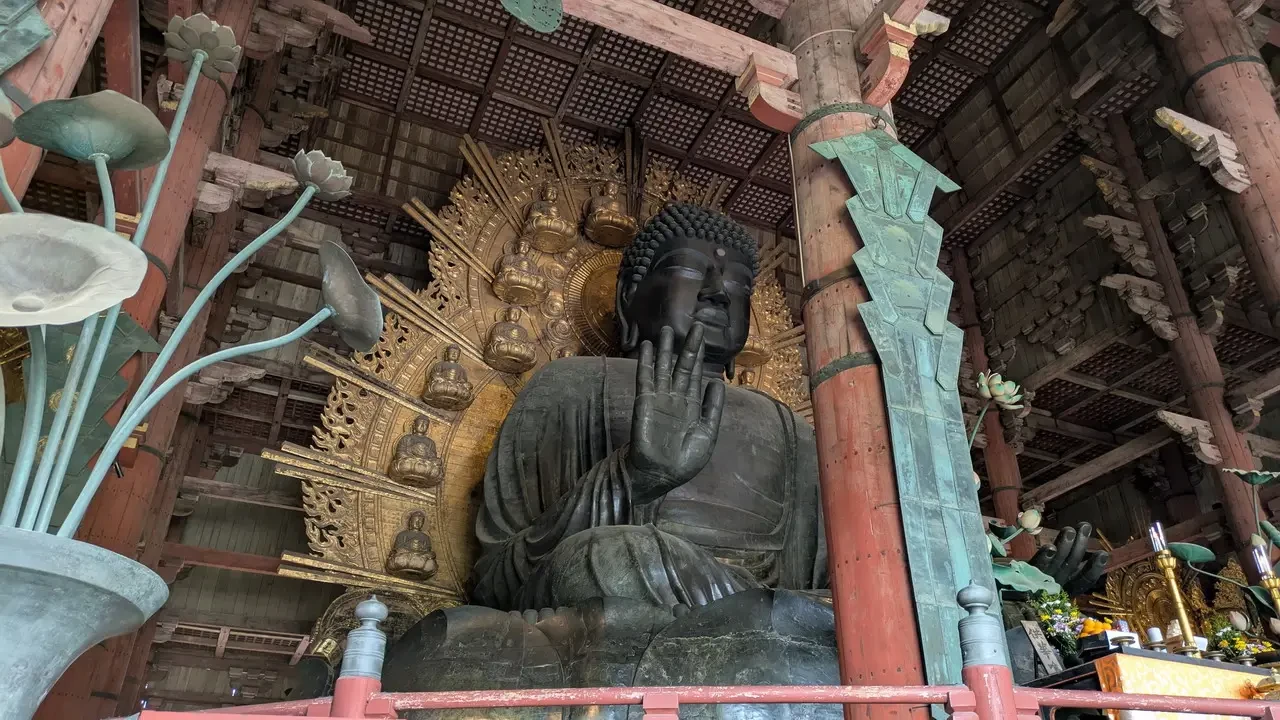
Meanwhile, the buses had started unloading hordes of tourists, all neatly lined up and heading towards the most popular destinations on the site. Unfortunately for us, one of these was the Todai-ji, temple which contains the Daibatsu, the bronze statue of the Buddha tall 15 meters, impressive in size and craftsmanship, definitely worth a visit. It can be talked about in terms of artistic and economic value, given the over 130 kg of gold that cover it, not to mention the almost 500 tons of bronze that form its structure. You can walk around the statue, among school groups and guides who are explaining a series of hows and whys to fascinated tourists. The students aren't here for tourism; they have questionnaires in hand to fill out after observing certain details, which will likely be followed by an interrogation.
Traditions and spirituality
We venture further to see some other temples scattered throughout the park, finding ourselves almost alone in this enchanting setting between nature and art. The buses for organized tours go directly to Daibatsu and a few others, leaving plenty of space to visit the rest peacefully. The same can be said for Kyoto, where the tours focus on Fushimi Inari (limited to the first part), the Golden and Silver Pavilions, Kyomizu-dera, and a few other sites. There is people around them, but not large crowds of tourists waiting in line.
Arrival in Nara
We visited the Kasuga Taisha, a Shinto shrine.... along which stretches a wide avenue lined with hundreds of stone lanterns, within which candles are occasionally placed, protected by thin and almost transparent sheets of rice paper. We conclude with the Ukimido Pavilion, a procession of floating pavilions on the lake, connected to the mainland by a walkway. A couple in wedding attire are taking formal photos: the photographer and the bride are making every effort to get the best shots despite the cloudy sky. We also take a few pictures, then leave the park to see the former merchant district of Naramachi, which is charming but not essential. We converge on the main street; it's just midday, but choosing to have lunch in a local restaurant proves to be perfectly timed: within a few minutes, it's completely full, with everyone eager to taste the famous okonomiyaki, cooked directly on a fixed grill that also serves as the table center. All that remains is to walk back down the street leading to the station, from where the JR Nara Express will depart for Kyoto at 1:37 PM; while the train continues towards Kyoto, the first raindrops begin to fall; upon arriving at Kyoto Station, we go up to the upper floors to admire the large spaces and the architecture Highlights of this balanced modern work. One wouldn't expect to find a building with around twelve floors and skyways, as well as galleries suspended between the sides of the building and an elevated garden overlooking the city center, at this stopover (just like all the others). It was unfortunate that it rained, but the view from above is still amazing, especially when you're facing the Kyoto Tower, a prominent structure emerging from the urban landscape.
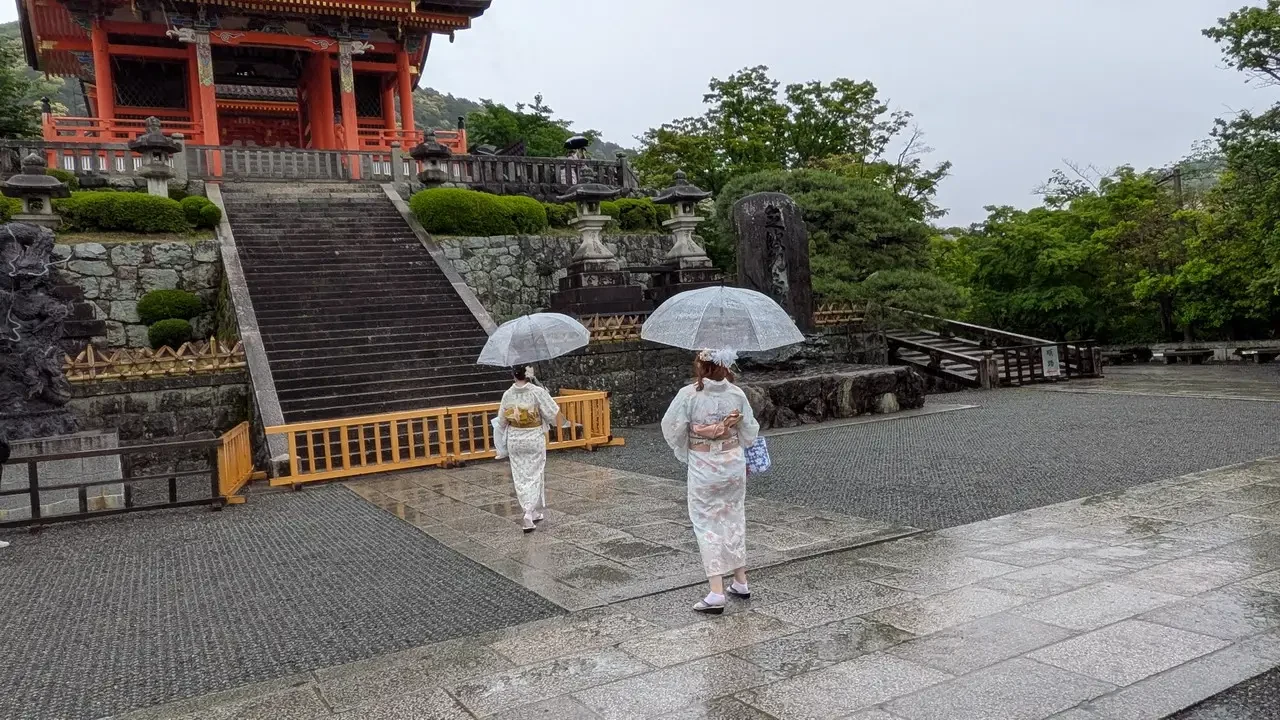
We get off at the bus stop, where even the hustle and bustle around the station manages to be orderly. We take the one that takes us near the Kiyomizu-dera, Buddhist temple characterized by its large panoramic terrace overlooking the greenery on one side and the city below on the other; definitely one of the most interesting, even within Kyoto's rich artistic landscape, which would have been even more beautiful when viewed in the sunlight, as it is nestled amidst the foliage. You can take a walk along an asphalt path to admire the temple from different angles, especially when it appears to emerge like a lotus flower from the greenery. Of course, for believers, it represents a place of great spiritual value: many people come here to small incense sticks, pray before the altars and toss small coins as a symbol of devotion; there are many people who They approach you wearing kimonos., available for rent in nearby shops, which are particularly beneficial to tourists who rarely own one. The old quarter is located nearby, with its two main streets. Ninen-zaka and Sannen-zaka... which present historical aspects in the buildings and modern ones in the shops located there. A quick look at the Ryozen Kannon Temple with its impressive Buddha statue and the Yasaka-jinja, a Shinto shrine where the graceful ... five-story pagoda.
We are now close to the center, and with just a few bus stops, we can see the famous Nishiki market, known for its diverse culinary offerings. But tonight we will choose to have dinner at a restaurant just a short distance away in the Ponto-cho neighborhood, where you can enjoy sushi made with thick slices of raw fish Seasoned with soy sauce produced in the Okayama area, carefully poured from a bottle into special containers because it was particularly valuable and of excellent quality. The young waitress was also very friendly, speaking good English (she is half Filipino) and asking us about Italy, which she intends to visit soon. After receiving so much information about the country that is hosting us, it's nice to be able to provide some information about our own country and also to have a chat with someone, in this Japan where English remains taboo. Not only because of a lack of willingness to learn it, but also due to the objective difficulties inherent in learning a language with a completely different structure. Another matcha ice cream, just like we had yesterday evening, and now we are ready to return, drink a small glass of sake, and rest for another short night.
We leave Kyoto, a truly unique city with an incredible number of monuments, but which seems to lack the DNA to accommodate tourism, even one that tries to be respectful but inevitably becomes intrusive. The future will tell whether the residents will be able to adapt and take full advantage of this profitable and clean industry, or whether they will close down as Japan did at the beginning of the 17th century. The most interesting temples and buildings are scattered in locations outside the city center that are difficult to reach on foot, so it takes a considerable amount of time to get around due to the limited usefulness of the two metro lines, which were built primarily to connect commercial areas with residential ones rather than tourist highlights.