

Day 2
Kyushu Island I
Devil and holy water: the hells of Beppu and the Dazaifu shrine.
Morning in Tenman-gũ
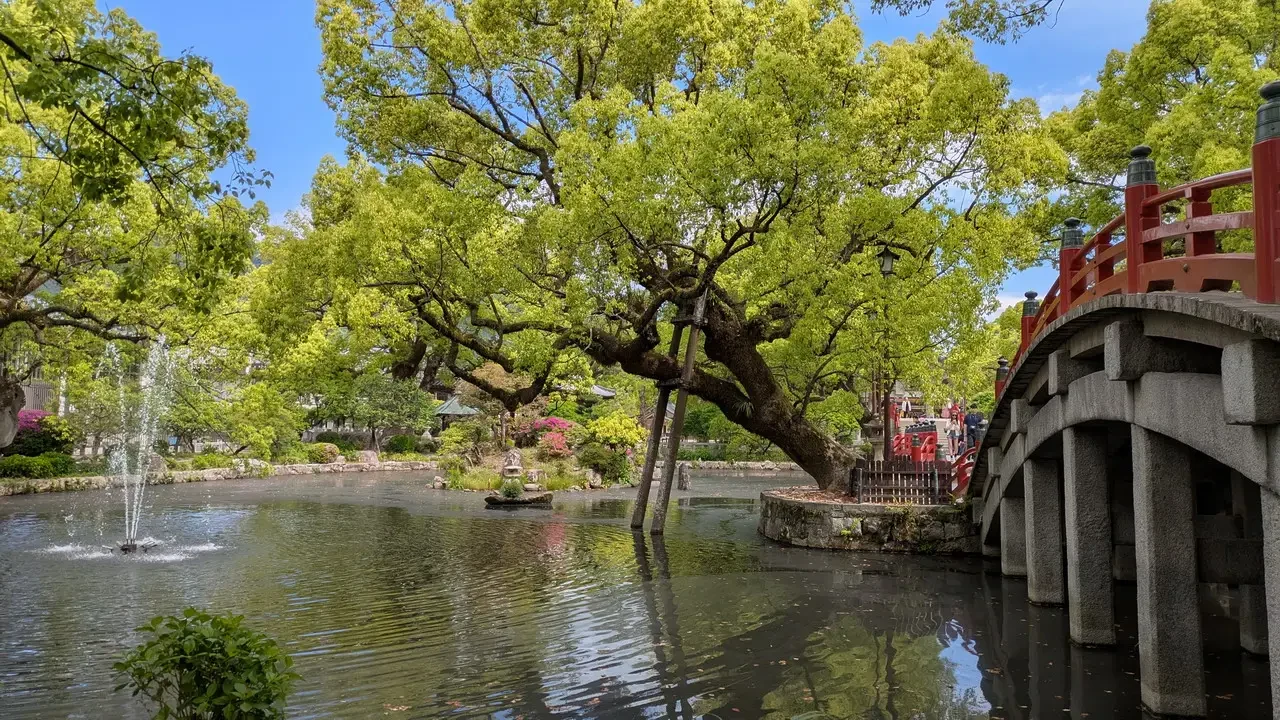
Wake up at 6:30, breakfast in the room (to be understood as a tea prepared with an electric kettle and some biscuits/sweets purchased from a supermarket, which we try to find is also typical). Budget Rental Car opens at 8:00, we arrive a few minutes early, using Maps and starting to get a first impression of what a large Japanese city is like. Children in uniform go to school, the only sound audible in the area, while adults dressed smartly head to work without showing any emotion. Renting a car in Japan is easy and not bureaucratic: at the time of booking, there are no charges (but you are released if you do not arrive within an hour of what was agreed), no amount is blocked as a deposit for damages, and in addition to the documents required in Europe, upon request (and it is advisable to do so) an ETC card is provided, which the operators insert into the device located inside the car: this will serve as a Telepass, being the only way to access the toll highways (almost all of them). Upon returning, the rental car staff remove the card, insert it into a device, and a report of the trips made with the amount to pay at that moment is issued. For the rest, you need to see and confirm some pages on a tablet where the rules for travel and emergencies in Japan are explained, but nothing extraordinary; as this was our first time, we took longer to read the warnings than the other party to complete the process. Of course, the steering wheel is on the right and it is advisable to have at least some experience with this type of driving. We rented a Suzuki JSKN class car, essentially a compact cube-shaped vehicle, very well equipped and extremely efficient, small in size for economic reasons but also to be able to move more easily through the narrow streets of Japan, not just in cities. In this and the two subsequent occasions when we rent a car, it will be useless to start talking in English, unless you say a few words related to the context, preferably accompanied by efficient mime. With all the necessary precautions, we leave the narrow urban streets of Fukuoka and, with a couple of small misinterpretations of the GPS, arrive in Dazaifu. Here, we have our first experience with the peculiar system of raised parking platforms; we will quickly get used to it, appreciating this clever way of charging the correct amount without complications. Dazaifu is a town a few kilometers from Fukuoka, but rich in history thanks to the shrine. Tenman-gũ, which features a garden that is extremely well-balanced between natural and human-made elements; the typicality of Japanese gardens It's all about skillfully combining courses of water with bridges, usually red in color, trees whose branches are shaped to create bushy foliage, and bushes that are molded from a young age to achieve spherical or at least rounded shapes, as well as stones arranged to complete an harmonious visual picture. In the waters of the lakes, large and colorful fish swim peacefully. I'm going to Algiers., a sacred symbol of strength, patience and courage; the qualities of the samurai, essentially. Their colors, ranging from white-red to gold, are so vivid that they seem artificial. Today we have the good fortune to arrive at the moment when the ceremony is taking place. a celebration, of which we understand nothing but can admire the ceremonial attire and the attention to detail in the gestures of the attendees. There are quite a few people for the occasion, but not so many as to disturb the peace of this natural environment created by humans in a sublime way, which leads one to think about the divine. Arriving early will avoid the queues we see in the opposite direction; probably the celebrations will last all day, and the Japanese are not particularly early risers when traveling for tourism.
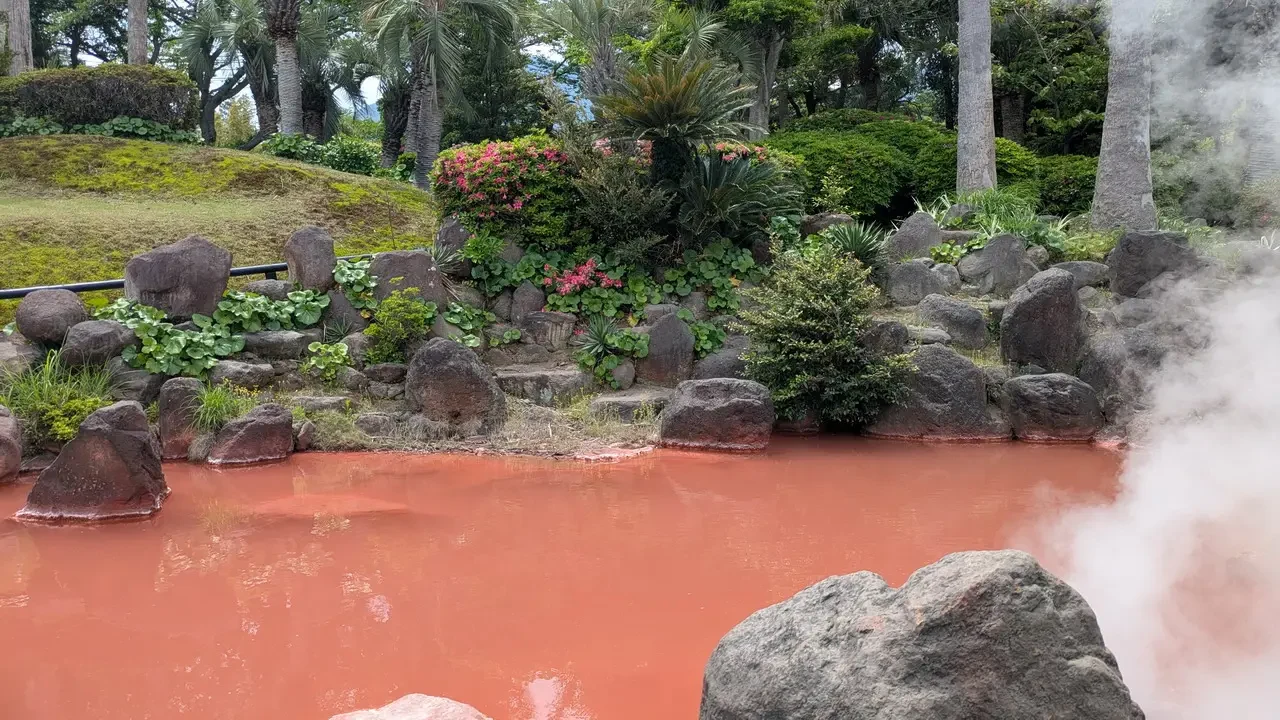
We take the highway that crosses the island of Kyushu heading southeast through rice paddies, diverse forests ranging from the pale colors of bamboo to the dark hues of cypress trees, with some wisteria vines clinging to other trees as if they were parasites, finally arriving in the bustling area of Beppu. Here, the underground is alive and brings forth steam, hot water, and the smell of sulfuric acid, making the environment seem like a preview of hell, of course only visually. We don't stop at Beppu, we continue towards Kannawa, which represents its outskirts, where there are the "hells," or jigoku in Japanese. And these "hells" are actually the seven sites located nearby the city, five of which are close to each other, while the remaining two require a short car ride. Despite being far from places like Yellowstone or Iceland, they offer remarkable chromatic arrangements: muddy grey steaming, the red brick of the two lakes with boiling clay, to reach the turquoise of other small lakes revealing veils created by the heat of the water, which reaches up to 100°C. In short, what is defined as a hellish place due to its extreme heat and steam becomes a paradise for the eyes. One of these "hells" consists of a series of pools within which or on whose edges lazy... eighty of crocodiles. Their massive vision in captivity isn't great, but it's comforting to know that they are enjoying warm water as if they were in their natural habitat. Meals along the way They offer eggs and vegetables. cooked using natural steam and it's easy to imagine that the residents don't have to worry much about winter heating, which is delivered directly to their homes from underground. One interesting fact comes from this location, where... regular distance of 35 minutes A jet of water comes out from a hole in the ground: it's not really a geyser, but the regularity of its flow is surprising. After all, we are in Japan and one must maintain standards, so a viewing area has been created in front of the site to accommodate around a hundred people waiting for the event. Equally, if not more interesting is the flowered hillside with azaleas Just above: an explosion of colors that we will see immediately after witnessing the waterfall, before others arrive and take over the paths, making the photos less scenic. The fact that there is no sun doesn't diminish the beauty of the view at all.
Despite being Japan a densely populated country, we manage to find a corner that seems to have been forgotten or perhaps abandoned. The town of Kitsuki is presented to us by the guidebook as the location of a interesting castle, in fact, it is, but everything is left to chance, almost searching for a patron who takes over the entire site. The sun is no longer an option, while the cold wind becomes noticeable. We still enjoy a moment admiring the coastline with low tide and the small park with dense trees and mosses, from which stone dwarves emerge. It's getting late and we can't find a suitable place to eat, so we buy some pastries at the bakery. This type of shop will be a surprise: used to Italian bakeries that display their products and package them without ceremony, here they treat artisanal sweets as works of art, wrapped in elegant cardboard boxes like perfumes, so that from afar the displays seem exactly like perfume shops. The taste remains the same, but the perception is different. This will also happen elsewhere, where the most refined shops are indeed bakeries. For sweets that must be eaten fresh, the packaging will also contain ice!
The urban face of Tenman-gũ
As the sky has now become covered with clouds, we simply need to get back on the highway and head towards the accommodation booked for tonight, near Yufuin, in a quiet location on the hillside overlooking the town. It's a simple guesthouse, and as is typical with such accommodations, you have to take off your shoes upon entering and put on the provided slippers; when going to the bathroom, there are another pair of slippers ready to be worn instead of the ones already on your feet. The property has an onsen (a traditional Japanese hot spring bath), which is standard even in private homes, separated for men and women as you enter naked after a good shower. We get back into our "car" and head towards the center for dinner. Since we have no idea where to go and it's our first proper meal, we rely on Google to find something typical (and there was nothing else), and end up in an unassuming izakaya (a Japanese pub) in a quiet area with few signs: it feels like entering someone's home, with two low tables and four chairs, of course, it is only frequented by locals, where you can enjoy delicious sashimi, grilled chicken, and kalbi (thin slices of beef). cases of sake It looks impressive in the background, but we don't take advantage of it. We will do so shortly when we go to buy breakfast for tomorrow: a small bottle to pour over with some matcha chocolate sweets once we have settled down, while exchanging a few words with a friendly gentleman from Fukuoka on vacation who speaks decent English. It is interesting to observe the passion people have for their own country: it provides us with valuable information for tomorrow, when the schedule will be packed and time is limited; it advises against going to Kumamoto to take the ferry that would lead to the Shimabara Peninsula, as there is a high risk of not finding a place on board for the car and long waits. It's better to go to Nagasaki by road, leaving early. We will appreciate and follow his advice.


