

Day 7
Shikoku Island III
Matsuyama Castle and the Koraku-en Garden in Okayama
Morning at Dogo Onsen Honkan
Woke up at 6:45 after a sleep aided by the ticking of rain on the windows; today's itinerary includes a visit to the castle of Matsuyama, a city of half a million inhabitants that we reach in 45 minutes. The forecast predicted rain, and it rained, for the first time since we left, although initially scattered low clouds allowed rays of sunlight to shine through, illuminating the dense forests with all possible shades of green, punctuating the hillsides. As we move towards the west, the landscape presents itself as extremely undulating, alternating viaducts with seamless tunnels; in the background, we can see rare flat areas filled with villages and rice paddies, small estates that surround the settlements. As we approach the coast, the weather gets worse, and when we reach our destination, it has started to rain. We see from outside the Dogo Onsen Hotel, a historic thermal spa that deserves a short visit just for its architecture; the rain suggests we stroll through the two commercial galleries that intersect at right angles to reach the typical Botchan Karakuri clock. The sky remains dark but at least it stops raining when we climb back up the staircase under the trees (there is also a cable car, but it's not suitable for our abilities) which leads to the top of the hill where the famous castle stands. Matsuyama-jõ, also surrounded by a beautiful park with city view... while the rain stops at the same time. Just before entering, we are greeted by a gentleman stationed at the top of the staircase who advises us to be careful as the ground is wet! We decide to visit the property to get an idea of what life was like inside a Japanese manor and gain valuable insights into the past era. Of course, after depositing our shoes and putting on the flip-flops provided by the organization. The interiors are entirely made of wood, featuring narrow and steep stairs that climb up four floors to the tower, a beautiful viewpoint since the castle stands at the top of a hill in a fairly central part of the city. Unlike others, this monument is also rich inside, with a nice collection of katanas (the samurai swords), where it's even possible to lift two for a better understanding of their weight: at first glance, they seem heavy in the context of rapid movements during a battle. Another interesting detail is how sharp they are, a typical Japanese art. In the past, they were used to cut three prisoner heads with one stroke or divide a unfortunate person exactly in half with a single vertical cut. Taking advantage of the fact that it's no longer raining, we spend a few moments in the courtyard admiring the sloping roofs and smooth stone walls, which fit perfectly together. the beautifully maintained trees and the city below; with such good weather, it's hard to imagine what it was like.
We return to the parking lot and, using the car, head to the Buddhist temple Ishite-ji (also known as Temple 51); it's not far from where we are and is worth a short detour. It's also called Temple 51 because it's part of the circuit of 88 temples along the perimeter of Shikoku Island, the most famous pilgrimage in Japan, a worthy counterpart to the Camino de Santiago in Europe. It was created based on the fame of a Buddhist monk who lived around the year 800; number 1 is located in Naruto, where we were yesterday to see the marine whirlpools, and they should be visited in the predetermined order. Those who undertake it wear a white tunic, and we can actually see two pilgrims dressed like that, having just arrived, contemplating this sacred place. Here too, part of the economy revolves around the route; for example, the Setouchi guesthouse, where we stayed last night, also serves as a stopover point.
The urban face of Dogo Onsen Honkan
Finally, we will have visited an interesting city, with heavy traffic but always flowing smoothly thanks to an efficient public transport system, fluid urban planning and respect from drivers. We will observe the same situation in other important towns as well as on highways; even though we are in a highly developed country, the heavy traffic is not particularly intense. Due to the presence of many narrow streets, the parking area must necessarily be limited in size. We buy some sushi at a supermarket, an onigiri and some maple-flavored doughnuts which we comfortably eat in the car with a cold coffee, a very common drink in this area, and continue our journey towards Okayama via another isthmus located just north of it, which with a third plastic bridge (We crossed one on the way and saw the second during our visit to the whirlpools) which brings us back to the mainland of Honshu. In reality, it's a longer route and a series of others that literally hop between islands, appearing to be strategically placed to connect the two largest islands of Shikoku and Honshu, resembling a giant Japanese step. Despite the grey sky, the landscape of green hills rising from the water is sublime; imagining it with a clear sky is almost impossible and must be breathtaking. Under a sky covered in grey clouds, Okayama welcomes us for the second time, this time via roads to the Budget office where we will return the small Mitsubishi rental car; over three days, we will have traveled 350 km.
Stop at Castle called U-jo
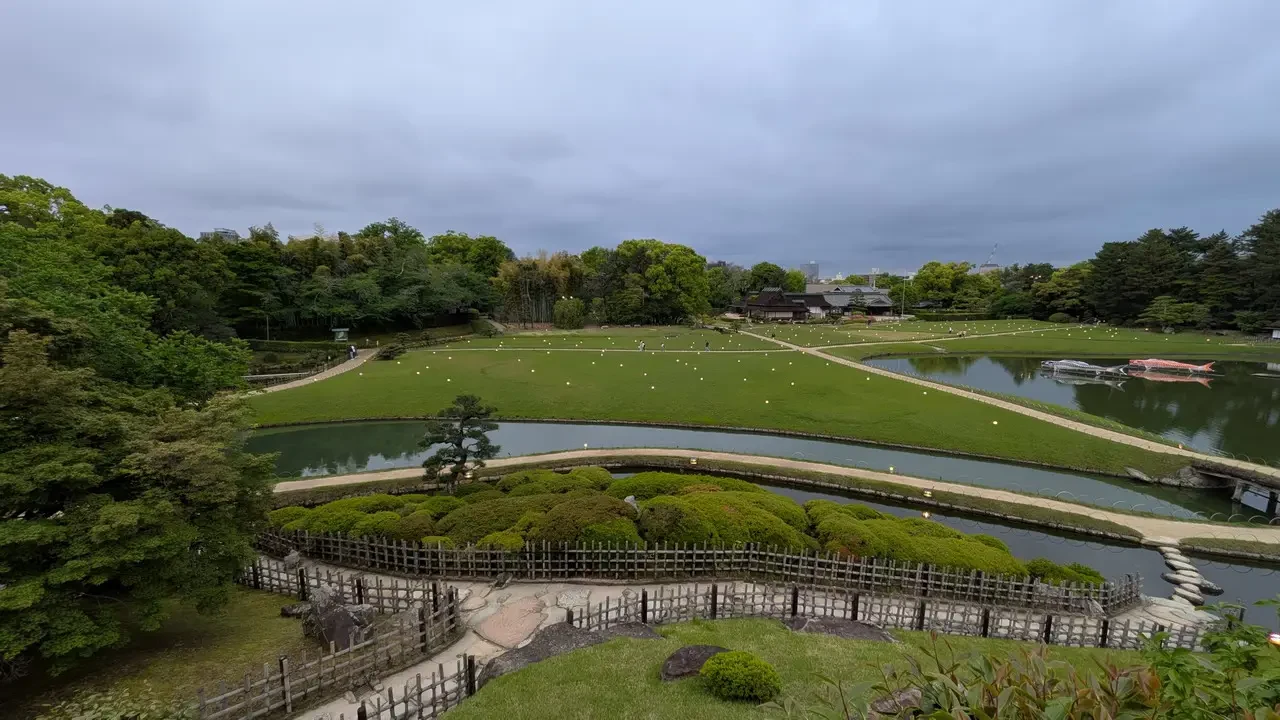
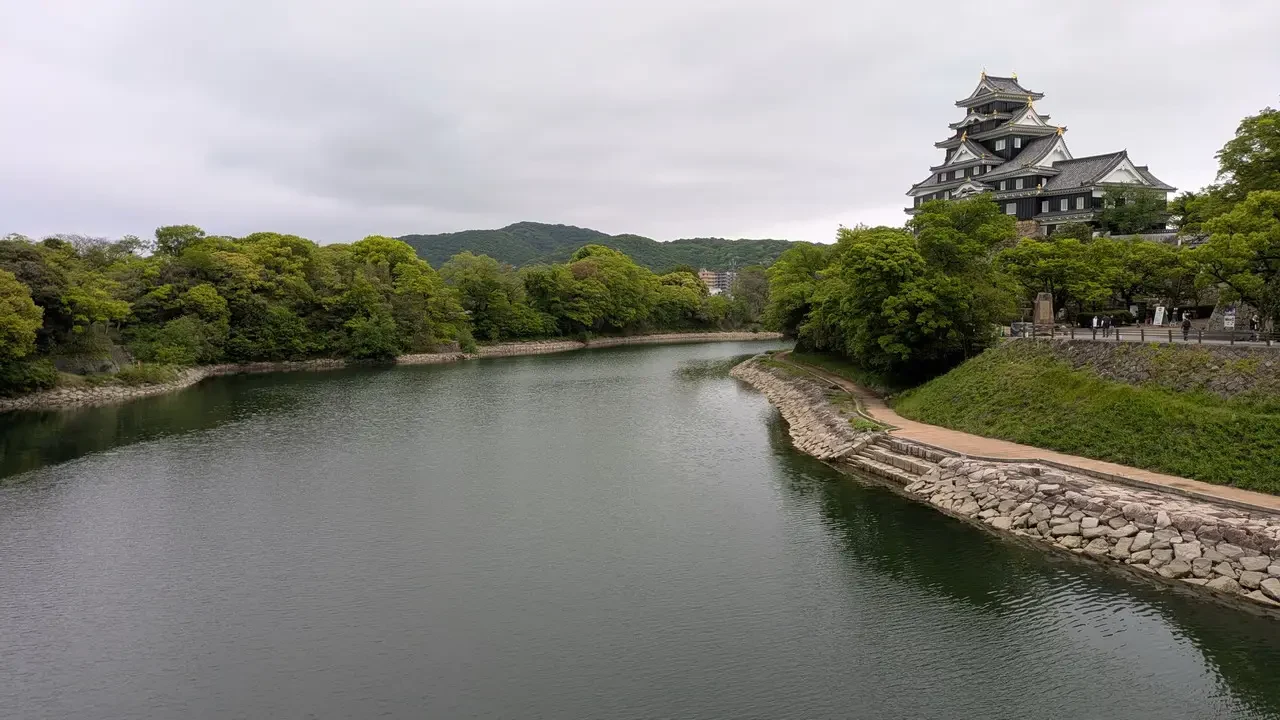
It's now mid-afternoon: we walk to the hotel, which is a few hundred meters away, passing by the station where we will depart tomorrow morning, just beyond which lies a neighborhood full of restaurants and bars that will be useful for dinner. But first, we plan to visit the Koraku-en garden, beautiful even under the grey sky, indeed enhanced by lamps scattered across the meadows and even with the edges of streams decorated with lights continue, although it is not comparable to the Ritsurin of Takamatsu. On the other side of the Asahi River (same name as the famous beer), you can see the Castle called U-jo(of the raven, due to its black color). In the park there is a small tea plantation, rhododendron bushes and a birdhouse where there are some crow, the national bird of Japan. As the end of the visit approaches, a sudden downpour convinces us to speed up towards the exit. We then visit the shops in a beautiful covered gallery where we buy some pastries for breakfast tomorrow at the bakery; the rain stops, and for dinner we retreat to one of the many traditional restaurants, where there are small private rooms separated by wooden partitions offering complete privacy. The floor is level with the seating and slopes downwards so that you can rest your feet on the ground under the table without having to cross your legs in a lotus position; shoes remain at the entrance and we proceed barefoot. Excellent fish, raw. Of course: a mix of sashimi and grilled fish in five different varieties (octopus, sea urchin, salmon, tuna, and mackerel). We return early, but before going to sleep, we still manage to enjoy a beautiful view over the Okayama skyline from the room on the thirteenth floor; the view was enhanced by a good glass of sake, purchased for the occasion and properly stored in the refrigerator in the room's minibar, as always equipped with all comforts.


