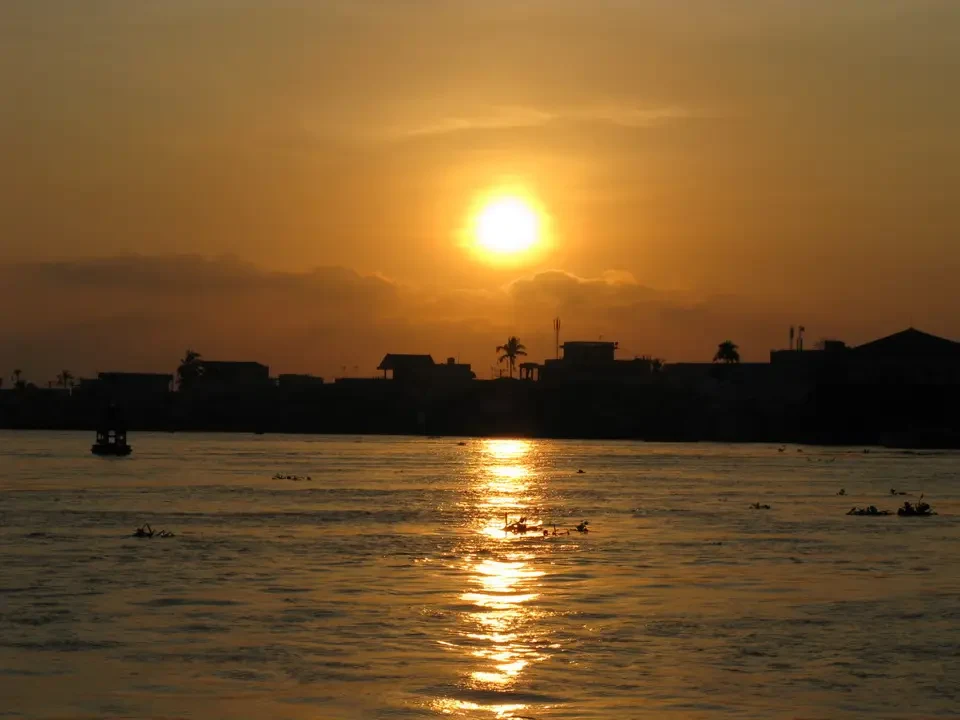
Market at dawn in the Mekong Delta
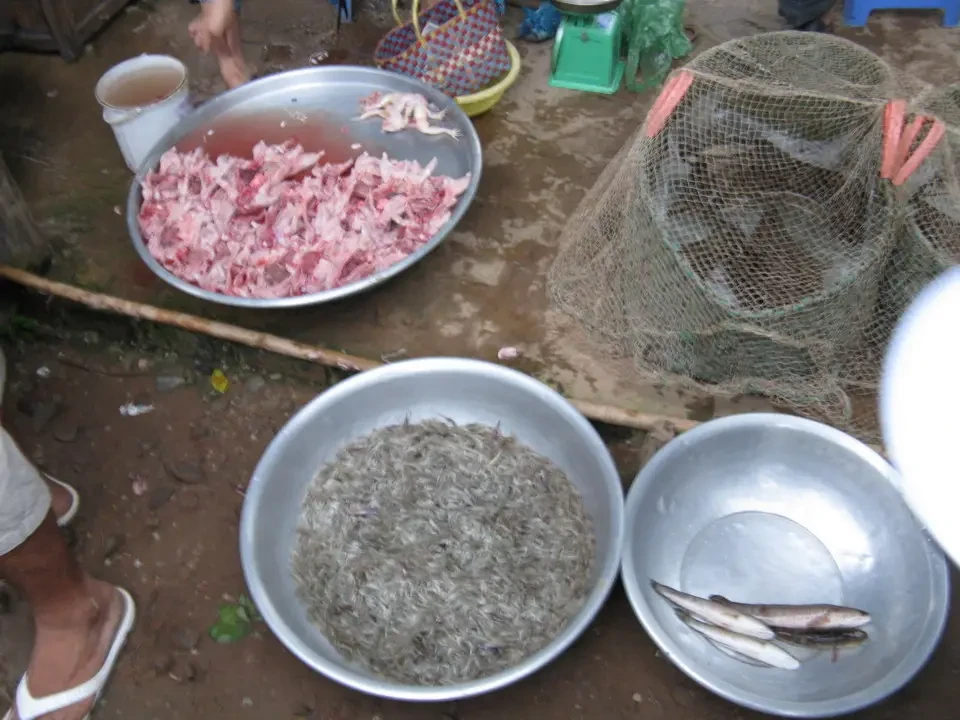
Wake up at 5:45 to be ready a quarter of an hour later: our host takes us to the local market to do some shopping. We walk about 400 meters and cross the canal on a small boat that doesn't offer much stability, but the journey only lasts a couple of minutes. In the Mekong Delta, markets start very early in the morning; then everyone returns to their own activities and the workday begins.
The displayed goods offer a good insight into the daily life of the area. As often happens, it's the meat counter that draws our attention: we see fish from fresh water, frogs and pre-prepared animals that they are rice paddy rats. To dispel any doubts, we are also shown a live mouse attached to a pole with a string: if sold alive, it guarantees fresher meat and therefore costs more. The logic here makes perfect sense.
We return at 6:45 AM for breakfast and then we board for our journey to the floating market of Cai Rang. At the point where our canal meets one of the branches of the Mekong, we are transferred to another boat and venture into the market.
Cai Rang, the water market
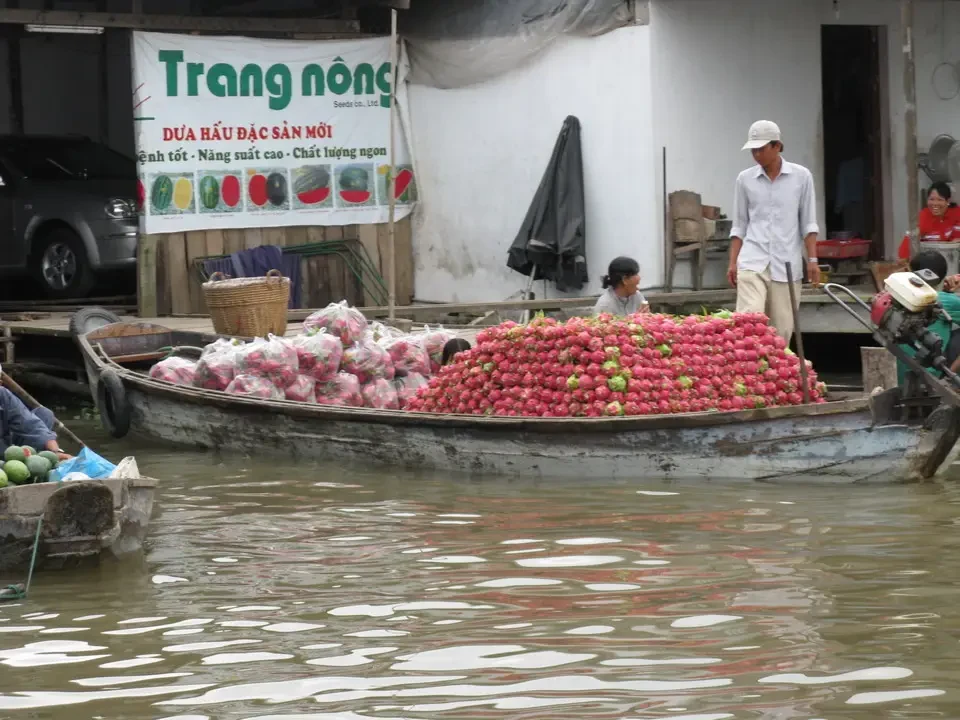
Cai Rang is located a few kilometers from Can Tho and is one of the largest floating markets in the Mekong Delta. It's not a tourist market in the strict sense: it's mainly a wholesale market, where producers bring goods to traders who will then sell them at local markets.
This mainly involves fruit and vegetables... and the large quantities make the colors even more vibrant. The transfers between boats involve throwing the goods as if they were balloons, sometimes even two pieces at once. Among the river traffic also circulate tourist boats and a boat-cafe, equipped with a pot for making pho and other small specialties intended for merchants.
A very practical detail is the system of bamboo poles: each boat hangs up a sample of the products they sell high up, so that they can be recognized from afar. After leaving the market, we travel upstream on the river to Can Tho, where our driver is waiting for us. Along the banks, we find beverage factories and areas of woodworking and also a Catholic seminar, a rather rich construction in an otherwise very rural setting.
Towards Chau Doc
Let's take the road to Chau Doc, passing through Long Xuyen, which was once a stronghold of the Hoa Hao sect. We arrive for lunch and stop at a restaurant in the center. It doesn't look very promising from the outside, and the service overlooking the kitchen isn't ideal, but the food is outstanding. At this point, we decide to make the most of the remaining half-day.
We first visited the Cao Dai temple The Caodaism draws on elements from various religions, including Catholicism, and makes extensive use of bright colors, neon lights, and symbols. At the back of the temple is the large divine eye, always depicted as a right eye because, according to tradition, it is the one that sees best. The exterior is deliberately eccentric, with vibrant colours far removed from the sober image of many places of worship.
We then move on to the Tay An pagoda, also painted with very vivid tones. Here, the orange robes of the monks stand out, the swastika In its original religious meaning, much older than the Nazi appropriation. As we walk along, we pass shops selling... dried fish, from which the intense smell of preparations based on fermented fish emanates.
Chua Xu and Mount Nui Sam
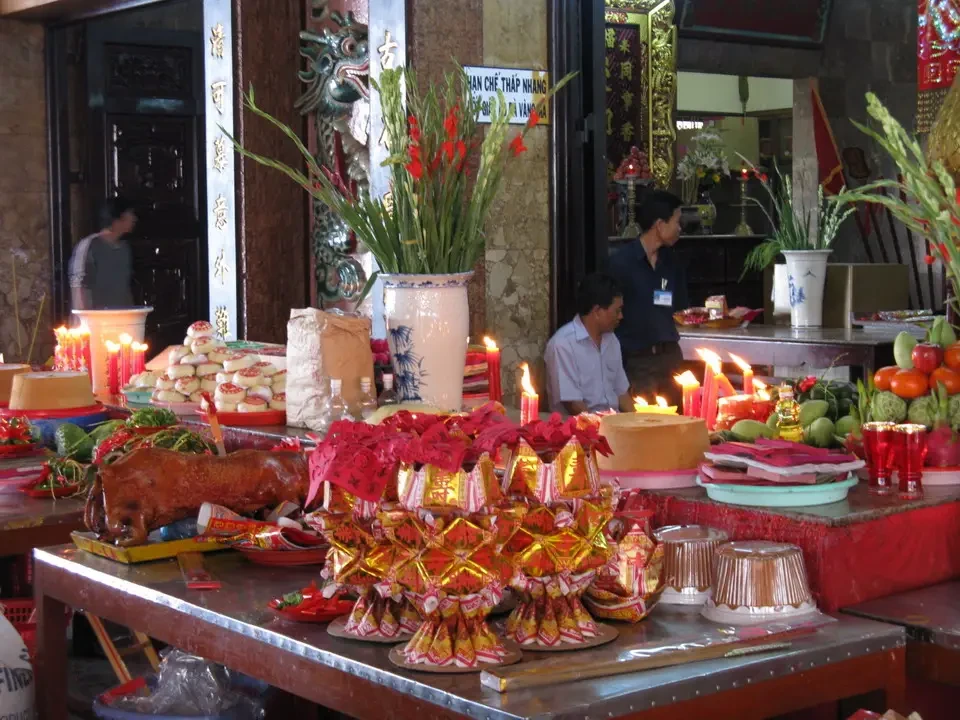
With a short walk, we reach the temple of Chua Xu, dedicated to Mrs. Xu and very popular with pilgrims. It is customary that those who have their prayers answered return with thank you notes The offers range from flowers to roasted piglets, up to real treasures kept in the museum next to the shrine. The statue of the goddess is cleaned once a year, dressed in precious clothes and carried in procession.
From here we begin the ascent towards Nui Sam Hill, which has an elevation difference of approximately 400 meters. From the top, you can enjoy a beautiful view. the rice paddies up to the Cambodian border. The area is also one of the most sought-after burial sites: those who can afford it purchase land for a tomb, while those without money resort to cremation, which is still expensive. Funerals for the wealthy can reach very high costs, including coffins, land, tombs, offerings and rituals.
Below the hill, you can see villas that don't hide their wealth, often belonging to Vietnamese people who have emigrated abroad and returned with significant financial means. However, further on, poverty remains evident. The school seems increasingly inaccessible: those who want to educate their children often face heavy costs, and many children stop attending after primary school to go to work. This contrasts sharply with the official image of a socialist country.
Religions, ancestors and floating villages
The guide also tells us about the Vietnamese religious mosaics. Different colors and symbols appear in the temples: yellow is often associated with Buddhism, red with Confucianism, and blue with Taoism. The Caodaist religion, unsurprisingly, encompasses them all. Many beliefs also maintain a strong connection with venerating ancestors and respecting the elderly. There's no idea of abandoning them to their own devices: the family remains at the center of social responsibility.
We are informed that Cambodia, where we will be arriving tomorrow, is the poorest country in Indochina. Relations with Vietnam are currently peaceful, but recent history has been very difficult: in 1978, the Khmer Rouge also invaded the Chau Doc area, killing more than a thousand people; the Vietnamese retaliated by invading Cambodia at the end of that same year.
As we head back, the local news broadcasts blare from speakers everywhere, including an account of an accident used as a public lesson to encourage drivers to slow down. At 7 pm, we return to the same restaurant where we had lunch and this time we try... the local frogs Let's end with a walk along the riverbank and return to the hotel on foot.
In the Chau Doc area, you can also find the typical floating villages of the delta, with fish and shrimp farms. The highest concentration of floating houses is located on the banks of the Bassac River, near its confluence with the Mekong. The houses rest on empty metal containers, and under each house, cages or nets are suspended where the fish grow directly in the river water. Thus, the house is both a home and a source of livelihood.