Hué, between citadel and war memory.
Hué was the capital of central Vietnam and still retains a noble atmosphere, although its recent history has been anything but peaceful. After 1975, many buildings associated with the Nguyen dynasty were considered politically incorrect and left to decay. During the Tet offensive of 1968, the city remained under the control of North Vietnamese troops for several weeks and was the site of violence, executions, and mass graves. Here, on August 30, 1945, the last emperor Bao Dai abdicated, bringing an end to the Nguyen dynasty before the delegation of Ho Chi Minh's revolutionary government.
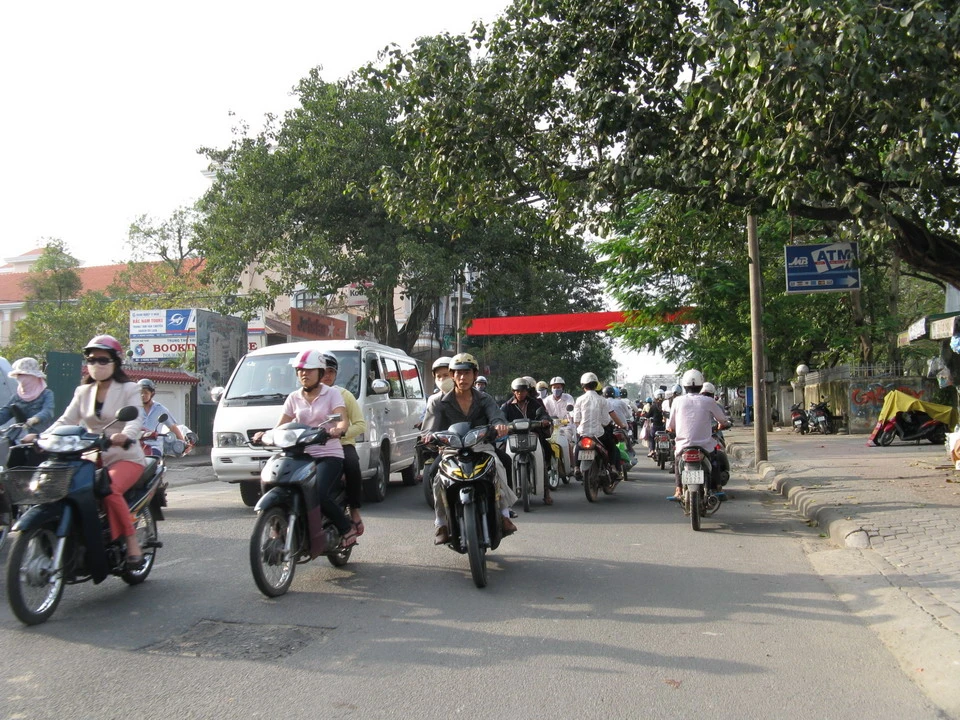
We wake up early to see Hue as it starts to come alive. By 7:00 am, we are already on the road towards the Citadel, passing through the crowded Phu Xuan bridge The first stop is at the outdoor military museum, where exhibits include armored vehicles and artillery Americans. The apparent abandonment seems deliberate: it's a stage for victory, designed to show who remained and who fled instead.
The captions are striking: when referring to the US military, "Americans" appear, while the South Vietnamese army is referred to as "puppet soldiers". History, once again, is written by the victor. If the opposing side had prevailed, perhaps we would see tanks with the red star and other "dummies" to condemn. The historical truth remains steeped in political, ideological, and unresolved pain.
The Imperial Citadel
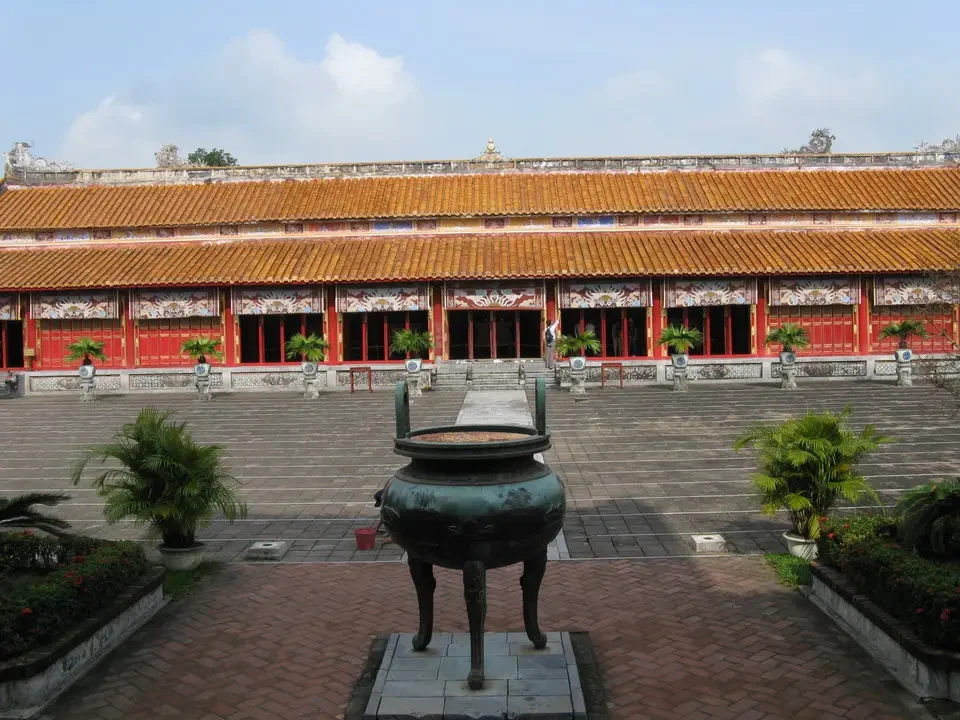
At 8:15, we meet our guide at the hotel and go to visit the Imperial Citadel with the Royal Enclosure. It was built according to the model of the Forbidden City in Beijing, following the principles of Chinese geomancy, the I Ching, and the balance between yin and yang. The symmetries and arrangement of the spaces are not random: everything seems to represent order, power, and cosmic harmony.
We visited The Imperial City and the remaining parts of the Forbidden City. The complex is still undergoing extensive restoration. Many of the damages are attributed to American bombings, but the history is more complicated: during the war, the Viet Cong had also set up bases within the area, attracting some of the bombing raids on this zone. This is further compounded by the climate in Hue, one of the wettest cities in Vietnam, which is often affected by typhoons and floods.
Today we are lucky and find sunshine, but the humidity is overwhelming. The reconstruction is proceeding slowly, and in many places it's not about restoring, but recreating buildings that have been lost, based on postcards, drawings, and documents salvaged from the war. We also visit... The Royal Theatre, where traditional performances are still held.
The Perfume River and the Thien Mu Pagoda
From the pier, we board a small motorboat and begin our journey on the Fragrant River, Huong Giang. The name comes from the fragrant flowers that, at certain times of the year, would fall from the trees and be carried away by the current. The name is poetic; the reality of the modern river, wide and bustling, makes you think more of smells than perfumes, but the charm remains.
We reach the Thien Mu Pagoda, the Pagoda of the Old Celestial Lady, built in 1600 on the left bank of the river. It is one of the most famous architectural landmarks in Vietnam. Behind the pagoda there is a garden of exotic trees and bonsai managed by monks: pepper, Frangipane, bread tree, grapefruit and jackfruit, a fruit with such an intense smell that it is prohibited in some hotels and means of transport.
Behind the sanctuary, there is also preserved a car Austin with which in 1963, the monk Thich Quang Duc traveled to Saigon to immolate himself in protest against the South Vietnamese regime of Ngo Dinh Diem. The photograph of his act went around the world and contributed to showing the depth of the political and religious crisis in South Vietnam.
Imperial tombs and the Nguyen dynasty
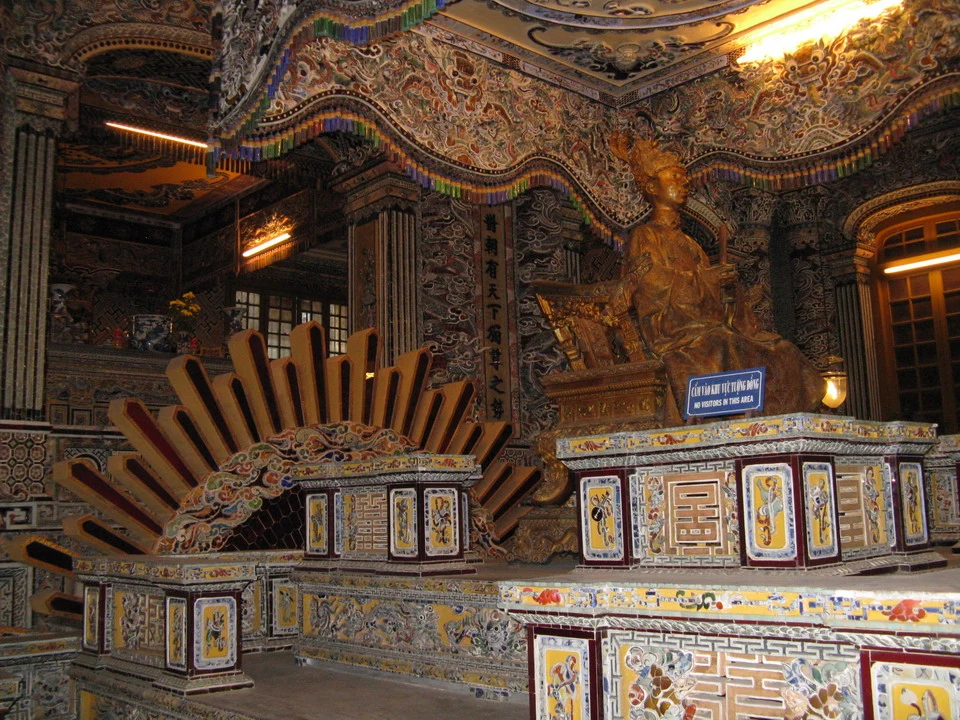
We return to Hue by car for lunch and then in the afternoon we visit some imperial tombs, which are located close to the city center. We start with the tomb of Minh Mang, perfectly integrated into the natural surroundings, and continue with that of Khai Dinh This one is surprising in its size and style: built about eighty years ago during French rule, it combines Eastern monumentality, neoclassical taste, and a certain desire for grandeur.
The setting is powerful, but also ambiguous. The last Nguyen emperors were now mere figures, maintained by the French to better control the population. Perhaps that's why the tombs emphasize so much on grandeur: where real power is weak, the monument tries to compensate. It's not surprising that the dynasty was not well-liked by a population forced to pay tribute to both rulers and colonizers.
Hué on a bicycle-rickshaw
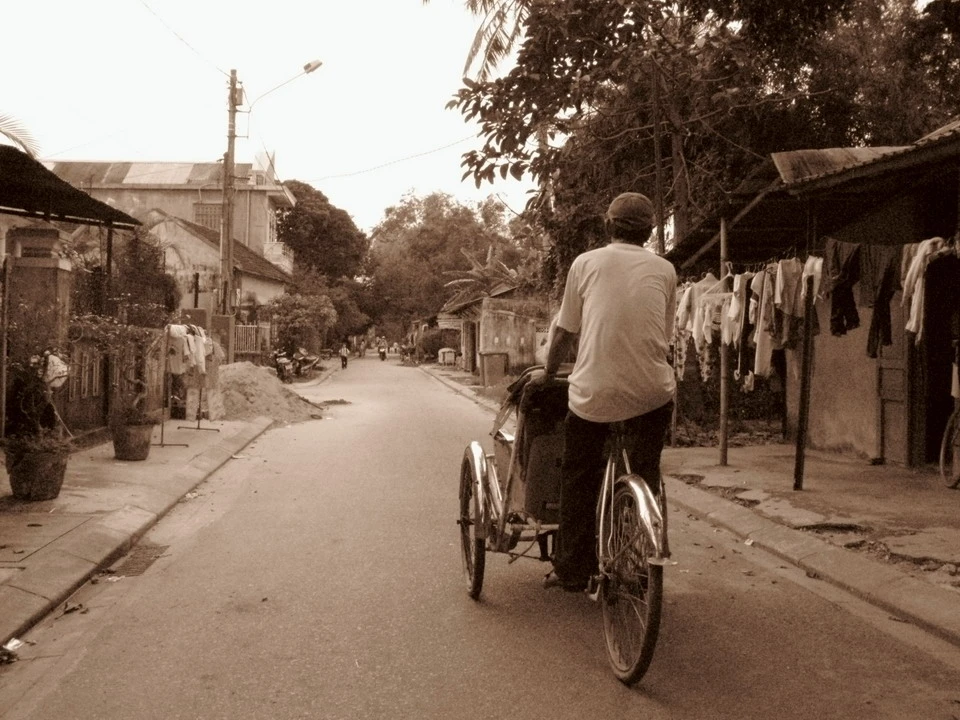
Back in town, we rent a rickshaw to take a tour of the city center. It's a vehicle that we had often seen in films set in Indochina and which was once a symbol of French upper-class society. Riding it is a pleasant way to observe the city, but also a very exposed experience: sitting there, in first line in traffic, you feel like you're right behind the cyclist with the bumper.
We pass through areas with floating houses, neighborhoods within the Citadel, and bustling streets full of children, a clear sign of the country's young average age. Compared to Hanoi, Hue seems more livable and still influenced by a French-style bourgeoisie. Along the river, you can find colonial houses belonging to wealthy families, which were later confiscated and turned into public offices or schools. The city retains a noble character, likely linked to its past as an imperial capital.
New Year's Eve in Hue
The New Year's Eve menu includes spring rolls with Hué-style fish, fried calamari with pineapple, honey-glazed pork, duck with orange sauce, flambéed banana and pineapple, wine, Vietnamese coffee, and lotus tea. We will dine in the beautiful outdoor area near the hotel pool, in a simple but very effective style.
After dinner, we take a walk through the city center to see it in its everyday life. In front of the bank and office windows, we see employees celebrating the end of the year; floral arrangements are also seen outside as greetings. Once again, it's striking how New Year's Day is celebrated not only at home with family but also in the workplace with colleagues.
Tired from the day, we return to the hotel. At midnight, we toast with a small bottle of water and one eye is already half-closed. The other soon follows suit, allowing us to enjoy a well-deserved sleep.