

Amidst temples and shrines in Hanoi
The alarm goes off at 7:30 and an hour later we have a meeting with Han. Thus begins the adventure, starting with a visit to Hanoi. The capital of Vietnam, which means "on the other side of the river" in Vietnamese, is located along the banks of the Red River with green gardens and beautiful pagodas. Thanks to a deep sleep, we were able to adjust well to the 6-hour time difference, we get into the car and, amidst hellish traffic, leave the central area where our hotel is located, heading north for the Tran Quoc Pagoda, the oldest in Hanoi, located on West Lake. Meanwhile, let's start learning the difference between a pagoda and a temple: the former always features Buddha statues and is dedicated to this God, therefore it represents a profession within Buddhism. The second one practices Taoism or Confucianism, and you will find images or statues of saints and revered figures, who can also be nobles, generals, or wise people from the past who have achieved great merits in their fields. The first religion to arrive in Vietnam was Taoism, at least in the north, brought by the Chinese. Following their fall around the year 1000, it became possible for Confucianism and Mahayana Buddhism to penetrate.
In the capital, you can see construction work everywhere to restore artworks: in 2010, it will be the millennium anniversary of the founding of Hanoi, specifically in October.
Quan Thanh and the first rituals of Hanoi
We move to the Taoist temple of Quan Thanh, which is located a short distance from West Lake. Along the path that leads us to the temple, we encounter a lady with her iconic cone-shaped hat and the Gánh, a bamboo pole worn over the shoulder that supports two baskets, which allows women to carry even weights of up to 80 kg, evenly distributed between the front and back. With skillful maneuvering, they pass me the tools so I can take their picture, and consequently buy a bunch of bananas and a peeled and cut pineapple, all for just under €1.50. We pay this as a friendly toll to our novice in the skillful art of Vietnamese commerce, and we enter the dark and mysterious temple, where the stern faces of the statues observe the foreign visitors wandering around their home.
The political district and the Ethnology Museum
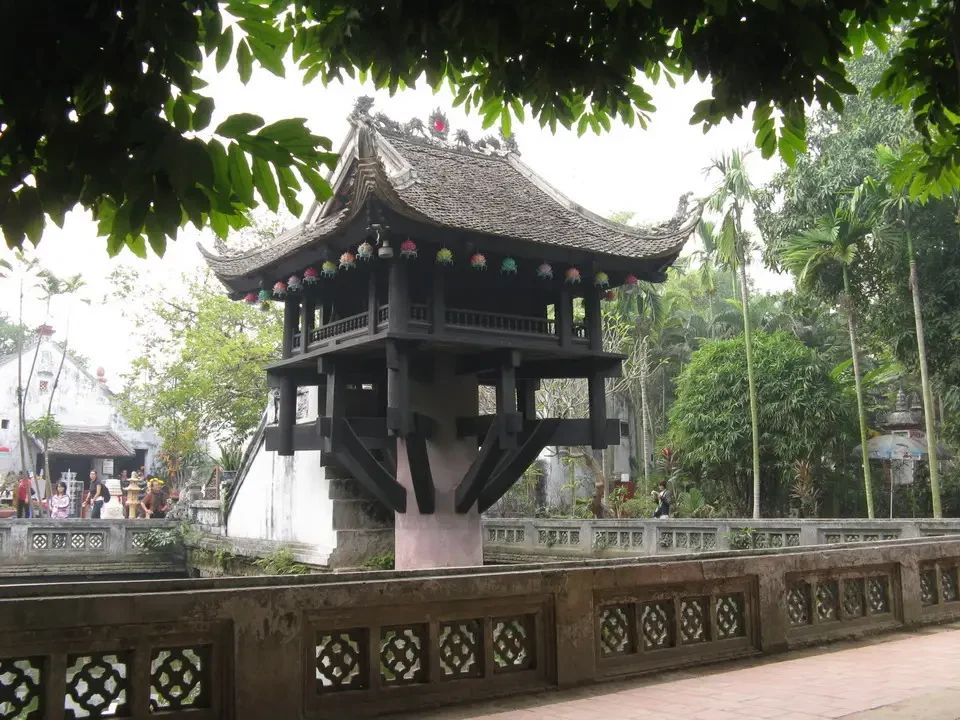
We cross the street on foot, a true testament to faith, in those who are above and in those who must avoid two approaching points while crossing a river on two wheels. We continue for another few hundred meters and find ourselves in the political district of the capital. We pass by the Presidential Palace, which is prohibited to photograph, and on the terrace of the Ho Chi Minh's Mausoleum (Lang Chu Tich), a magnificent structure made of marble and granite that houses the remains of the famous politician in a striking glass coffin. The mausoleum is closed for three months each year to allow the embalmed remains of Ho Chi Minh to undergo maintenance in Russia. Today, it is still closed, otherwise there would be long queues of Vietnamese people paying their respects to the father of the nation. The security personnel at the mausoleum cannot be photographed, as is generally the case with anyone wearing a uniform. Finally, you arrive at Single-pillar pagoda (Chua Mot Cot).
Next to it is the Ho Chi Minh Museum in a modern communist style. We get back into the car and head northeast to settle our accounts with Asiatica Travel, where we meet Ms. Nguyen Than, before continuing towards the Ethnology Museum, which houses a collection of artifacts related to the various ethnic groups and minorities that populate Vietnam. There are 53 of these, plus the Kinh people, who have settled in the more fertile plains and represent 15% of the population.
The houses stand out with their straw-covered roofs that reach up to 16 meters high, very steep. They are built in the center and serve as a communal home. Other houses on stilts are much longer: whenever the family expands, they add another section in length, reaching several dozen meters, with multiple hearths for all the families living there. They all have braziers, which of course are used for cooking, since heating is only used in some mountainous regions in the northwest. The stilt-building technique arose due to defensive reasons and especially to protect from frequent floods that affect almost everywhere. There are also displays of costumes worn by ethnic groups, as we will discover in the coming days, they are worn daily and not just on folkloric festivals. The Viet people occupied the lower and most fertile areas, while minority ethnic groups had to settle for higher ground or mountainous areas, which can be defined as a true process of human settlement related to altitude levels. These minorities never had the strength to obtain better positions and still live in conditions of economic inferiority compared to the dominant group, in a conflict that sometimes has even taken violent forms. The French, taking advantage of the discontent of minority groups, tried to foment this resentment to divide and subdue the country. We also see what is called the "funeral house": several years after burial, the deceased are placed in communal houses surrounded by wooden statues, which serve for the worship of the dead. At this point, they are no longer worshipped as it is believed that they have reached celestial peace. A large amount of food is put in the middle of the house, and it is believed that this will sustain the deceased until their rebirth. Generally, throughout Vietnam, there is a great respect for the dead.
In some homes where the floor is made of wood, you can enter with your shoes on; in others, where the floor is made of bamboo, you need to remove them. This has no religious basis, but simply aims to prevent sand from getting between the bamboo slats that make up the floor.
In the public sector, people usually work for five and a half days a week. A public employee earns approximately $100 per month, which is very difficult to live on, so it's necessary to supplement this income with other jobs or by exploiting one's skills and engaging in corruption. In the private sector, people also work seven days a week because they are paid daily, and a skilled worker can earn up to $300 per day.
It's interesting to notice how shops selling the same products are usually arranged in rows, with almost identical displays next to each other, in a competition that couldn't be more perfect: furniture, bricks, wood, butcher shops, etc. The same applies to barbershops.
Memories and history in Hanoi
We move back towards the city center to see the B52 Museum, which is interesting even though it's small. The main attraction is a B52 hit by the Viet Cong, therefore it is broken into several sections. It has been reassembled exactly according to its original dimensions, which gives an idea of how this fortress was rightfully called. It's interesting to note how state rhetoric displays both Vietnamese weapons (of Soviet or Chinese production) and American ones in the same museums. They are easily recognizable: the first ones are painted and in good condition, while the second ones are left to rust and are clearly abandoned, which also aesthetically demonstrates the inferiority of the enemy.
We pass by the Hanoi Tower, a modern and controversial center built by demolishing much of the former Hoa Lo prison, also known as Maison Centrale or Hanoi Hilton. We take a break for lunch at a restaurant that has charitable purposes, employing street children and educating them in a new job and life. A good example of great rigor and equal efficiency.
The Temple of Literature
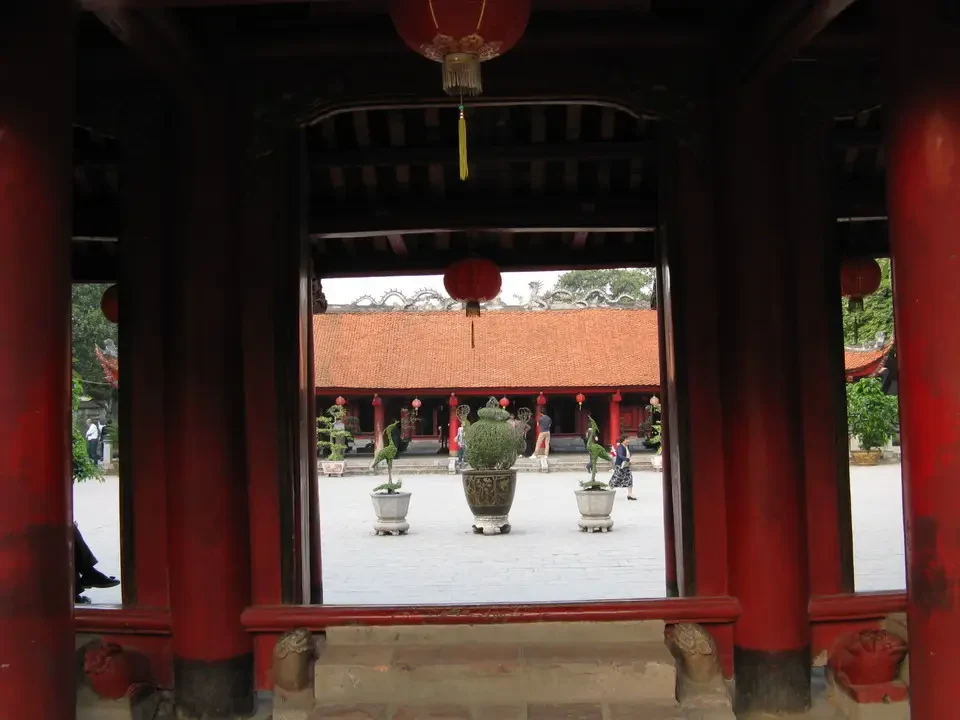
Let's go to the Temple of Literature (Van Mieu Pagoda), an ancient university built in 1070 in honor of Confucius, which became a Confucian school. It is divided into 5 courtyards. The area with the steles is particularly significant, where the names of those who obtained their doctorate were carved after long and incredibly rigorous studies. Those who were promoted had a guaranteed career, which could even reach that of a high-ranking official. Confucius was the patron of studies and science in general, and those societies that have adopted his philosophy give great importance to these principles. The path to the temple represents for the pilgrim walking there the same path that the examinees took during their various exams: you pass through doors and enter a new courtyard, from which you access the next one, which is increasingly important.
We leave that area, which was once the center of Vietnamese culture, to immerse ourselves again in the hustle and bustle, which becomes more chaotic as we approach the city center, a maze of scooters and increasingly rare bicycles. There are also some cars with large engines. By 5 p.m., we arrive at the Puppet Museum, where a puppet show on water begins. The performance recreates everyday life stories and popular legends, in which the actors are wooden puppets and the stage is created on the water. This is a typical Vietnamese custom, originating from farmers who used rice paddies as stages to represent scenes of history and society. In our case, there are 17 acts depicting daily life, the return home of newly appointed mandarins, a series of hunting and fishing scenes, as well as local mythology. At the end, we walk alone through the maze of the old quarter, along 36 Streets-corporations, a true labyrinth of narrow streets with shops and artisans of all kinds. A characteristic feature is the houses with galleries or corridors, which have very narrow facades; it is said that in the past, tax was based on the width of the house's facade, but they can reach up to 40 meters long. This system creates pressure differences, favoring ventilation on hot days, which plague the capital during the summer months. On the streets, we see many police officers who do not hesitate to stop people for checks. We discover that the officers in dark green uniforms are responsible for the security of buildings and embassies, while those in khaki uniforms control traffic. Crossing the streets, as in other Asian countries, is almost an art. The most common practice is to continuously honk the horn. This is not so much to tell someone to move, but rather to signal one's presence. Therefore, everyone honks constantly when traveling. Those who are subjected to the honking do not get angry and argue back with gestures as we do. Instead, they simply acknowledge that someone is nearby and may move accordingly. Despite the chaotic traffic in Vietnam, it is rare to see road rage incidents. And there would be good reasons for this. Similarly, the right of way is not a priority specified in the traffic code. We are even told that there is no such thing, and we don't know if whoever told us was joking, but simply taking note of a fact: if it were true, we wouldn't have any problems believing it. We don't make a big deal out of it because it doesn't really matter. Whoever enters the street does so, and others allow it without fuss. Everything happens slowly but without hesitation, as if by tacit agreement.
We are also told about how, immediately after obtaining provisional independence on September 2, 1945, devastating floods destroyed the rice crop and directly and indirectly killed approximately two million people, as many as those who died at the hands of military forces during the wars of independence. It is strange that no book discusses this topic, but instead emphasizes only the wartime events. Current historiography admits that the history of Vietnam in the last century was also marked by errors on the part of the Communist Party, especially after unification, when a true regime of terror was established, where people fled from the south out of fear, as well as for the sad story of the boat people. After the economic disaster of the 1980s, in which a rigid communist system was implemented, it became clear that the Vietnamese people are very hardworking and therefore resistant to any form of centralized and planned Soviet-style control. The late realization was to understand this tendency and steer towards capitalism, even if centralized. Allowing private initiative, even on an individual or small scale, can be the only way to achieve constant economic progress. The normalization of relations with the United States has contributed to attracting significant investments, although recognition for assistance during the anti-American war should go to the Soviet Union, which, despite its own interests, helped Vietnam with weapons and military training to fight against the enemy. China also provided support during the anti-French war, in the name of solidarity between communist countries, before relations deteriorated within the tension that characterized the 1970s between the USSR and China.
History, communism, and transformations of Vietnam
If Vietnam can boast its independence, it is also thanks to a series of contributing factors, sometimes fortunate ones. After World War II, China had already occupied northern Vietnam. However, it was forced to withdraw due to the internal unrest caused by Mao's communists against Chiang Kai-shek's regime, which was forced to focus on domestic issues. Subsequently, the revolution that brought Mao to power made the powerful neighbor pay more attention to internal political matters and therefore allowed France to take control. Ho Chi Minh skillfully facilitated the return of French dominance, well aware that this would have been easier, although it required further nine years of war, culminating in the historic victory at Dien Bien Phu in 1954.
Vietnam follows the Chinese calendar, which is based on the lunar cycle.
The Vietnamese coffee that we find particularly good has a cocoa aftertaste. It is actually made with finely chopped green cocoa beans added to it, which don't change the color but make it denser and more fragrant.
North and south, work and daily life.
One difference between Hanoi and Saigon lies in how people manage their finances. In the capital, residents are more frugal and try to save a significant portion of their income for lean periods, which are expected to arrive with the typhoons. In contrast, people in the southern metropolis tend to spend their entire salary, hoping that the difficult times won't come. In fact, nature is kinder to those in Saigon, and they typically have successful harvests throughout the year to feed their families. It’s also worth noting how French and then American rule has left a more consumerist culture in the south compared to the north, which was accustomed to Chinese and Soviet influences. Rent in Hanoi is very expensive, easily reaching $300 per month, without needing to live in luxury accommodations. This is due to the constant demand for housing and the city's lack of space for expansion. Families make every effort to send their children to university and help them escape from the relative poverty that most people experience. As a result, young people often live together in Hanoi. Rice cultivation can yield two harvests in the Hanoi area, one on the northern mountains and up to three in the fertile Mekong Delta. Rice is sown in small fields, then transplanted, while the field is plowed when dry, then filled with water and weeded or flooded as needed. The transplanting follows. Energy: 60% of energy sources are hydroelectric, thanks to some large power plants built with Soviet support, while the rest comes from thermal sources. Specifically, coal, which is abundant in the area around Halong, or oil extracted off the Vietnamese coast. There are also plans to build nuclear power plants. Currently, without refineries, they export crude oil and re-import it refined. During the war, the Americans introduced some vines that grow very easily; anyone passing under them would be detected because they would move. Other vines infested the forests, choking the trees and causing them to die. It seems that after many efforts, they have finally managed to limit their proliferation.
In Vietnamese tradition, but generally throughout East Asia, there are four mythical animals: the dragon, the unicorn, the phoenix, and the lion.
We have dinner at Little Hanoi, followed by a walk through the main streets to take a look at... evening markets by Hang Be and Dong Xuan and up to Lake Han Kiem, where we have our appointment with Han. We head to Hanoi Station, which is crowded with people waiting for the train. Crossing the tracks, as you wouldn't be able to do anywhere else, amidst the noise of diesel locomotives in the dark, we search for our train scheduled to depart at 9:10 PM to Lao Cai. Here, we find the sleeping car and finally, the reserved bunks. The four-berth sleeping compartment also includes Han, as well as a Vietnamese man who has lived in France for several decades and is returning to visit his home country. On time, the train leaves the station to travel through the city center, further increasing traffic congestion. It's like an elephant passing by, stirring up a beehive around it. It crosses the Long Bien Bridge over the Red River and heads towards the countryside. The journey takes more than 8 hours to cover 320 km, but it is forced to make several stops to allow for transfers with other trains. The railway heading north-west has only one track, and the increased trade exchanges with China in recent years have significantly intensified traffic, especially freight traffic.


