Angkor Thom and the south gate
Today is finally the big day of discovery, at least for us, of the archaeological treasures of Angkor. At 8 am we are ready to leave and, after a few minutes, we pass through the entrance to the site. It is one of the largest archaeological sites in the world: archaeologists have classified hundreds of monuments of primary importance there. Moss-covered temples supported by the roots of ancient trees, old stones carved with figures dancing that seem to come alive with the first rays of sunlight, towers reflected in still waters or set ablaze by fiery sunsets: Angkor is all this together.
The capital of the Khmer empire from the 9th to the 15th century, Angkor, preserves temples that still testify to the power and glory achieved by this civilization, many of which remain hidden or overgrown with vegetation. We enter through... South Gate, a grand entrance with two nagas running along the railing towards the artificial lake, and we immediately head to the complex of Angkor Thom. The early morning is the best time to visit it.
Angkor Thom is a fortified city built around 1180, with impressive walls and monumental gates erected between 1181 and 1220 by Jayavarman VII. While Angkor Wat represents the pinnacle of classical Hinduism, Angkor Thom reflects a shift towards Mahayana Buddhism, which emerged after the disaster of 1177 when Angkor was overwhelmed by the invasion of the Cham people from present-day Vietnam. This change was spearheaded by Jayavarman VII, who completely rebuilt Angkor and initiated a frenetic building campaign.
From Bayon to Angkor Wat
Let's start with the beautiful Bayon... located at the center of the fortified square, dedicated to the Buddha. It is characterized by bas-reliefs of enormous realism and the large stone faces, unsettling in their enigmatic smiles, which have played a crucial role in the myth of Angkor. They crown 54 tower-shrines, at the top of each of which are four enormous faces, oriented towards the cardinal directions, projecting the image of the bodhisattva Lokeshvara. It is perhaps the most enigmatic and evocative of the Khmer temples.
We enter through the south entrance and explore the first two levels, paying close attention to the epic and everyday stories depicted in the bas-reliefs. We continue towards two older temple-mountains: Baphuon, from 1050, with its pyramidal shape and beautiful decorations, and Phimeanakas, from 968. The first one we see from the outside because it is undergoing renovation, while for the second one we climb the steep stone stairs to enjoy the view below. This last one was connected to the royal residence, while the Bayon was intended for worship.
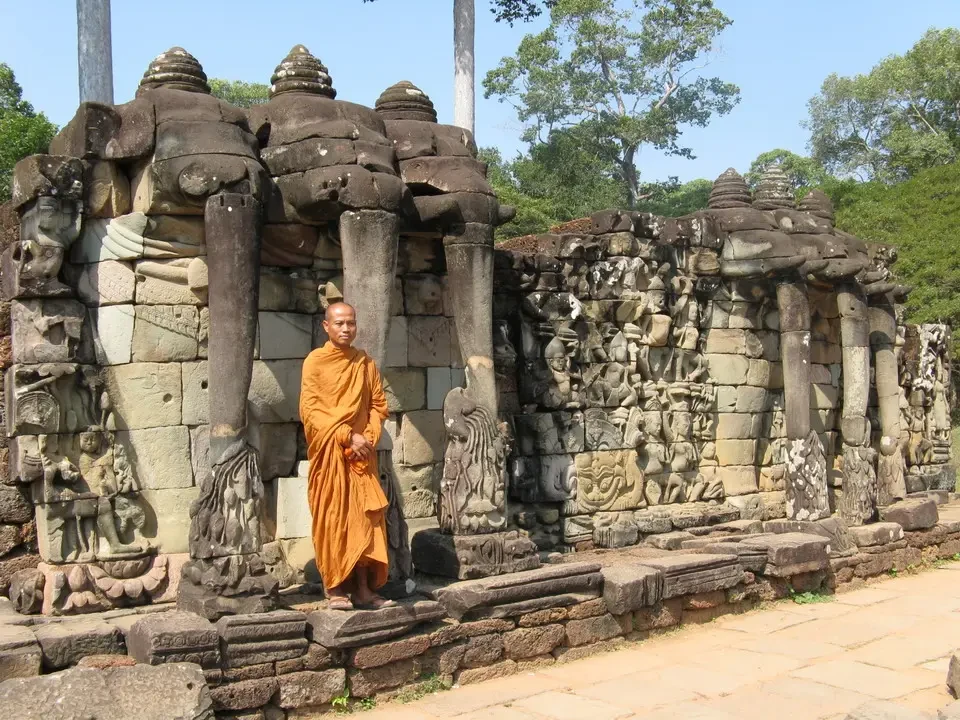
Following Preah Palilay, a very simple temple, and the Tep Pranam, where there is a Buddha statue about 4.5 meters high, we then see the Terrace of King Leprosy, a platform 7 meters high on which the supposed statue of the founder of Angkor is located, who, according to legend, died from leprosy. Terrace of the Elephants, which was once used as a platform and named so because it was decorated with a parade of elephants.
We have lunch at a restaurant right across from Angkor Wat, and in the early afternoon, while most tourists are sitting with their feet under the table and the sun is blazing hot in the sky, we head towards the most famous temple.
Angkor Wat is the iconic image you see everywhere, the undisputed masterpiece of Khmer architecture and art. With its refined bas-reliefs, is the emblem of Cambodia and a symbol of the amazing medieval Southeast Asia. The immense temple dedicated to Vishnu, built around 1115, still represents the unity of the Cambodian people and is featured on the national flag. It was commissioned by Suryavarman II, the "king protected by the sun", who also wanted it as his mausoleum.
Construction began in 1122 and finished around 1150, the year of the ruler's death. Angkor Wat occupies an area of approximately 2 million square meters, surrounded by a moat 200 meters wide. The outer perimeter measures about 1,800 by 1,300 meters, while the central sanctuary culminates with the refined profile of the five towers that dominate the landscape. It is the only large temple facing west, towards sunset, on the "Road of the Dead".
Built while the cathedral of Pisa was being consecrated in Italy and Notre-Dame was being built in Paris, Angkor Wat features kilometers of bas-reliefs carved into walls, porticos, and galleries, depicting scenes from the great Indian epic poems. We walk through the west and south galleries, reach the second level, and complete a circuit of the southern side. We pass by the four symmetrical basins for ablutions, the Hall of Echoes, and return. Near the entrance, we also notice a pillar riddled with bullet holes during the civil war.
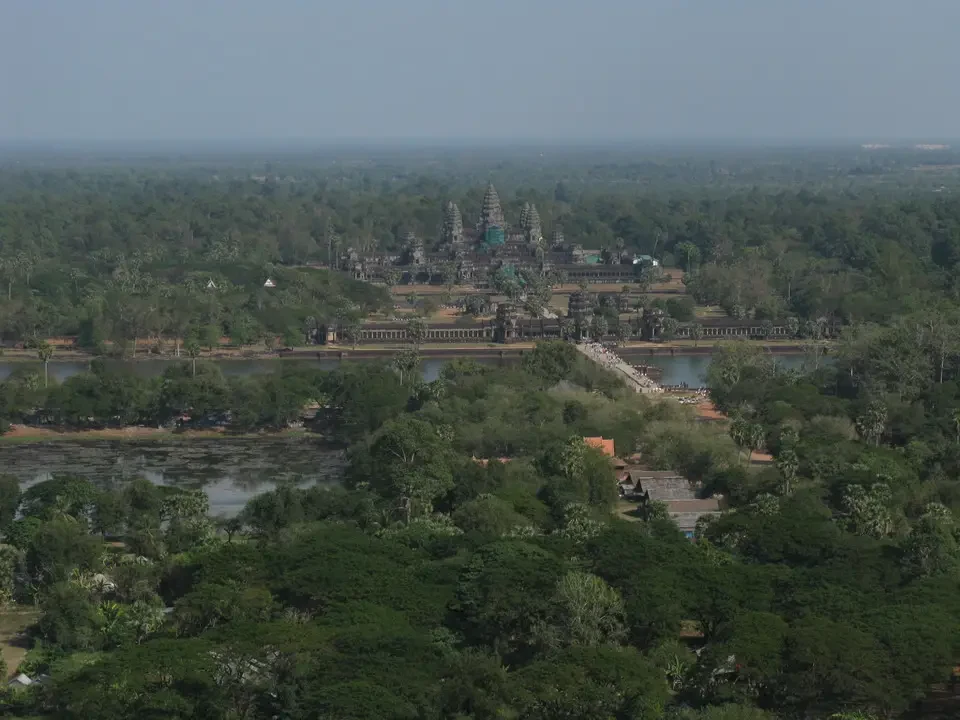
To better appreciate the harmony of Angkor Wat, there is a hot air balloon nearby that rises to about 200 meters: it's an opportunity for a amazing view from above. Afterwards, we will rent a tuk-tuk to do the short tour.
Short tour, sunset and Apsara dances
The route includes the Prasat Kravanh, dating back to 921, featuring five elegant shrines dedicated to the worship of Vishnu; the Banteay Kdei monastery, known as the "citadel of cells", built by Jayavarman VII at the end of the 12th century and dedicated to Buddha Lokeshvara; and the Ta Keo, temple dedicated to Shiva. This one, made of grey-green stone, dates back to around 970 and has five tall towers. It is unique because it lacks carved decorations. We climb three steep staircases.
As the sun prepares to set, we see the Thommanon perfectly illuminated. The temples were built using hard laterite on the inside, as a support, and sandstone on the outside, which was more suitable for sculpture. Many bas-reliefs, both at Bayon and on the Elephant Terrace or at Angkor Wat, are unfinished: this suggests that, when everything was abandoned, there were still works in progress.
The earliest structures are inspired by Hinduism; the Bayon was built by Jayavarman VII, who had embraced Mahayana Buddhism, while his successor returned to Hinduism and modified or destroyed many Buddhist traces. The ongoing restoration is sponsored by UNESCO, France, Switzerland, Japan, the United States, and India, but it does not seem that Cambodia offers support proportionate to the value of its own historical monuments.
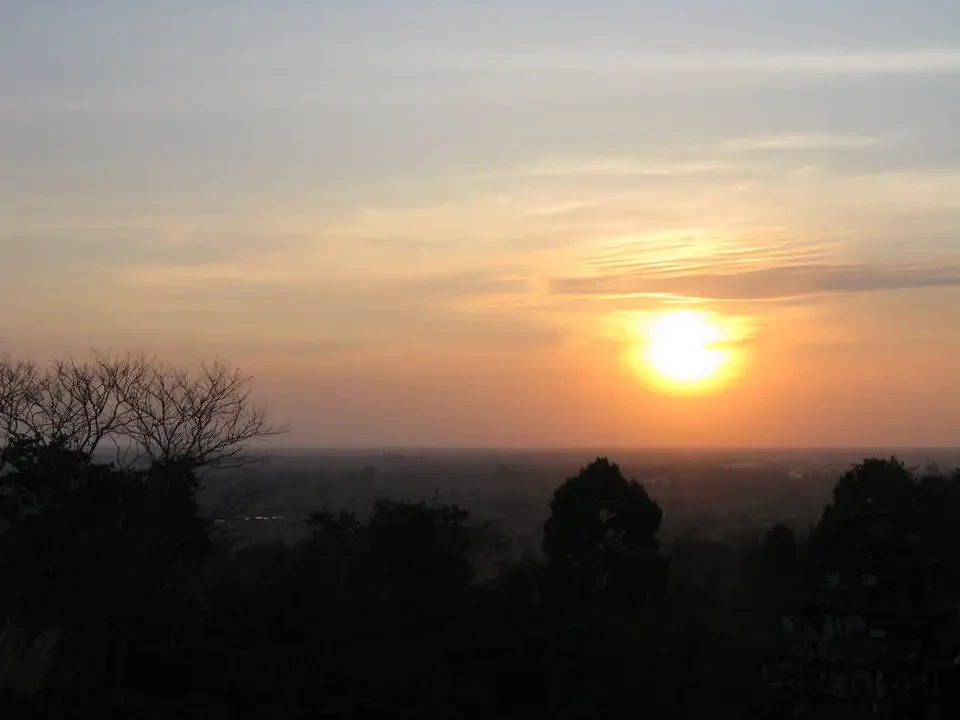
With the tuk-tuk and its friendly driver, we head back to the meeting point with our protectors, while the sun has begun its final descent. To enjoy its colors and emotions, we climb to the Phnom Bakheng, a hill that is 65 meters high and one of the oldest temples in the area, dating back to around 890. From here, you can enjoy a beautiful view of Angkor and the Western Baray, a large artificial lake created by digging it out in ancient times as a water reserve for rice cultivation. At 5:40 PM, we see the sun setting behind the jungle in a rainbow of warm colors, and we bid farewell to the Angkor site with well-deserved tiredness.
We return to the 21st century and find ourselves in a completely different environment. Dinner is served at Amazon Angkor, a restaurant known for hosting large events, with tables set up on stage where a show takes place. apsara dances, the heavenly nymphs of Hindu paradise, symbolizing elegance and mastery in dance. It's the classic tourist climate, with elegant ladies in evening gowns that seem completely out of place. The buffet is good, although adapted to the tastes of Eastern and Western tourists. The dances are beautiful and more professional than what we had already seen in Baray, although the simplicity of that environment and the motivations of the children still appeal to us more.
We can't really enjoy the Cambodian music, which consists of repetitive and unappealing tunes that verge on being annoying. We're playing along and acting like tourists here, just for the sake of it.
Siem Reap, the tourist bubble of Angkor.
Siem Reap is also and especially this: it doesn't take a keen eye to realize that visiting this city means more than just seeing Cambodia. After all, if millions of tourists pass through Angkor in one of the poorest countries in the world, there are many reasons to make the most of the wealth generated by the site. However, it is regrettable to see how the benefits end up in the hands of a few. Only a limited portion of the revenue seems to actually go towards restoring and protecting the monuments.
The city is an island in the desert of poverty. Not that the residents live well, but the tourist finds everything they are looking for here. We expected a tourism more focused on adventure or historical research; instead, many seem to arrive almost by chance, as an organized extension of vacations at Thai beach resorts, just over an hour's flight away. In the center of Siem Reap, you meet people better suited for tropical beaches than historical ruins.
Everywhere we see children begging or trying to sell something. They are as persistent as flies, and their lost eyes evoke pity, as they ask for something about which they may not even have a clear understanding. Some repeat "one dollar" in a learned chant from adults. There are also many people wandering around the dilapidated shacks or sleeping on hammocks under the shade.
It is true that Vietnam appears, on average, less poor than Cambodia, but above all it seems to be characterized by a sense of pride that prevents certain forms of exploitation. Conversely, Cambodia appears more liberal in the negative sense: prostitution, drugs, corruption, prices in US dollars and the reil currency are almost treated as a secondary currency. However, it is difficult to remain indifferent to children or groups of amputees from landmines who roam around in the most frequented areas. The problem of landmines remains one of the biggest: demining efforts are constant, but injuries and deaths continue due to explosions. The only positive aspect compared to neighboring Vietnam is the lower traffic, probably due to the greater rural nature of the population and the fact that many people cannot even afford a scooter.