

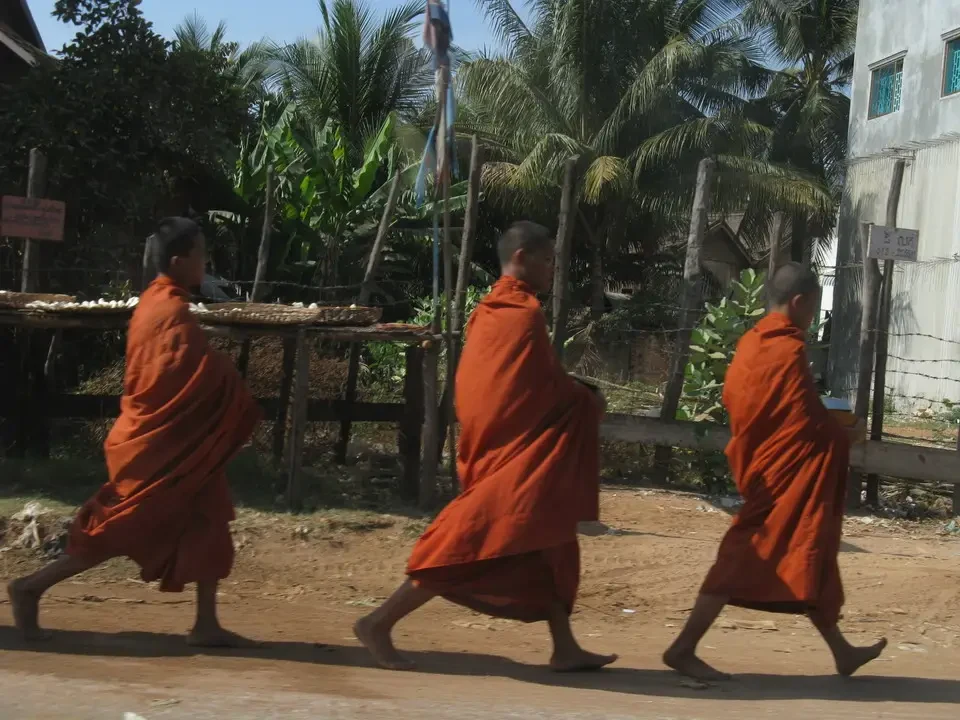
From Bayon to Siem Reap, via Phnom Santuk
At 4:30 am, the roosters begin their concert, much to our regret that we didn't put them in a pot the night before. The rest is pleasant but not particularly relaxing, given the thin mattress between our backs and the bamboo floor. After the sunrise at Baray at 6:30 am we have an appointment with the guide for breakfast and then we depart towards Siem Reap.
Before arriving in town, we climb to the hilltop of Phnom Santuk, a sacred place for Cambodians, where a revered pagoda has been built, offering a wide view of the surrounding plain. I was 809 steps approximately 200 meters of elevation gain, quickly ascending a staircase surrounded on both sides by Naga, the mythical serpent figures supported by religious figures. At the top, you'll find a temple undergoing renovation and a beautiful view of the surrounding countryside.
The religious atmosphere is palpable, confirmed by the presence of many. young monks and from the reconstruction of numerous temples and pagodas. Our guide is a Buddhist monk who has worked for five years and explains some differences between Theravada and Mahayana Buddhism. In Cambodia, however, religious practice also retains strong animistic influences: we see incense burning at the base of large trees, offerings made near water sources, and signs of veneration for natural elements of particular importance. Along the ancient royal road, we also pass by... stone bridge Built under Jayavarman VII: today, the state highway NH6 runs over a modern bridge, but the ancient one still stands proudly after almost a thousand years.
Roluos, before Angkor
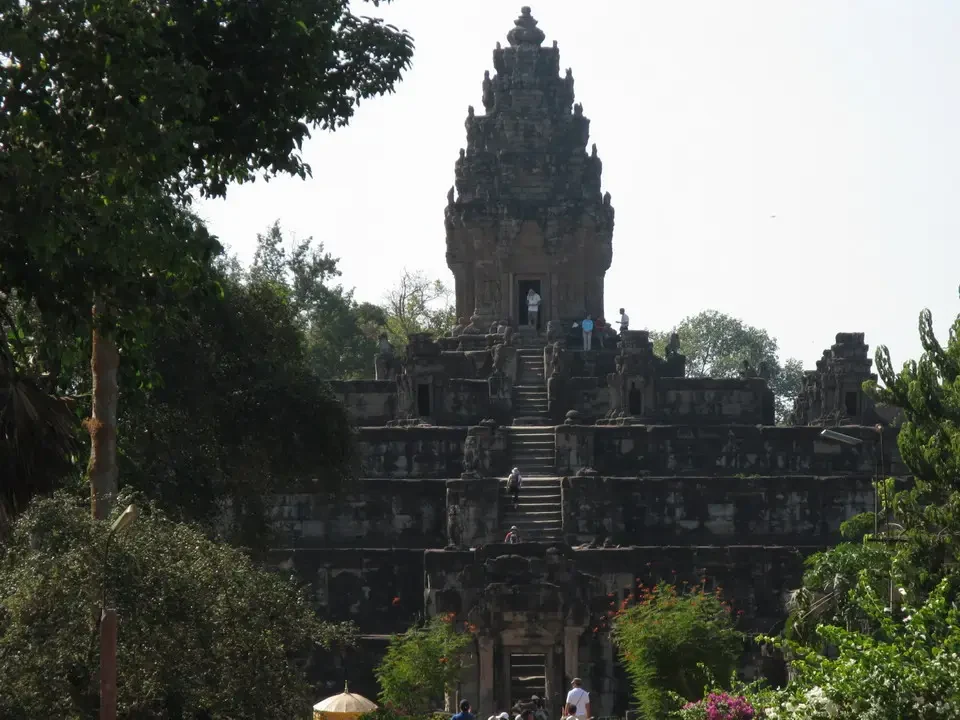
Shortly before noon, we arrive in Siem Reap, meet our new guide, have lunch, and then visit what could be considered the precursor to Angkor. Returning on NH6 for 13 km, we reach the Roluos group, consisting of Preah Ko, Bakong, and Lolei, temples from the 9th century that were built before the major development of Angkor.
Preah Ko now only retains a few structures, while Bakong It still retains the grandeur and majesty of a five-story temple. Inside the shrines, one could find a linga and a yoni, symbols related to Hindu tradition. There are also railings made of nagas, and in front of the temples, several statues of Nandi, the sacred bull associated with Shiva. Even the birds perched on some columns allude to Indian mythology, confirming how this first Khmer world was already a combination of power, religion, and symbolic imagery.
Siem Reap, the night before visiting Angkor.
The temperature is 35°C, with fortunately low humidity, but walking in the sun is still not easy. At 15:45 we are at the hotel and then go for a walk around town. Siem Reap has developed almost entirely thanks to the Angkor treasure and shows surprising opulence for one of the poorest regions of Cambodia. They tell us that there are several high-end hotels and that everything revolves around tourism. The center is made up of two streets full of restaurants, but it still manages to retain a certain Eastern atmosphere.
We had dinner at Cambodian Barbecue, where we tried... snakes and squid on a barbecue set up directly on the table. The cooking system It's simple and clever: a slightly conical stand is placed on top of a terracotta pot filled with burning coals. Vegetables and water are placed at the bottom, while meat is cooked at the top; the juices drip down into the broth, flavoring the vegetables.
It's interesting to notice how even the licenses for guides are territorial: whoever can accompany visitors in the capital cannot do so at Angkor without a specific license. This leads to a transfer of clients between different guides, but we eventually find our original guide again when we return to their area. Before going to Roluos, we also purchase tickets for Angkor, which were scheduled for tomorrow at a cost of $40. The price would be acceptable if we didn't later learn that only a small portion is allocated to the restoration of the sites; the rest goes into state coffers and the mechanisms that manage them. Many restorations are actually funded by foreign cultural organizations, as we will see in the following days.


