From Pre Rup to Kbal Spean
At 8 am, we arrived promptly at the lobby of our hotel in Siem Reap to explore the surrounding areas of Angkor. We drove along the eastern section of the site and stopped at Pre Rup, a magnificent temple-mountain dating back to 945 AD, with its warm ochre colors and intricately carved arches.
We continue along the Eastern Baray, an extensive artificial lake with a small island in its center dominated by the Mebon Orientale, an Hindu temple. Just beyond is Srah Srang, the "pool of ablutions" from the 12th century, a large basin of approximately 700 x 300 meters. Our main destination is Kbal Spean, about 30 km north of Angkor. The name literally means "bridge of the head": it's a natural stone bridge over a river in whose bed, according to legend, thousand lingas and other images taken from the Hindu temple.
It can be reached by a walk of about an hour through the dense vegetation, one and a half kilometers with a slight incline. Depending on the season, the scenery changes significantly: during the dry season, the sculptures are perfectly visible but there is very little water; during the rainy season, the carvings are barely visible, while the river swells and forms... wonderful waterfalls. During this period, a small stream of water flows over the sculptures, almost caressing them.
Kbal Spean is made up of sculptures carved directly into the rock that forms the bed of a winding stream. The walk finally gives us a more immediate connection with nature: a looming nature, full of tall and dense trees, which seems to envelop anyone who walks there. When we arrive in the area of the thousand lingas, once a place for ablutions and therefore imbued with sacredness, the forest has now enveloped everything, and it is barely possible to see the opalescent sky.
Banteay Srei and Ta Prohm
Banteay Srei, located approximately 28 km from Siem Reap, is a small-sized temple considered by many to be a jewel of Khmer architecture. Built in 967 and dedicated to Shiva, it is famous for its elegant carvings, proportionate pavilions, and pink sandstone reliefs, all crafted with unprecedented precision. It is nicknamed "temple of the women" and has a rare feature: it was not built by a king, but by a court official.
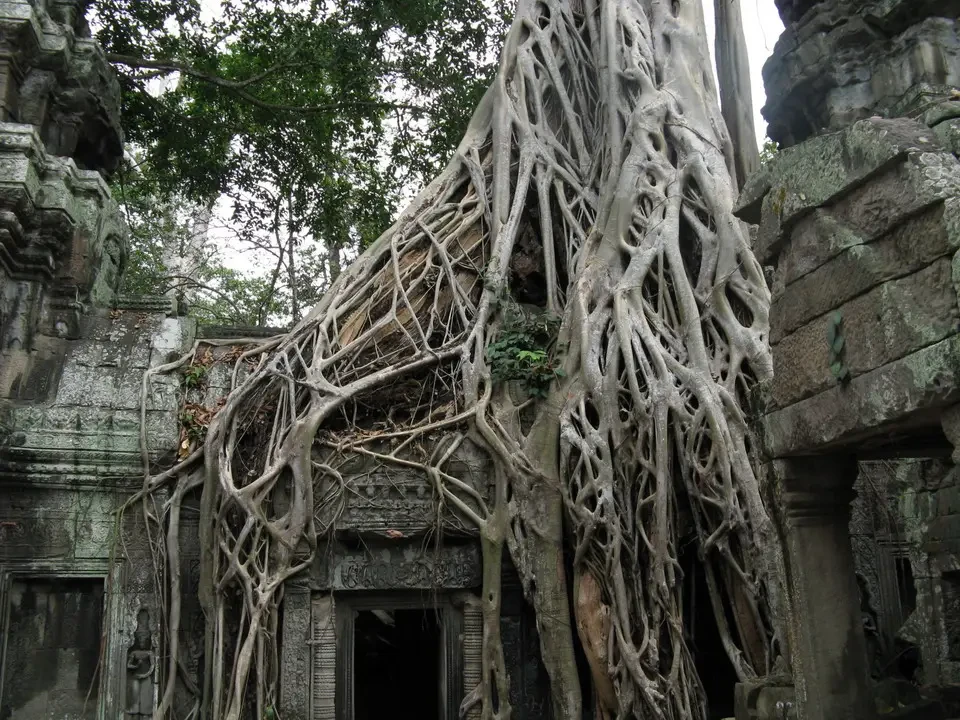
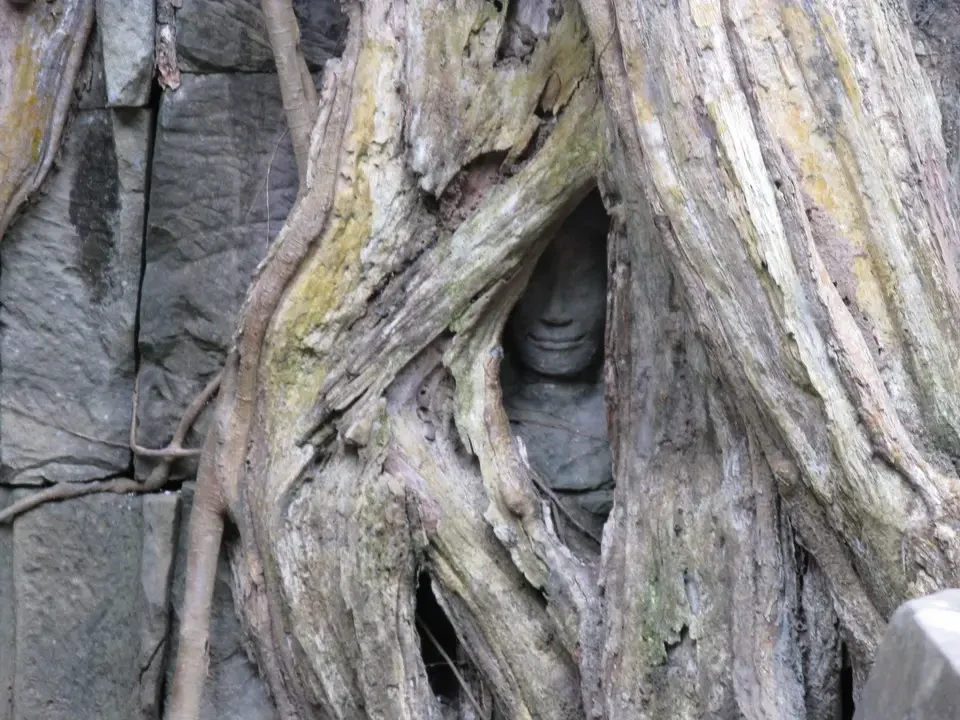
We then arrive at Ta Prohm, a large Buddhist monastery built in 1186 by Jayavarman VII. The archaeologists have deliberately left it partly in the state in which it was found: giant trees rise among the towers, enormous roots surround the galleries, and bushes grow from the roofs, making it impossible for visitors to distinguish the human effort, from nature's creations The complex is located behind a 3,200-meter long sandstone wall.
It's interesting to note how nature has regained possession of the place and not have been evicted from the new tourist colonization of these temples. Here, the ruin doesn't seem to be just a loss: it has become a form of the landscape.
Tonle Sap Lake and floating villages
The weather, less sunny than yesterday, causes a slight drop in temperature and allows us to enjoy the day more. We have lunch in Siem Reap and then head south for about half an hour, towards Tonlé Sap Lake, near Phnom Krom, on the shores of the Great Lake. We take a boat trip on the largest lake in Southeast Asia.
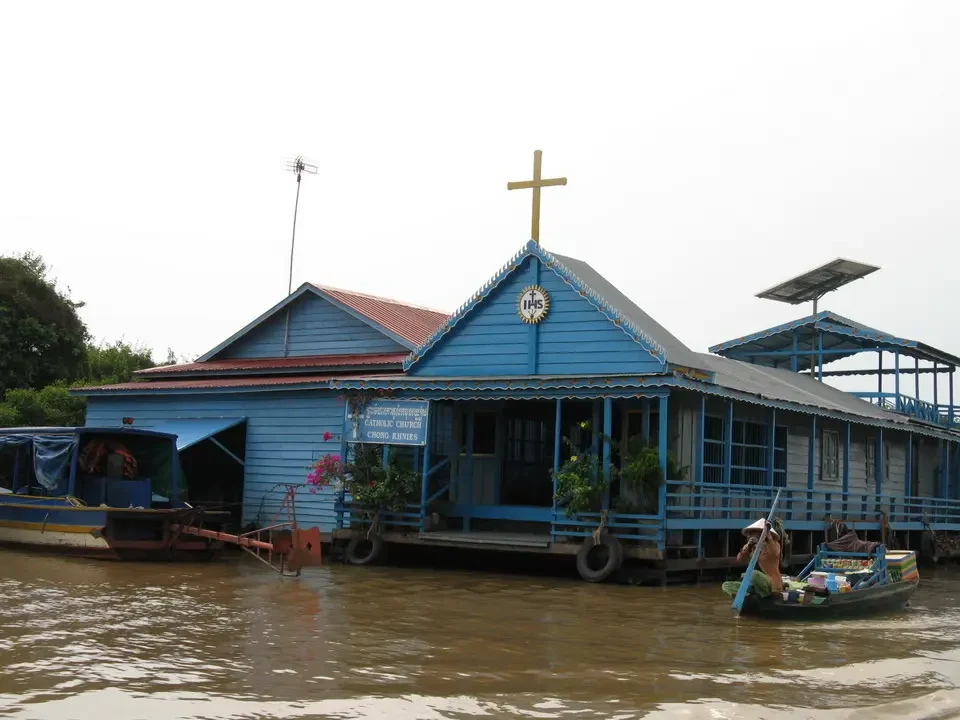
Dozen of boats house the floating houses of the Vietnamese fishing village...a community of "lake nomads" who move according to the fishing seasons. A unique feature of Tonlé Sap is its variable size, which changes dramatically between the dry and rainy seasons, and the extraordinary fish population in its waters. We see lush gardens, pig farms, a barber shop, a school, and many other activities, all curiously floating. Not least are a floating church and a the house dragged into the river.
The inhabitants of the villages are mostly of Vietnamese origin. Despite the apparent wealth offered by nature, there is a palpable atmosphere of latent poverty: the annual income only amounts to about $500, life expectancy does not exceed 54 years, and a significant number of children do not reach the age of 5. Some inhabitants of the mainland, forced to rebuild their homes almost every year, are Khmer. Snakes and alligators nest in the mangroves; we can see some in a floating farm. lake children They observe everything with a naturalness that makes the difference between our tourist visit and their daily lives even more apparent.
Evening in Siem Reap
We return to the tourist capital of Angkor for a stroll through the evening market and a foot massage, a perfect prelude to dinner. We enjoy the local specialty, amok with fish and shrimp, then return to the hotel by tuk-tuk at around 10 pm.
The temples with towers facing north are dedicated to Vishnu, the central ones to Shiva, the main deity, and those to the south to Brahma, to whom it seems that no independent temples are dedicated except within the context of the trinity. In Buddhism, entry is often located to the east, because that's where the sun rises: a different interpretation than that of Christian architecture.
The day also provides a clear comparison between Vietnam and Cambodia. Vietnam offers the idea of greater moral and social order: Cambodian children run around freely until a certain age completely naked, while when they grow up they wear tattered and ill-fitting clothes, something that we would hardly see among the most meticulous Vietnamese neighbors.