

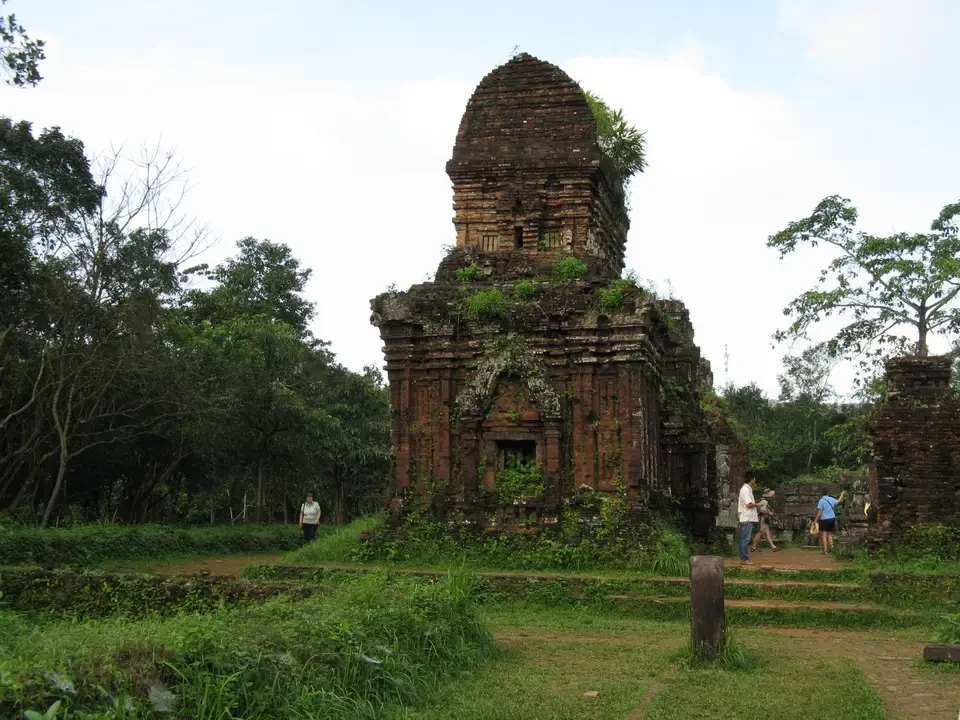
My son, ruins of Cham amidst the clouds
Today's itinerary includes a visit to the My Son archaeological site, located approximately 45 km inland from Hoi An. It is the most important Cham complex in Vietnam, a religious and cultural center of the Champa kingdom, dating back to the 4th century. Here you can find the highest concentration of Cham towers, declared a UNESCO World Heritage site.
The site preserves remains of shrines and buildings, many of which have been damaged or destroyed by American bombings. The Champa kingdom maintained commercial and cultural relations with the Indian world and Java, where some scholars also resided. However, today, the place does not always convey continuity with that illustrious history: weeds grow, towers show signs of deterioration, and the war has left visible scars.
The structures may appear as simple piles of crumbling bricks, but they tell a different story than the more familiar Vietnamese world. Also the arches and structures These techniques are quite different from those used in Europe at the same time. The surrounding mountains, covered in clouds, create a very atmospheric and almost surreal environment. We also witness... local dance performance, then we start our return journey passing through rice paddies and cassava fields As we drive along the road, we pass by a funeral procession, with people dressed in traditional attire engaged in solemn mourning dances.
Cycling around Hoi An and flight to Saigon
We return to Hoi An and rent a bicycle, heading towards Cua Dai beach where we stroll among the swimmers. Since we don't have swimwear, we simply touch the water with our hands. On the way back, we stop for lunch at a local restaurant and then continue exploring Hoi An by bike. The day is hot, but the humidity remains manageable.
Return the bikes, we need to be on time for our meeting with the driver and continue towards Da Nang, returning approximately 30 km. The airport is small, with only two gates, and the signage isn't helpful: you either need to know Vietnamese or have a driver. Fortunately, we have the latter option. The flight from Da Nang to Saigon departs at 18:10 and arrives at 19:20 on Vietnam Airlines.
In Saigon, the temperature is 28°C and we are greeted by a new guide, a woman of 46 years old who arrived with some difficulty. From the very beginning, we realize that we have entered a much more chaotic or cosmopolitan environment, depending on the interpretation. We dine in a restaurant that is far too luxurious for our tastes, where we suffer from the cold due to an overly efficient air conditioning system. In a poor and hot country, even air conditioning becomes a way to display opulence.
Evening in Saigon
After dinner, we check into the hotel to drop off our luggage and then go out to explore the city on Saturday evening. Saigon retains a pleasant colonial atmosphere, with wide tree-lined avenues, quiet residential areas, and neoclassical buildings. Today it is the industrial and commercial heart of Vietnam; its inhabitants are known for their business sense and their cheerful way of life, which seems almost in contrast to the austerity of Hanoi.
The city has a very recent and intense history, but less ancient roots than other Asian capitals. Regardless of the day of the week, the streets in the center are rivers where motorcycles and scooters of all kinds flow. The few cars seem like boats in the current. Crossing the street requires faith: you move slowly, trusting that everyone will avoid you. It usually works, until it almost becomes a game.
The center is still decorated for the holidays, with a dazzling display of neon lights that resembles Las Vegas transplanted to the Far East. Religion plays little role: Christmas and New Year become pretexts for imitating Western culture and its image of wealth. However, the scenery is cheerful and gives the city a different face than the tragic one with which it is often remembered.
We pass by the former town hall, today the administrative center of southern Vietnam, brightly lit and considered one of the most photographed buildings in the country. Just a little further on we also find the Opera, another clear sign of French colonial heritage.
Boat people, Hotel Continental and colonial memory
In front of a restaurant frequented by wealthy returnees, the guide tells us about the Vietnamese from the south who fled after the end of the war. Some of the so-called "boat people" have managed to rebuild their lives abroad and now return investing in their homeland. Many others, however, died at sea or in refugee camps. It is one of the less-told faces of the war: after victory, a part of the south was punished for having lived on the wrong side.
During the most difficult years, the name Saigon could not be officially pronounced, replaced by Ho Chi Minh City. Today, the city seems to have regained its strength, especially thanks to the economic shift that has favored the south, which is more open and commercial. The wounds of the past are not forgotten, but the unity of the country does not seem to be in question anymore.
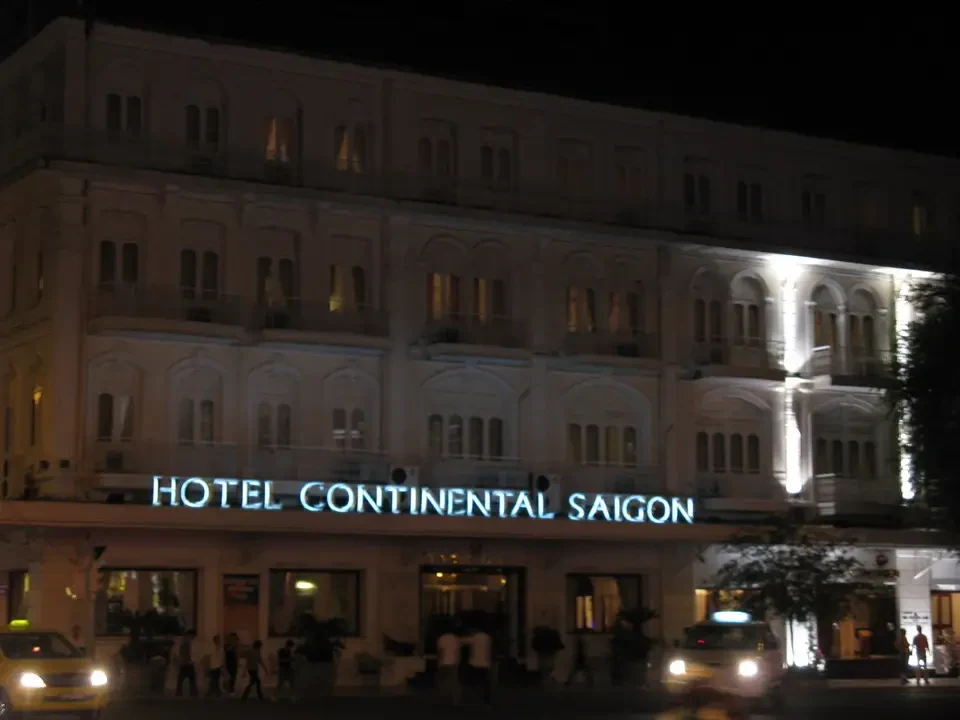
From the lighting of the Opera, we stop in front of the Continental Hotel, a place full of memories. During the war, it was a base for journalists, correspondents and foreign observers: many stories about South Vietnam also passed through here, from terraces, hotel rooms and diplomatic conversations.
Notre Dame Cathedral and Presidential Palace
We arrive at the Notre Dame Cathedral, well-lit, where a group of worshippers are kneeling before a marble statue of the Virgin Mary. This religious fervor should not be surprising: mysticism is strong in Vietnam and often expressed in ways different from those observed elsewhere by the same religion.
The streets become increasingly dark and we continue towards the Presidential Palace, which is also full of history. The photo of the tank It became one of the symbols of the North Vietnamese victory and the end of the war. We return somewhat exhausted, aware that in Saigon it is best to be mindful of the local customs, and we enjoy a well-deserved rest.


