From Lao Cai to the markets of Can Cao and Bac Ha
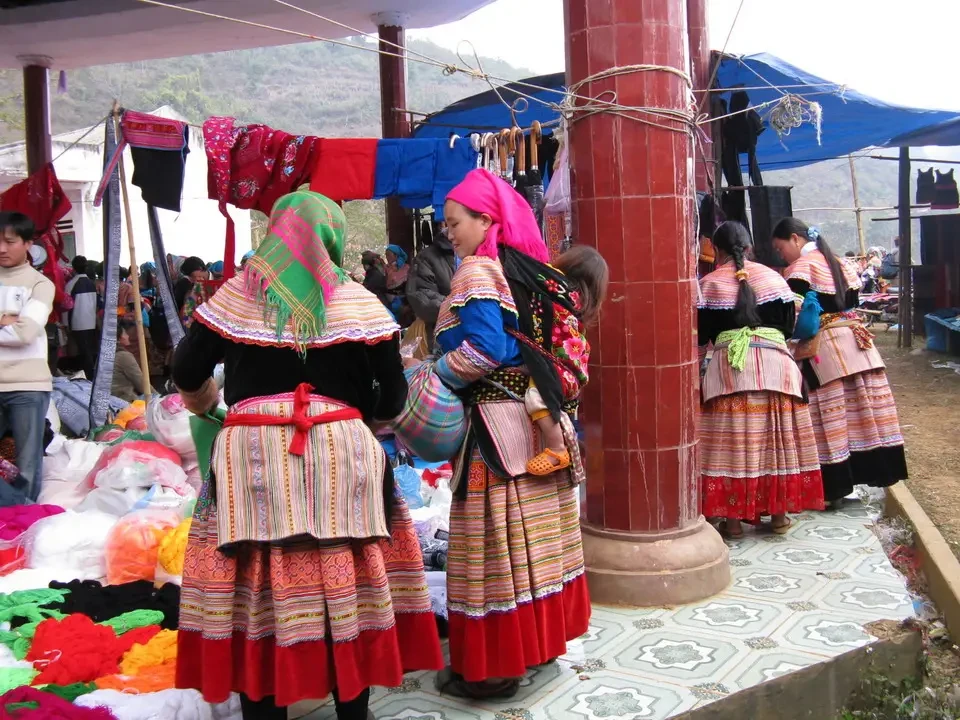
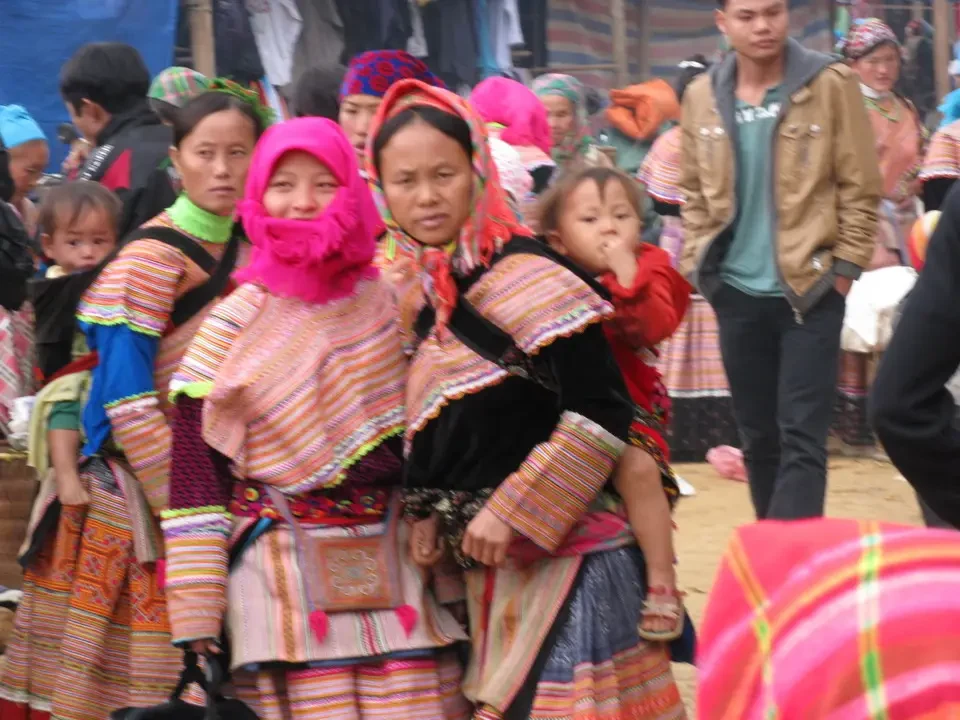
Despite the cramped conditions and the smallest bed I've ever seen, sized for Vietnamese rather than Western tourists, we were able to get a good night's sleep and arrive at our destination at 5:30 AM the following morning. The time difference helped us to relax and fall asleep easily. We went to have breakfast in a small restaurant nearby the station, when it was still very dark, enjoying freshly squeezed oranges. At 6:30 we met with a local driver and set off by car, climbing up one valley at a time towards Bac Ha, where on Sundays there is a market populated by 14 groups of Montagnard people, with their goods. Since it was Saturday, we went to Can Cao, 20 km from Bac Ha, just 9 km south of the Chinese border, to see the Saturday morning market passing through beautiful rice terraces. Can Cao Market It is one of the most fascinating markets held outdoors in the region, where you can find everything. Women crowd around stalls selling clothing and household items. the men find themselves in the area dedicated to livestock and on a hill where cages with wild birds are hung on the trees. We then meet up at one of the many bars-restaurants, where we enjoy meals of purely local cuisine. The beauty of the place is given by the backdrop of... rice paddies with terraces, from colorful clothes worn by women belonging to the Hmong ethnic group, as well as the variety of goods on display. It's interesting to see how some of the alcohol in bottles, obtained from the fermentation of rice or corn. Later, in a secluded farmhouse, we will see the production process with woks for cooking and stills for distillation. The near absence of tourists makes everything more authentic. Its proximity to China attracts many merchants from the neighboring country, and this is also evidenced by the trade in dogs.
To travel to China, a visa is usually required, which cannot be obtained at the border crossing. However, locals have exceptions that allow for cross-border movement, as these minority groups are often found in both countries. The journey to Bac Ha requires one and a half hours from Lao Cai on a very scenic road, after which another hour is needed to reach Can Cao, where the road becomes more uneven.
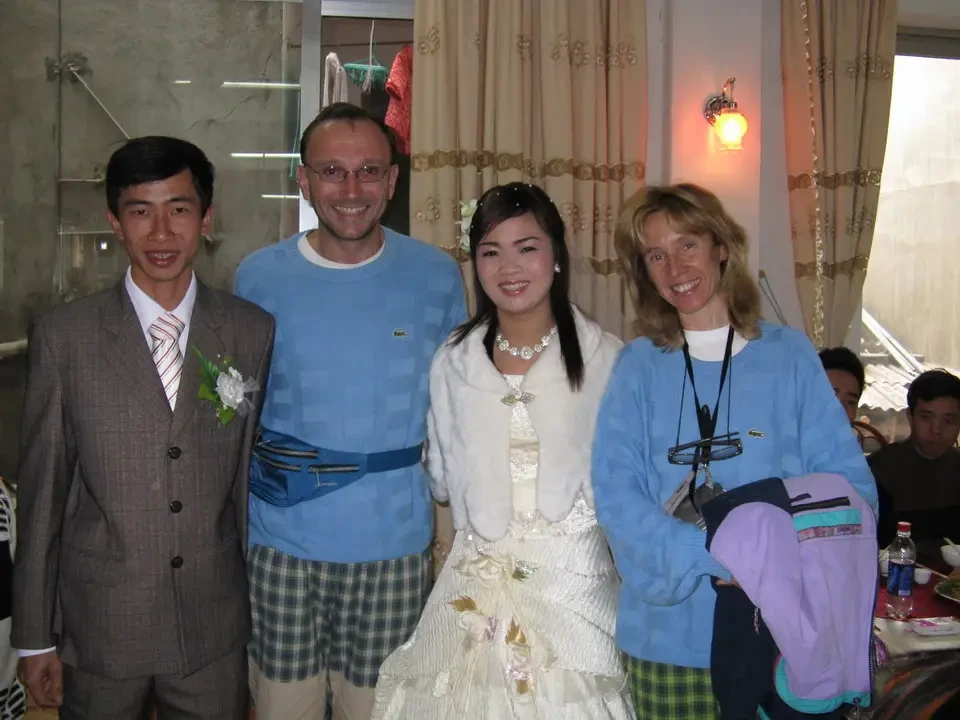
On our way back to Bac Ha, we take a path that leads us to visit some isolated houses nestled among the rice paddies. We find several of them along the way. girls sewing a car with bags or clothes in bright colors that they will then sell at the weekly markets. The houses are built with earth walls and often have cracks, but we are told that they are not at risk. We arrive in Bac Ha just before noon, when a couple is about to offer a wedding lunch to a large number of guests. We observe them curiously and wish them well, taking some photos. a photo with them We appreciate the civilization demonstrated by these populations in offering a lunch that doesn't last longer than three-quarters of an hour. The hard work and respect of the Vietnamese people are also evident in these details, even in the most remote areas like this one. After lunch, a fortunate walk at the local market, although it is small. Tomorrow there will be the important event, with a large influx of tourists. It's interesting how the butcher shops We hang the meat outside without protection, using salt or keeping it cool. It is then placed on wooden tables, with cardboard simply laid underneath. We are told that the animals are slaughtered, dismembered, and then displayed in a way to facilitate their quick removal, within about half a day.
Lao Cai, the border with China and the ascent to Sa Pa
We then set off towards Lao Cai, which is located on the border with China, formerly a caravan city that had been traveled by nomads and merchants for centuries. In 1979, during the Chinese invasion, the city was razed to the ground, and today almost all of the buildings are new. The border, closed due to the war, was only reopened in 1993. Under a hot sun and still not used to these temperatures, we go to have a drink at a bar right on the Chinese border. Only a river separates us from the Celestial Empire, which can also be crossed on foot. The bridge connects the two states.... decorated on both sides with a large gate representing the entrance to the respective countries. The buildings that can be seen across the border also seem to demonstrate the opulence of the neighboring country. It is another way to show strength and make oneself visible, fortunately without weapons. Although there is now full economic cooperation between the two countries, mutual suspicion persists, and the wounds of the recent war, although healed, have left scars. Furthermore, for the Vietnamese, it is a rule to be wary of such a giant that weighs on their northern borders – this is a form of wisdom. For centuries, the Chinese have considered Vietnam as their southern province, and the name Viet Nam itself somehow evokes this concept. They never made it a secret, since they had dominated Vietnam for over a thousand years and subsequently repeatedly tried to regain control. Only the Vietnamese tenacity managed to drive the neighbor back beyond its borders, albeit at a great human cost. This happened most recently in these regions in the 1970s, when the Khmer Rouge of Cambodia, supported by the Chinese, launched increasingly persistent incursions into Vietnam, which in turn invaded Cambodia and ended the Pol Pot regime.
Surprisingly, we learn that Vietnam is a major importer of Chinese products. This is not due to low labor costs, as it could be even cheaper here. However, this comes at the expense of quality. The reason lies in the large-scale production of Chinese factories, which can therefore be more competitive, while here the base is usually artisanal. Only food products flow in the opposite direction, but the imbalance towards China remains a problem for the Hanoi government. Trucks loaded with all kinds of goods constantly pass over the bridge. human-powered carts Absolutely unbelievable. It doesn't take a seasoned customs official to understand that smuggling is the norm, rather than an exception, despite the presence of customs guards who are clearly well-trained and integrated into the system. Goods pass right under their attentive eyes, appearing as legitimate transactions.
It's interesting to note how the Vietnamese people with whom we interacted recount historical or ancient events with such emphasis, as if they were narrating epic events. At the same time, they always use the pronoun "we" with a tone full of pride when recounting historical or war-related facts. Proud descendants of a people who have always had to fight to defend their territory, and who have succeeded every time.
Sa Pa, fresh from the mountains and evening market
Let's take the road that leads towards the mountains of Vietnam, to reach Sa Pa. It is an old mountain climate station located at an altitude of 1,600 meters, situated in a beautiful valley on the edge of a natural oasis of approximately 30 square kilometers, characterized by a cool climate that allows for the cultivation of fruit trees and the development of lush gardens with palm trees and tea plantations. Given the more temperate climate, one can find varieties that would not otherwise grow in Vietnam. It is even possible to experience snowfalls here.
This is one of the most enchanting places in the unspoiled northern region of Vietnam. The mountainous landscape here is dominated by the Hoang Lien Son range. Around the town, surrounded by high mountains, you can find cascading waterfalls and the suspended Muong Hoa River bridge. Sa Pa has French origins, and its name comes from "sap," which means fir tree.
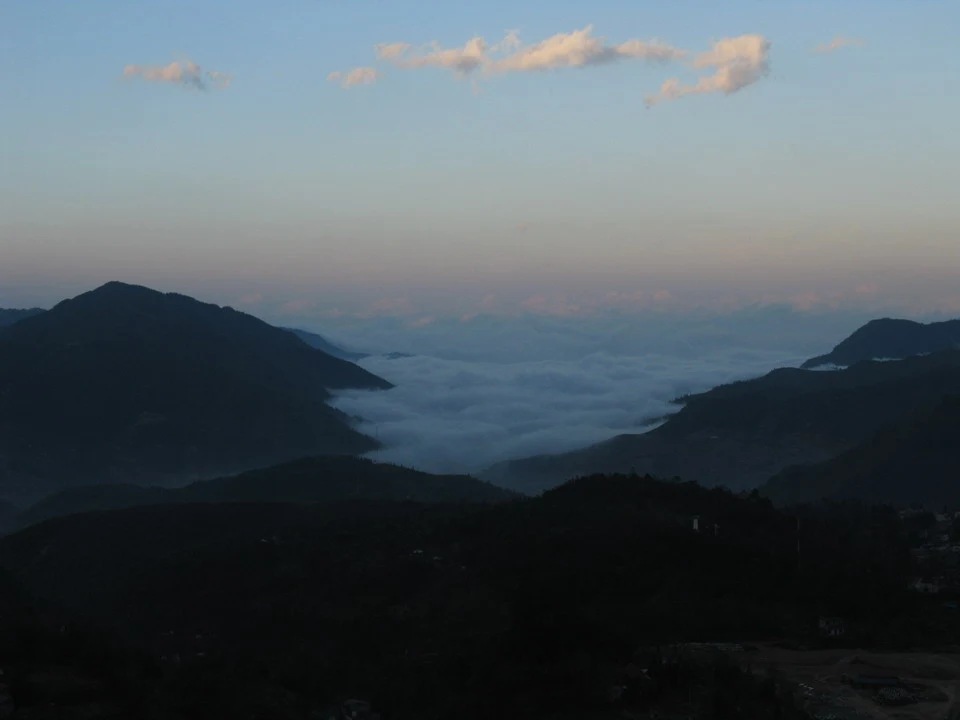
The temperature becomes cooler, reaching around 10°C, and the night will be colder than expected in a tropical climate. We still have some time left, so we take the opportunity to climb Dragon Mountain, from whose summit you can enjoy a wonderful view of the surrounding valleys, as well as... small town of Sapa. Wonderful scenery The atmosphere was hazy due to the interplay between clouds and fog coming from below. Meanwhile, the stalls of the Saturday evening market began to fill up, and we started gathering ideas for ethnic shopping. After a brief visit to the luxurious Victoria Hotel, which contrasted sharply with the simplicity of the surrounding environment, we had dinner at the nearby Fansipan restaurant. Another trip to the market to buy handcrafted items, then back to the hotel for a refreshing and invigorating overnight stay, despite using a fortunate stove pulled out from the room's closet.