From Siem Reap to Phnom Penh
At 8 am, we left Siem Reap in a car driven by a driver whose driving style makes us appreciate how wonderful life is, especially when you don't have any reason to think it will end soon. It’s true that certain values are appreciated most when you don't have them, or when you're about to lose them. The light traffic and straight roads seem to allow him to drive freely along the road to Sisophon.
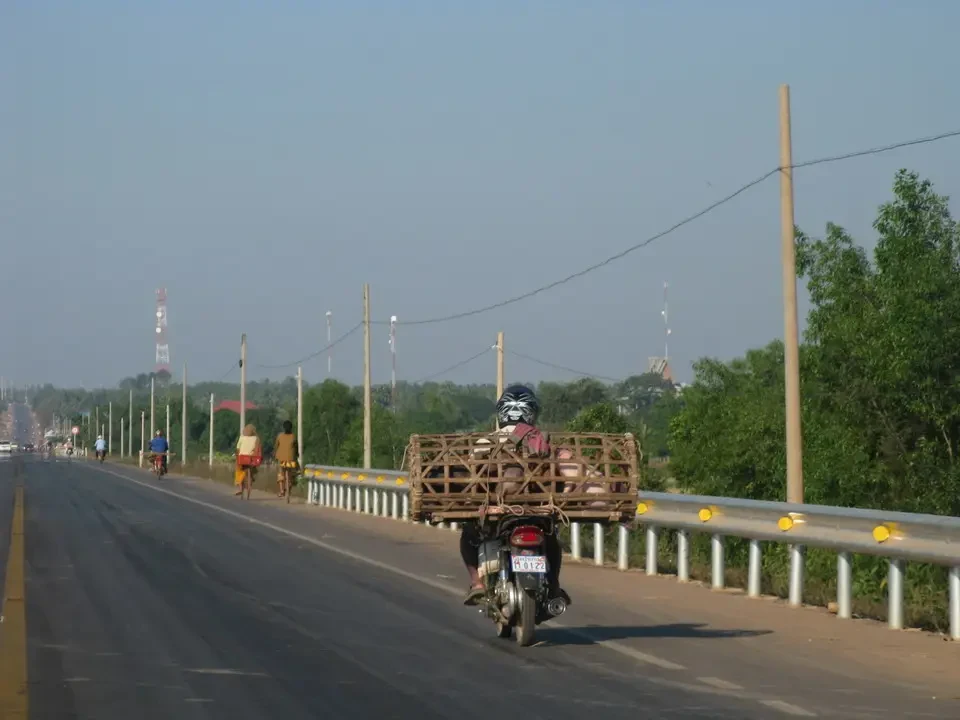
The landscape is flat, consisting of dry rice paddies, monotonous but revealing the rural side of Cambodia. We occasionally pass through villages where life moves at a slow pace. with motorcycles loads of all kinds of products: live pigs inside the baskets, dead ducks hanging on a stand, four on each side behind the vehicle. The peaceful atmosphere is only disturbed by our car, which demands passage with honking and gets it through force. In addition to the danger, which the reckless driver seems not to understand, we also miss out on excellent photographic opportunities.
We leave the NH6, which runs west towards the Thai border, and turn south onto the NH5, heading for Battambang. This is the second largest city in the country, located in a fertile plain where tourism hasn't yet arrived decisively. We stop for half an hour to allow our driver to recover from the morning meal. fill up with LPG The experience is interesting: in a crowded square, under a shelter without signs, those who know can tell that fuel is being sold. After inserting the hose into the tank, the petrol pump starts the electric motor and the gas begins to flow. A puff of gas comes out, which, besides disinfecting our suitcases, also releases a pungent odor in the air. Fortunately, nothing explodes.
We continue our journey on a beautiful road, although maintaining a speed of 120 km/h remains excessive for the context. We see a single-track railway line for bamboo trains running alongside us: when two carriages meet, one is unloaded and reassembled after the other passes by. The rice paddy landscape becomes greener, but it remains unattractive from a tourist perspective. We pass through Pursat, Kompong Chhnang, and Oudong. Before Oudong, we notice a mine clearance center with special vehicles parked nearby, providing concrete evidence of how landmines are still a real problem in Cambodia. Along this route, we also encounter many people lying on hammocks and children begging. It is a poverty without pride, and the comparison with Vietnam comes naturally to mind.
At 2:30 PM, after six and a half hours of walking, we finally reach Phnom Penh without even having had lunch. For today, the lavish meals from the previous days will suffice. We go to Hotel Blue River, which is located in a less central area, so it's not very convenient for getting around, but has a room balcony overlooking the Mekong. What more could we ask for to end these vacations? We say goodbye to the driver and thank him for keeping us safe. For $15, we immediately book a tuk-tuk for the afternoon and start exploring Phnom Penh on our own: the meeting with the guide is only tomorrow.
Phnom Penh, located 291 km from Battambang, is situated at the meeting point of the Mekong, Bassac, and Tonle Sap rivers. Its name comes from the combination of the Khmer word. Phnom"hill", and the name of the woman Penh, to whom tradition attributes the founding of the city in 1372. It is the capital of Cambodia since the 15th century, after the decline and political abandonment of Angkor.
Tuol Sleng, memory and abandonment
We head straight to the museum. Tuol Sleng, a former high school that under the rule of Pol Pot was transformed into a headquarters of the political police. It is impossible not to be shocked by the atrocities committed in that place. The complex became a torture center: In the cells, small and cramped, prisoners could barely lie down between one torture and another.
It's also depressing to see the state in which the museum is maintained. This gives the impression that everything has been done to respect the politically correct, then leaving the place in disrepair. It is precisely this state of abandonment that best describes this neglect: a museum like this should maintain the memory of the tragic events that occurred, and it also serves as a welcome sign for foreign visitors, being one of the most visited in the country. Instead, it seems to be a missed opportunity to show a break with the past: as if someone had wanted to say "it needs to be done," but then a painting falls, it is left on the ground with the caption still attached.
Sunset over the Mekong
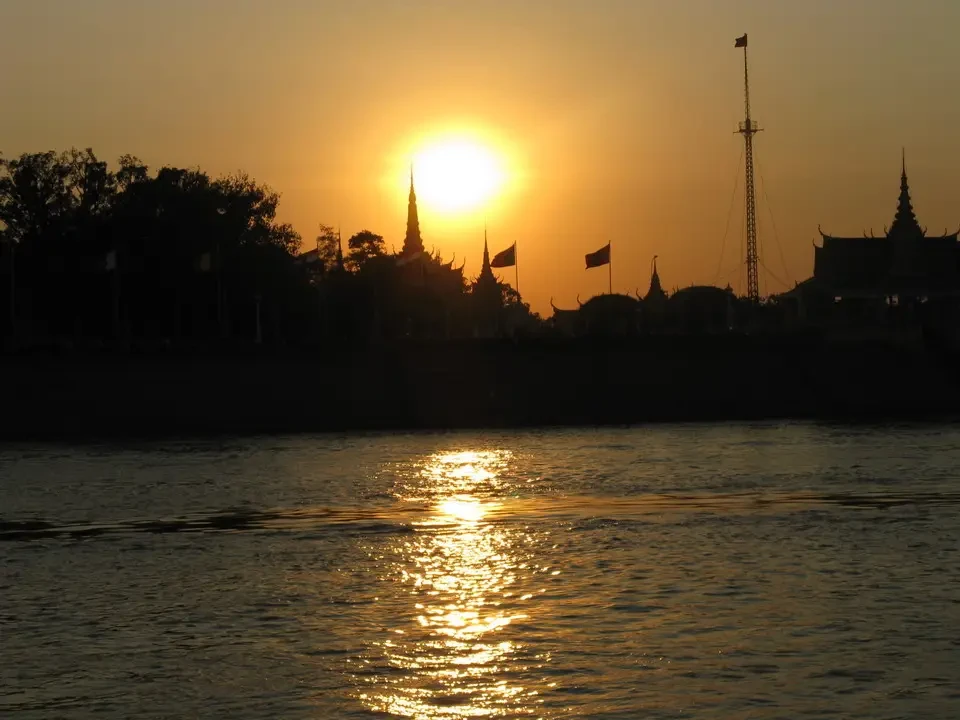
Changing completely tone, let's go see the sunset over the Mekong. With a boat, we take an hour-long tour on the river, which it allows us to see the ball of fire descend slowly behind the city and illuminate with warm colors the water of the large river.
We return for dinner, where we enjoy an amok, which we had already tasted the previous evening in Siem Reap: fish with a very flavorful sauce. This is followed by a walk in the city center, where it's hot but bearable; temperatures are still comparable to our best summer days. We get back into the tuk-tuk that was waiting for us and return to the hotel for our last night.