Day 13
Red Tsingy
Along the disastrous RN6 road, near the Tsingy Rouge and Ankarana sites.
Morning at Red Tsingy
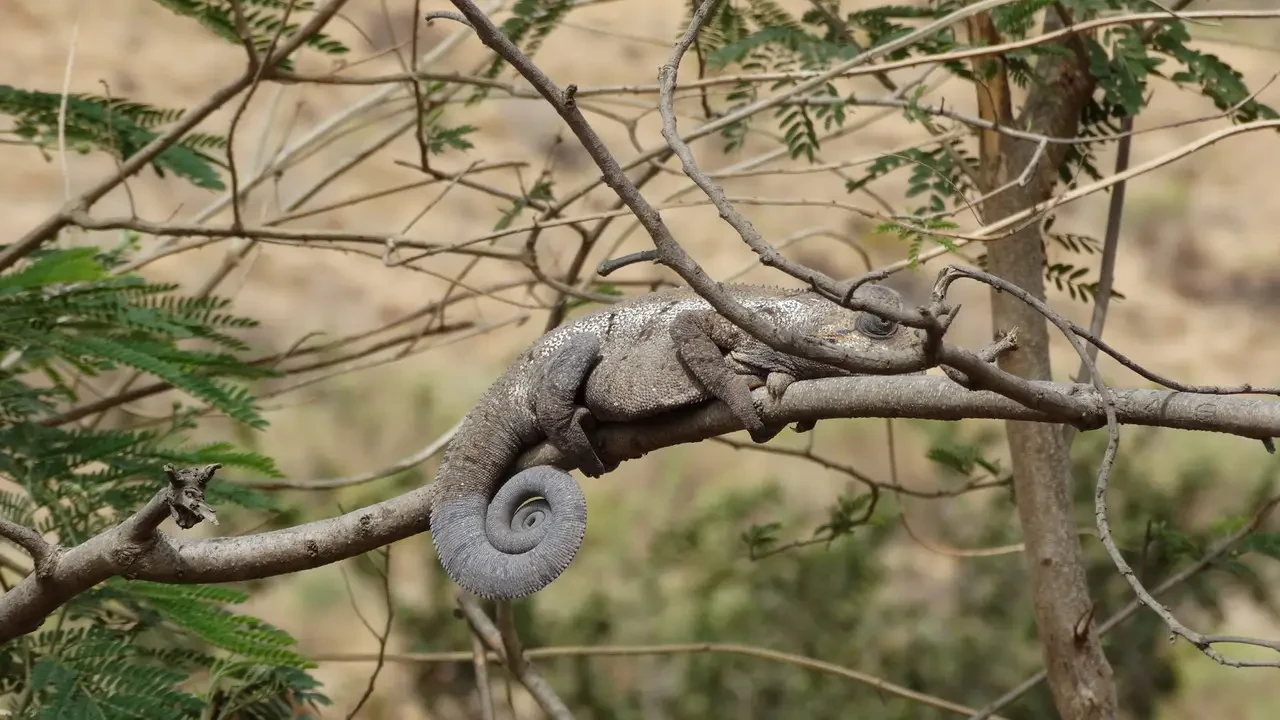
We are picked up at the camp by Taki at 7:30 after a good breakfast where we sample the corossol juice, a large green fruit almost like a pineapple, from which an excellent drink is extracted. We retrace the beautiful coastline of Baie des Français, 20 km long, which leads to Diego and then turns south along the RN6. This road, part of the Route Nationale, is quite basic, although it represents the only connection between the capital and the most important city in the north. In the opposite direction, vehicles of all kinds are arriving, loaded with an unbelievable amount of food intended for the market in Diego Suarez; the vendors arrive more or less every hour, and if they don't sell everything, they stay overnight and return when they have sold everything. We see a drongo, a black bird like a starling, which is known for its ability to mimic the calls of many animals, even the wolf, to scare away other competing birds. In two and a half hours, we arrived at the entrance to the beautiful dirt road in red earth that will take us to the view of the Red Tsingy.
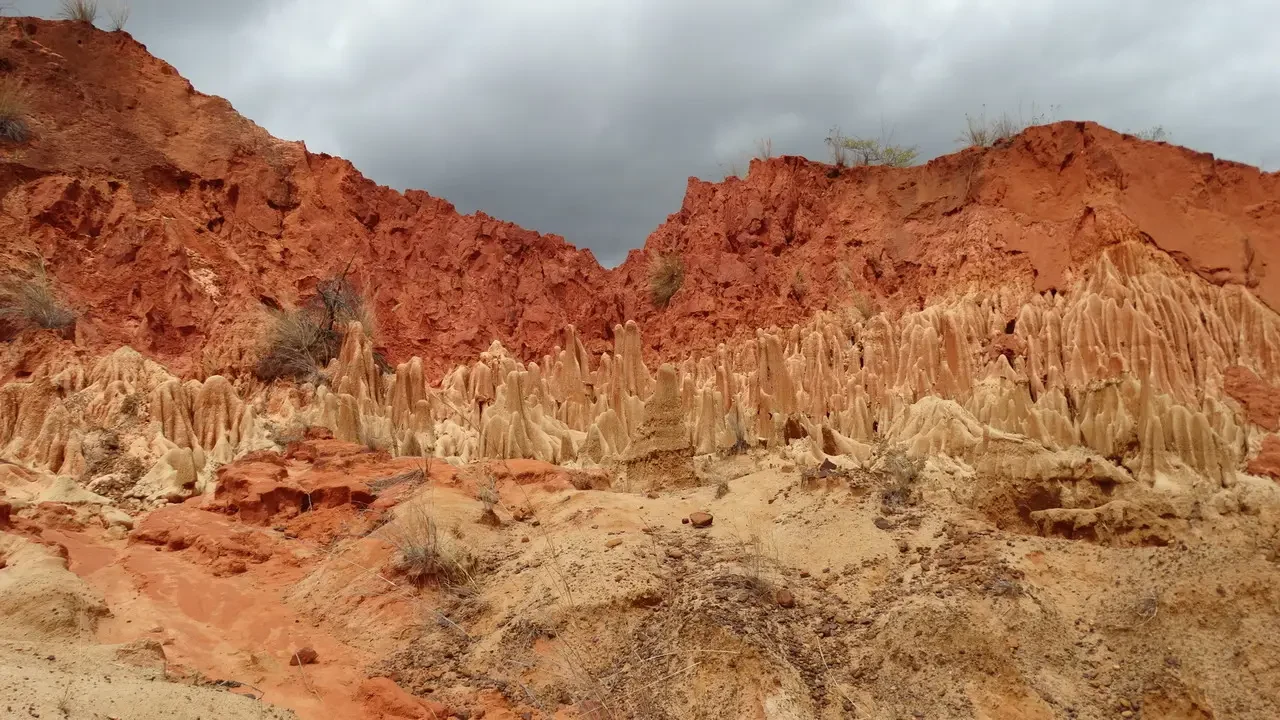
Museums and memory at Red Tsingy
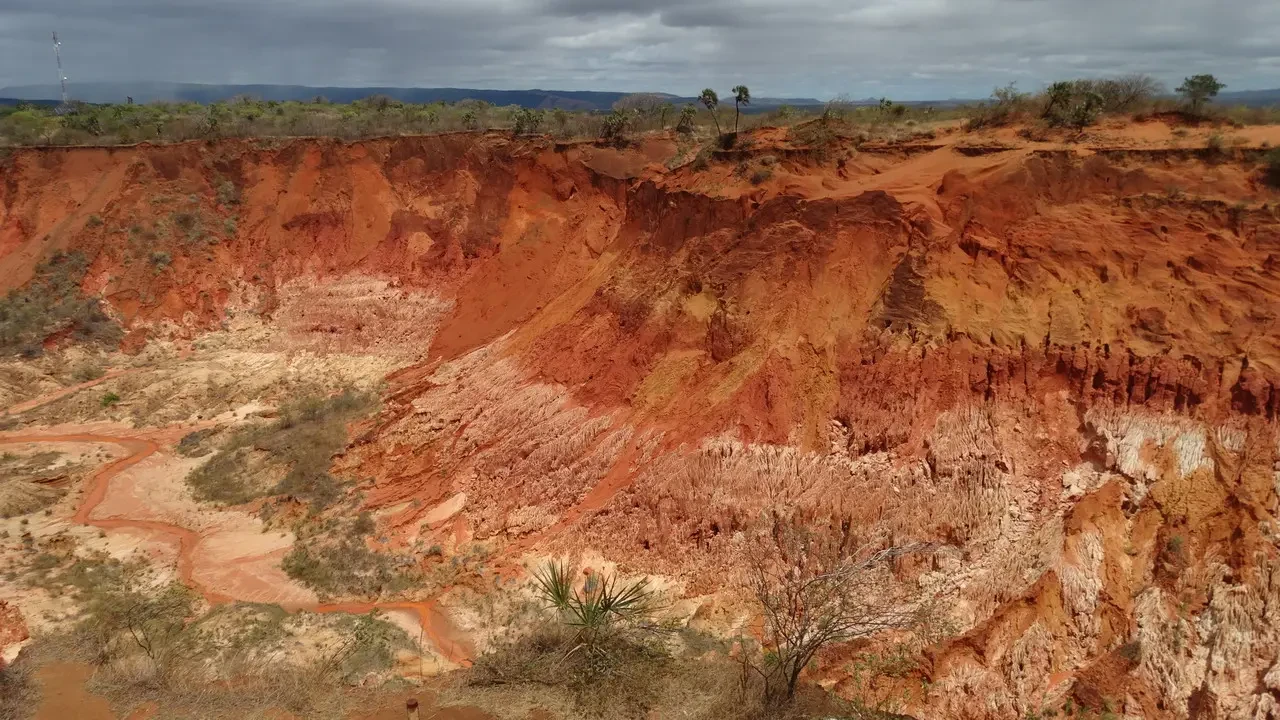
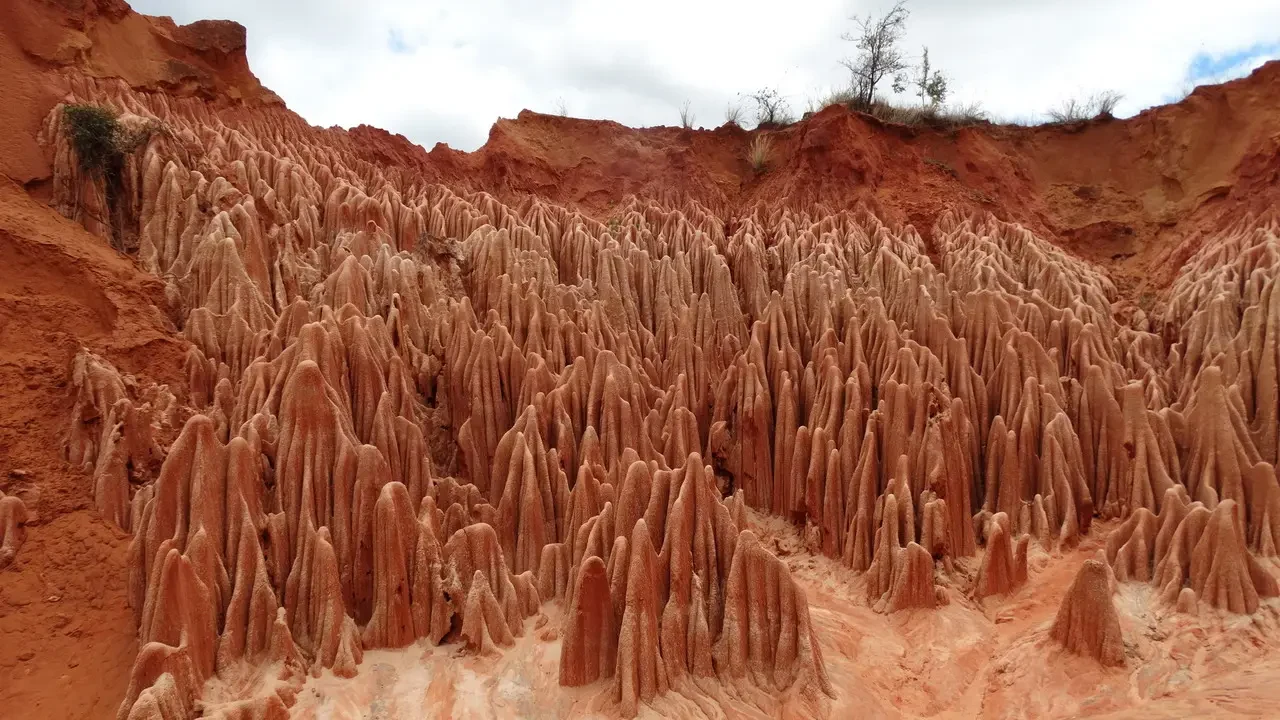
The sky is veiled by a layer of clouds that occasionally parts, revealing bright rays of sunshine, which will illuminate the peaks that nature has placed in this area. A true work of art; we wander along the paths as if we were among... museum hall. From time to time, the sunlight creates breathtaking displays of light and color. The term Tsingy – we will learn about them well at Ankarana – it means "to walk carefully" and comes from the fact that to cross them you had to move with great caution. It seems that they emerged no more than 25 years ago: the formation is very particular, as they are located inside other fragile rocks; when these dissolve due to erosion caused by atmospheric agents, the limestone peaks, which can be up to a couple of meters high, are revealed, appearing fragile enough to look like soil, but in reality they are much more resistant. Once the tour is finished, there are two other points to visit: the one that is called the Grand Canyon, a majestic opening in the plateau, with formations of Tsingy on its sides, and a another route in which I encounter another beautiful collection. These are less reddish, probably because there is less water, which contributes to the pigmentation. The soil higher up appears almost amethyst in color while the peaks range from intense orange to whitish. Here too, the zebus graze peacefully, ignoring the barriers erected by the park authority. Everything is well organized to avoid damaging the formations, with walkways and stairs; the same road is perfectly maintained with drainage channels for rainwater. In all, the two-hour tour will not involve more than a dozen people, which gives the visited environment a particular mystique. When midday has passed, we set off to retrieve the RN6 and head south again, stopping briefly at a small cafe called Snack 17, located within an unknown village. Here, we enjoy a light avocado salad with vinaigrette, but we cannot resist trying flambéed bananas. In addition to being already good in itself as a mature harvest from the plant, adding sugar cane syrup with a shot of rum until only the aroma remains makes everything particularly delicious. Children and chickens run around, making the atmosphere even more authentic.
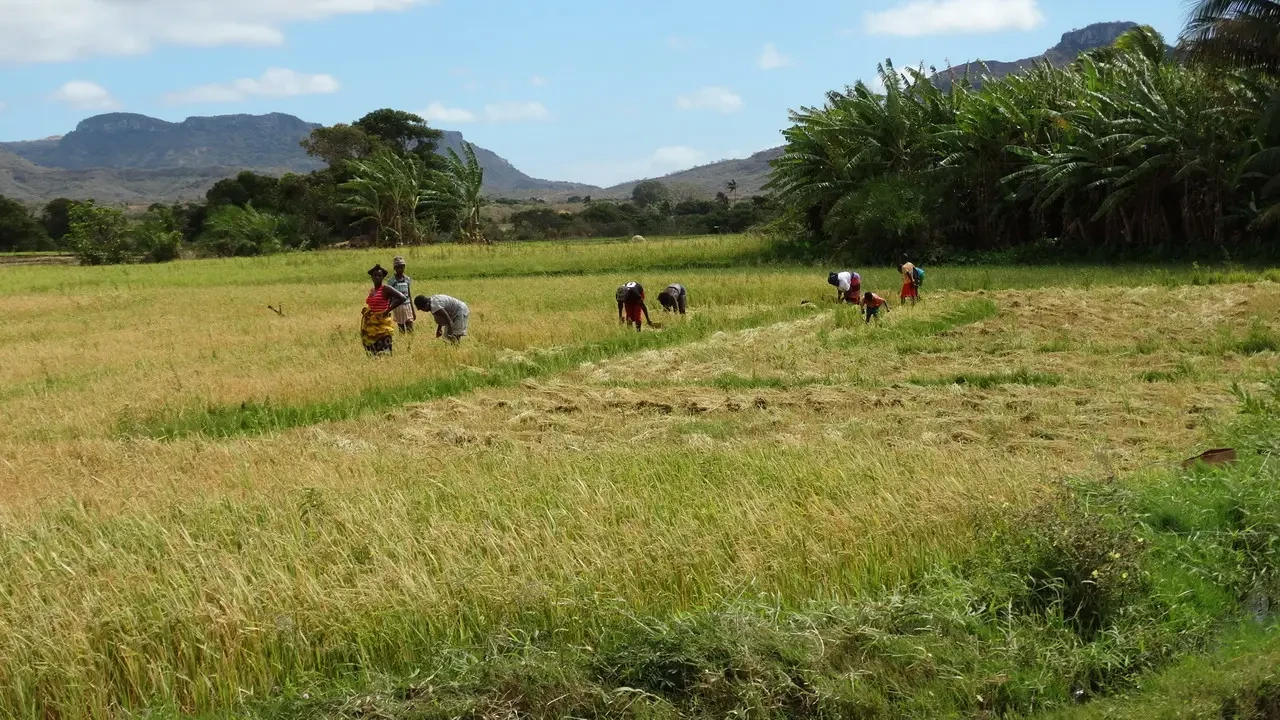
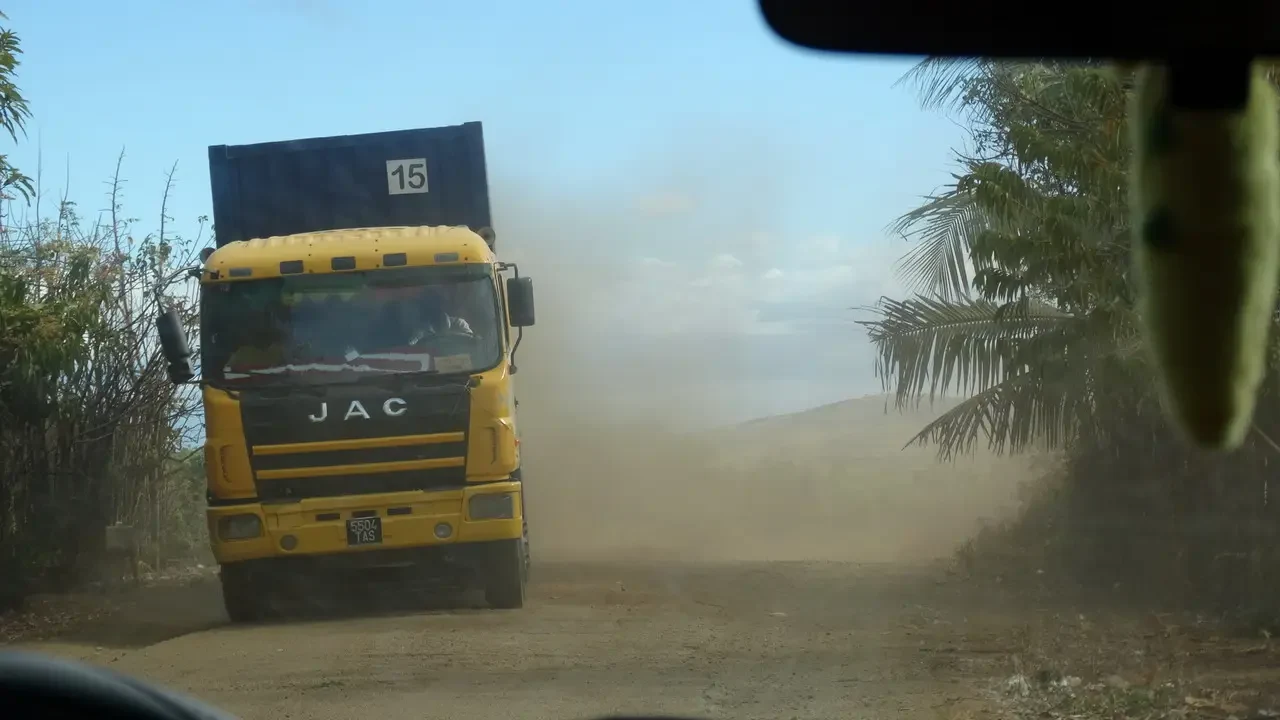
Another hour and a half of very poor road is needed to cover the meager 50 km that separate us from the Relais d’Ankarana, passing through potholes that seem like real craters. The asphalt is missing in several places, and vehicles are almost forced to stop, get out of the hole, and climb back up, being careful not to damage the tires at the point of fracture. A bridge has partially collapsed, where there is an opening. deep hole, a couple of meters deep and we move onto a very narrow lane, but there are no signs and therefore it is prohibited to get distracted. In this section we will find the only rainy moment During the entire trip, as timid drops begin to wet the thin and imperfect asphalt surface. It won't last long, even though we are heading south into an area where rain is a very rare phenomenon. In fact, the Mountains of Amber are a low mountain range that stretches for several dozen kilometers north-south and has its own microclimate due to the altitude with frequent rainfall throughout the year; this causes rivers and streams to branch off from its slopes towards the two seas surrounding it, the Mozambique Channel and the Indian Ocean. Near these waterways, irrigation becomes possible and therefore agriculture, while where one is forced to wait for the rainy season, life becomes more difficult, and thus poverty increases. And at this point, we start to see yellow jerry cans filled with water stacked near the increasingly rare streams, with people carrying them home in every way possible. Further on, only dry beehives remain. In the area where the positive influence of Amber is felt, rice cultivation is common, reaching two harvests; further south, hunger forces people to burn grasslands and scrubland in the hope of getting a little grass that can at least feed the goats; it's difficult to give ecological advice to someone who is hungry. As we continue, the presence of goats becomes increasingly rare, replaced by easier-to-raise chickens. Even though the child population remains decidedly high, the feeling is that the incidence is lower than in the south, especially because they are less insistent when asking for help, they approach and show an unusual kindness elsewhere. We stop to take a photo at a large tree that produces white snowflakes It also represents a substitute for cotton, used for mattresses and pillows, etc., and we also see pistachio cultivation. Finally, we pass through a couple of villages whose main activity is the extraction of sapphires; we are not in Ilakaka, but it seems that the gems are readily available. Under a blue sky, we reach the Relais d'Ankarana, owned by a friendly gentleman of age, who welcomes us with spontaneous kindness that alone deserves 5 stars on TripAdvisor. The bungalow is nice, suitable for the challenges imposed by nature. We try to minimize water usage and remember to charge our batteries when there is power from a generator: after 10 pm, there is a blackout. He informs us that there is no Wi-Fi and seems relieved when we say that this is not a critical necessity; conversely, he says that he has met people who don't stay in this beautiful paradise just for the lack of vital connection.
The sun is setting, so we take the opportunity to go for a walk along the highway and see some everyday life; the traffic is limited and not very fast. Everyone must fill the potholes and in particular the truck They can't afford to damage the goods they are transporting, and also try to preserve the mechanics. There are already too many on the roadside waiting to be repaired or with a mechanic emerging from underneath in search of the problem. In fact, in case of breakdown, you need to call a mechanic from Diego or Ambilobé. The peak comes when we see a taxi that was parked in a very congested area... which assures us that we will be there for three weeks; tomorrow we will find someone who is taking care of it, perhaps the spare parts have arrived. However, the President has made a vague promise: next year, work on renovating the road will begin. To balance this out, we hear the saying that politicians' promises are only binding to those who believe them. If we continue with this sentiment, the logical conclusion is that everywhere is the same. During our walk of two and a half kilometers to and from Ambilobè, we see how life develops along the road; the village stretches out in length, and identifying its center is quite difficult, but it can be inferred from the intense presence of stalls. However, in reality, the center and the periphery here are one and the same. We see artisans hammering on granite stones until they crumble and become usable as building material: the problem is that workers sitting down end up breathing in the dust raised, which, combined with the dry climate, makes working conditions decidedly unhealthy, and we are assured that respiratory diseases are very common, and consequently, life expectancy is short. The sun sets on the bamboo shacks without making them any more beautiful; however, the children who run around smiling in a permanent celebration are beautiful. Some of them work according to a practice where everyone must contribute to feeding themselves. Meeting people is pleasant; we greet each other in a form of respect that is no longer known in our latitudes. In the north, we observe how the clothes are particularly refined, with very bright colors worn by women and often with an original cut that highlights their already considerable beauty, especially those with turbans coordinated in pastel tones. We appreciate how the modest lifestyle does not negatively affect clothing. The sun has now set; trucks and taxis continue to slalom at a walking pace on the Route National, so much so that we sometimes realize that we are moving faster on foot.


The construction types vary from village to village depending on the materials available: sometimes raffia is used, which are the stiff leaves of a palm tree, and with which both the roof and the walls are built; in other cases, the roof is made of dried grass that lasts for about three years. If bamboo is present, it can be used to build, and it can last up to seven years.
Upon returning, we have a chat with the manager, from whom we will learn a great deal. There is a serenity that is rarely found in human nature, even though his words certainly do not convey trust or optimism: he speaks of the potential that the country has, if only it could harness them. From one perspective, that of the people from the north, colonization contributed to bringing a minimum of equality, as in the 19th century, the Merina dominance had only led to the submission of local tribes. They also built the few infrastructure that still exist today. Finally, he admits with bitterness that the Malagasy have not been able to recover, so much so that Madagascar is forced to import rice from Asian countries due to political interests, while there are all the conditions for cultivation locally; until just a few decades ago (with an even smaller population), the country was self-sufficient. There is a vicious cycle that prevents development: a clear example comes from rice, which is often harvested only once when it could be twice, the first to feed families and the second to sell. This means moving to sell it and being away for several days due to poor road conditions, which makes everything economically unviable. The politics and corruption that this brings with it obviously play a role, but there is a distorted mindset and the division into tribes contribute to preventing economic development. The collusion between administrators and foreign powers (especially France), who are interested in keeping the country in a state of social and economic humility, gives the final blow.
The sky is getting darker and the moon rises with a completely unusual shape for us: we discover that in the southern hemisphere, the new moon is perfectly horizontal, without the inclination with which we are used to seeing it and depicting it: Pierrot would be lying down peacefully, while the moon appears with a perfect smile.
Every night we spent in Madagascar, we slept in beds with mosquito nets, which is essential during certain seasons and a pleasant addition during this dry period. We occasionally see mosquitoes flying around, although they shouldn't carry malaria, so we are very careful not to get bitten.
The night passes relatively quietly; the camp is not far from the road, but vehicles cannot speed through; you can hear trucks rumbling and clattering up and down in the potholes, while the fainter hum of taxis suggests a slightly higher speed. We were also woken up by almost demonic screams, probably caused by a girl who had overindulged in rum.
In the north, the Famadihana tradition is not practiced. When someone from the south or Tana dies, the body is taken home This can only happen on certain days and after being preserved in formaldehyde. It is then loaded together with the luggage on the roof of the minibus and returned by family members along the difficult roads of this country, which require more than 24 hours of continuous travel, even up to Tana. This covers a distance of 1200 km, of which the first 400 are here in the north, along routes where one often has to walk. To cover the 450 km separating Diego from Sambava, trucks take three days, and during the rainy season, they cannot always go. Reaching Ambilobe, just 25 km from our overnight stay, requires a crossing: two years ago, the bridge was destroyed by a cyclone, and its reconstruction is still pending, so one must get down to the water level and cross it, which is impossible during the flood months. In this case, a small boat is taken across to the other side, and from there you need to take a tuk-tuk or taxi. In short, what should be a short journey becomes a real adventure.