

Day 5
Central highlands
Market and crafts in Antsirabe and Ambositra, then enter the rainforest.
Morning in the Central Highlands
Wake up at 6.30 and after a good breakfast, we immediately went to explore the Saboty market, which in Malagasy means Saturday and is about 2.5 km from the hotel. We were lucky to be here on the right day. The sky is overcast but will clear up around 8 am when the sun will win out over the mist. We take a tuk-tuk driven by the friendly Pascal (who will also wait for us at the exit to bring us back) to the entrance, and then we wander aimlessly, paying attention to the displayed products, to see how much is similar and different compared to our markets. On the subject of similarities, it's definitely worth noting the vegetables: carrots, zucchini, eggplant, various salads and a lot of onions, tomatoes and peas. In many cases, the vegetables are displayed already cleaned and cut, ready for use in the kitchen. The ravitoto It is extracted from manioc leaves, already prepared and displayed nicely in a container. The butchers' stalls are characteristic, with many internal organs and even the skin of zebras on display, as well as zebra and pig meat. There is also the area for live poultry and... pasta... on the stalls, there are piles of fresh pasta ready to be thrown into the water. Passing by, we see stalls full of bicycle parts. The people we meet have sad, almost resigned looks, except for a few who greet us cordially in the morning. We are the only white people here, and we are particularly alert because the market does not have a particularly good reputation. We hope that the bad guys are still asleep, and it will probably be so. To be honest, we don't even sense any risk; we walk carefully, curious to see all these original and interesting products, while the vendors are also curious to see us. It surprises us and gives us a sense of where we are, seeing stalls selling empty plastic bottles and scrap metal ready to be cut and used in every household setting. Others sell second-hand clothing from wealthy countries. We leave with Pascal towards the hotel, where we check out and begin our new day after this first experience. As we return, we are amazed by the strength of this man's legs, the real engine of the vehicle, two pistons that can move themselves (and even without shoes) with two passengers. It must be his job that gives him exercise, or perhaps he is just old, but probably he is still young. Before leaving Antsirabe, we take a walk in the former colonial area, where there are villas that were once highly appreciated: now the gardens are full of weeds and there is no sign of maintenance. The town is particularly large, as it is not far from Tana (about 170 km), and people chose this charming location rather than the chaos of the capital. A roundabout in its center has a memorial plaque commemorating the independence achieved in 1960, while on another one stands a tall obelisk with the symbols of the 18 tribes of Madagascar.

With a more tourist-oriented but undeniably culturally rich perspective, we also visit Chez Mamy, an artisan specializing in the production of souvenirs (bicycles, rickshaws and small scooters) made from recycled materials. It's fascinating to see with what skill he cuts a piece of metal, bends it, and covers it with a tube for intravenous use, then creates a bicycle, adding the spokes with fishing line and using a spring as a pivot. Afterwards, we observe the processing of… ram's horns: the horn is cooked, the soft inner part is extracted and then processed for various purposes (decorative or everyday use). In a nearby workshop, musical instruments are produced, including a type of harp (the valiha) with strings around a bamboo stick; it's played by resting one end against the wall in front of the player.
We leave the city and after a few dozen kilometers, along the road we encounter a group of people in a festive mood in the courtyard of a house: they are celebrating the ritual of fahamadiana, the turning over of bones. Our driver manages to be introduced to the family, who provide us with some explanations. Not being particularly inclined towards macabre things, we don't mind learning that the dearly departed, exhumed and reburied shortly before, was returned to his grave. The relatives and friends continue to celebrate with loud music and many faces are clearly under the influence of rum, accompanied by rice and zebus meat. Along the way, we will also see the signs of various cults calling for help, salvation, apocalypse, etc., taking advantage of people's gullibility and probably enriching themselves in the face of such poverty.

When the morning is almost over, we take the road to Ambositra (pronounced Ambush), in decent conditions, along soft clay hills that promote brick production. When we arrive, it's lunchtime and we find ourselves at a tourist restaurant with other pale-faced people we have seen during this trip. We appreciate the finely carved wooden bungalows: the food is good, but the atmosphere is slightly less appealing, worsened by a group of singers and dancers entertaining the diners between courses. It might suit many, but it's not our kind of environment. A short walk uphill and we are in the center, on a hill, where the impressive Cathedral, erected in a grand style, probably to demonstrate to the simple minds of the locals that the greater the symbol, the greater the power of God. It stands quite prominently alongside the uncertain huts seen here and perhaps does not represent exactly what is read in the Bible, moreover, it is also not in harmony with the requests for alms for poor countries that we hear during religious rituals at our latitudes. Ambositra should be noted as the center of wood craftsmanship, and there are many shops offering all kinds of objects: from tourist souvenirs to those for discerning buyers who have come this far to choose competently how to furnish their homes. In a religious context, there are some fantastic nativity scenes made of rosewood or other pieces in palissandro. It is Saturday, the day of weddings: we see two processions with many guests crammed into unbelievable ways on buses or trucks equipped with benches.
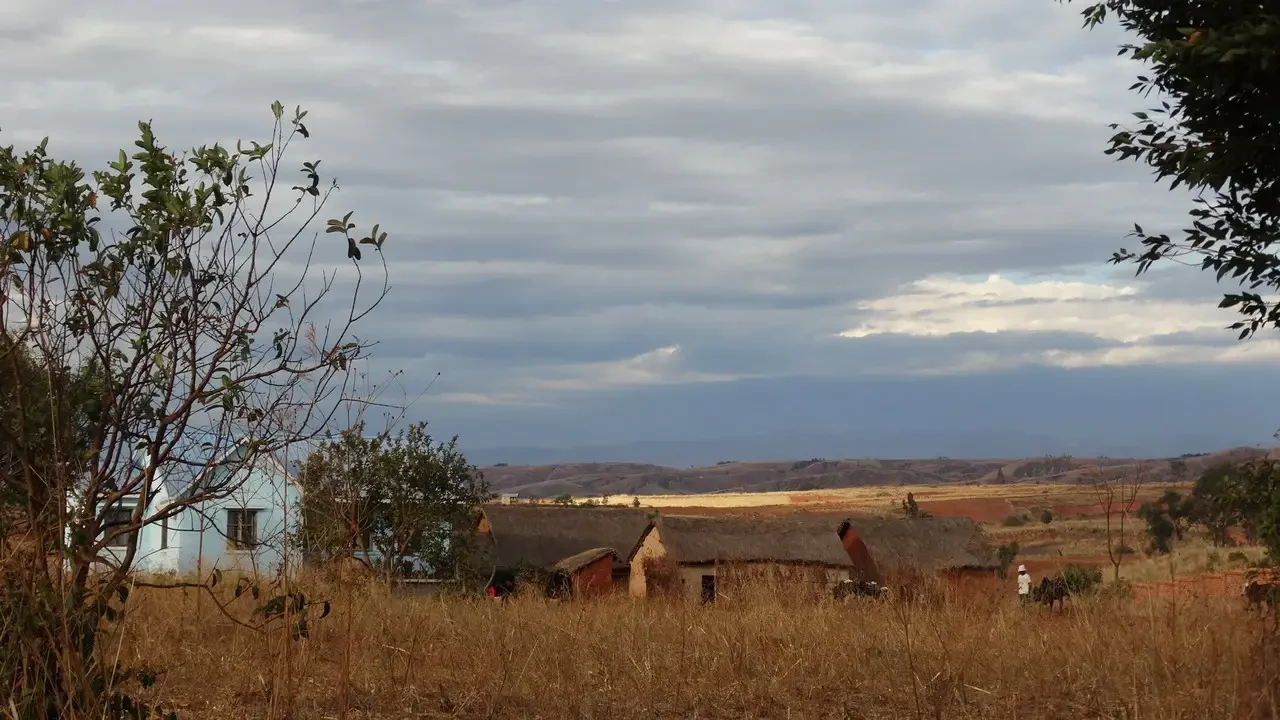
We continue our journey descending into a wide valley, where there are intensive agricultural areas, in an environment that is generally characterized by an acceptable standard of living. We can see eucalyptus trees, imported from France two centuries ago for use as fuel in steam trains. Along many stretches, the road is bordered by mimosas. balconies They cultivate rice during the wet season, while in the dry season, they grow it on the same terraces. vegetables. In other cases, it is possible to harvest twice: the first crop is planted in July/August and harvested in November, allowing for replanting thanks to the rapid growth provided by the humid season. The rice paddies also occupy the lower part of the area, while around them rise Terraced gardens. Once there was forest here, the arrival of humans brought fire, destroying the trees and leaving space for cultivation. And the forest continues to be burned in search of new arable land, given the scarce possibilities of obtaining fertilizers. Along the road from Ambositra to Ranomafana, we will see many fires, which should not be confused with the equally frequent fumaroles of the charcoal pits; these also burn wood but for a different purpose.
It's almost 6 pm and the sun has just set when we arrive at Ranomafana, at the meeting point where we will observe nocturnal wildlife. So far, we haven't been bored, admiring the alternation of cultivated hills with others covered in a green carpet as we move eastward. Ranomafana is a rainforest area, and this is immediately evident from the raindrops while we watch small nocturnal lemurs. ran, different chameleons Angelin, our nature guide for today and tomorrow, helps us distinguish them in their stunning camouflage. It's a decidedly humid environment, very different from Ambositra. Around 7 pm we reach our evening destination in the village: the accommodation is cold in every sense, food and service are not up to par, and we can consider it the worst part of the trip, especially because the main course is characterized more by the presence of bones than meat. The bungalows are not bad, well-spaced along a lush garden and caressed by the sound of the stream that flows just a short distance away. We settle in for the night and hear the constant rain fall, and it will remain until we wake up. Sleeping with the sound of the rain is far from unpleasant, but if the next day brings a visit to one of Madagascar's most beautiful parks, then it's easy to understand how sleep might be disturbed by some apprehension.


