

Day 2
Morondava
Immediately towards the western coast: Morondava and Kirindi
Morning in Morondava
A delightful breakfast in a Franco-Malagasy style allows us to start the day right: dried grapes and homemade yogurt are particularly noteworthy, accompanied by other dishes that are less traditional but equally delicious. While we haven't had to adjust to different time zones, the flight is still a long one, and our bodies need rest. In Tana, we had planned to stay for only a short time, so today is the only opportunity we have to spend a couple of hours taking a quick tour around the hills that surround it. We immediately head to... upper town... so to the Queen's Palace, which was burned down in 1985 and is currently undergoing slow reconstruction: you can visit it, although the fire has left very little inside to see. We pass by the Ministry of Defence, at Andoha'lo Cathedral ...and to the oldest Protestant church in the capital. The city is buzzing with activity, and there are many ongoing projects, cleaning and reorganization efforts in preparation for the imminent arrival of the Pope, scheduled for the day of our departure. The Lake Anosy Located at the base of the historic center would be an excellent area for relaxation, provided it was kept clean and tidy. We passed by the stadium where the Barea play, the national football team that reached the quarter-finals of the Africa Cup just a few months ago. This was the first time Madagascar had participated in the tournament, and achieving such a good result led to a strong sense of national unity, which the country desperately needed. Traffic was blocked upon the players' return, causing widespread excitement. They are not professional players, except for those who play in the French or Belgian Second League. The only sport in which Madagascar has won a world championship is pétanque (boules). This clearly has a French origin, and it can be seen being played in various places during spare moments. After all, the equipment doesn't require much, and if the field is not perfectly flat, the game becomes even more exciting. Another sport where Malagasy people excel is rugby, but this is at a national level only.
In Tanà, energy is mainly produced thanks to hydroelectric power from the surrounding dams: however, power outages or scheduled restrictions are not uncommon.
As you move further along the avenues, you enter the heart of the popular areas, which are characterized by markets along the road and, shortly thereafter, by the first rice paddies where it's not uncommon to see farmers wading up to their knees to remove the grass. All of this happens in areas where industrial zones are found in our cities: it's difficult not to express an opinion on this point. Just a short distance away, workers are building a section of road and they have brushes with white and red paint, and wooden signs are being made on the spot to indicate the detour. There are many jobs, often sponsored by Chinese companies. We continue towards Ivato Airport, along rice paddies that we could almost call urban. The atmosphere is busy, with people working in the fields or at the markets. Poverty can be perceived even from the window of a car. Some roads leading to the airport are already closed in preparation for the Pope's arrival.
Flight TNR – MOQ 12:20 – 13:20
With a air jump We arrive after about an hour. Morondava, located along a dry coastline that opens onto the Mozambique Channel. The landscape during the flight is also arid and flat, with the classic reddish color that characterizes the country. In town, it's 29 degrees, which is more than acceptable. We get to know our driver/guide (Huby), who will accompany us flawlessly for the next few days and beyond. Our curiosity will bombard him with questions, "whys," as if we were children trying to understand this world. The only difference is that we are not children, but our desire to understand Madagascar is strong, and Huby will prove to be an essential contribution, a key to unlocking the soul of this country.

Arrival in Morondava
We are on the sea., sitting at a small restaurant with views of the fishermen arriving from the sea, we take advantage of this to have our first lunch with grilled fish and zebù stew (a typical local meat dish seasoned with a manioc leaf pesto), continuing immediately afterwards north in a 4x4 for about two hours towards the Marofandilia reserve. We cross the Allée des Baobabs that we will have the opportunity to admire tomorrow evening at sunset, our first meeting with the multitude of children begging for money (this topic is discussed more broadly in the general section), many of whom have the typical prominent belly, a clear sign of malnutrition, especially in the most touristy area of the country; adults are walking along the road, carrying with them what little they had managed to collect in the forest: branches and some weeds to start a fire; we don't really know what we can put on it for tonight's dinner. We are truly at the dawn of civilization, when gathering people depended entirely on what the surrounding nature was able to offer them. When we see the forests being burned, according to the ancestral technique of "burn and slash" or "debbio" in Italian, to obtain new arable land, we will have definitive confirmation of the concept. Here it is not about making environmental considerations, but about establishing the level of human development achieved by the local populations. In principle, burning is prohibited, however, people continue with this safe practice without consequences, motivated by immediate needs. women are presenting a face covered from a muddy area that we will discover is a cream made from squeezing the bark of a tree and used to make the skin softer. The carriages are rare; we mostly encounter pedestrians, as well as people on bicycles or struggling to pull handcarts through the dirt. women are walking along the road, with a basin of freshly washed clothes at the river: it's an art to keep a heavy and bulky object on your head with so much balance. The forest is dry; we are in the deciduous tropical forest and it is the dry season, which they might call their winter, when everything rests.
The government has built some wells In this area so lacking in water, where a bucket of about fifteen liters costs 300 Ariary (7 cents), the cost of water is very high. A family needs approximately five buckets a day, but many cannot afford it. Life here is lived on the road; the house is simply considered a place to sleep, making it less important.


Camp Amoureux
We will see charcoal production sites throughout the country, where residents burn wood under a layer of earth to produce lightweight and easily transportable charcoal. We can also observe small plumes of smoke rising, accompanied by the characteristic pungent smell.
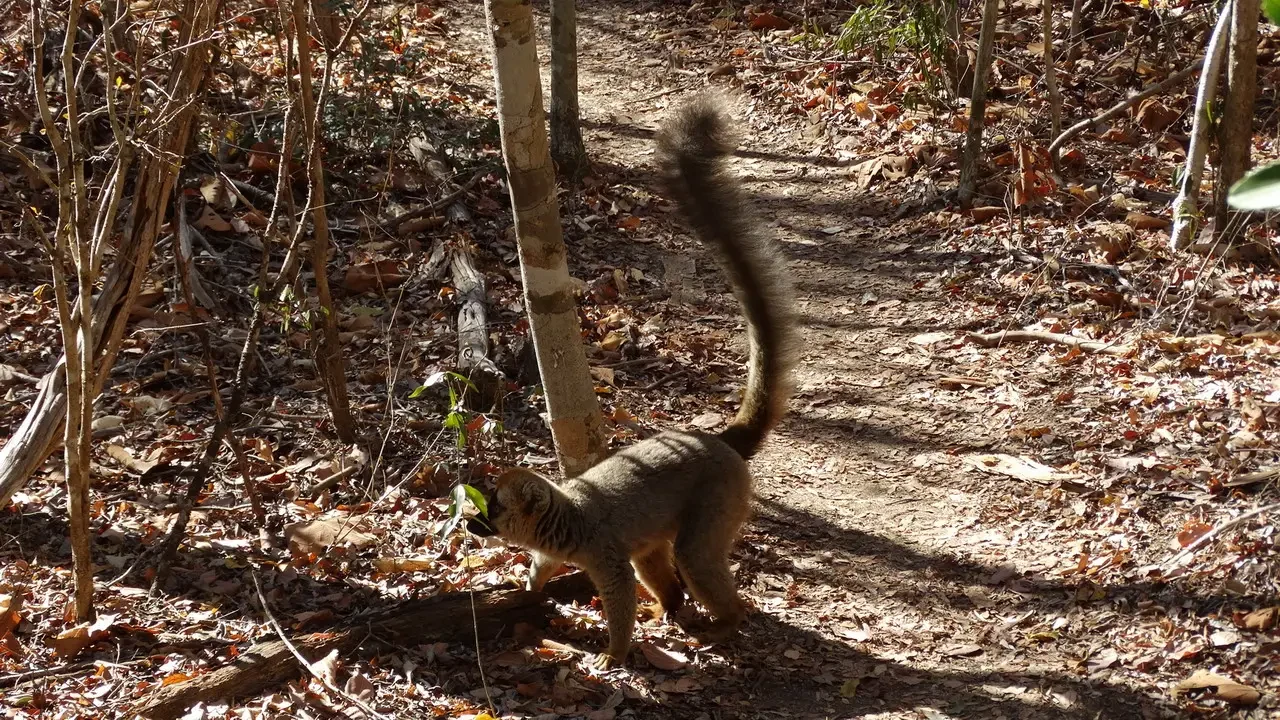
With a few bumps due to the numerous potholes, we reached our accommodation at the Camp Amoureux, named after two baobab trees ( Baobab lover) embraced in a cyclopean hug. The tent is spacious with an attached bathroom built into the structure, meaning there's only one wall separating it from the forest; the toilet overlooks the woods directly. But we are not in a downtown area, so we prioritize lemurs over anything else. The water that flows into the sink is stored in a container just above, which explains why we need to use it sparingly. The camp is located in a forest stripped bare by the dry season. Baobabs and evergreens stand out, alternating between enormous and slender trunks, all designed to share the limited available water. In just a few hours, we have gone from the chaos of the capital to this secluded corner of tranquility. A great improvement, which we appreciate even more when it gets dark and we observe the nocturnal nature around us. With a local guide, we explore the trails that lead deep into the forest, making our first contact with the fauna of Madagascar. Given the time of day, we first encounter the night lemurs, small and elusive, sometimes like mice. They are the Madame Berthe, Sportive Lemur, and a couple of other species. We also encounter birds, some reptiles, spiders (some venomous ones that nest under the bark of dead trees), and holes where boas sleep during this time, discovering how the jungle is particularly lively when darkness falls.
In Madagascar, it is possible to observe three types of forests: the thorny forest in the southern area, the deciduous forest in the western part, and the tropical rainforest in the northern and eastern parts.
We return to camp For dinner, the meal was served with great care, considering the circumstances of our location.


