Day 14
Ankarana National Park
Ankarana National Park with the grey tsingy and back on the R6 road.
Morning at Ankarana National Park
After seeing the sun set around 5:45 yesterday, this morning we enjoy watching the sunrise just before 6 am; as a result, the stages of life are earlier than the usual times we consider. Meeting at 7:30 to visit the Tsingy of Ankarana National Park We immediately met our guide, Mohammed, and agreed on a visit that would take us to see some sites during the morning, until 1 PM. Here too, the term "Tsingy" means "to walk carefully". Immediately after...
Bat Cave, to admire it in its natural state and appreciate the quietness: we are alone, and this gives it a certain mystique. To reach it, you need to descend a long staircase carved into the earth, pass by the enormous wall that overhangs it, and enter the darkness of the cave, lighting the candles and passing through a narrow passage that forces us to walk crouching due to the presence of the wall. As soon as we point the torches upwards, we see an enormous amount of bats hanging from the ceiling, almost making it appear black. We listen to what the silence has to say, imagining how such a hidden place could have protected the Antakarana tribes during the Merinas conquest. We move to a crossroads of rivers that are currently dry, where nature has created a funnel-like structure called Perte des Rivieres Here, the waters from various directions are discharged as if it were a huge sink, which often fails to drain the strong flow, creating floods that force the park to close. The site has been closed for several years in the area of Lake Vert, where sapphires have been found: the official reason is the safety of visitors, as the people who frequent the area are not particularly desirable. However, we are more inclined to believe that they do not want curious onlookers in the extraction zone, where business deals take place. In fact, the outlet for the water from the rivers is not very large, and we wonder what would happen if one of the large boulders fell partially blocking the opening. It's quite strange that the waters sink and research has shown that they flow into the Mozambique Channel, about 60 km away, under the sea.
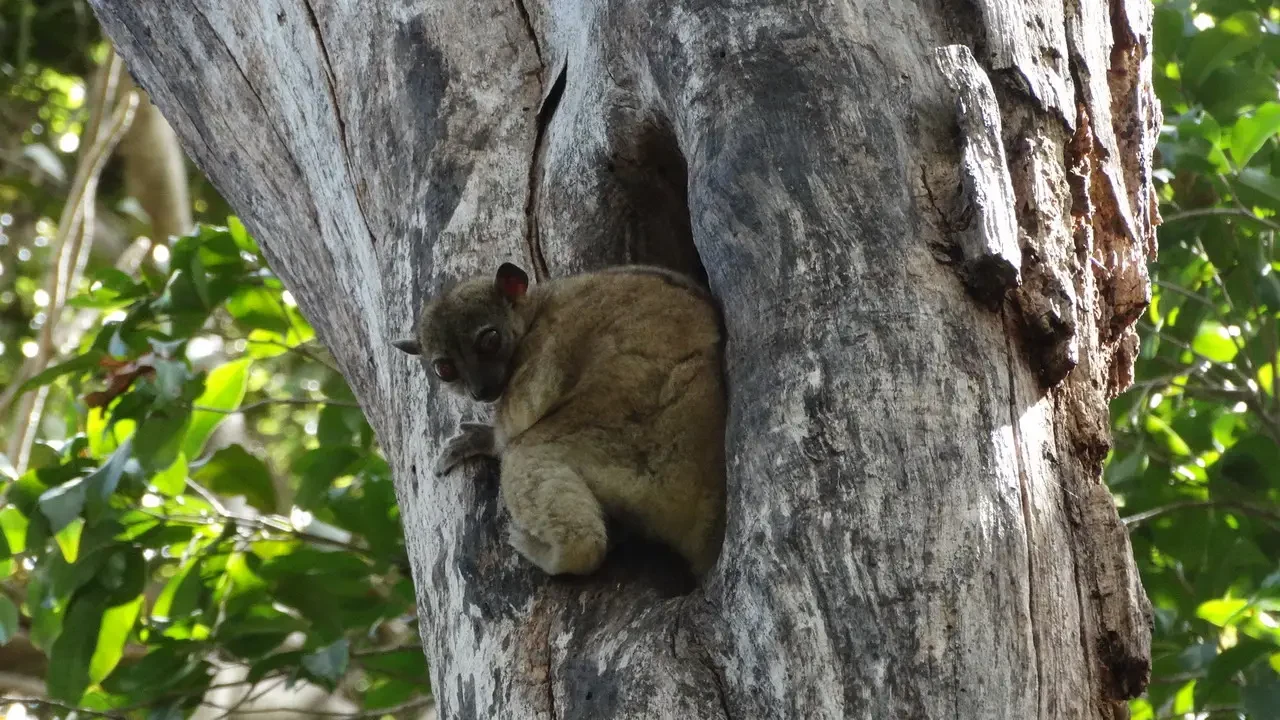
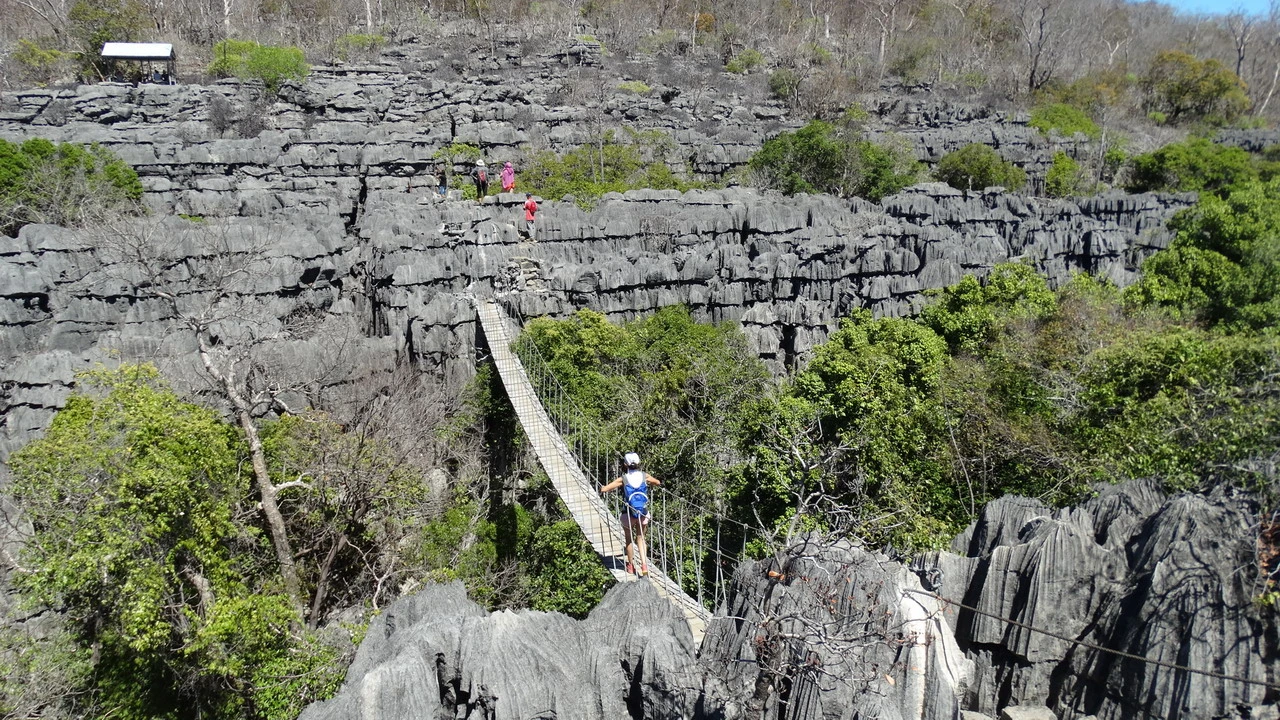
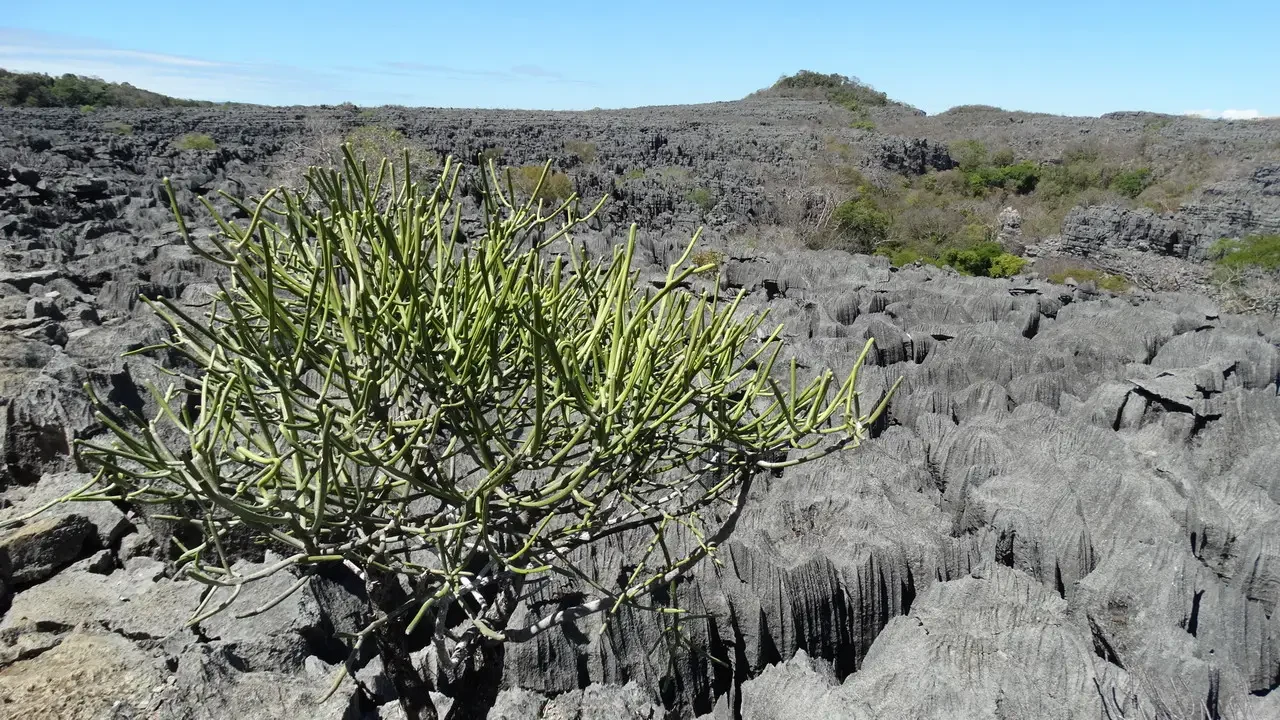
A walk where we occasionally encounter a small lemur lying in the hollow of a trunk, and here we are facing the main attraction of the park, namely the grey tsings, sharp-pointed stone formations that appear to have been deliberately placed sharpened by a handyman to cut through. We cross two suspension bridges to reach an observation point. Although they resemble each other in some ways, they are extremely different from the red tsingy seen yesterday; these appear as solidified earth, while these are symbols of hardness and are definitely sharp. It is difficult to imagine how, during the Merina conquest war, the warriors of the local tribes were able to escape in such a hostile environment on foot. Two distinct morphologies coexist here: the rock is limestone, consisting of sediments that emerged from the sea approximately 150 million years ago, when Madagascar and India separated from Gondwana, and even seashells can be seen. Nearby, sometimes right next to each other, the yellowish-gray limestone mixes with the black basalt rocks, a result of ancient eruptions in the Amber Mountains area. Thanks to the limestone rock, hundreds of caves have formed around the tsingy expanses. Horizontal sedimentary faults are noticeable, while vertical ones are due to ground movements. The origin of the tsingy is linked to the action of wind on the limestone rock, but we are led to believe that there are more complex reasons that contributed to forming such particular and sharp shapes at the same time. There are four types of forest in the park: deciduous, evergreen, a dense undergrowth mainly consisting of shrubs, and baobab forest, which sometimes take very fanciful forms. Many hard, precious wood palissades can also be found. There are eleven species of lemurs, 3 of which are diurnal, with fossa and boa as their natural enemies, which are not dangerous to humans. Walking on flat ground inside the forest is pleasant; however, when you step out into the sun, the heat in the tsingy area tends to burn upon contact with the skin. We return to taste a refreshing Fantananas (a delicious pineapple-flavored drink) and continue our four-hour journey towards Diego and then Ramena.
We stop in the city to buy vanilla, a valuable resource of the north, especially from the nearby Sambava region. It can be found almost exclusively on one street (Rue Colbert), sold by street vendors. You need to negotiate and try to find the best quality: it should be the one that bends easily and whose pod is no wider than your little finger. They are available in various vacuum-sealed formats, and the prices are quite high: we will spend 55€ for about 300 grams of this precious pod.
By exchanging a few words with the locals, we discovered that a waitress earns approximately 200,000 Ar. per month (equivalent to about 50€), while a teacher earns around 60/70€. Finding work doesn't seem very difficult; the main challenge is finding a decent salary that allows one to live with an acceptable standard of living. The cost of living in Diego is lower than in Ramena: here, rent costs very little (the equivalent of 10€), but the accommodation is extremely basic, there is running water and it's free, electricity must be paid separately, and there are no toilets; you go to the bush for bathroom breaks.
Dinner at the campsite and a quiet evening under the strong wind blowing from the bay.