Day 7
Yazd II
Exploring Yazd. Mosques, bazaar, museums and meeting with Zoroastrian culture.
The urban face of Yazd
We are fortunate (especially for locals) to experience one of the few rains that Yazd receives each year, so our guide informs us that the Free Walking Tour will start at 10 am instead of 9 am, allowing us to walk around the city without an umbrella. Indeed, when we arrive, it has stopped raining and a cool, strong wind keeps us company. This event started around 5 pm, with puddles everywhere, further confirming that these rains are quite rare. Apart from the photos that would have required a cobalt background, walking is significantly easier, and fatigue feels less intense in the absence of the usual stifling heat. We also discover how the clarity of the buildings often contrasts well with the dark sky. In the afternoon, it will clear up again without extreme temperatures. One wonders how life should flow slowly during the hottest moments.
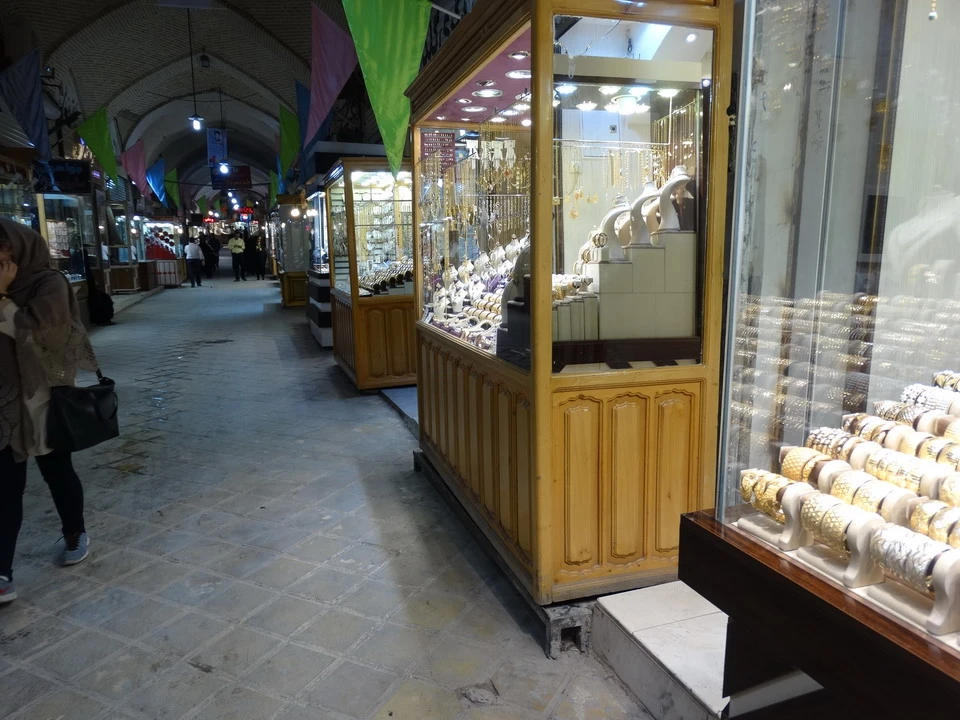
We take advantage of the early morning hours to visit the Water Museum, useful for understanding how the Qanat system works. The nearby mountains are the reason for the settlement, providing a water source originating from snowmelt that ensured sufficient water for survival. When the rain stops and the sky clears, we can see the snowy peaks in the distance; these are the highest peaks that can reach 4000 meters. The museum describes how the channels were built: the workers wore white clothes so they could be seen even in the darkness of the depths, and in the worst cases of fatal accidents, these same clothes could be used directly as shrouds to wrap the body. We descend several meters to reach the water flow level. Some carried clean water that was stored in cisterns (which could hold water for several months and was kept cool using a system of badgir), while others were used for washing and finally for irrigation purposes. In the houses, water naturally arrived first in the neighborhoods located higher up, so living slightly higher was always a sign of a higher social status. We head to the bazaar where jewelry shops are opening, and with some difficulty we reach the pre-arranged meeting point in front of the Majed-e Jameh. We are surprised by the large number of sellers of necklaces, bracelets and various trinkets. From a brief survey, we learn that women, even though they are hidden behind clothing that covers them almost entirely, do not differ much from Western women in their vanity (or taste for beauty) and their passion for the jewelry storeGiven the number of shops and the amount of jewelry on display, it seems likely that this is Chinese-made jewelry, but we are quickly proven wrong: it almost always consists of real gold. The Iranians have refined tastes and do not settle for imitation or lacquered gold; they demand genuine pieces and consider them an investment, especially during times of isolation and high inflation. In short, gold is not just a luxury item, but also a safe haven from the risk of devaluation. Given the wide selection, it seems that this is not only for the city's upper class, but for anyone with some savings who believes it is better to keep it out of the bank. Considering our jewelry stores, protected by anti-theft devices and equipped like fortresses, it is surprising how few security systems there are to prevent intrusions by criminals. However, it does not take much mental effort to understand that thieves in Iran do not have the right to conditional discounts and end up in prison without any delay. Another advantage of traveling in this country is the absolute sense of safety one feels, even in the most crowded areas like the bazaars. Thieves go to jail for a long time, while murderers have short lives. This is a completely different concept and legal system compared to those in Western countries, which could be discussed at length, but here and now, the perception is that of absolute security. However, regarding the theme of justice/crime, it would be appropriate to add two words on the side.
Arriving early at the meeting location, we visited the Bogheh-ye Sayyed Roknaddin, the mausoleum dedicated to a scientist who lived in the 19th century, the beautiful dome is on the outside while the interior part is currently being renovated. We get acquainted with the guide and the two couples who will share the tour with us. Due to the strong wind, we immediately seek shelter at the Majed-e Jameh. This is a true masterpiece of 14th-century Islamic art, consisting of symbols, decorations, and geometric figures in various shades of blue and turquoise. It appears to have been built on land that was already sacred, where an ancient Zoroastrian temple from the Sasanian era once stood, which was later converted into an Islamic place of worship during the Seljuk dynasty. The attractive assortment of turquoise tiles and sand-colored bricks of the Great Mosque of Yazd creates a suggestive atmosphere that evokes the time when the city was an oasis in the desert, welcoming and providing rest for merchants who came here to exchange goods and ideas along the Silk Road. The magnificent main entrance. It is enhanced by verses from the Quran, reading materials, good deeds, and a rich symbolism of the region's art and spirituality. Two impressive minarets The deep blue hues add to the solemn atmosphere. To explain the interior decorations, the guide uses an intelligent system: she takes a close-up photo of the detail, shows it to us, and then draws the letters with her finger. In this way, we discover that certain stylized images represent a geometric representation of the word Allah, while others repeat the name Mohammed six times. Among the floral ornaments, the lotus flowers stand out, which can also be found in Persepolis. The drawing of what initially seems like a drop is actually a sloping cypress, a symbol of flexibility and longevity, two characteristics that humans aspire to. It is one of the symbols of this religion, and its branches are used to decorate the nakhl (wooden cypress structure that, during the Ashura celebration, is decorated with black cloths and carried in procession). At the height of mihrab (a niche carved into the wall facing Mecca, from which the imam leads the prayer) there is a corridor that comes from the area reserved for women, allowing them to reach the preacher and ask him questions without being seen, as it was forbidden at the time. We explore the old town and reach the Amir Chakhmaq (including a mosque, a religious school, and the nearby bazaar), the Clock Tower, a Recent Mosque still under construction and the market to visit small ponds and artisans at work. At some point, a dilapidated caravanserai opens up, but precisely because of this, it is still original, to get an idea of how it could have been in the past. The rooms on the upper floor were used in summer as they were more ventilated, while those on the ground floor were preferred for the cold season. The myth of these buildings can be found almost everywhere, and it was the rulers who favored their construction to facilitate trade, which brought goods not present in the country, allowing them to be exported; this contributed to a fairly widespread wealth. Patricia, the lady I met in Varzaneh, told us that in the Ottoman Empire, staying for up to three nights in a caravanserai was free, with stable services included. This was to encourage the transport and exchange of goods.
We go up to the roof of a building to get an overview view of the city and mountains that surround it on two sides. The urban landscape, besides the monochrome of the houses, features the characteristic of tall, perforated towers called badgir (These early air conditioning systems were built to capture the wind and direct it into the houses using an ingenious engineering system). They can be square or round, with the latter having the advantage of being able to collect air from all directions, although they are more difficult to build: they feature horizontal bars that protrude from the walls. There are several theories about why they exist: some believe they serve as a connection between the walls to support the structure, while others think they were used for climbing and maintenance or as a pigeon roost to collect their droppings. Perhaps there is some truth in all of these versions. We pass by the small and almost unrecognizable synagogue: here, the remaining Jews number around one thousand, while the Zoroastrians are about 5,000. The former had a much larger presence, but they have emigrated to other cities or abroad.
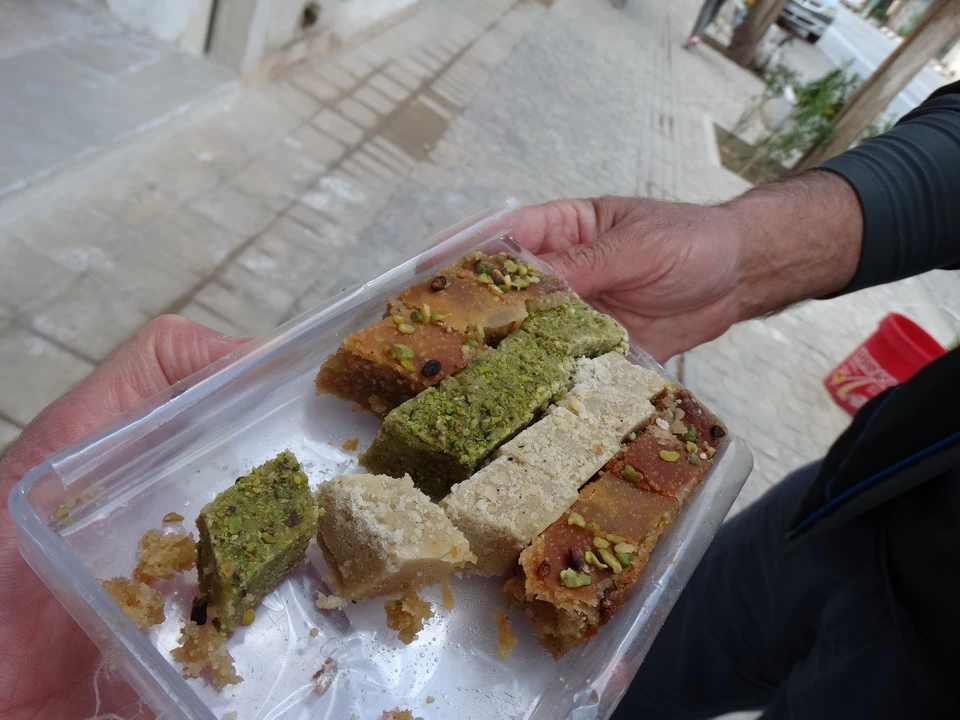
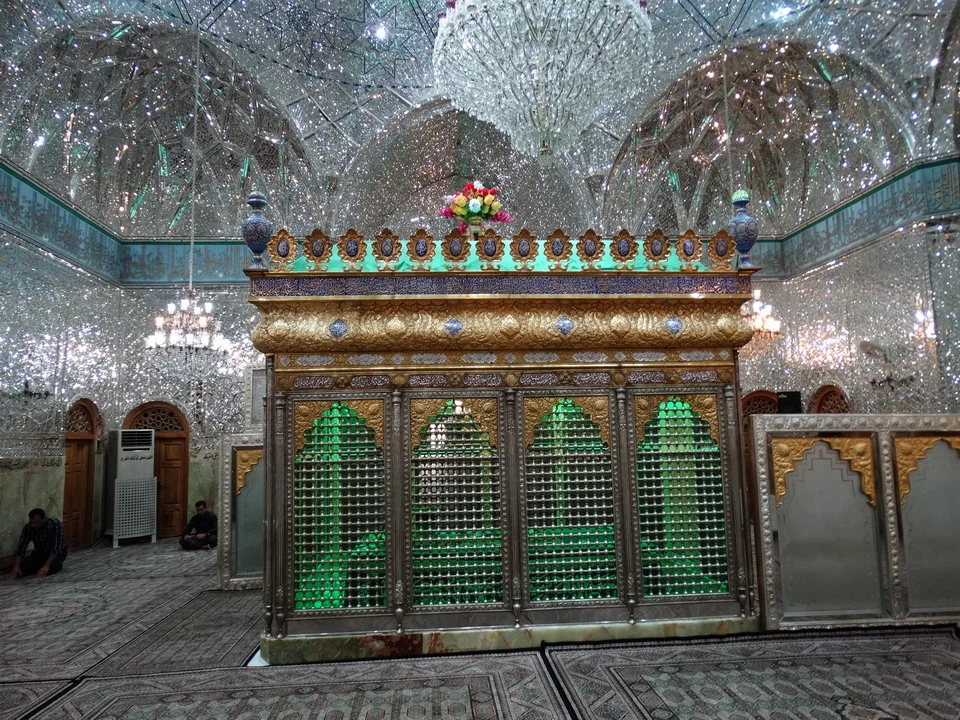
We say goodbye and head to have lunch in the pedestrian tunnel that passes under the Amir Chakhmaq. We had aimed to try the local specialty, the liver kebab The name "kebab" shouldn't mislead: it's not the döner that we slice into pieces, but rather small chunks of meat threaded onto a flat metal skewer and cooked over hot coals. The same applies to beef, lamb or chicken (sometimes garnished with saffron), as well as tomatoes, all served with unleavened bread. This is the basis of Iranian cuisine, both in restaurants and street food stalls. We've now settled down for a while, moving further north along a busy road, and we bought a box of… baklava (very sweet pastries made with pistachios and other nuts) for enjoying as well. The destination is the mosque of Imam Zadeh Jafar, recently built (approximately 40 years old). Men and women access from various entrances, and the second they must wear the chador, but if they don't have one, a replacement is offered to them from a basket placed at the entrance. We are amazed by its magnificence and splendor in the truest sense of the word. The interior is completely covered with small mirrors which, due to the different angles, reflect light in a unique and sparkling way.

We take a 180° turn to reach the opposite side; in the center, like a seed enclosed in its shell, is the mausoleum, which, if possible, is even more richly decorated. We only glance at it and take a couple of photos, trying not to disturb those praying. We return without tiring from seeing the dazzling firmament of mirrors that surrounds us, resembling diamonds, covering the walls and ceiling of the place of worship. The dome is also splendid from the outside.
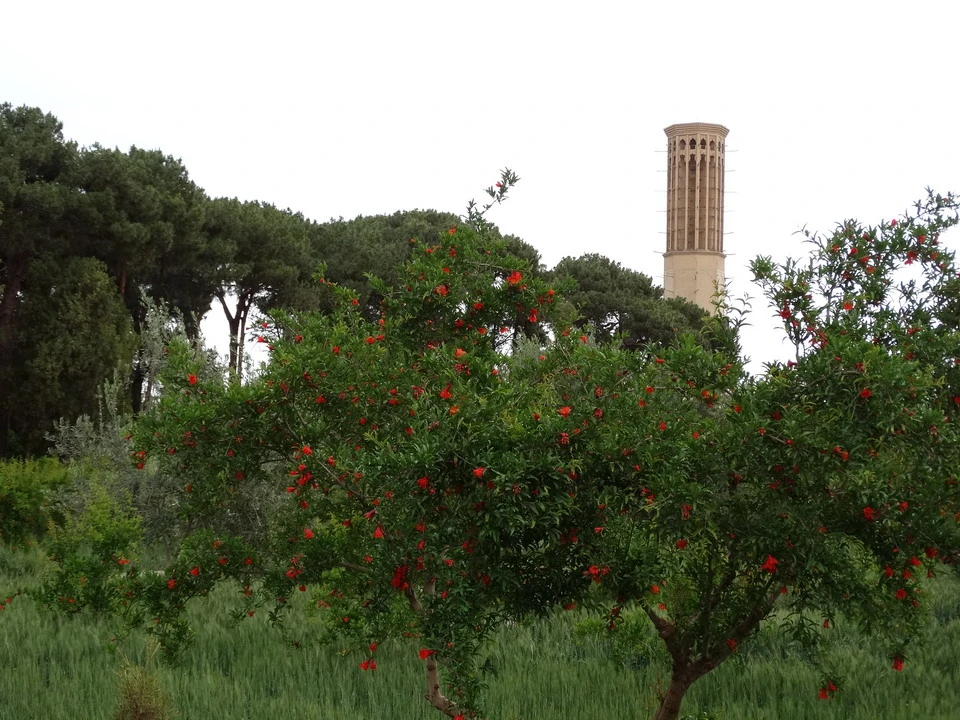
Thanks to a recently downloaded app that allows GPS navigation even without a data connection, we try our luck in the maze of narrow streets, hoping to find it while reaching the Bagh-e Dolat Abad, a garden in typical Persian style with the water element at its center and a pavilion with a badgir (wind tower) that is taller than any other in Iran or perhaps even the world; a 33-meter arrow pointing upwards. The park is dotted with pomegranate With their red, orange, and bitter-tasting vines and sturdy trunks, they are a sign of considerable longevity. In the undergrowth grows a cereal that could be wheat. Facing the palace is a long rectangular lake and various canals where water flows. The lanterns, perhaps no longer in use, during the day seem to transport us back a couple of centuries, and it seems one can imagine the gentlemen strolling through the tree-lined avenues.
Traditions and spirituality
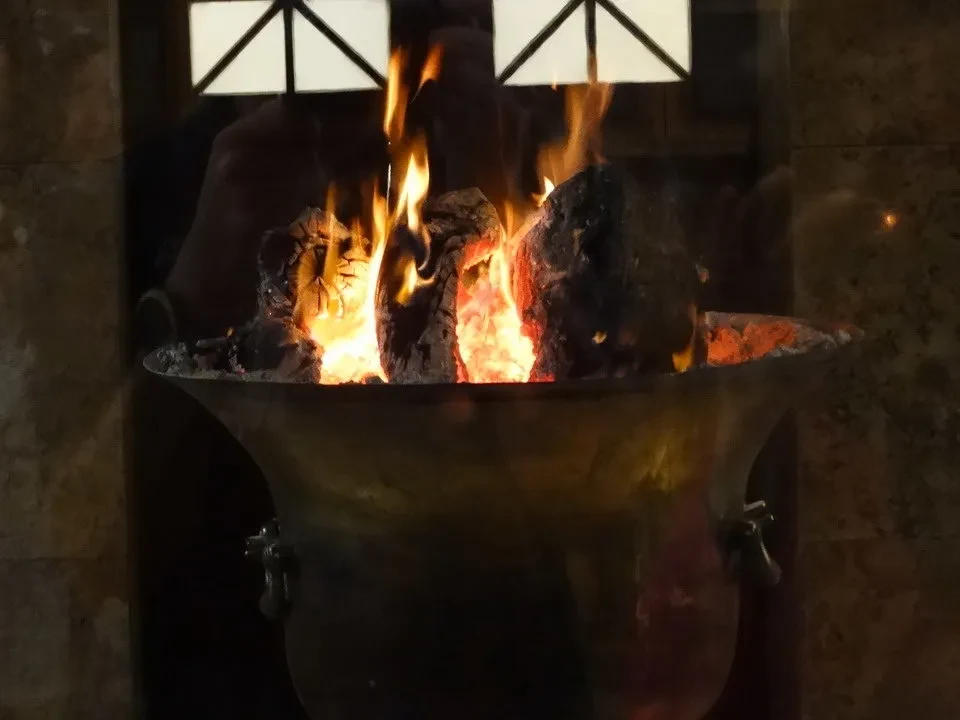
Let's get a taxi and take a break. Zoroastrian right in the city where this community has its most significant representation. This allows us to reach... Silent Towers Zoroastrian (Dakhmeh-ye Zartoshtiyun), a bit outside the main residential area, where followers of Zoroaster's religion would bury their dead outdoors, allowing animals and weather to contribute to decomposition. They were used until the 1960s for funerals. The religion that venerates Zoroaster does not allow burial in order to prevent soil degradation, nor cremation to prevent air contamination. This necessitated raising the bodies on two towers built on the peaks of the surrounding hills and letting them be devoured by crows and other birds, in a process that is entirely similar to what still happens in Tibet; only here it's not about respecting religious rules but rather those of nature, which sees the land frozen for much of the year and has a constant lack of wood. Islam has always tolerated this practice, and religion in general, with the exception of respecting public rules (e.g., women must wear veils, cannot drink alcohol, etc.). In fact, as the original religion of Persia, it adopted several rituals, thereby favoring their integration. In more recent years, a graveyard with tombs barriers that prevent contact with the ground, in a compromise that seems to have satisfied all parties. From above, one has a beautiful view of the mountains and on the city, which has just over a million inhabitants but, due to its lack of very tall buildings, appears particularly extensive. We are in an area prone to earthquakes, but to a lesser extent than the south-east of the country or the Teheran area. The recent constructions comply with earthquake safety regulations, except for buildings intended for resale where efforts are made to contain costs and, consequently, security. The taxi dropped us off at the Ateskadeh (Sacred Flame of Perpetua), a temple of fire where the eternal flame burns continuously since 470 AD. In a separate but adjacent area, large pieces of wood are burning in a brazier, symbolizing the sacred peak of the religion, which originated approximately 3500 years ago, and like all religions born during that era, draws much of its foundation from the elements present in nature such as fire, wind, and water. There is also a great museum which brings us closer to this, undoubtedly one of the oldest monotheistic religions, from which the three major religions that followed (Buddhism, Christianity and Islam) have drawn inspiration. Inside, an extensive photographic documentation shows its rituals and beliefs (e.g., the distinction between good and evil, aimed at deepening our understanding of humans and extracting the positive aspects), making it appear less mysterious, although many points remain enigmatic and therefore interesting. Nearby is a typical restaurant that was recommended to us; we reach it on foot in front of one wonderful sunset. The meat rolls are particularly eye-catching. A final walk around the bazaar area dedicated to copper, and then we return.