

Day 3
The Iranian province
The rose gardens of Qamsar, the red Abyaneh, Natanz Mosque. And finally, Isfahan!
Morning in Abyaneh
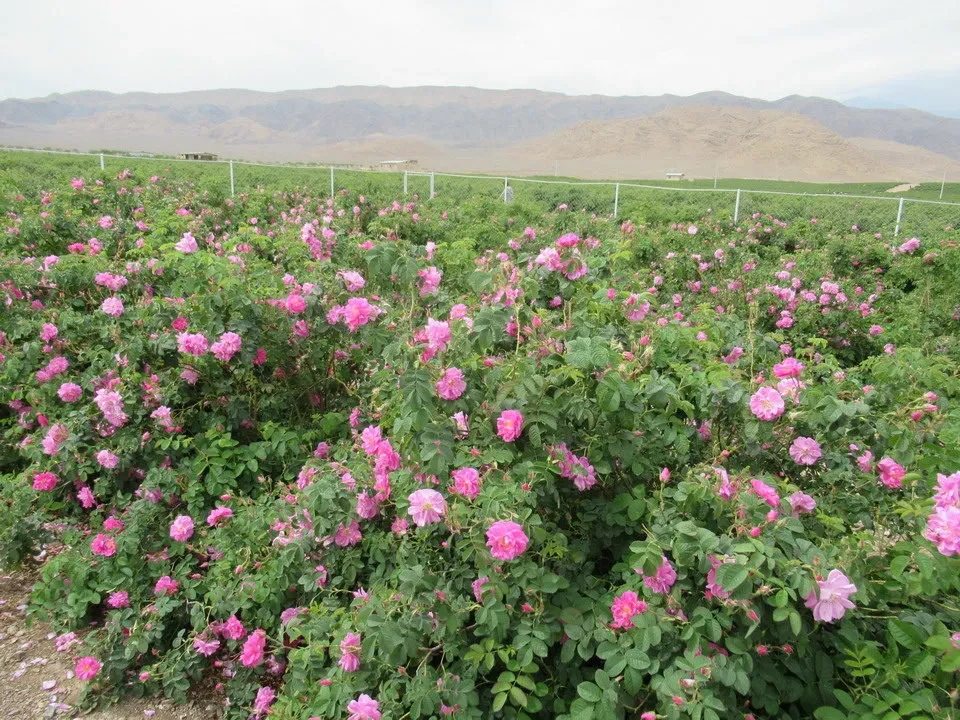
The night passes peacefully, and breakfast is served in a long courtyard with a table in the center. Guests help themselves from the buffet and then sit together, with the opportunity to get to know each other and chat. The Iranians are undoubtedly a sociable people who enjoy talking and getting to know others. One interesting fact that we find quite straightforward. If the infrastructure facilitates contact between different people, all the better. Today's destination is Esfahan (many websites and books call it Isfahan, but locals pronounce it with an "E," so we follow suit), passing through some places of definite interest. The driver fills up the tank, and we are amazed by the price of gasoline: 18 €/cents per liter, and they complain that it has increased significantly in recent times! After a few dozen kilometers, we reach Qamsar, known for its rose fields that are really blooming during these weeks. However, we are in the desert, with dry mountains rising to the west; nevertheless, enough water manages to descend to irrigate the extensive rose gardens and make the area very fertile. We visit a center for... rose water production: the process involves a container with a fire underneath, and the evaporation carries the steam to another still located inside a pool of fresh water, so that it condenses more quickly. With 30 kg of rose petals, you can obtain approximately one liter of extremely fragrant water, which is mainly used for making sweets or perfumes, as the essence needs to be more concentrated. Qamsar is located high up, at the top of a constantly ascending road, while the plantations are lower down, and are the subject of photographs taken by enthusiastic viewers.
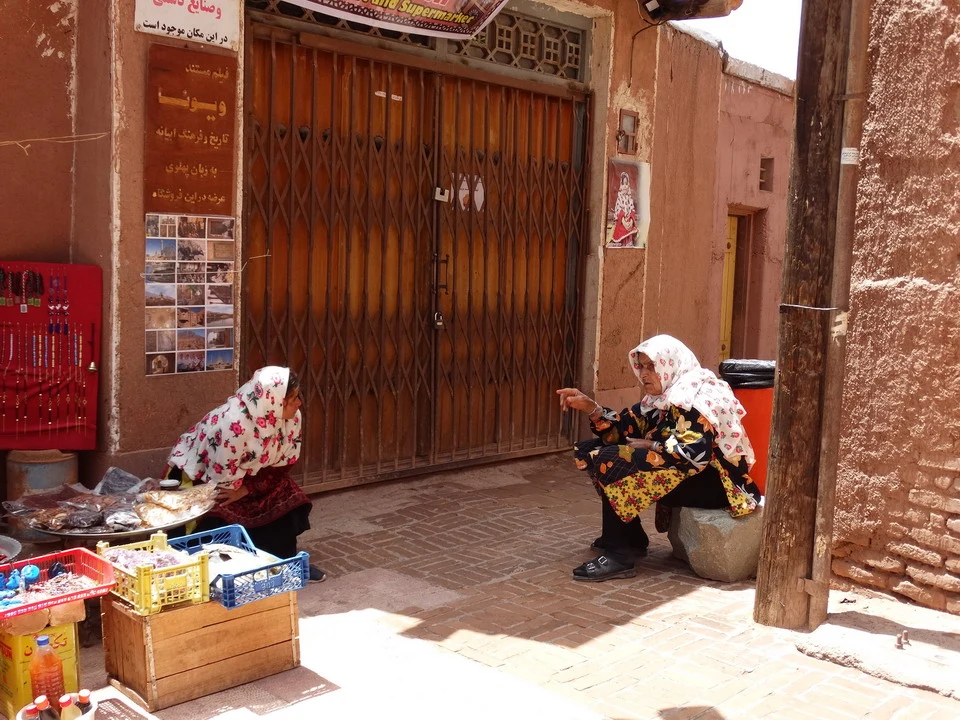
Still a few dozen kilometers and we are at Abyaneh, an intriguing little village nestled on the slopes of the Zagros Mountains, where time seemed to have stopped, preserving its architecture and ancient customs (including those worn by women). What further enhances its charm is that it is one of the oldest villages in Iran, dating back approximately 1500 years. Its orientation towards the southeast allows for maximum sunshine and minimizes the effects of harsh winter storms with very cold temperatures. Now, it has experienced a commercial boom, and the streets are bustling with tourists, especially school groups or families taking day trips. We are at an altitude of 2000 meters, and the wind feels cool. After a busload of visitors completed their tour (which was quiet and peaceful), the village seems to be ours. As the guide we read says, old, worn-out With their distinctive veils decorated with roses on a white background, they sell bags of dried apples at the entrance to their homes. Elderly people wander aimlessly, and everything seems to come back to life. scenes that have been repeated for centuries... We also head to the other side for a better view of the village, admiring how it is perched on the mountainside. While observing the typical features of Abyaneh and its perfect integration into the mountainous landscape, we see some caves carved into the rock. In the past, they were used by shepherds for sheltering livestock (sheep and goats), now they are storage areas for agricultural tools, but they still have a hole at the top, corresponding to the peak of the hill, to allow air circulation. This detour of 35 km from the main road is definitely worth it.
Most of us, when thinking and talking about Iran, inevitably make two mistakes: assuming its inhabitants are Arabs and that it is only a hot country. Both assumptions are completely wrong: confusing Persians and Arabs It's a terrible mistake, although the written and spoken language are similar and religion unites them, while also dividing them at the same time. These are cultures that are close but completely different, having overlapped for a couple of centuries after the Muslim colonization in the 17th century. However, the Persians have a much older and glorious history, drawing their roots from the Achaemenid Empire of Cyrus and Darius, a civilization that dominated and had much to teach during the pre-Roman era. The same dynasties that followed (Sasanian, Safavid, etc.) have left their own mark and differentiated Persia from other neighboring countries. weather It is instead very hot and continental during the summer, as the seas are often far away and their currents are blocked by high mountain ranges. At the same time, the average altitude of 1500 meters makes the winters dry and very cold, where temperatures can easily drop to -10°C in the arid areas from Tehran to Yazd.
Visit to Naqsh-e Jahan Square
Along the road, after a short lunch, there is still Natanz to visit with its Mosque When there's no one around, the silence echoes like music between the slightly worn tiles. Time seems to tell us about invasions, faith, and everyday life. Not far away stands a ruin that takes us even further back into the past, almost abandoned Zoroastrian temple of fire. A place where religious ceremonies took place in pre-Islamic times, and the timeline stretches back over 1550 years. In addition to the driver, we now have a guide who accompanies us, to provide some useful information.
Arrival in Esfahan (former Safavid capital) immediately begins with the honors of a traditional hotel, recently restored and opened just a few months ago: the new elevator design coexists and integrates with colorful stained glass windows, worthy of a beautiful mosque. We will learn that the colors of the glass have their own reason, and in particular, red is intended to keep the mosquitos away. But we won't stay long to admire the beauty of this place that will host us for the next two nights, as it is just 10 minutes walk from the bazaar gallery The center of Esfahan awaits us. The covered section reveals a series of craftsmen at work in their shops, while also attentive to the passage of any customers. The ticking sound pervades the long corridor, skilled hands hammer copper into trays and other utensils, until we emerge from a porch and find ourselves facing the immensity of the Naqsh-e Jahan Square(Imam Square), with views of stunning blue domes and minarets, which is a UNESCO World Heritage site since 1979. Around it, almost hidden, stretches the bazaar that dates back to centuries ago when the city was an important stop on the Silk Road. It is the second largest square in the world after Tiananmen Square in Beijing. In fact, this one appears much smaller because it is adorned with trees, lawns and fountains which contrast with the grey surface of the Chinese one. The common denominator is the photos of the founders of the nation: there is Mao's giant portrait here, and we can see large… pictures of Khomeini and Ali Khamenei. Always present in every public or open place, both of the two supreme religious guides of the Islamic Republic seem to be there to enforce the observance of the fundamental principles of Shia Islam, transposed into their theocratic timeframe. The first has a stern gaze that tends towards warning, while the second is more conciliatory but not very reassuring, with a slight smile seemingly emerging from his lips. We will discuss the political aspects later; for now, it's important to admire the square and what surrounds it.
Having said that, the center consists of a succession of green areas where adults stroll after work or children play, and of blue areas from which joyful fountains, it is important to pay attention to the frame of the square itself. There are two beautiful mosques and a government palace from the Safavid era. The rest is all about... two-row balconies in a cream color, vaguely reminiscent of Piazza San Carlo in Turin. On both sides of the square, you will find two sturdy pillars planted approximately 500 years ago and used to mark the entrances to the polo field, which originated at these latitudes and later became a popular sport among the English nobility. Dinner with the TAP Persia team in a very original venue where, sitting as locals do, we had the opportunity to chat while enjoying excellent food and even smoking shisha.


