

Day 1
Qom
Qom: The journey begins with the most conservative city.
Arrival in Qom
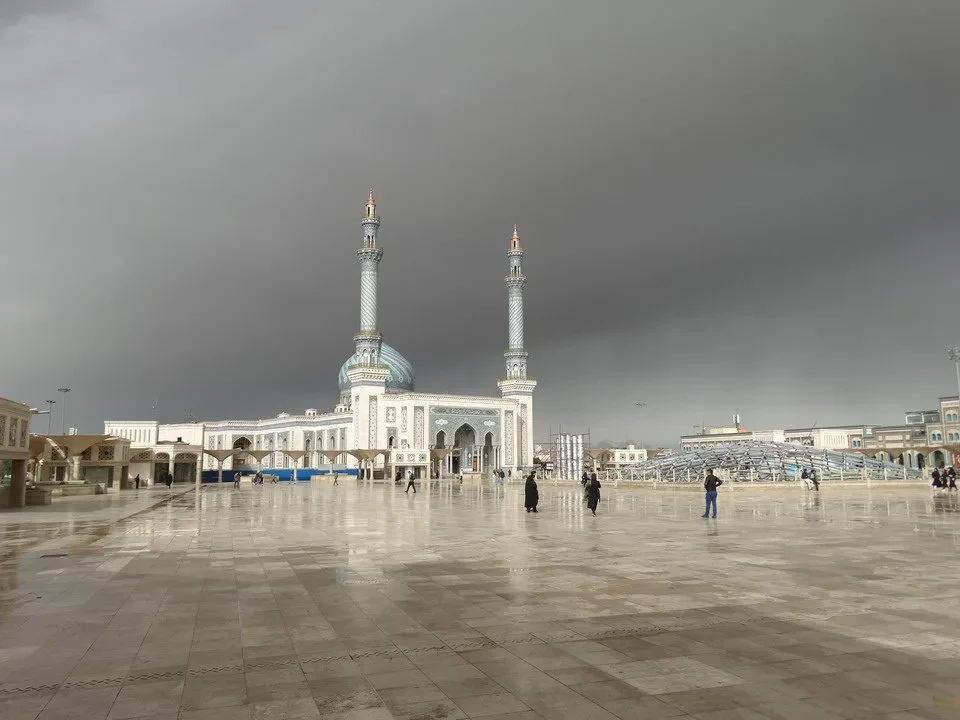
The Airbus 380 that brings us to Dubai is sometimes forced to circle for twenty minutes above the Emirate due to congestion at the airport. When we land, we are even picked up by bus instead of docking at a convenient finger as would be appropriate for an aircraft carrying almost 600 passengers. But never mind, the density of these aircraft in Dubai is like that of swimmers on a Ferragosto beach, so we have to accept it. We would gladly do so, were it not for our connecting flight just a few minutes later, which allows us to catch it by flying ourselves to the gate and reaching it when we had already lost all hope. Good luck for the days to come: being able to travel quickly and without getting tired must be the first ingredients in a trip! The Boeing 777 is still waiting for us, and everything goes smoothly until arrival, when the plane circles the city several times in bad weather without losing altitude. We begin to suspect that they want to divert us somewhere else, but in the end we successfully reach our destination. Air traffic is relatively scarce for this destination, and the airport of Tehran is instead much more austere than other Middle Eastern airports, although it is recent (inaugurated in 2004) and functional. There are only a few flights and there are no queues even when applying for a visa. Whoever arrives is immediately taken care of by a decisive officer who immediately asks for 75€; with the receipt he hands us back our passport, e-visa and travel insurance obtained in the previous weeks. A calm official proceeds with the formalities and everything is returned to us with a request to wait a few minutes before presenting ourselves at the control point for stamping. Unfortunately, my name does not appear on the police officer's monitor and I have to redo the procedure: meanwhile, I think about the conditions that could hinder my passage and parallels with the film Argo begin to emerge. It was probably just a computer problem, so after about twenty minutes I am cleared and can finally fully enter the Islamic Republic of Iran. We look for Iranian SIM cards but find none, while we don't bother changing them due to unfavorable rates: the driver anticipates an amount that we will return to the agency in Esfahan. There are no large police forces, although the feeling is that the checks are as strict as they are silent. On the outskirts of the airport there are large abandoned aircraft, even 747, for which probably the embargo does not allow us to obtain spare parts or maintenance components, so they have to rot due to human negligence. In the desert areas, rainfall should be short-lived, a few drops fall, the rain has just finished when we arrive in Qom after 100 km of highway covered in one hour. Some roads are flooded and going around without an umbrella would be quite imprudent; the roads and drainage systems are typical of arid zones, so all the rain that falls remains there waiting to evaporate or slowly filter into the ground. The car park ranges from old Paykan cars built under the previous Phalavi dynasty, to modern Korean and Chinese models with larger engines. In between there are many Peugeot 407s or Renaults (you can still see some R5s) of medium size. It is early afternoon, we leave our luggage at the hotel and go for an exploration of what is our baptism in this very conservative city. Indeed, Qom is the second religious center after the distant Mashhad, the birthplace and place of education of Imam Khomeini, as well as the headquarters of many fundamentalist Quranic schools. Apart from the Mausoleum of Fatima Masumeh (sister of Imam Reza) and another mosque is not a major tourist destination. However, it is the first one that is a pilgrimage site for Shia Muslims: men and women enter under separate tents for inspection, while the second must wear the chador, which is provided free of charge. The veil (hijab) will be an inseparable companion, which ladies can only remove behind the closed door of the hotel room. A friendly young man informs us about the procedures between football matches, while another who comes to pray offers us a bag of fragrant roses; finally, a mullah picks us up and takes us for a walk. Security measures are in place for everyone and are necessary to prevent attacks. It is important to remember that ISIS sees Shia Muslims as an even greater enemy than members of other religions, considering them apostates. Wonderful decorations adorn the courtyard, but we cannot enter the actual mausoleum, which is reserved for those who observe Muslim practices.
Traditions and spirituality
It's actually the conversation with our guide that makes the visit more interesting. He provides us with a series of historical, religious, and architectural information, which is highly appreciated, as are his words in the name of a religion that should promote dialogue and not be used as a pretext for perpetrating violence. Not as it is understood by some Sunnis, especially the Wahhabis who live in Arabia and, in his opinion, have actively contributed to the creation of ISIS. They see the need to find in the Shia their ideal enemy to attack through Iraq and Syria, which required the intervention of Iran to defend its national interests. He explains that Western media are very influential, and as a result, one ends up having a distorted idea of Iran and its religion. The same applies to America, for which good words are spoken about the people, who however have the limitation of being influenced at the time of voting. They speak of a state and a people as terrorists, while it is they who have suffered attacks from fundamentalists in recent months. The Shia do not engage in proselytizing; there are currents within Sunnism that involve imposing religion by force, to the point that the flag of Saudi Arabia includes some of the first verses of the Quran, and immediately below, a sword intended for use against those who do not convert. The Shia believe that it is impossible to impose on someone a thought that their mind does not accept, therefore they cannot understand all the hostility from major powers towards Iran.
Upon his death, the supreme leader is replaced by election by a council of 25 experts, which currently includes three women who have recently joined. The mullah is surprised at how in our religion women have a more marginal role. The Shia believe in Mary (one of the three women named in the Quran by the name Mariam), a figure to whom they are particularly devoted as the mother of Jesus Christ, one of the greatest prophets. The second most significant female figure is Fatima, who is buried here. According to Muslims, women are particularly important and respected, to such an extent that for the purpose of achieving the requirements to enter paradise, marriage with a woman means 50% of the merits needed for purifying oneself from one's own errors. Anyone who has a good attitude towards women automatically becomes considered more devout and closer to God.
Returning to the monument where we are walking, the glittering golden dome contains 270 kg of gold, arrived through donations from worshippers and recently renovated, while another entrance is entirely made of glass. Thousands of mirrors are embedded in the arches and galleries, signifying that everyone should behave well, as they reflect one's image realistically.
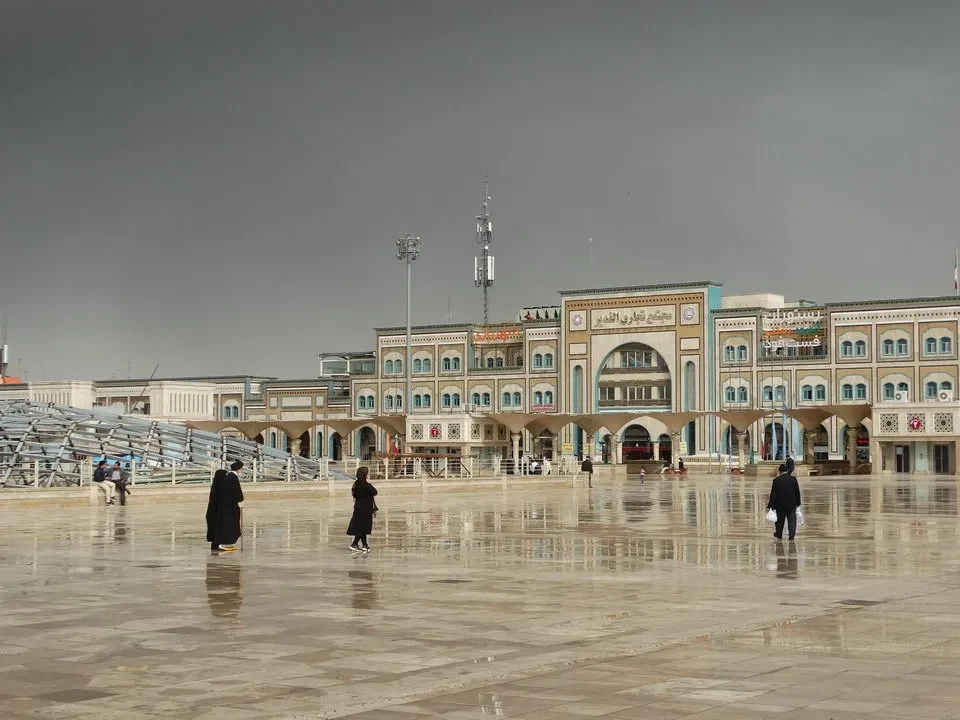
Meanwhile, we are a little bit of sunshine also appeared, we exit through the gate located on the opposite side of the sanctuary to cross the wide Astana square decorated with gardens, and also a bustling scene of turbans worn by religious people of all kinds, to enter into Mosque of Imam Al-Hasan We don't know the local rules, so we try to understand what they mean by asking politely. We remove our shoes and place them in a nylon bag, while our feet float on the beautiful carpets that cover the mosque floor. We move respectfully, trying not to disturb anyone, in complete silence, with the narrow windows letting in shafts of light from above. It would be amazing to see inside the dome with its decorations. Some worshippers are praying, others are reading the Quran, and others are discussing in groups as if they were reviewing a lesson. One person approaches us to ask where we're from and tries to make us feel comfortable. We can take photos without any problems; we are guests and welcome. It seems unbelievable: we are in the heart of a mosque, in one of the most conservative cities of an Islamic Republic fighting against the Western world, and we are greeted with friendly smiles, as if they were waiting for us, inviting us to take pictures of what is undoubtedly a work of art. We certainly didn't expect this, but it will be just the first of many surprising experiences.
We visited the market, considered one of the most original, especially in its unique design. timcheh, an internal square dedicated to the sale of specific products and arranged to provide as much light as possible inside. This is the area for carpets, although at the moment several shops are closed, probably because the early morning hours are more active. It feels like we've gone back in time centuries, and at any moment Marco Polo himself might appear around the corner. In the meantime, it's dinner time, let's go look for a restaurant among the few options offered by Qom, but we can also get to know Iranian kebabs. Afterwards, we buy some sohani in a shop, traditional sweets made with pistachios, cardamom, cocoa, saffron and almonds, to eat while we stroll through the streets as it gets dark. We are trying to leave, but the hotel is on the other side of the Mausoleum and making a wide detour would be inconvenient. We approach the checkpoint and explain our intentions: we do not intend to enter the courtyard for a visit; we simply want to walk along the adjacent road to exit. We are allowed to do so, but we must be accompanied, and the women are spared from wearing the chador. At this point, we realize where we really are and what the reactions of intransigence are like: some strict observers start looking at us suspiciously, saying that women should wear a tunic. Our security guard explains the reasons for our transit, and the situation is resolved before it even begins, thanking whoever was able to explain everything in Dari and avoid any danger.
We return after a first interesting day that didn't dispel the doubts we had: while the official facade presents a peaceful religion and a country that has done nothing wrong, it remains true that many points still don't align with our common thinking, some of which are however understandable or even shareable. We need to see things not only from a Western perspective, but to abstract from our culture in order to understand deeply without necessarily making judgments. For the rest, our opinion on certain topics remains unchanged and will remain so after a pleasant chat with members of the establishment. What is undoubtedly true, however, is the courtesy and friendly approach of the people. The city doesn't offer other tourist attractions; we only see two other foreigners wandering around the center. Along the way, we are often stopped by travelers who ask us where we come from. In the following days, people will ask us to take photos with us, with a completely disinterested friendliness. For example, there is a 17-year-old boy who accompanies us on our return journey solely for the purpose of exchanging a few words with us and practicing his English. It's touching how, at that age, he tries in any way to break free from anonymity, even by talking to strangers. And with the same delicacy with which he approached us, when we are nearing our destination, he goes on his way, wishing him success. The hotel will finally provide us with some rest after spending the night on a plane. When checking in, we met the manager of the Tabriz football team, who is here on loan for a league match that will start soon. It would be interesting to see an Iranian match, but other commitments await us.
The women are almost all dressed in black chadors, and it's interesting to see the mannequins in the bazaar that showcase various fabric and outfit variations, but always observing the same strict line. The more rebellious ones leave a strand of hair visible, while some wear trousers underneath their dresses that conceal their figures. In general, when we look at them from a distance, their curiosity invites them to stare at the stranger, but as they get closer and make eye contact, they lower their gaze as dictated by modesty. Our way of dressing is interesting.


