

Day 4
Esfahan
Esfahan: it truly is half of the world. The ancients were absolutely right!
Morning in Esfahan
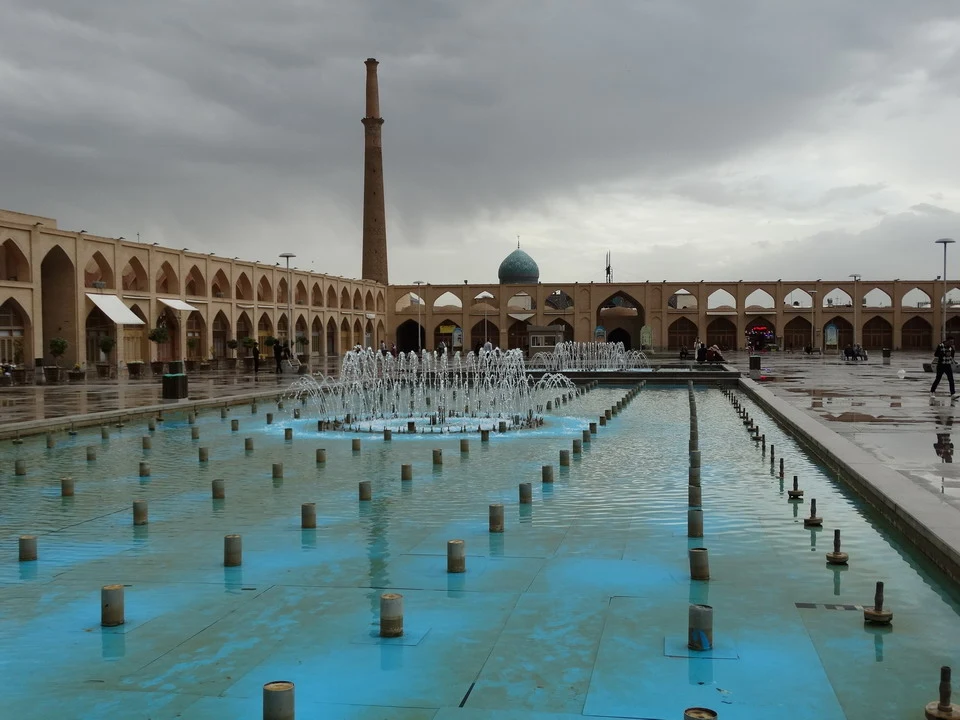
Woke up early to see the Imam Square again, as it was still empty. It's hard to say whether it would have been better yesterday evening, full of lively activity, or today in its quiet stillness. It feels like our own, despite its size. The green landscape of lawns, trees, and bushes dominates the view, while the yellow of the porticos is punctuated by the gleaming domes and minarets that rise above the mosques. In one corner, some boys have set up a football pitch and seem to be practicing before going to school or work.
Towards Esfahan
We return at 8:30 to have breakfast and then meet up an hour and a half later in the square opposite the clock tower for the free walking tour, organized by TAP Persia for those who have made reservations with them. We will start with a visit of the Kakh-e Chehel Sotu (Palace of the 40 Columns), Persian garden pavilion, dating back to the Safavid era, located right behind Imam Square. This is named because the columns that support it, reflecting in the pool in front, appear to be forty. Here, Shah Abbas II held parties and welcomed foreign dignitaries and ambassadors. We visit the interior with large paintings hanging on the walls, as if the room had been specifically designed to display them. It's interesting to note that there are several vases of wine Among the diners at a lunch in a painting from the Islamic era, which symbolized how high-ranking officials could afford the forbidden fruit. We will discover in the following days how, despite the formal prohibition, the wine circulates abundantly among Iranian homes, through a well-organized smuggling market. What matters is to maintain observance in public. In fact, it was widely known before our departure that there was a huge difference in customs between public and private places: restaurants and bars don't even dare to offer wine or beer (let alone alcoholic beverages), but at home and especially during parties, you can find scenes that would make the most extravagant Westerners envious, truly worthy of "One Thousand and One Nights." Alcohol, if not deliberately drugs, and fashionable, tight-fitting clothing are the vices of a certified rule that passes through the loopholes of the Quranic law and are not particularly pursued. One of the paintings was painted during the Qajar era, and in defiance of the previous Safavid dynasty, it depicts the only Safavid defeat in a battle against the Ottoman Empire, in order to discredit past rulers. In the Palace, meetings took place with foreign delegations; outside, the pools shine under the sun, long rectangular bodies of water surrounded by inevitable gardens and especially roses. Nearby are parks, and entering them makes you feel like you're leaving the city and no longer hear the chaotic sounds of traffic.
The Majed-e Shah It has undergone several name changes over time and is currently undergoing renovation. Its entrance is on one of the short sides of the square, but the clever courtyard that welcomes visitors beyond the The arch points diagonally. so that the mosque is correctly oriented towards Mecca. There's a point where the echo is repeated seven times, while seven are also the colors that The ceramic tiles add a touch of elegance., with a predominance of yellow. We meet a mullah who, after the formalities, asks if we have any "simple" questions to ask him, and we discuss the hierarchical structure in their religion, how one becomes an ayatollah (the highest level of theological studies which can also have political significance), while imams have studied for at least 5/8 years and end up being of a higher rank than the mullah. The role of Ayatollah exists only among Shia Muslims; on the Sunni side, the equivalent is the Mufti, while the Grand Mufti corresponds to the Supreme Ayatollah.
Let's go and see the workshop of a miniature artist He also decorates with fantastic paintings made with delicate brushes crafted from bird feathers. They require a lot of time and have very high costs; a painting measuring 10x5 (postcard size) costs around €250. We also visit a carpet shop, where we are told that each region of Iran has its own production: we see examples ranging from those from the Kurds, to the eastern ones in the Mashhad area, to the famous Tabriz carpets, and those made by nomadic people living in the Zagros Mountains, depicting natural subjects. We do not visit the Palace of Ali Qapu (Kakh-e Ali Qapu), the residence of Shah Abbas, built in the 17th century, which rises in Imam Square opposite the Lotfollah Mosque, slightly forward on the square to show the supremacy of the State over religion and everything else. The Sheikh Lotfollah Mosque, built in honor of the Shah Abbas I's father-in-law, it was originally intended for private use and features more refined lines with a changing dome depending on sunlight, a true architectural gem. It is the only one without minarets. It is closed for lunch and we will visit it tomorrow; meanwhile, we can admire its majestic exterior.
Let's also take a break with a local specialty, the fereny, a sour yogurt mixed with honey and cardamom. The Qeysarieh Gate, which leads from the square to the Bazar-e Bozorg, is decorated with beautiful ceramic tiles and frescoes by Reza Abbasi, depicting scenes of the Shah's war against the Uzbeks, hunting scenes and banquets. It features a loggia, a portico, from which news were once communicated to the people, before other sources of information existed. We finally continue to the Hasht Behesht, just a short distance away, a building shaped like a diamond, literally "eight paradises", located in a park that was used as a residence by the royal family. The windows They present wooden designs that are so perfect they don't need glue or nails; you simply interlock them to hold them in place.
Finally, we take a couple of photos with the guide, also as a gesture of gratitude for her passion and dedication in showing us her city. We sadly say goodbye to her.
Arrival in Esfahan
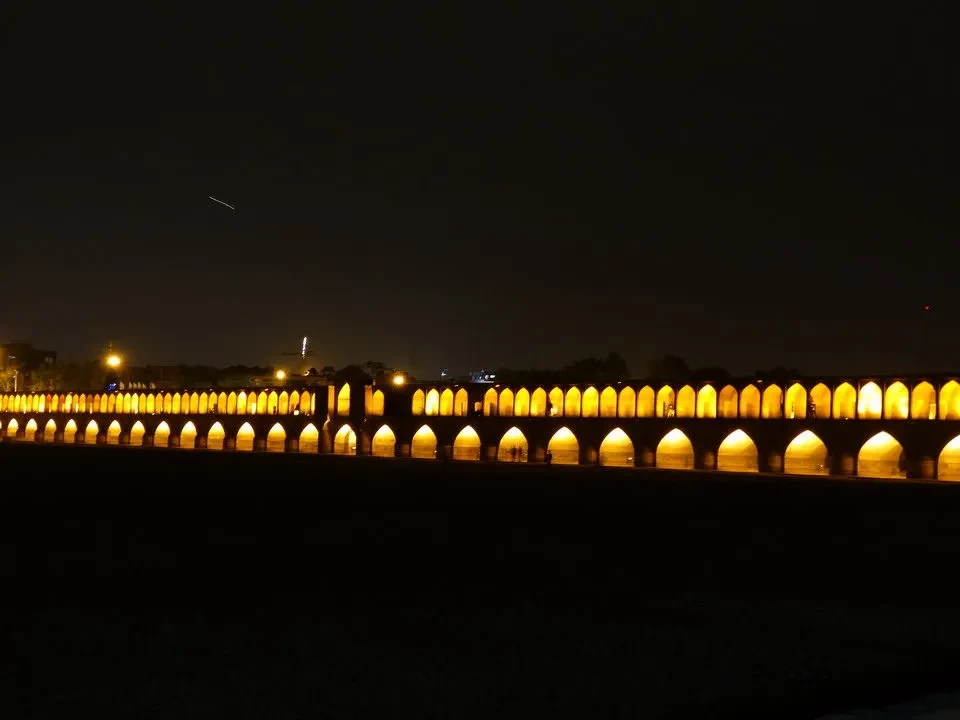
Let's take a look at the arched passages of the bazaar and we head towards the enormous Imam Ali Square; on one short side, another splendid dome appears, that of the Majed-e Ali, allowing you to reach the Majed-e Jameh with just a few steps. Very large and impressive, especially in the iwan, although not decorated like the previous ones, as they are from an earlier period, but precisely for this reason more intimate and mysterious. The columns create shadows., the same ochre colour takes on different tones, with only a few tourists mixing in with the people praying. When we return, the sky clears and night takes over. We take a taxi to the other side of the river, to the Armenian quarter of Jolfa, in search of a restaurant serving traditional cuisine. In reality, Jolfa has always been a kind of free port, free from the restrictions imposed by religious dictates. And this tradition means that there are many restaurants here and you can find young people enjoying their Saturday night out. We return on foot, along the beautiful Pol-e Si-o-Seh, bridge over the Zayadeh River, unfortunately dry for several years due to the diversion of water upstream for irrigation purposes. The rainfall is also scarce here, and the water needs to be used where it's needed. The bridge, beautifully illuminated, is fantastic in itself; it’s incredible to imagine when the thousands of lights that illuminated the 33 arches reflected on a body of water. We walk back towards the center to see Imam Square illuminated: once again, in a new configuration and with new emotions. The domes of mosques that shine under the spotlights, while the fountains gush in the central ponds illuminated by changing lights. All that remains is to walk along the section of bazaar, now closed but no less fascinating, for the final steps that lead us to the hotel.
Walking around, it feels like we know half the city; everyone greets us and asks where we're from, welcoming us to Iran. This is a significant source of pride that people feel for their country. As tourists, we are welcomed guests because we offer a temporary escape from global isolation, and we also represent an economic resource. However, it's not purely self-serving reasons that prevail, but rather an innate desire to get to know people, exchange opinions, and improve ourselves through interaction. While there may not be as many foreign visitors as in typical international tourist destinations, we do see quite a few "pale faces" with clear European origins. Generally, we are seen as someone who has dared to challenge the prejudices of our world in order to meet and understand the reality of modern Iran. In some cases, especially when talking to religious figures, there is an almost subtle sense of victimhood. Most people openly admit this and further appreciate those who have made an effort to learn about Iran firsthand and without filters. They often ask us to take photos together, appreciating when we do so with our cameras. This allows them to see themselves alongside us. It's almost touching when they seek dialogue despite their limited knowledge of English; they are honest and straightforward, reflecting the open-minded nature of a people who are forced into isolation by the regimes that control them. There is no doubt about the innate desire for enjoyment and living life to the fullest that exists among ordinary people. This is evident in impromptu picnics, perhaps somewhat naive, along urban parks and sometimes even within roundabouts. Essentially, it's a desire to live without restrictions, but with the pride of a people who don't just focus on holidays.
We were worried about frequent security checks Police officers with guards everywhere, attentive to enforcing dress codes and the behavior of foreigners. None of this. There are agents, and there will be more, including those in plain clothes, primarily because the Shia Muslims, considered apostates, are a target for fundamentalists far more than we Westerners. It seems that the checks have become more refined and now take place mainly through social media and other technologies besides simple street patrols. Just recently, we learned that Telegram has been shut down, a tool of unwanted communication. Apparently, the Minister of Communication (a young man with reformist ideas and, precisely because he is young, aware of the resources offered by technology) admitted that once one channel is blocked, another will open, and so on, in a technological war that cannot be won, except by banning the possession of smartphones. There is no perception of crime; we are actually reassured to feel safe, and even pickpockets are a very rare breed. One must adopt an attitude appropriate for a large city, but the risks are practically reduced to zero if one adopts a criterion of ordinary attention.


