

Day 10
Dunhuang
Desert of Dunhuang. The Mogao Caves: the ultimate expression of Buddhist art on the Silk Road.
Crescent Lake
We take the elevator down where a sign indicates that spitting is prohibited (and that's all there is to it!). During the Beijing Olympics, an explicit ban was put in place on practicing this habit in public during the games. It certainly wasn't considered an Olympic discipline.
At breakfast, we met some individuals from our ethnic group. It was a group of Germans who had left Uzbekistan, traveling through it from west to east, arriving in Kyrgyzstan, crossing the border to reach Kashgar, and finally arriving here. We, on the other hand, arrived from the east, and if it weren't for certain important details, it would seem as though we had taken a step back in time when the Silk Road still existed and travelers exchanged information and experiences. They tell us that Kyrgyzstan is very beautiful, although the Ferghana Valley is still closed by authorities due to the risk of armed encounters. Its proximity to Afghanistan makes it an undesirable place, despite its spectacular nature. Perhaps this indicates that the Taliban and those who support them have a certain appreciation for the landscape. Border crossings require patience, time, and some knowledge. Based on our experience in Kashgar, they recommend visiting it again this year, as the old city will then be replaced by new constructions.
DUNHUANG used to be a crucial stop for caravans traveling the Silk Road between the Gobi Desert and the Taklamakan Desert. The city, founded in 121 BC, whose name means "Shining Beacon," is a fertile oasis where cultivated fields are gradually disappearing on the slopes of high sand dunes. It was the place where you had to decide whether to go north or south around the Taklamakan Desert; this formidable and vast area, devoid of life and where conditions can be so extreme that even survival is threatened. Many sources describe it as the most terrible desert in the world, second only to the Sahara in size.
Let's start our visit with the dunes and the singing sands, Roaring Sand Mountain (Mingsha Shan), located 6 km south of the city.
Also here, and perhaps even worse because it's a natural attraction, the entrance and its surroundings are indistinguishable from those of a circus, with vendors trying to sell all kinds of souvenirs. Where the oasis meets the desert, amidst the dunes, lies Crescent Lake (Yueya Quan), in crescent shape, where spring water drips into a depression to emerge on the surface. Having said that, the lake is little more than a pond (although very evocative) and the sand only sings if you have a lot of imagination, because the friction should create a sound similar to a whistle, the place itself is fascinating. The dunes remind us of what we saw in the Gobi Desert, which are likely close relatives. Let's ignore the temptations offered by progress and technology, take off our shoes and walk barefoot on a ridge that leads us steadily to the first "peak". The spectacle is grand, the wind hurries to cover our steps as if it wants to erase the past and restore the previous order before our footprints. To the south, we can see the alternating dunes, and to the north, the entrance is finely paved with the usual large plazas full of people. Fortunately, those who want to take a few steps are still few, and we can immerse ourselves in the environment as well as in the sand. Of course, there are also comforts for those who don't want to miss anything: quads ready to wait for tired tourists, camels lined up climbing towards an intermediate point, facilities for paragliding, slides on the sand, and all kinds of souvenir stalls. Those who access the dunes can instead rent special footwear to prevent sand from entering their shoes. Given the orange color, we also have the certainty that no one will get lost.
Close to the entrance are gardens that demonstrate how careful irrigation can make everything bloom, even in the desert. There is even a plant with its fruit hanging from it. Afterwards, there is a demonstration of how a natural amenity can be polluted by typical parking areas, stalls, and anything else that can be priced. After all, access to the dunes is also paid, and it is well deserved. The Chinese tourists have themselves photographed in every position, focusing attention on themselves, when it is the landscape that deserves observation and reflection.
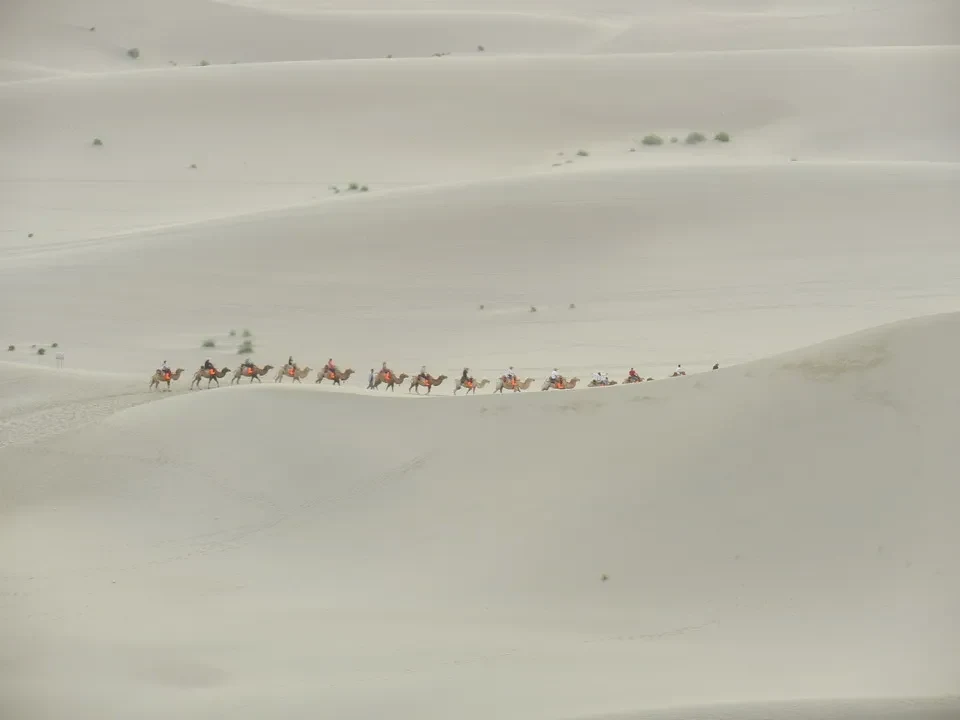
The camels return to the base in an orderly line. There are no more passengers on board, as they have already transported their valuable load of tourists towards the dunes. Pausing for a moment and looking at the line of camels with the dunes in the background, it feels like we are reliving the time when caravans passed through this area, exporting silk and importing Western goods. The "desert ships" were the essential and only means to allow passage. Now, merchants still exist, but they have lost the nobility of their profession.
Lunch in Dunhuang was once again characterized by spicy flavors.
The afternoon is dedicated to the Mogao Caves, located 25 km southeast of the city center. On a sandstone wall, the caves of the "Thousand Buddhas," dating back 1600 years, open up. The 45,000 square meters of mural paintings and the two thousand painted sculptures were created over more than a millennium, from the 4th to the 14th century. The caves represent the highest expression of Buddhist art in China, with the richest collection of Buddhist sutras, murals, and sculptures.
The legend tells of a Buddhist monk named Lezun, who in 366 had a vision: a thousand Buddhas. He then convinced a wealthy pilgrim on the Silk Road to establish the first temple here. Over the centuries, the temples grew until they exceeded one thousand, and with them were built shelters, repositories of sacred texts, and votive chapels. Between the 4th and 5th centuries, the monks of Dunhuang collected numerous Western manuscripts, and many of the pilgrims who passed through the site painted frescoes inside the caves, in addition to leaving an offering and praying for a safe journey.
A reliable and easily understandable guide helps us understand the mysteries and reasons that allowed this site to be created away from major centers, but close to a key city on the Silk Road. The fact that the Silk Road eventually gave way to maritime routes for transporting goods between Europe/the Middle East has caused everything in a more isolated location to be forgotten for several centuries. This is why the artifacts are largely intact. Furthermore, it seems that in 1963, the government of Beijing decided on a renovation project that was completed within a few years. During the Cultural Revolution, which began in 1966, it appears that the zealous Red Guards "forgot" to destroy this religious heritage. However, it seems that Zhou Enlai intervened to prevent this integral part of the country's culture from being permanently dispersed. After 1982, work resumed and brought the site to its current state. Western powers, which had reduced China to a semi-colonial state at the beginning of the last century, also contributed to driving people away from the country and partially obscuring the archive of books. With the help of a Taoist monk who discovered thousands of rare or unique ancient texts in Cave 17, European adventurers seized the material and sold it to some of the world's most important museums. As a result, the Diamond Sutra, the oldest printed text, is now at the British Museum. The story of its discovery is worthy of an Indiana Jones film, and it would be nice if the books were still in their place or nearby. Some argue that if they had fallen into the hands of the revolutionaries, the texts would have been destroyed. However, the fact remains that they are now scattered around the world, and in some cases even hidden in private collections.
During the visit, the two statues of Buddha sitting, respectively 34 and 27 mt high, are particularly noteworthy. The first one is the third largest representation existing. The other two are always located in China. There was also a fourth, even larger statue, but it was destroyed by the Taliban's extremist justice in Afghanistan. The statues could be touched by worshippers and you could walk around them. With the opening of the site to tourism, the number of visitors has required closing the circuit, which still has a deep religious significance regarding prosperity. The construction of the 34-meter Buddha started from the bottom, while in all other cases it began with the head. It is always made up of a wooden structure that serves as the skeleton: the exterior is made of chalk and the finishes are created with a mud mixed with straw, which allows for better shaping of the forms. Nearby there is also a reclining Buddha of similar size to the one seen in Binglingsi.
The caves and statues were commissioned or built by families to commemorate their deceased loved ones. The only one that is, in a sense, "public" is the 27-meter Buddha statue, which required 12 years of work. Other caves were constructed by merchants who had safely crossed the desert or were about to do so, and therefore needed divine assistance. The earliest sculptures date back to the beginnings of Buddhism in China, but it should be noted that this is where this religion entered the country from northern India, where it originated approximately 900 years earlier. One cell contains a Buddha statue in the style of Mona Lisa, as it has an expressionless face, making it unclear whether it is serious or smiling. Perhaps it is simply an unsuccessful creation, and we leave convinced that China has not yet produced a Leonardo.
The guide also tells us that it's not worth trying to figure out which Buddha we are looking at when we encounter the sculptures, as there are no specific rules: Nibbana of the past, Shakyamuni of the present, Maytreya of the future, etc. Usually, the Buddha of the present is found in the central niche: the Apsaras are usually painted on the ceiling and are merely a secondary element, as they belonged to a social class that was not very high-ranking, and therefore did not deserve statues but were exclusively painted.
In the past, there was no balcony walkway connecting the different cells; each one accessed its own via a staircase, and the caves were not connected. The facade has also been reinforced, removing something from the ancient image but serving to preserve the site over time. The cells are in turn closed by shutters that allow air to pass through but not light, while photography of any kind is prohibited. This is a site worth seeing and justifies the fame of Dunhuang, which is mentioned in every treatise concerning the Silk Road.
As the shadows begin to lengthen over the desert, we head towards Liuyuan, which is about 120 km away and takes an hour and a half to reach; here you will find the train station from which trains depart for Turpan. The road passes through a bustling area of farmers harvesting crops, goes through less fertile areas where melons are grown (fresh melon stalls are common, with shaded areas for drying them), and finally opens into the true desert. Sparse bushes interrupt the expanse of gravel, with hills in the background. At some point, the sun takes on the warm colors of sunset and disappears behind the western mountains. The city has nothing to show except a small restaurant where you shouldn't be too fussy about eating dinner. Taking a train in China is not so easy: even if you have a ticket, you need to know which carriage to board. To say goodbye to the guide and driver who need to reach Lanzhou at night, we tell them that they can go once the checks are complete and we are inside the station. Since the boards only display Chinese writing, it might be dangerous to try to understand the announcements, the guide takes us to a passenger heading to our same destination. This young man takes care of us as if we were minors and escorts us to our compartment once the train arrives, which is already midnight. The train will arrive an hour and a half late. Of course, we don't have a common language, but with gestures, we can understand each other for what little we need to communicate. For the second time in a row, we can count on the soundtrack of someone snoring, so our night is not one of the most comfortable.