Day 6
Tibetan Monasteries I
The mystic of the Labrang monastery and mountain landscapes. The Tibetan region, regardless of political maps.
Morning at Buddha Maytreya
The inevitable honking that echoes down the main street greets us: if we had booked a room facing the street, we would definitely have woken up before the alarm clock. Before breakfast, we take advantage of the beautiful day to enjoy the sunrise in this environment filled with mountain and spiritual atmosphere. We follow the path of southern coast (the tour around the Labrang Monastery) was marked by more than 1000 prayer wheels. Shortly after 7 am, it is already full of followers of Lamaist Buddhism who pray in the various ways prescribed by their religion: they turn the wheels, lie down on the ground facing the monastery and move sideways one step at a time. It's a world that is truly incredible: people from other parts of China, Mongolia or even Tibet itself meet here, which for centuries has been one of the main destinations for this branch of Buddhism. There is quite a lot of poverty in their clothes, as well as a near-total abandonment of their faith. Those who have fully embraced this religion do not care about earthly concerns, aware that the afterlife is what matters. This detachment is difficult for those coming from a completely different culture to understand. The sun begins to rise and its rays fall on the roofs of the temples, giving them a golden glow. We cross the bridge over Daxia River to climb onto a hill. This place is called the Terrace of the Tangkas. This place actually has a nearly vertical slide where, during festivals, the famous tapestries are displayed. sacred drawings From this balcony overlooking Xiahé, you can clearly see the two districts of the city, separated by the Labrang monastery complex. When we return for breakfast at 8:30 am, the camera's memory cards already contain several scenes of local life. The meal would also be plentiful, but what we enjoy most is the atmosphere: a semi-enclosed courtyard at the top with the classic flags to give a folk atmosphere. When we leave with Can, we follow part of the Kora route where we meet many pilgrims engaged in the traditional circuit walk.
Traditions and spirituality
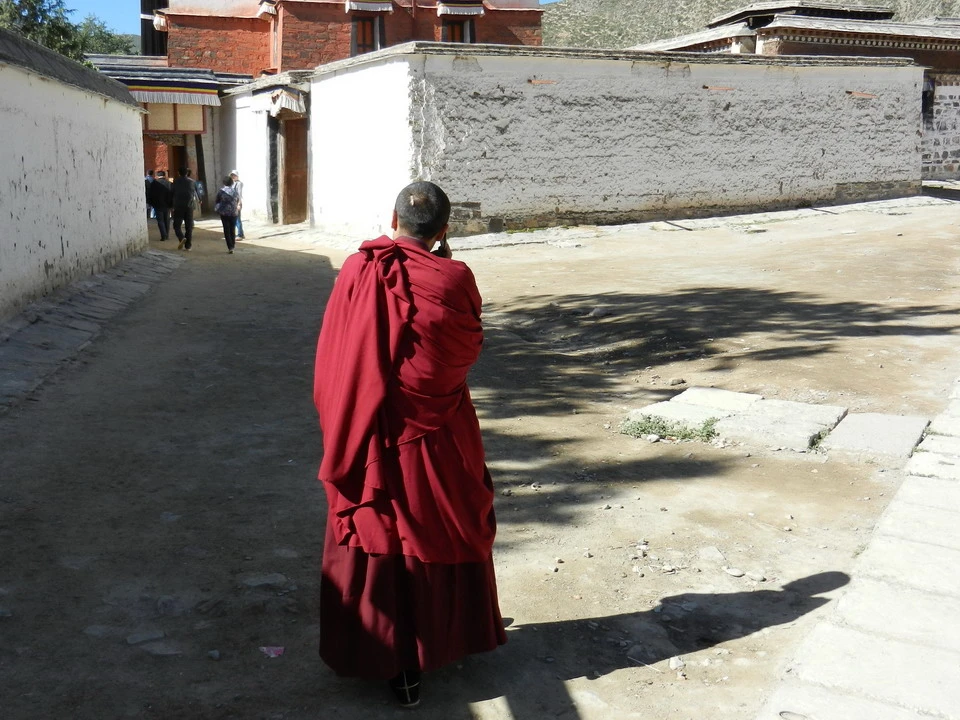
Along the route, we encounter several topics that the guide patiently explains to us: monks usually enter monasteries very young, often even as children, and sometimes this helps them avoid a life of street begging and hardship. However, those who decide to leave the monastery to live a lay life can no longer return. The surface area of the monastic complex is significantly reduced compared to when Mao had decreed its suppression; for proof, simply compare the current extent with that represented in the painting found at the reception desk. our hotel Before 1959, there were approximately 5000 monks living in Labrang, and now there are only 2000. Most of the buildings were either demolished or severely damaged during a period when blind materialism also led to forced labor or forced marriages (which even affected the sixth living Buddha, who represents the third highest authority in Tibetan Buddhism after the Dalai Lama and the Panchen Lama), affecting all the monks.
The ongoing reconstruction, currently using the same construction method as before, gives the impression that the temples are original.
Along the route, there are stalls where locals sell. cedar branches, which are used in braziers instead of incense and release a pungent odor into the air. Similarly, small balls of earth are also used for this purpose.
Some faithful people around the monastery perform prostrations or bows, reaching up to 10,000 or 100,000. They make this a vow and perform it once they have received a grace, for example, to pass an exam, the vow is usually around 1000. One goes to a monastery and prostrates themselves before the deities.
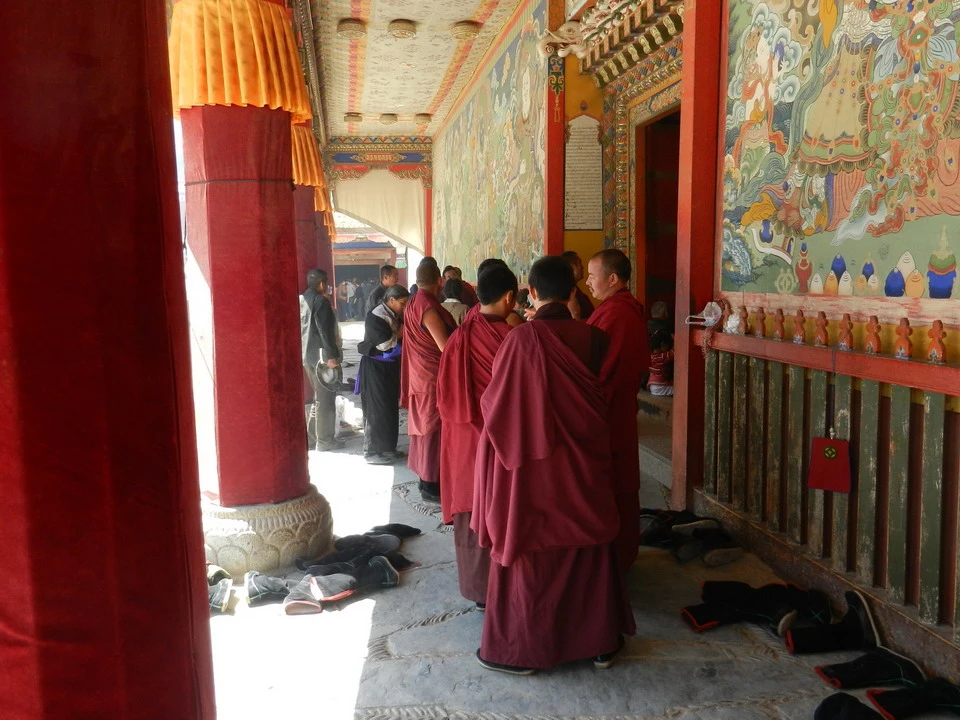
The visit to the Labrang Monastery (also known as Labulengsi in Chinese) is guided by a local monk, following traditional practices. purple tunic. Since 1709, during the Qing dynasty, the monastery was one of the 6 most important aspects of Buddhism Tibetan from the yellow-hat sect. The interior of the temples is quite dark, but photography is not allowed. In many of them, we see long lines of monks praying and reciting mantras while sitting cross-legged on cushions. It's interesting to see the statues of... yak butter, among which stands out a detailed Buddha Maytreya: Usually there are no temperature issues, but recently, to avoid any risk of melting, air conditioning units have been turned on.
We are told that the Dalai Lama is the authority of the Gelug school and that he will elect the Panchen Lama, who will then appoint the next Dalai after his death. This explanation of mutual elections between president and vice is essentially provided to illustrate a more complex election mechanism, a mechanism further complicated by the fact that there are currently two Panchen Lamas: one appointed by the "Beijing government" and one by the Tibetan authorities, who are currently in exile in northern India.
Lunch at Xiahé. Although quite simple, the restaurant is frequented by many people. Perhaps Sunday also has a special significance here, as a day for socializing. The fact that there are Chinese diners is evident from the remaining... fireworks exploding which decorate the entrance to the restaurant. On special occasions and celebrations, it is customary to bring a cardboard box containing a dozen firecrackers that are set off in sequence, creating fire, smoke, and a lot of noise. This happens when many guests are already inside having lunch peacefully without participating in the fireworks display. Outside remains a large area covered with scattered debris, which not everyone will bother to clean up.
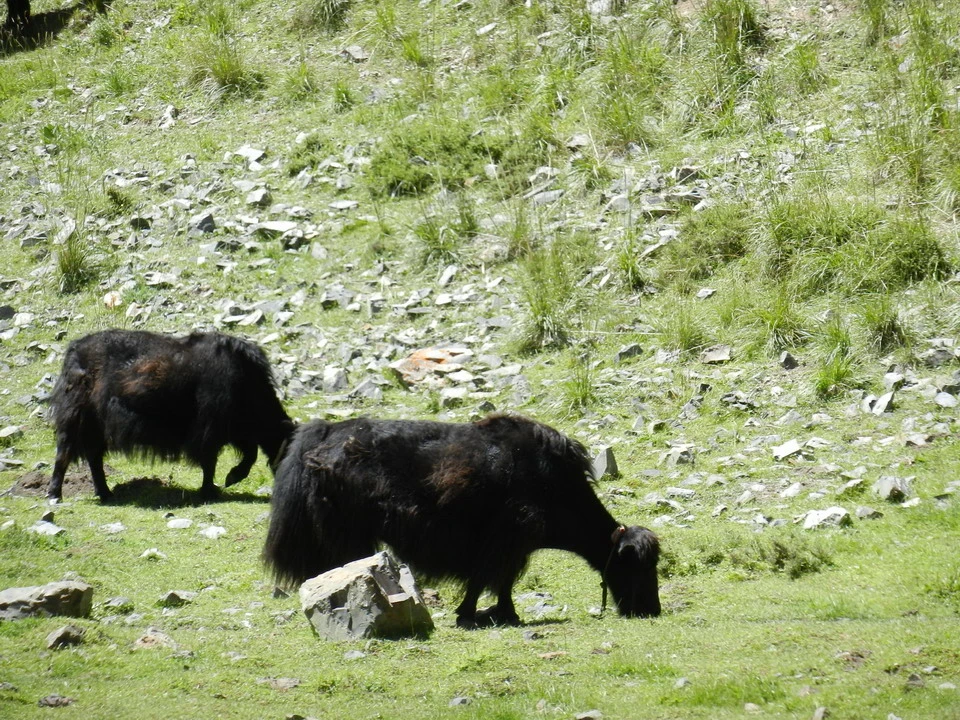
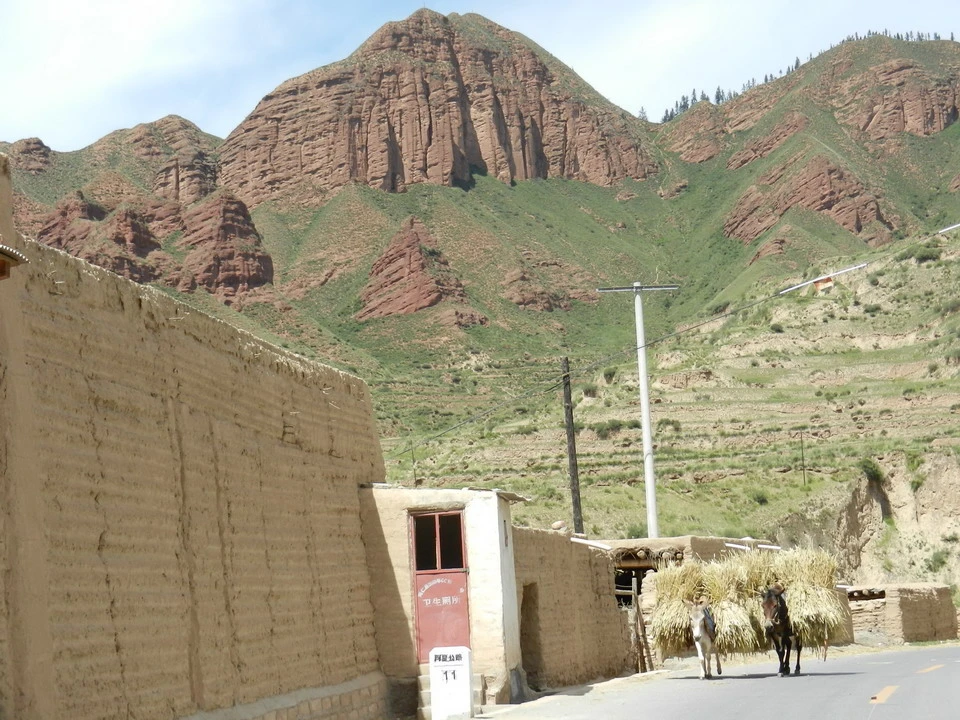
We are heading to Xining, climbing further up until we reach an altitude of 3643 meters, following a very scenic road. The landscape is dotted with... Tibetan villages with people busy collecting their harvest of grains with the donkeys pulling bulky luggage (probably wheat), while the sheep graze lazy pigs in green meadows.
It's amazing how there is still so much greenery in a setting full of flowers despite the altitude: the same hill is scattered with pastures Even in urban centers, the avenues are lined with trees that have not yet shown the colors of autumn, despite the pollution.
Near the villages, you can also see sheep and, to a lesser extent, goats and cattle. The buildings are typical Tibetan structures with ochre-colored walls. earth-toned flooring. On some occasions, you might find cow droppings stuck to the walls to dry and use later as fuel. These walls define the property boundaries, acting as a perimeter for the courtyard. Higher up, you can see... used items The shepherds spend their summers in these houses to be close to the herds: they are simpler and more rustic than Mongolian ones, but it should be noted that they only represent summer accommodation, while during the cold winters people live in the villages.
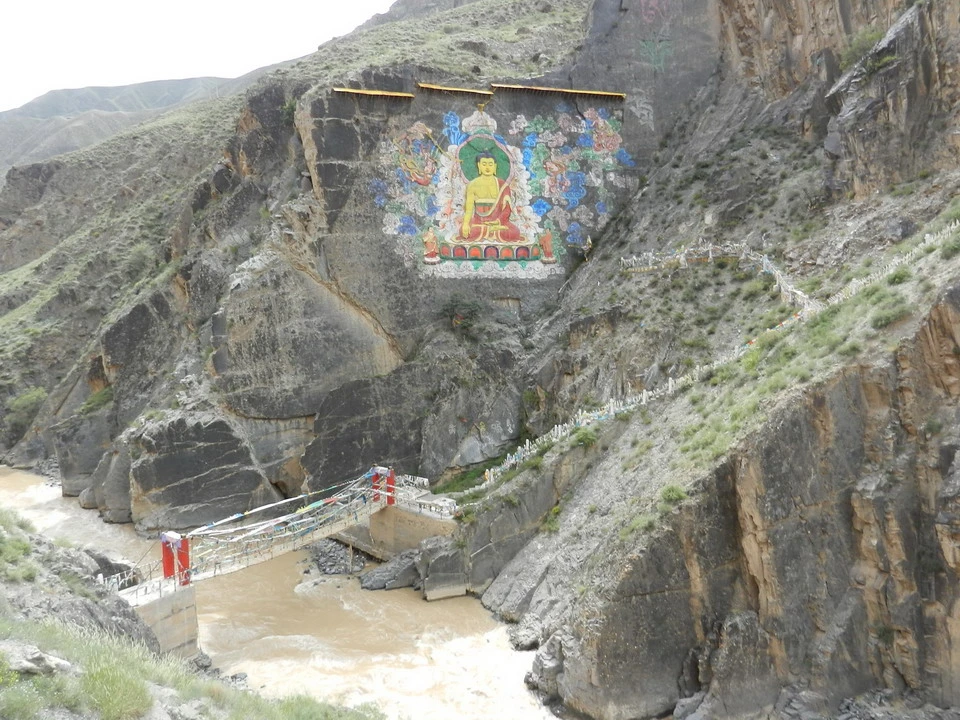
We descend along mountains of rusty color which quickly change the color of the mountain streams, which descend powerfully in a rich coffee-colored hue. At a fork in the valley floor, we turn north. The streams have become so large that they are now true rivers, continuing further on... Yellow River, we see slowly passing by, not very wide given the morphology, but deep. Shortly afterwards we encounter a Buddha depicted on a rock located on the opposite side of the road, surrounded by stupas and a Tibetan bridge that crosses the stream and leads to a narrow path ascending towards the image. We have now entered Qinghai province (one of the poorest and driest in China, serving as a testing ground for nuclear exercises). From this point onwards, we encounter only more villages of Hui Muslims (the term used in China to refer to Muslims): the hills have softened, leaving space for a largely flat landscape. White pumpkins, women wearing veils, and the domes of mosques become a constant sight. We head towards an expressway that takes us 75 km to Xining, the capital of Qinghai. The total distance will be 300 km. In general, we see many highways under construction with impressive viaducts. XINING, with 2.2 million inhabitants, is located on the extreme of the Tibetan plateau at an altitude of 2200 meters. The most relevant activity in the area is steel production, but it is certainly a city that has experienced rapid development, and the shops in the center demonstrate this.
Another reason that has favored the development of Xining is that this city serves as the starting point for the railway that leads to Lhasa in Tibet. Inaugurated in 2006 after numerous difficulties related to building a railway reaching an altitude of 5,000 meters, this line currently represents a confirmation of Chinese tenacity, and also serves as a bridge for the definitive colonization of the Tibetan region. As a result, anyone traveling from Beijing or Shanghai by land must stop here; in fact, when recent demonstrations by Tibetan monks, who set themselves on fire to draw attention to the problem of their region, caused this area to be closed to tourism, and the surrounding area also experienced restrictions regarding foreign access.
Once we arrived in the city, we were confronted with the spectacle of buildings under construction, even entire neighborhoods that were emerging to meet the needs of affordable housing. We were told that they were for seasonal workers who came here in summer to return south in winter: it seems strange that so much capital was being invested in temporary workers, and even more surprising how these cities, located in the middle of nowhere on the outskirts of the empire, could have such significant size. This is a situation we will encounter again, and there is a clear feeling that they are housing for rural populations invited to come and work in factories. This is a high-risk emigration. If it is true that work in the city is better paid and a salary represents certainty for workers, one can still ask whether this exodus does not undermine the social fabric of a region with a clearly rural vocation. Furthermore, if the uncontrolled boom that the region is experiencing were to somehow stop, one can wonder how and when it will be possible to reverse course. These are situations experienced almost everywhere during their industrial development, but what is happening in China has abnormal dimensions and a speed never seen before.
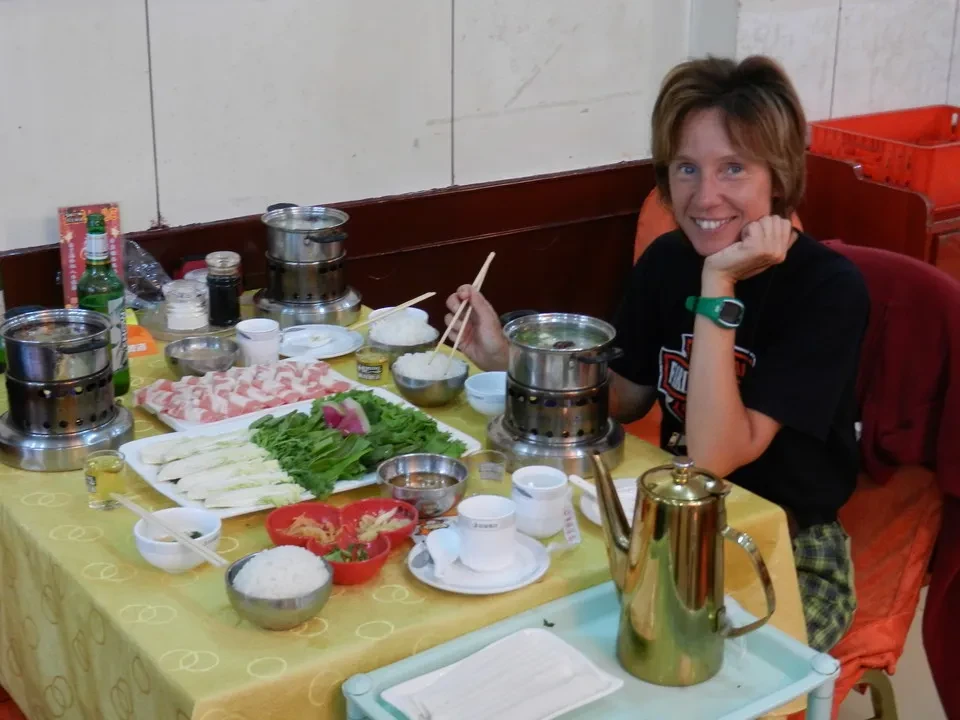
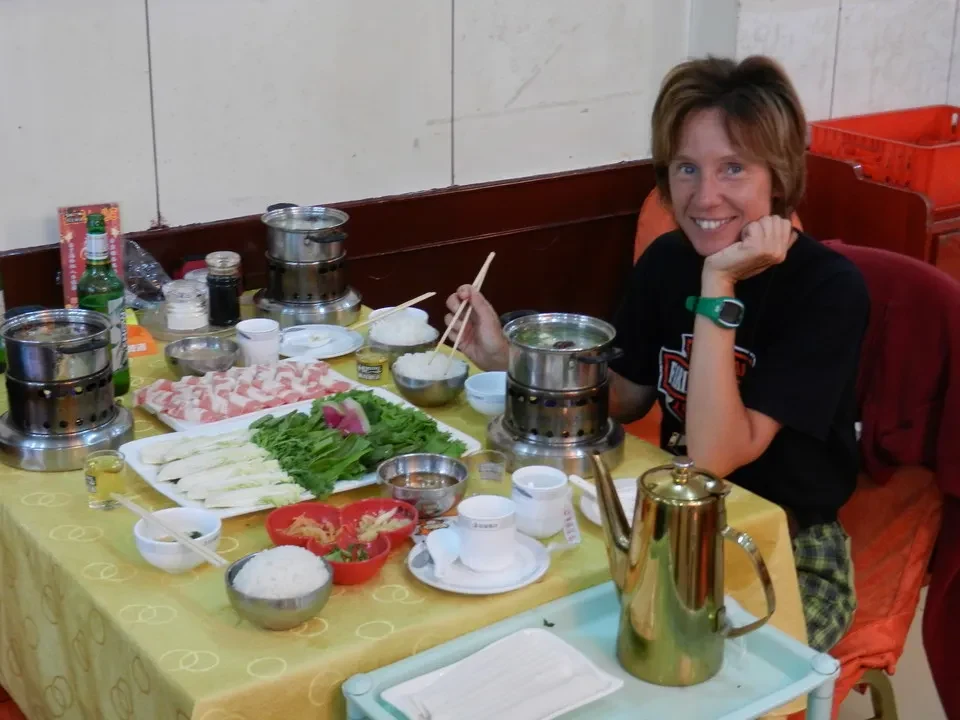
We have dinner with Can at a restaurant specializing in... Chinese Pot It's essentially a Burgundy-style dish: vegetables, meat, potato pasta noodles and tofu are successively immersed in a pot with a lit flame under it, filled with broth with various flavors (dates, celery, onion and herbs). Everything is left to cook to your liking. Once removed from the pot, it is then soaked in a mixture that each person prepares, containing garlic sauce, chopped chili pepper, soy sauce and other flavors that make everything savory. Rice accompaniment is a given.
After dinner, it starts to drizzle, but we still go for a walk. through the city center where traffic is a constant source of smog. The city center is particularly elegant: we walk quickly between fashionable restaurants and high-end shops selling everything from clothing to home furnishings. In particular, the clothing stores have beautifully designed displays, with items that would certainly be found on our main streets.
The dazzling display of neon lights and a large crowd of young people on the streets complete the picture. Returning, I see the magnificent pagoda illuminated.
The hotel is in a good location and features typical Soviet-style architecture. Its functionality follows this style.