Day 11
Turpan
Turpan, an oasis in the hottest place on Earth: mosque, vineyards and karez (tunnels for water supply).
Turpan
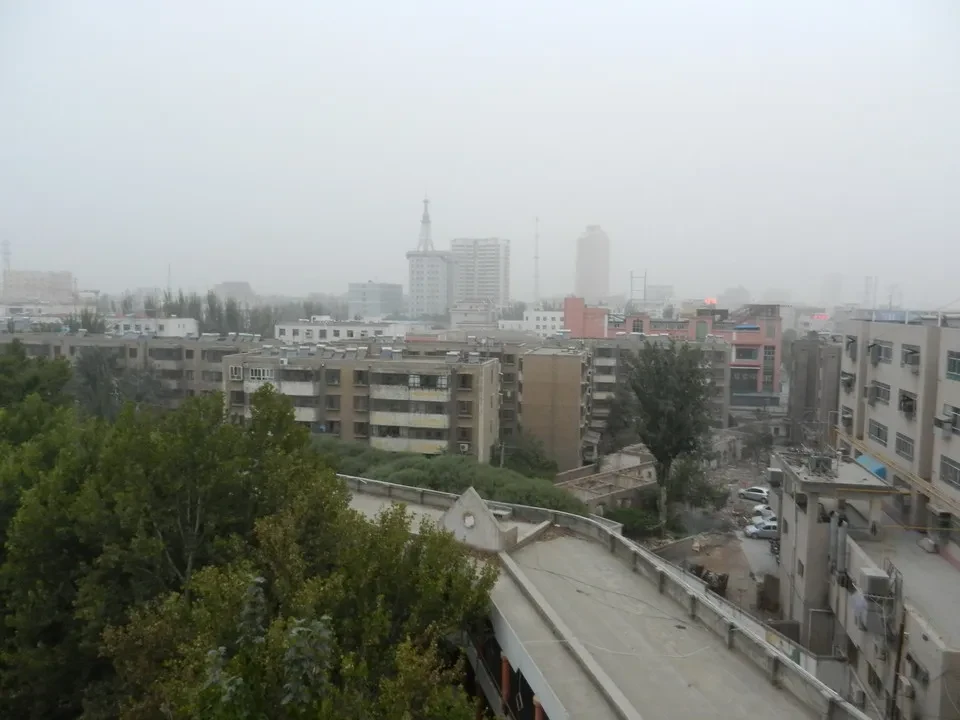
We arrive at the Turpan station a few minutes before. at 9 AM. Surrounded by the sunny expanses of the desert, TURPAN (255,000 inhabitants, -150 mt slm) is a gateway to Islamic Asia, inhabited by the Uyghur Turks, a crucial point along the ancient Silk Road, with its characteristic rows of poplars, plums and willows. We have finally arrived in the autonomous province of Xinjiang, and we immediately notice that it is a special province, as evidenced by the large police presence, second only to that in Tibet. At this point, we need to provide some explanations gathered about Xinjiang, a state within a state. Despite the central government continuing to encourage the immigration of Han Chinese, the Uyghur population remains the majority and is different from that of other provinces in every way. This ethnic group has been present on this territory for more than 800 years, practicing Islam, with a Turkic-origin language that has nothing to do with Chinese (the writing system is Arabic) and possesses a culture very different from that of the rest of China. Which is visible right from the first contact. Deng wanted the Uyghur name to be transliterated into Arabic characters instead of Latin ones, as happens with Turkish. He feared that using our alphabet would facilitate the learning of English or other European languages, thus giving this ethnic group an advantage. This advantage meant a window to the outside world and the resulting risks of instability. The wise Deng, without intending it, initially hindered the Uyghurs' access to the internet. Meanwhile, Chinese children learn English at school, but their knowledge remains only theoretical. They know that they will be promoted and do not dedicate themselves particularly to studying and practicing a foreign language. However, the Uyghurs are able to learn and speak it much more easily.
The fact that they are Muslim does not unite the Uyghurs with the Hui people I met in the previous days, as they are ethnically different. It seems they originate from Mongolia, from where they were moved in ancient times. They have been repeatedly dominated by China and other Western empires, even having a brief period of independence in 1944 until after World War II. In 1952, they became an integral part of the People's Republic. Currently, it is unclear what they want: some seek greater autonomy, while others demand independence. They certainly do not want to be discriminated against by Beijing. It is true that China has all the interest in maintaining control over Xinjiang due to the enormous oil deposits located underground and the strategic position of the region. As in the past, it still represents the western gateway to China, in an area where relations have historically been very delicate: the border to the south with India is still disputed (territories occupied by China and claimed by India), while to the north and west are the former Soviet republics with the Russian-controlled zone. The attempt at integration into Chinese society takes place through progressive industrialization and the construction of infrastructure such as high-speed rail, which will soon connect Urumqi to the rest of the country. Currently, there is already a highway and a busy traditional railway. The mass relocation of Chinese people to the west will never mean integration between the two races but will serve to bring everything to a point of no return. Chinese labor is more expensive but is preferred over Uyghur labor. It is said that Han people were sent to steal jobs from locals. Although a Chinese worker without special skills earns 400 ¥ per day and a Uyghur earns half, it seems that the first is always preferred. It is clear that the source of this information is biased, and it would be necessary to thoroughly investigate the reasons. When it comes to money, it is difficult for a Chinese entrepreneur to pay twice as much for the same service. It is possible that something is slipping through, but it is certain that the workers we see have almond-shaped eyes, both in private and in public (see Kashgar Mosque). The same applies to law enforcement officers. Even if you happen to see a Uyghur police officer, his superior will always be a Han. A technician earns 800/1000 ¥.
The fact that they speak a language closer to our own allows the Uyghurs to have a much more understandable English pronunciation and to better understand. This detail will prove very important for being able to communicate widely with guides, but especially with other people met during their stay.
In Xinjiang there are 13 ethnic groups, of which 7 are Muslim (Uyghur, Hui, Tajik, Kyrgyz, Kazakh, Uzbek and Tatar). They are all Sunni except for the Tajiks, who are of Persian origin and therefore Shia. The Uyghurs represent the majority.
Those who speak the Uyghur language understand at least 70% of Turkish, 80% of Kyrgyz and Uzbek, and 100% of Kazakh, with only minor differences, especially in pronunciation. The Uyghur script is simpler than traditional Arabic, as it has only 5 diacritics that can be placed above or below, while Arabic has 13.
The province has an area comparable to that of Alaska or France. The population of Xinjiang is approximately 4.5 million, with around 3 million living in Urumqi, which has a majority Han population. This demographic shift has largely occurred in recent years due to massive immigration. Turpan is primarily a Uyghur city.
Relations with Buddhists are quite cool, but there are no conflicts related to religion. They believe in Allah, a strictly monotheistic religion, while the Buddhists have what they call "idols," given the multifaceted figure of Buddha. In the early stages of their civilization, the Uyghurs practiced shamanism (probably during the time when they lived in Mongolia), then transitioned to Manichaeism and Nestorianism. They subsequently converted to Buddhism and, around the 11th or 12th century, adopted Islamic doctrine.
Currently, the Uyghurs also find it difficult to find allies in the world as no one is interested in antagonizing a good business partner like China. Pakistan and the former Soviet republics are allied with the powerful neighbor. There are good relations with India, which however already has reasons for contention with China and does not intend to create new ones. At the same time, trade is becoming more frequent, so politically correct demands that they adopt a cautious approach. The United States are not particularly well-regarded as they often wage war against their fellow religious people, but they recognize that without the US and the EU knocking on Beijing's door from time to time to demand respect for human rights, they would no longer exist.
The Uyghurs number less than 4 million, and the majority live in Xinjiang, while some minorities reside in the former Soviet republics. This is due to the fact that China, at the time of the collapse of the USSR, made shrewd concessions of territories inhabited by Uyghurs in order to disperse the population.
In the north of the region, it is very rare for Uighurs to marry Hans, but this does not happen entirely in Kashgar, where the two communities actually live in separate neighborhoods. Some Hans are already in their third generation, but there is no talk of integration. There is no real racial hatred, but the Hans are seen as being controlled by the Beijing government to colonize their region, and therefore they become the successors of the main enemy, as well as the usurpers of their land.
Morning in Turpan
We exited the station and headed to a restaurant near the center of Turpan for a quick breakfast. We settled for tea with some cookies, but our guide, who had been waiting for us for three hours, enjoyed a full breakfast. Despite it being 10 am, we were surprised to see so many people. We were explained about the time difference, which we had already read about earlier. In short, in China, the sun rises when the Communist Party wants it to. It's true that we are in the Land of the Rising Sun, but it is also true that the star has always risen at different times depending on our location along the meridians. That's why time zones were created. Beijing decided that there should only be one time zone, and that should be the capital's, located to the east. This means that Xinjiang is two hours behind what it should be, based on sunrise and sunset. This has led to the creation of an unofficial time zone, which is used in personal interactions, while official ones, such as those for public transport or government offices, follow national time. This can only lead to misunderstandings, but it is also clear that in Kashgar at 8 am, it is still dark. This explains why there were so many people in the restaurant at 10 am: for them, it was 8 am, and breakfast is typically eaten then. Whether the dishes are what we eat for lunch or dinner is our own consideration.
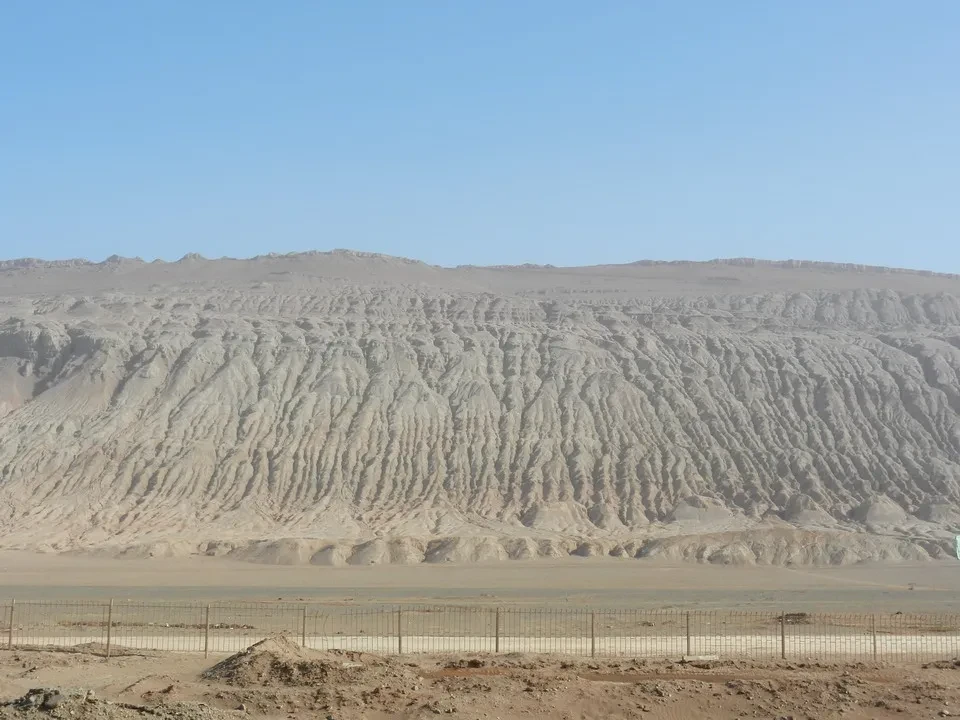
We set off to see the flaming rocks. Flaming Mountain They say it's one of the hottest places on Earth, but today the furnace is closed. We simply enjoy taking pictures of these beautiful red mountains, which we have definitely seen before. It's also possible that in extreme heat conditions, there are such bright lights that they make the peaks appear to be on fire, but this isn't why we came all the way from Italy.
It is also interesting to notice the beautiful vineyards that are the fame and pride of Turpan, and which represent 80% of the area's crops. As we go to visit... the local mosque with the famous Sultan Emin's minaret, in the architectural style of Central Asia. Inside, it is quite bare, although it is not yet frequented by worshippers. We are told that the service takes place in the afternoon. However, it should be noted that Turpan is a more secular city while Kashgar is more religious. The same women are more likely to wear veils and one rarely sees older ladies covering their faces with a brown scarf, a kind of Uygur burqa. While we are in the mosque, they remind us of the 5 rules of a good Muslim: to believe in one God who is Allah and that Muhammad is his prophet, to pray five times a day after ablutions (before sunrise, midday, evening, after sunset and before going to bed), to visit Mecca at least once in life if one has the mental, physical and economic conditions (otherwise it is necessary to renounce), to give 2.5% to one's church (which means to donate to those living in poverty) and to practice Ramadan once a year.
Those who visit Mecca are also expected to behave appropriately in their daily lives. This is also a moral obligation.
Around the mosque, the Islamic cemetery extends.
Traditions and spirituality
In the square opposite the Mosque, we are tempted to buy a bag of dried grapes: their sweetness and taste are unparalleled. Once harvested, the grapes are left to dry for 40 days in cellars built with brick that allow good ventilation but do not expose the fruit directly to sunlight. Wine is also produced, but consumption is limited by the rules imposed by Muslim religion. In any case, these varieties seem more suitable for making dried table grapes. This way, they are shipped everywhere.
The temperature remains warm due to the calm weather and the fact that we are in a valley about a hundred meters below sea level, but it will remain bearable until the end. It is even pleasant in the shade. Turpan is located in an oasis, which means that the water from the mountains to the north flows into this depression and emerges, making the vegetation thrive. As another contribution to fertilizing the area, since the first form of human life appeared about 2500 years ago, there have been created the Karez which we will see immediately after. It is an ingenious system of underground tunnels, dug by humans, that draw water from the Bogda Shan mountain range's aquifers to bring it towards the city. Only Turpan benefits from this, with a total length of approximately 6 km. Every 20/30 meters, a well was dug to bring the excavated soil to the surface and allow for aeration. The tunnel diameter is about 70 cm. At some point, the karez emerges to irrigate the fields. This system was created to prevent water evaporation during its course. The nearby mountains compensate for the chronic lack of water in this way. After all, rainfall of only 16 mm per year does not provide the minimum conditions for plant or animal survival.
We also stopped at an outdoor bakery. bakes bread with a a system I have never seen before After shaping the loaf and adding sesame seeds, it is placed against the inner wall of a large open-top pot/oven, while the fire burns at the bottom. The loaves are then removed and turned over to cook completely. We buy one that has just come out of the oven and enjoy its fragrance.
We return to the same restaurant from this morning for lunch, featuring lamb skewers as the main course. rice pilaf. Here too, there is the usual barbecue with burning charcoal for grilling, located outdoors. A fan blows sideways to keep the fire going and prevent the skewers from absorbing the smoky flavor. Fragrant spices enhance the meat and are a real delight for the senses.
A stroll through the city center reveals its unique features. Due to the intense summer heat, grape arbors have been created to cover the main streets. Under one of them, there is... the local market where negotiations can take place in the shadows. The bazaar is definitely more interesting here. Here, the goods are covered with tarpaulins and you can see various items on display, especially food. meat, spices, (vegetables) ... as well as hardware, toys and other consumer goods. There is quite a bit of poverty, but nothing alarming. We see crystallized white or yellow sugar for the first time, while chili peppers are everywhere in sacks, indicating that it's a product in demand.
At 3:15 PM, we depart from Turpan and head towards Urumqi. highway jump approximately 220 km to cover in 3 hours.
To see the karez and the mosque, we decided to skip visiting the ruins of Gaochang and the Grape Valley, as vineyards can be seen quite easily elsewhere.
Along the route, we encountered many checkpoints, and the police carefully monitored travelers, checking their documents. Sometimes, military personnel were also in riot control formation behind trenches made of sacks. On a couple of occasions, we had to provide our passports. The official reason was that there was an Eurasia-China exhibition aimed at attracting investment from third countries towards Xinjiang. However, it seems this is also an opportunity for local residents to see that law enforcement is present and that this serves as a deterrent to any potential troublemakers. The importance of the meeting, which included several heads of state and received extensive media coverage, remains significant. All Central Asian states and some European countries participated.
A quick dinner near the Urumqi airport, then we head to check-in for the direct flight to Kashgar. Urumqi It has 3 million inhabitants and will also be the capital of Xinjiang (the former Chinese Turkestan), with a large industrial complex, but the airport is a newly built structure, plastic in appearance but efficient inside. It's unimaginable considering its location on the map and the fact that the city is far from being a well-known place for most people.
Flight from Urumqi to Kashgar (CZ6801, 20:45 – 22:30)
The flight with the Boeing 737 of China Southern departs on time and arrives at the destination in about two hours, where there is currently a. sandstorm The effect is barely noticeable and doesn't cause any problems for air navigation; we only see a yellow haze around us. This is quite unusual, as in late summer the sky is usually very clear, and this is more typical of spring. We arrive in the westernmost corner of the most western province of China, at the edge of the world’s most terrifying desert, the Taklamakan. We arrive in a town where it's 23:00 but we know that for them it's only 21:00. After all, we are 4000 km straight from Beijing, but we use the same time zone. There is a lot of activity on the streets and people are enjoying kebab skewers in outdoor restaurants. We immediately adapt to local customs and go for a walk to get acquainted with the city. We don't even feel like we're in China. The writing is in Arabic, the people have features closer to those of populations living in Central Asia, and the architecture is different from what we have seen so far.