Day 5
Yellow River
From the industrial city of Lanzhou to a taste of Tibet, passing through the sacred site of Binglingsi.
Ten thousand Buddhas
Although the train was quiet and there were no particular problems, the night was spent poorly due to a Chinese man who started snoring as soon as he fell asleep. The fourth guest in our bunk bed is a girl who shares with us the forced insomnia of the snorer. At least with this one, we can exchange a few gestures, since speaking a common language is impossible and Chinese people are not even accustomed to saying hello. It doesn't seem that they exchange greetings when entering a shop or meeting a stranger on their way. This isn't rudeness; it's simply a common attitude that should be accepted as it is. Certainly, this cold attitude does not inspire particular sympathy. However, there are some people who make an effort to help you, especially if you are a foreigner and struggle to understand the instructions in ideograms.
Just before 6 am, a female officer from the railway regiment stormed into the compartment, turned on the light, and shouted something, thus giving us a good morning in her own way. When she returned a few minutes later to take the pillowcases, we were already awake enough to carry out the order without any arguments; after all, the night had passed practically sleeplessly. A subtle revenge was enacted against the snoring wild boar that had lingered, when the "lady" pulled the pillowcase away from under his head, waking him up suddenly.
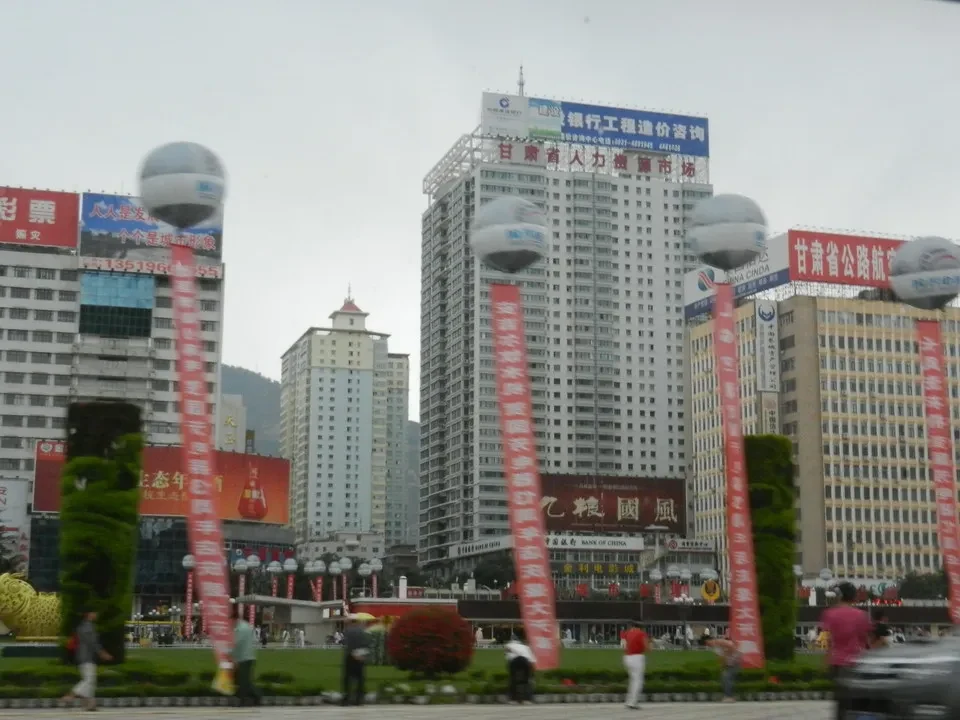
The train arrived on time, but we missed our meeting at the Lanzhou station. In the crowd of people, we couldn't immediately find the guide; we were the only pale faces and saw a young man holding a sign with two names that weren't ours. We continued to look around, but there was no reason for us to meet if someone else was waiting. After about ten minutes, when all the passengers from our train had disembarked and others from subsequent trains were flowing continuously, I approached to try and understand. I didn't even have to speak: I saw that on the other side of the paper were our names, and I discovered that he had simply mixed up which side of the sign to display. We couldn't communicate because it was the driver, and he didn't speak English. But he quickly got in touch with Can (a fictitious name used by Chinese people to appear more Westernized), who arrived immediately. There were two exits, and he had gone to guard the other one. Once all the members of the expedition were reunited, we could finally start for breakfast to break our fast. We didn't have much appetite, but eating some watermelon slices with coffee and brushing our teeth in the morning is a habit that we try not to miss. There was no mention of spaghetti, vegetables or chicken, nor garlic, which Can particularly enjoyed. As if it were needed, with our sense of smell, we immediately understood, but he would confess it at lunchtime. A quick walk through the city under a light rain that began to fall slowly: we didn't even want to think that those drops contained two parts of hydrogen and one part of oxygen: Lanzhou in the 1990s was the most polluted city in the world, and even if it had recently lost this sad title, it could hardly become an oasis of pure air. The refineries, textile and chemical industries continued to exist, and traffic wasn't any better than elsewhere.
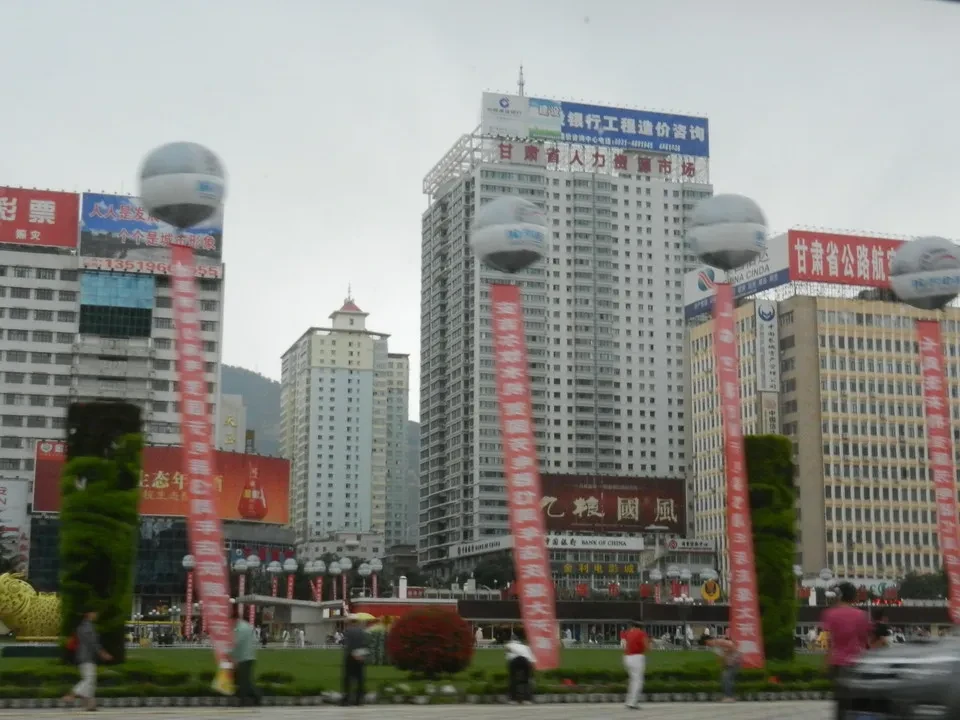
Located on Yellow River at an altitude of 1600 meters. Lanzhou (with 3.6 million inhabitants, representing 70% of the population of Gansu) is the capital of the Gansu province. Its commercial activity dates back to the Silk Road era: the city was located at the intersection of the main caravan route with several secondary routes that connected it to Mongolia, Qinghai, and Tibet. Han, Hui, and Mongol people live here. Usually, 200 mm of rain fall per year, while just a few days ago, a flood brought 14 mm in a short period, with predictable consequences for a city not accustomed to heavy rainfall. This resulted in flooding and cars floating on the water. You can still see large puddles around the city that are gradually disappearing, while the river moves smoothly With great enthusiasm, he carried with him all kinds of vegetation and trash while brushing against the trees in his hive. It looks like a huge stream of cappuccino flowing downhill. As we have seen in other areas, there are many willows among the tall vegetation, while each terrace represents a useful space for growing something, especially sunflowers, corn, and potatoes. To limit traffic on weekends, alternating license plates are used: people can buy Chinese-made cars with foreign brands (many VW Santanas) because the locally produced ones are of poor quality. In Xi'an, we actually had a car produced by Red Flag, similar to the Passat or its Kia equivalent. It was a high-displacement engine and fully equipped inside, but we were not sure about its reliability over time. However, it is interesting that a car clearly designed (or copied) in a bourgeois style is produced by a company called "Red Flag". If the contradictions ended here, we would be able to relax. Thanks to government incentives aimed at making cars accessible to everyone, you can spend from 30,000 ¥, but the quality remains the same. Accommodation, on the other hand, is very expensive: 100 square meters in a difficult-to-recognize hive can cost around 1,000 € per square meter, so few people can afford it. The work in the factories is attracting farmers who lived in subsistence agriculture in the countryside. This justifies the presence of huge construction sites that are building entire neighborhoods, but it's unclear how farmers can afford to buy these apartments. However, being a state with a high social structure, there will certainly be ways to make them accessible even to the lower classes.
The same applies to whiskey; there are two brands available and the taxes are high: it's a product for wealthy people.
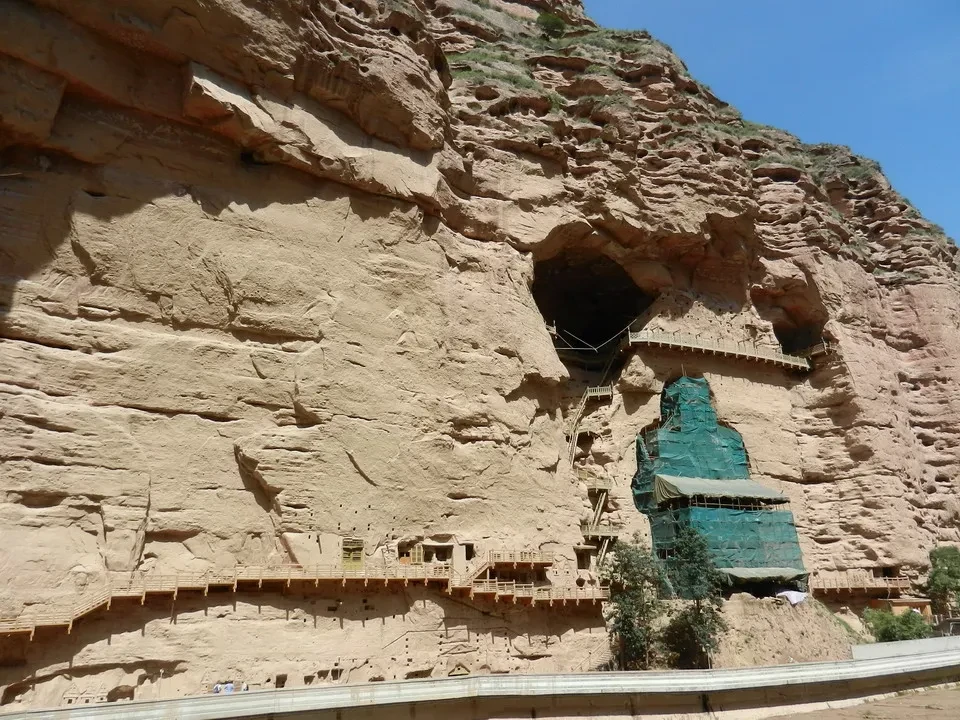
The road descends to cross the Yellow River again at the Yongjing Dam, which releases a huge amount of water to create a massive waterfall that flows through. narrow rocky walls When the river returns to a calmer flow, it passes through Liujiaxiaxiang, one of many industrial centers that have sprung up seemingly out of nowhere in a nameless valley. Industries that seem to be located only on the outskirts of major cities are found almost everywhere here. As you move away from the urban chaos, you return to rural landscapes until you reach the Yellow River embarkation point. Then, it takes about an hour to boat trip on the artificial lake created for the hydroelectric power plant, up to the complex of caves known as the " Ten thousand Buddhas"of Bingling, which is marked by a statue of the Buddha carved into a niche on the wall of a cliff.
Buddha Nirvana
The Binglingsi Temple cave complex is located approximately 100 km south-east of Lanzhou. It consists of 183 caves dug out in a porous rock and therefore easy to carve; they are painted on the wall of what is actually an Eastern Sculpture Gallery in a mountain, providing shelter for 7,200 stone and clay figurines and 1300 square meters of murals. The Tang Dynasty sculptures offer the opportunity to learn more about the original Buddhism. The decorations from 600 AD represent faces that are much more Indian than Chinese, as this religion had only recently arrived from northern India, where it was born approximately 1000 years earlier: the same Buddha in his various depictions has a longer face and almond-shaped eyes. In the later sculptures, he is represented as shorter and hunched over. The first Buddha, Shakyamuni, is usually depicted with hair on his head while Avalokiteshvara can have multiple arms, heads, or simply a crown. Near the God are usually the Kasapa, i.e., older disciples/students. The lama is a higher clerical status than a monk. Female nuns are called Nan. Mahayana monks usually cannot marry, but there is one type that can and distinguishes itself by having long hair and wearing a white-sleeved robe. Monks do not cover their arms and therefore do not wear long sleeves because legend says that Buddha was born from under an armpit, so that arm must remain free. The seated Buddha, 27 meters high, is packed for repairs but he clearly understands its scale. The size is also remarkable, and it is... Buddha Nirvana, which represents the past Buddha. lying down of those who have reached the afterlife. It has been moved to a raised position on the other side, as the dam would eventually flood it. It is possible that in the future, other caves could also be flooded by the drainage of water from the dam built in 1969, which has raised the water level and seriously endangers the survival of the structures. Via a steep path, we reach the hermitage carved into the rock overlooking the Yellow River. It is inhabited by a a small town that implies to clean the niche that houses some sacred statues. It's time to get back in the motorboat and head over to dock on the opposite side of the lake. It's interesting to notice how the river water... disembark yellow and the fine sand doesn't leave any doubt about its origin, while when it opens into the lake, the sand sinks deep and the waters turn crystal clear blue. It is estimated that the river has a loess density corresponding to approximately 50% of the weight of water. Indeed, the Yellow River is clear for the first part of its course, then crosses the so-called loess plateau, a vast area where thick layers of sand have accumulated over time, carried by wind from the Gobi Desert, which lies further north. Solidifying, it formed a sort of land that is gradually eroded by the river, which transports it downstream, making the eastern plains fertile. It seems that the entire river is not navigable, despite its size and length exceeding 5,000 km. Apart from the dams built for hydroelectric power generation, there are continuous rapids that prevent commercial transport. In the region where we are, the river is not yet polluted but will soon become so as it passes through Lanzhou.
During our visit to the caves, the driver drove the car onto the opposite side of the reservoir via ferry and then we continued on to Xiahe. We passed through a hilly area where the locals were busy with... collecting peppercorns red. Lunch at Linxia and a walk to get acquainted with this orderly town on a Saturday when there are many people strolling around and young people watching a show in the center. Now, bourgeois attitudes are no longer frowned upon; those who have some money can certainly spend it well.
We are located in an area with strong Islamic presence (approximately 80%), of Hui ethnic origin and Sunni religion. The mosques shine almost everywhere. every country we encounter It seems likely that they are being funded by wealthy patrons living in the Middle Eastern countries. There isn't much visible prosperity in the area, while there are many and lavish mosques. It's no surprise at all. Linxia It is called the "Medina of China," due to the fact that it contains... Islamic schools It is said that Muslims arrived as a result of migrations following the conquests of Genghis Khan. In summary, one can say that the oldest mosques are in Chinese style and therefore it is easy to confuse them with a temple (rare Arabic inscriptions are noticeable), while the more recent ones are in Arab style. Men usually wear white turbans (which distinguish Hui people), while women sometimes wear veils on their heads. A moderate and tolerant form of Islam is practiced.
Overall, we notice that everything is well-maintained and orderly, primarily for efficiency rather than aesthetics. In the countryside, it's mainly maintained to maximize every square meter for agricultural production.
As we approached Xiahé and gained altitude, we saw that he was harvesting wheat. other grains... then left to dry in large bundles tied together in the middle. Meanwhile, construction of the new highway is progressing, which will soon connect Lanzhou and Xiahé.
During the trip, we discuss several topics: We are told that there are good relations between the Muslim and Buddhist communities in this area, while regarding the second child policy, it mainly applies to the Han ethnic group and those living in cities. Ethnic minorities can have a second child, while those living in rural areas may have three. Anyone exceeding the established limits must pay significantly more taxes until their child reaches adulthood. Others will tell us that this policy is no longer strictly enforced, as industrialization and subsequent migration have created difficulties in "tracking" births.
Historically, the Xiahé region belongs to the Amdo cultural province, an autonomous geographical area until 1959, fundamentally Tibetan and separated from Tibet for essentially political reasons. Officially, we are still in the Gansu province and within an autonomous prefecture, ethnically belonging to Tibet. The same applies to the Qinghai province, a man-made creation; we could even call it a buffer province, but in any case, it is part of Tibet. Another culturally Tibetan region is Kham, currently divided between the provinces of Tibet and Sichuan, also subject to massive immigration by Han Chinese.
We arrive at XIAHE, where we return to see some familiar Western faces. The city is essentially split into two: to the west, the Tibetan quarter with its recognizable buildings covered in earth, housing 50% of the population. To the east, the Han (40%) and Hui quarters. We are at 3000 meters, and the air is starting to feel crisp. During a walk in the Tibetan region We'll meet up to observe how we act as if we were aliens, since the sight of foreigners is a special event. In particular, the children passing by greet us with a friendly "Hello," which represents their English vocabulary; we don't even know that in Tibetan. But meanwhile, during these days, we have discovered that "Mom" is said exactly the same way as in Italian. The local government has allocated several funds (around 3 billion ¥) to renovate the monastery and its surroundings, so we can see... countless masons (among which many women) were focused on paving the roads that had previously been unpaved: this will improve the aesthetic appearance, but something will be lost in originality and charm. The fact that there are several construction sites is not surprising given the country we are in, what is surprising is seeing women working on building projects that are usually reserved for men. They are accompanied by monks from round shapes completely unconcerned, going about their business with a calm and perhaps even nonchalant attitude, maybe even holding their smartphones. Each person pursues their own task or mission, but the overall picture is not particularly inspiring.
We are staying at what will undoubtedly be the most memorable accommodation of the entire trip: the hotel Baoma It is managed by a Tibetan family and features typical ethnic décor. While we check our emails on a computer near the reception desk, we suddenly see the young receptionist, who jumps onto the counter with impressive agility, landing on something that we can't quite make out. Once she has overcome her initial surprise, she explains that she saw a mouse. One of the colleagues then retrieves the animal and likely takes it to a safe area, as Buddhists do not harm even rodents that enter hotels.
Another walk through a town with unusual habits, and we say goodbye for today from this charming village.