Day 3
Terracotta Army
The Terracotta Army continues to inspire awe, even after 2200 years.
The urban face of the Terracotta Army
The night passes with the rattling of the train and is certainly not like resting in one's own bed. After 1200 km and 13 hours of travel, we finally arrive at XI'AN (formerly known as Chang'an) at 9:00 am, where we are greeted by our local guide, Michael. The city has a population of 8.5 million. For many centuries, it was one of the world's major metropolises and for 2000 years, it was the capital of China. It is the starting point of the Silk Road, currently the capital of the modern Shaanxi province. When Chinese interests shifted eastward, the largest cities also developed in that direction at the expense of Xi’An.
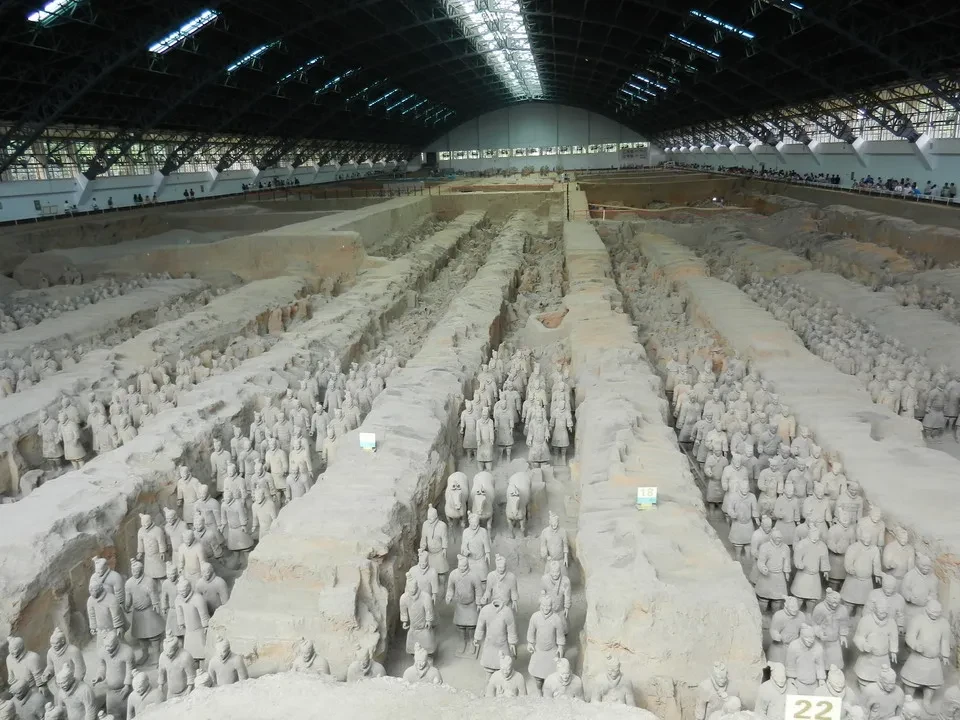
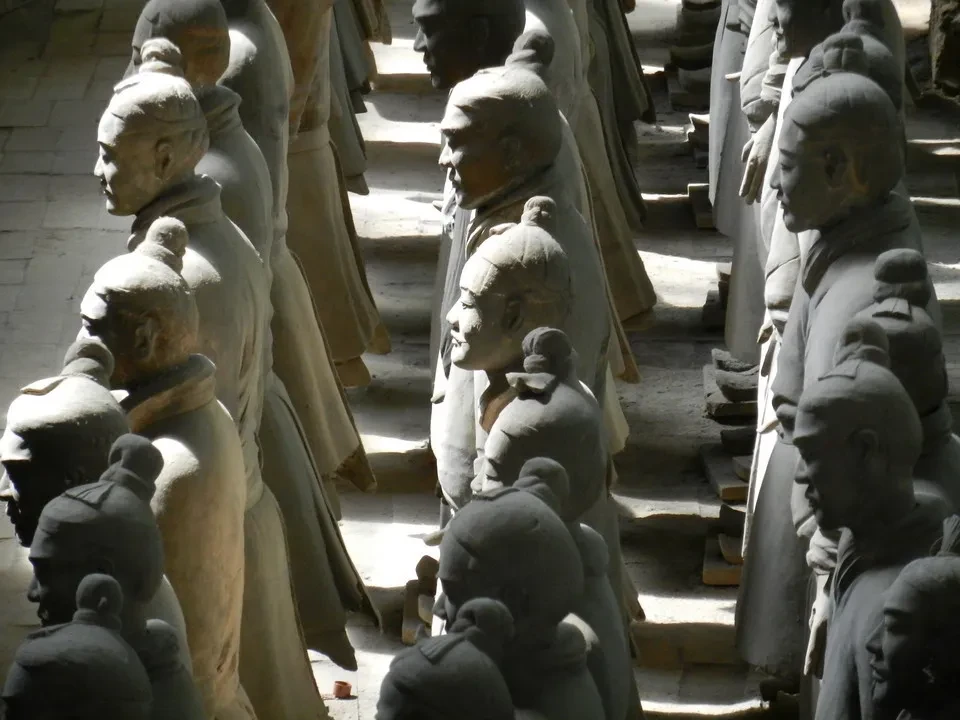
The Army of Terracotta It is located 28 km east of the center, and it is the burial place of Emperor Qin Shi Huangdi, who died in 221 BC, and was the first emperor to rule a unified China. The site, which is therefore 2200 years old, was discovered accidentally in 1974 by farmers digging a well. Half a kilometer east of the large tomb, one of the world's archaeological wonders came to light: an army consisting of 7000 life-size statues of warriors in terracotta arranged in orderly rows in battle formation: the warriors are depicted with different expressions and postures in a battle formation, with weapons and chariots pulled by horses. The excavation and restoration work continues to this day. The army can be seen in three large hangars, while the original bronze weapons were largely removed later Some weapons and two magnificent bronze chariots pulled by horses can be found in the museum next door. Originally, the army was protected by a wooden structure, which was then set on fire and covered with earth, parts of which are still visible today in a particularly dark color. Each warrior it's different From the other side, one might think that those who built them were inspired by people living in those places. The statues range from 1.76 to almost 2 meters in height. Although we are told that ancient Chinese people were taller, we believe it is more likely that these are deliberately exaggerated proportions intended to inspire greater awe. Pavilion number 2 is still largely unexcavated, but we learn that a significant portion will remain submerged underground to protect the warriors from sunlight and prevent their precious colors from fading. What can be seen here is already quite sufficient to attract visitors; the fact that not everything is revealed creates further anticipation and fascination for the site, as well as providing an opportunity when new discoveries are made. In a souvenir shop adjacent to the museum, I met an elderly gentleman who was busy signing books dedicated to the Army. He was presented as one of the discoverers of the site; there were 5, but only three remain alive today. Certainly, he must have been quite young 40 years ago: the story of the farmers digging a well is authentic, and the gentleman we saw might raise some doubts about the originality. What is certain is that his presence and signature on the books, as if he were the author, help with sales; however, at that time he had a pickaxe instead of a pen in his hand. It seems cynical to think that at least one of the discoverers will never die. It would also be interesting to know how the news was originally received, given that we were in the midst of the Cultural Revolution and that the Terracotta Army could only be seen as an imperialist symbol and therefore had to be destroyed. If the revolutionaries had destroyed the work, they would have caused a great injustice, not only to archaeology but especially to the thriving tourism industry today. The area adjacent to it has been completely paved (possibly also covering some artifacts) and is used for all kinds of commercial and recreational activities. Tourists flock in droves to get their photos taken with anything that might appear noteworthy in the background. Unconcerned about the true treasure they have before them, they demonstrate that their rapid evolution has skipped over some fundamental principles of travel.
Dacien Si
We have lunch at a small restaurant where a skilled chef prepares the "lamian," thin noodles pulled by hand, completely extending their arms. This requires skill and experience.
The tomb of Qin Shi Huang is located about 30 km from Xi'an, near the Army. Qin was the first emperor who ruled unified China under a ruthless tyranny and initiated the construction of the Great Wall. The tomb remains a symbol of infinite power and his ego. It appears as a mound, immediately covered with earth to appear as a simple hill, and its treasures hidden inside have not yet been revealed.
It is the pomegranate season Outside the city, we see fruits covered with plastic domes to prevent insects from attacking them. It's amazing how every single fruit has been protected to avoid spoiling. Amidst increasingly chaotic traffic, we head into town to visit the Great Wild Goose Pagoda. Dacien Si), together with that of the Little Wild Duck, was built to preserve Buddhist scriptures. It is the largest temple in Xi'an, set within a symmetrical avenue with side streets intersecting with fountains and flowerbeds. It is an ancient building well-preserved and a sacred place for Buddhism.
It seems the name comes from the fact that, while it was being built, they didn't know how to call it. When a flock of ducks passed overhead, one of them detached and landed on the ground. This gesture, symbolizing good luck, recalls the Buddha... which has had a worldly purpose to convert people. Regarding the "good omen", it is important to remember the Chinese superstition, which identifies everything and sees every gesture as a symbol related to fate, especially when selling something.
At the entrance to the Pagoda, there are two panels depicting... Xuan Zang, who is responsible for the spread of Buddhism in China; he was the one who departed to go to India in search of sutras and other sacred texts related to Buddhism. His work, along with the translation of texts performed in the pagoda, allowed Chinese people to have the guidelines for a massive introduction of this religion. Everything was then integrated with the other two existing religions in China, Confucianism and Taoism. The Pagoda houses paintings depicting... Buddha's life, a statue with Avalokiteshvara and a hall with the Buddha Shakyamuni: currently, 60 monks live in the temple. The building has 7 floors, and an odd-numbered floor brings good luck; you can reach the top floor, enjoying a wide view of the surrounding city.
Xi'an immediately appears to me as a chaotic city, less well-maintained than Beijing (as is logical). There are huge palaces still largely under construction: it seems that housing is also needed for the people of Xi'an. The most thriving industry in this city is high-tech.
Despite the sky being covered by a yellowish haze that makes it difficult to distinguish between clouds and smog, the weather is considered pleasant even though it's hot and humid. The traffic is unbearable: there are traffic lights at major intersections, and every driver drives in a way that we would certainly consider uncivilized. Everyone tries to find their own way through to pass simultaneously. What is civil about this is that no one complains and everyone honks their horns, not just to signal their presence; this habit has taken on a very different meaning than it does at home, and as a result, the noise pollution is not less severe than the air pollution. The motorcycles are almost all electric and do not make any noise, increasing the risk of not noticing them approaching and being hit. The heat keeps people indoors, and everyone stops to eat in the numerous restaurants along the road: for us, it's a buffet dinner with sweet and sour candied pork, various types of duck and chicken, a vegetable that seems to belong to the spinach family, and other dishes with plenty of celery, onions, and leeks. The most popular fruit is watermelon.
Traditions and spirituality
After dinner, we also go to the Muslim quarter where you can see. all kinds of food, but mostly with a looks delicious. The Muslim population in China (excluding the Uyghurs and a few others) are known as Hui, and they originated from migrations (whether voluntary or forced is unknown) that occurred at least 700 years ago. The religion has allowed them to maintain their own identity by marrying within their community and living in the same neighborhood while preserving their traditions. There are approximately 30,000 of them, and they practice Sunni Islam.
Let's take a look from the outside at the Tamburo Tower, well-lit, used to announce the sunset and therefore the closing of the city gates. The sound of the bell instead announced the sunrise.