Day 9
Jiayuguan
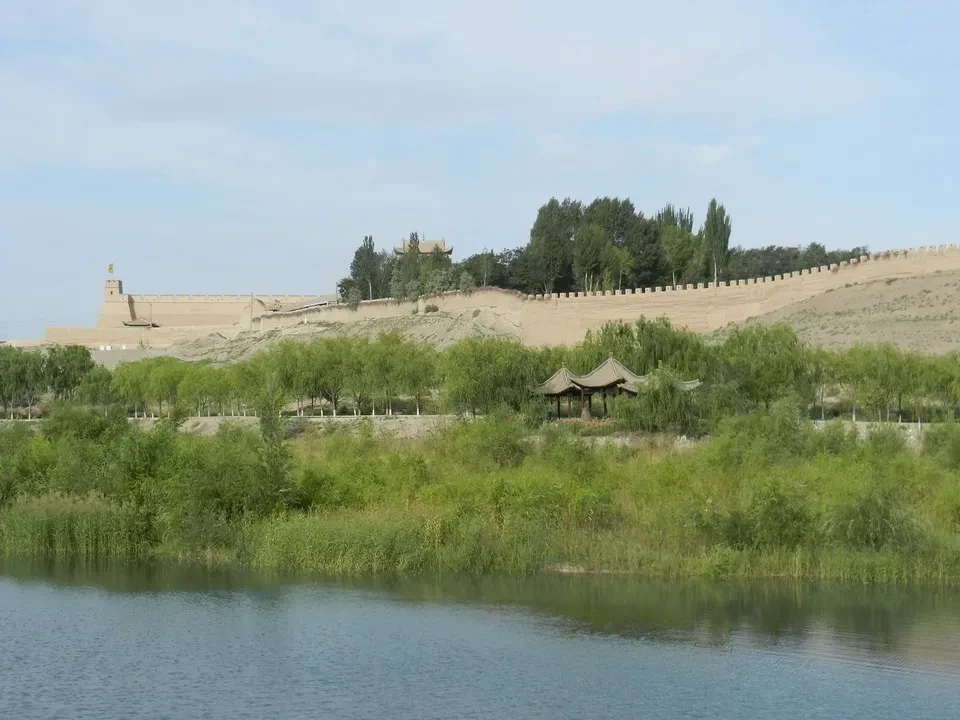
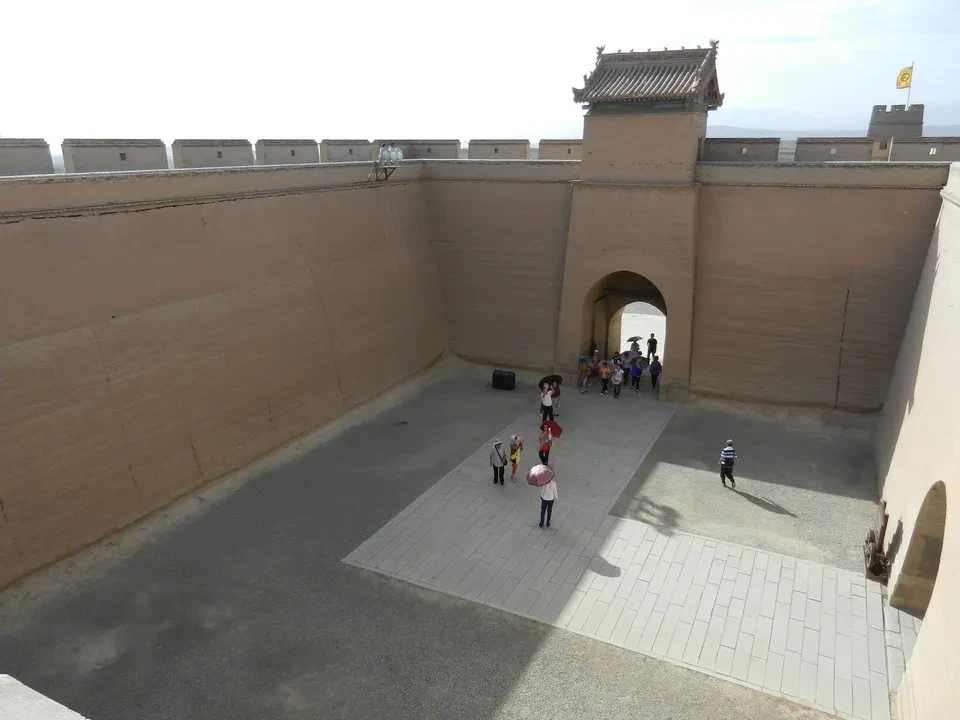
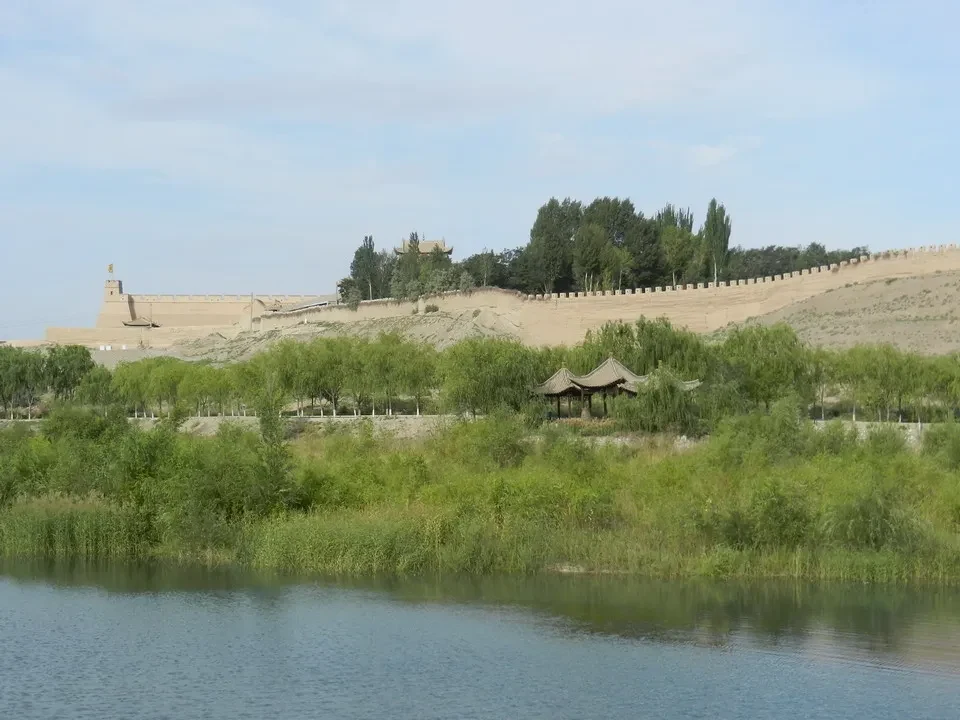
The Jiayuguan fortress, the western end of the Great Wall. Evening market in Dunhuang.
Arrival at Jiayuguan
We really enjoy lunches and dinners, but the breakfasts are disappointing. Having grown used to jams and pastries, we can't bring ourselves to eat boiled vegetables, tagliatelle in soy sauce, chicken bites, or even entire trays of boiled garlic. We settle for a cup of tea with steamed bread and move on quickly, heading towards the Jiayuguan Pass. Actually, the first view left us quite puzzled: we thought it was a fortress built on some unknown mountain pass, but in reality, the pass should simply be understood as... as a transit area of travelers at the narrowest point of the Hexi Corridor. We are at the western end of the Great Wall, and this place was the mandatory stopping point for all goods traveling between China and the West. To the south, the Qilian Mountains rise to over 5,000 meters, and to the north, the Mazong range creates a narrow passage in this part of the corridor that remains at least about ten kilometers The landscape is completely desert-like, and it makes you wonder what life would have been like here in ancient times.
The Great Wall Museum itself is a spectacular fortress completed in 1372, from which you can enjoy a magnificent view of the Hexi corridor, the surrounding mountains, and the final section of the Great Wall. The tourist facilities make the imposing walls appear as a Disneyland construction, diminishing their historical significance. Paved walkways and vendors of all kinds lead to the fortress. The original Ming Dynasty structure later lost its primary purpose, as the western part was also Chinese territory, thus rendering the main reason for its construction obsolete. For many years, it served as a small military outpost. while recently It has been renovated, just as it was during the time when... represented a strong defense. almost insurmountable due to the Invasions from the west The Great Wall continues for several kilometers, completely closing off the passage. In fact, in this section it would be more accurate to speak of... Small Wall as it essentially involves a narrow wall covered in muddy mortar. The same fort is built according to the same principles, and we can even see some workers transporting with mud and straw mixed carts for plastering a newly rebuilt area. In the best times, around 2000 people stayed at Jiayuguan, and here the water was channeled to ensure a certain level of water autonomy for the imperial forces. The fortress also housed women, translators, and writers. The story is told of the ambassador who went west to forge alliances, was imprisoned, and remained there for ten years. When he returned, he had at least managed to map the then unknown territories. Near the fortress is the museum of the Great Wall, which also provides valuable information for the Silk Road: it explains the construction type and allows one to understand how difficult it is to determine its overall length. Much of it is overgrown with vegetation and is even invisible to aircraft, while various sections are very narrow, unlike the traditional image we have. Depending on where it runs, the building materials also change: from squared stones to bricks or this type of hardened mud, where nothing else can be found. This last form is still resistant because it was tested through archery tests and the plaster should not flake off.
We return to Jiayuguan for lunch and then head directly to Dunhuang: it's about 380 km and takes approximately 5 hours. The C30 highway leads to Turfan, but at some point it branches off towards the south, diverting us towards our destination. a simple highway We continue south for several kilometers, first through a steppe-like environment and then into the most arid desert, inexplicably interrupted by rare oases where melons and sunflowers are cultivated. In this section grow the only trees that can thrive in these areas: high-voltage power lines and wind turbines. We are told that this is the largest wind energy production facility in Asia, and we find it hard to believe. The "forest" continues for dozens of kilometers without interruption, with a succession of wind turbines planted like toothpicks in the arid soil and cables supported by pylons carrying electricity elsewhere to support Chinese development. In the final section towards the east, low and undulating mountains stretch out, carved by jagged ravines, on which there is no vegetation whatsoever. To the west, there is nothing. From Beijing to Dunhuang, we have already covered 2881 km, according to the perfectly clear road signs that provide us with the distances.
In this eerie landscape, Dunhuang and its oasis are a pleasant surprise. Before reaching the destination, we pass by... cotton cultivation and melons. Practically, all the water here is extracted from underground, as the annual rainfall barely reaches 30 mm and evaporation exceeds 3000 mm.
Evening in Jiayuguan
Even this city at night (which, unlike Beijing, is about an hour later in time, maintaining the same time zone) transforms into a small Las Vegas in terms of neon lights; slot machines are not yet available. The evening market of Shazhou is one of the most interesting attractions: besides the countless souvenir stalls, you can see a glimpse of everyday local life among the stalls selling food and groceries. Meat, especially pork and lamb, is displayed on... wooden tables, the poultry is in the separate cages, while fish similar to large trout are found in tanks where they struggle to survive. The vegetables are the most varied, with melons from local production standing out. The stalls that are most attractively colored are those selling spices and of nuts. Among the first are all kinds of spices and grains to enhance flavor, with a particular preference for chili peppers, stored whole, sliced or chopped into sacks of jute. The second ones are a real treat for both taste and sight. All types of dried grapes (probably arriving from Turpan) up to dried kiwis, which are not found in our area.
We enjoy a local specialty, tagliatelle with donkey meat.