Day 7
Tibetan Monasteries II
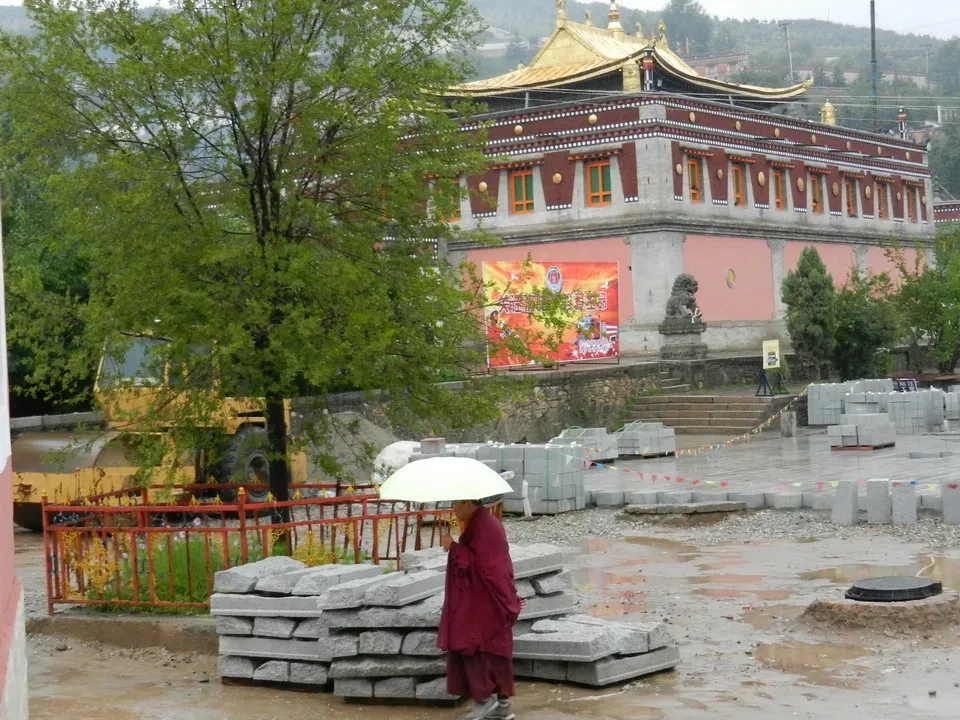
The Taer Monastery, still in a Tibetan style. But the Chinese influence is more prominent.
Kumbum Monastery
In the evening, it starts to rain and the rain will continue steadily until mid-morning when we leave the area. Breakfast is served in a hall that may be better suited for evening events. Nevertheless, eating spaghetti, garlic, and other similar dishes doesn't seem like the best way to start a day of visiting a new monastery.
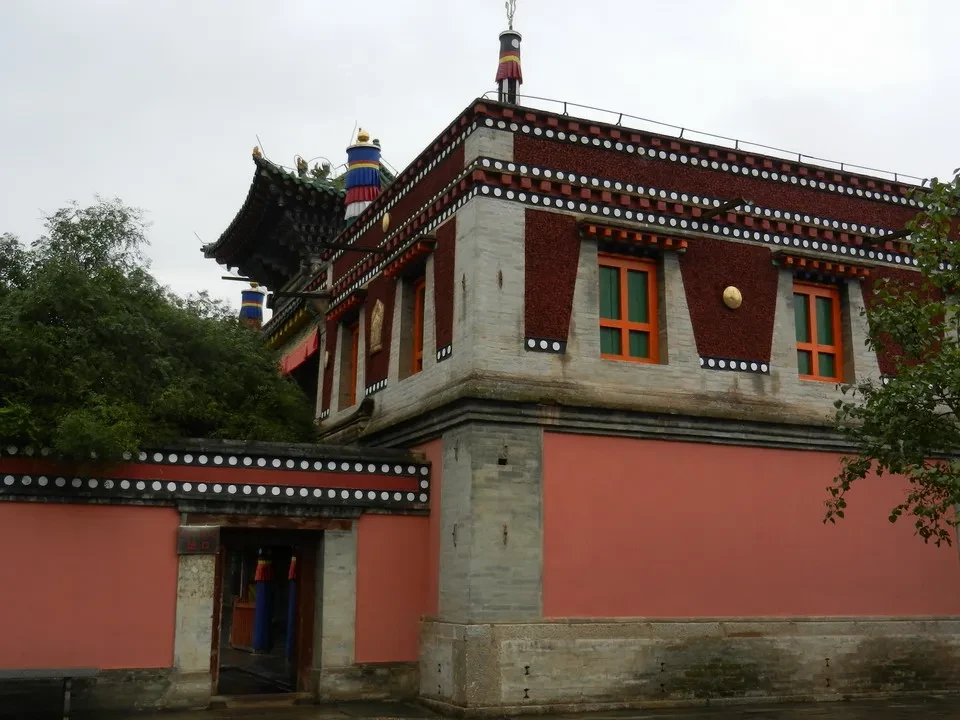
The Kumbum Monastery (Ta'er Si in Chinese) is located 25 km southeast of Xining It was built in the birthplace of Tongkhapa, the great reformer of Tibetan Buddhism, and founder of the school of the Yellow Hats. Nestled at the bottom of a valley, among cedars and junipers, the monastery is a popular destination for frequent and important pilgrimages. Here too, everything is under renovation (either to restore or rebuild), and the streets are still unpaved. Given that temperatures of -20°C are not uncommon in this area, the buildings are constructed with stone on the outside and wood inside. There is no heating; the only source of warmth comes from candles burning yak butter, which has the characteristic of burning without producing smoke. In the upper part of the walls, there are horizontal rows of herb stalks dry walls painted with the classic deep red that characterizes the temples; these structures allow for maintaining distance from moisture inside. The monastery also houses a palace for the Panchen Lama (the second in command of Tibetan Buddhism), who stays there during his presence, but usually lives in Tibet. In fact, this area is culturally and historically part of Tibet, but the authorities of Beijing decided at the time to create a buffer zone separate from any ethnic or cultural dimension. We meet some monks dressed in grey: These are Buddhist monks, but not of the Tibetan or Lamist tradition; they belong to what is known as Han Buddhism or Chinese Buddhism. The image of the plump and smiling Buddha belongs only to this tradition. Han Buddhists do not have a spiritual leader like the Dalai Lama.
Traditions and spirituality
Regarding Tibet, we learn that before the so-called "liberation" by Maoist troops, there existed a feudal regime in which ownership of land was held by monasteries or powerful lamas, effectively creating a theocracy. With the Chinese conquest, everything came under state control, and essentially only the name of the oppressor changed. Recently, we have seen limited liberalization, and as a result, most Tibetans prefer to remain under Chinese rule because a return of the exiled government could lead to demands from previous landowners. In any case, Tibetan society is largely made up of poor and uneducated farmers who have suffered abuses without interruption.
At Ta'Er, there are approximately 600 monks and it is a place of great reconstruction process: a temple seems ancient, but in reality it was only rebuilt two years ago. Sometimes the buildings lose some of their charm: inside they have historical furnishings, but upon closer inspection you realize how recently they were restored. In some cases, instead of wooden flooring, you might even find linoleum or smooth tiles.
We notice the almost complete absence of foreigners. Certainly, we don't see any Westerners; perhaps some Japanese or Koreans have slipped past us. At Labrang, there were probably around fifteen pale-faced people.
We leave Ta'Er when it is already 11:15. This place is very different from Labrang: like the previous one, tourists pay to enter and therefore contribute to the renovations, while worshippers of course are not required to purchase any tickets. Many have already undertaken a long journey using every possible means, and their expressions certainly do not reflect opulence, but rather sincere devotion. However, many still leave offerings before the deities. A characteristic already noted elsewhere is that statues of Buddha or other prominent deities are always surrounded by donations and money, which contrasts greatly with our tradition, at least in terms of form. As a result, Mao's image printed on all Chinese banknotes is present everywhere. But at least this does not represent a sign of control.
Zhangye is approximately 350 km away, and along the road to reach this city, we are struck by the intensive hydroelectric use. The route is reaches an altitude of approximately 3,000 meters for occasionally taking a stroll on some steps ranging from 3650 to 3792 (Dapan Pass) or to 3767 (Ching/Qilian Mountain Yang Pass) Mt. At this point, we take a short walk uphill to see a vibrant event of prayer flags and we quickly realize how much the cost affects our breathing. The edges of the road form a single long dump of waste almost everywhere we visit: right on the highest pass, we see several luxury cars with passengers getting out just for the necessary time to throw bottles and all sorts of other trash along the road, before speeding off again. Along the way, we often see api keepers who spend the season near the hives, extracting honey. As we go higher, pastures for other animals give way to sheep; in the most rugged areas, there are goats, and even higher up, yaks. There are no dogs for herding the flocks. We cross a section where... Recent rains have brought with them the road. and some houses that were nearby. With a slight detour, we solve the problem. The real challenge is driving in China. Apart from the structural issues such as the lack of manholes and the presence of scary, unmarked potholes, it's actually the way people drive that is astonishing: everyone tries to converge at the same point simultaneously without stopping or giving way, both in the city and outside. This results in frequent traffic jams, even though serious accidents are rare due to the moderate speed. What we see here is further confirmation of why driving in China is prohibited for non-residents. In summary, everyone drives slowly but never stops. In a typical Neapolitan style, everyone tries to fill the gaps. Where a car doesn't pass, scooters take over. To reduce the risk, many highways are being built, but since they are paid and travel mainly occurs on short distances, they are mostly used by trucks. Those who work on highway or railway construction sites, or simply maintain them, sleep in tents set up nearby, sometimes even in the middle of the desert, hundreds of kilometers from the nearest settlement.
The birthplace of the current Dalai Lama is about 70 km from Xining. Foreign visitors who intend to visit the village, which itself has no particular features, are screened and their background checked to ensure they pose no danger. There is also a good chance that their luggage will be searched, which can sometimes cause problems.
The shepherds we see in the mountains are Tibetan, while in the villages we can see many Islamic mosques. From the ger (yurt) comes smoke that spreads a pungent smell in the air. Since there is no wood available, dung (especially yak dung) is burned after being dried beforehand. In the villages, the dung is placed against the walls to speed up the process. We discover that in this area, the shepherds are nomadic throughout the year and therefore do not return to the villages in winter as happens in the mountains beyond Xiahé: the government is trying to settle them with policies of assistance for building permanent houses, at least during the winter. This is the time for potato harvesting, and just before Zhangye we see a long queue of trucks loaded with potatoes, waiting to enter a facility for producing products from this tuber.
Regarding the funerals, there are essentially four possibilities:
- cremation: necessary in cities due to space constraints
- burial: preferred solution by the Han and Muslims.
- to be eaten by birds after being dissected to make it easier for the birds: this form, which at first glance may seem terrifying, mainly occurs in Tibet, and there is also a platform in Labrang for this type of burial. It is typical of places where the land remains frozen for long periods and there is no fuel available for burning.
- Scattering of ashes in rivers or lakes
In Tibet, fish are not eaten because it is believed that they are the origin of the human race. This theory somewhat echoes Darwin's theories on the origins of humanity.
I arrived from the mountains of the Qilian range, having traveled for 200 km through a flat and arid area that has been made cultivable thanks to an extensive network of canals, to Zhangye.
During a reconnaissance trip, we pay tribute to Statue of Marco Polo located right in the middle of a roundabout, where traffic flows just like in other cities. The Venetian traveler would never have imagined that the price of fame could be so polluting.
We have dinner at a small restaurant frequented by locals. The cuisine (as is common throughout the northwest), is quite spicy, with many dishes featuring chili peppers and other spices. However, we still manage to keep it within acceptable limits. Today, the highlights were... fried noodles, a kind of well-cooked pasta, seasoned with soy sauce, some lettuce leaves and pieces of meat; overall, it's very good. The most popular beer is Snow, which isn't bad but is quite light. A liter quenches thirst and doesn't cause any discomfort. A good alternative is green tea, in which no sugar, lemon or other ingredients are added, as they are considered impurities.