Day 2
Great Wall
Tombs of the Ming and Great Wall: Facing imperial history
Ming Tombs
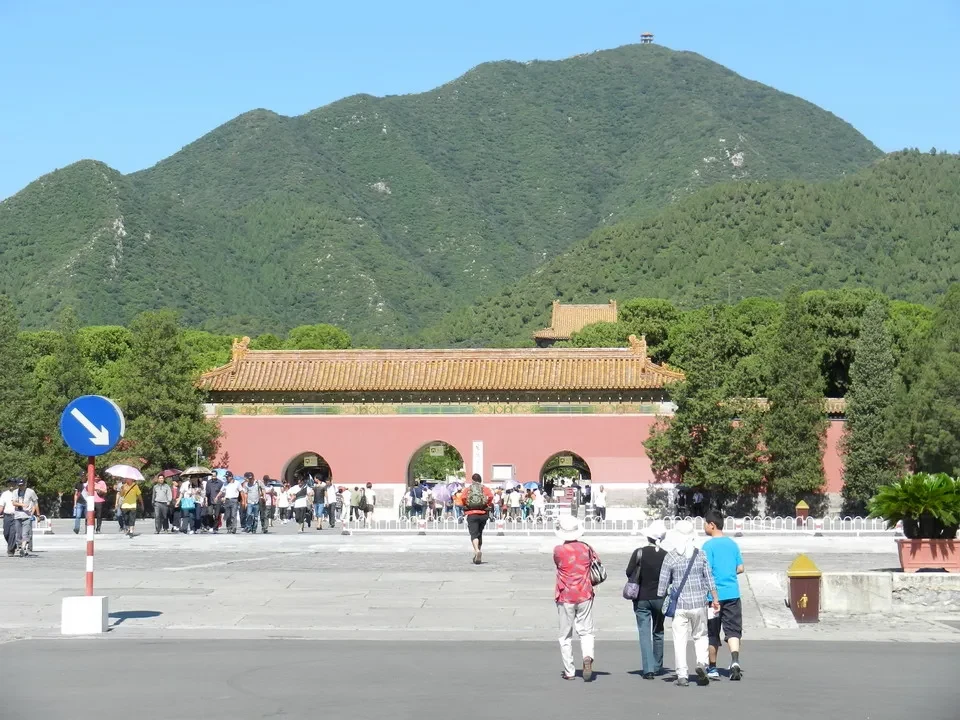
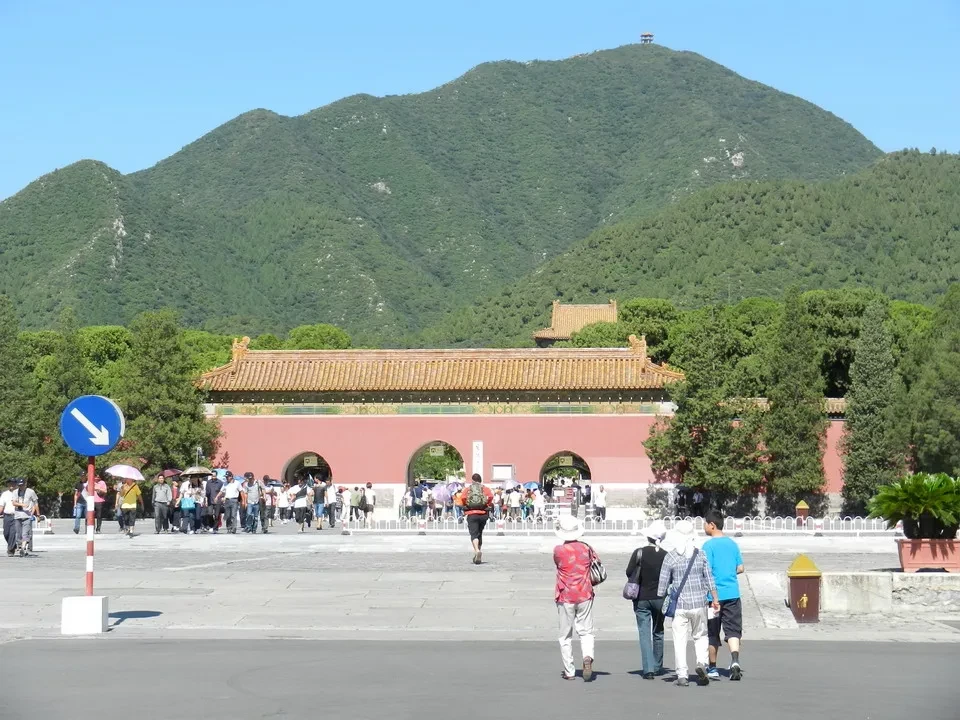
We were picked up at 8 to go and visit the Ming Tombs. These are the tombs of 15 emperors of the Ming dynasty at the foot of the slope of Mount Taishou(originally Monte Huangtu). The one we visit belongs to an emperor who came to power around the age of 10 and died at 59: he was not very popular because he neglected the administration of the state, dedicating himself to alcohol and other hobbies. He had started construction of the tomb in his youth so that it would be ready at the appropriate time. The site is located northwest of Beijing and is considered particularly suitable for "the rest of the emperors" due to a series of geomantic calculations and because the area is between a mountainous region and the river. The same reasoning applies to Emperor Qin Shi Huangdi in Xi'an. Along the way, we see fruit cultivation, especially peaches covered with nets to protect them from hail. Peaches are usually white and are quite impressive for their almost melon-like size.
There isn't much left to see from the tombs, as the first and second entrances were destroyed by the cultural revolutionaries. Only the foundations remain, while to reach the area where the emperor was buried, you descend 27 meters to reach the actual tomb, where the princess and favored concubine are also buried. Often, the emperor had a wife imposed by the court and political environment, but he also had concubines, one of whom usually took on the role of favorite, a position that also carried political significance. Once you descend the stairs leading to the burial site, you find that there is very little left to see, as the gold and jade were stolen by the Red Guards. What remains has no value and has been scattered: what remains of the complex is certainly interesting, but it is only a small part of what it once was.
To get out, there is a Chinese-style door which symbolizes the transition between the realm of the dead and that of life. It must be crossed by saying "return to the realm of reality". Women should cross through the gate using their right foot, while men should use their left. Couples can hold hands. From this point towards the tomb begins a circular perimeter, reminiscent of the sky, while the preceding part is square, representing the earth and therefore earthly life.
Arrival at the Great Wall
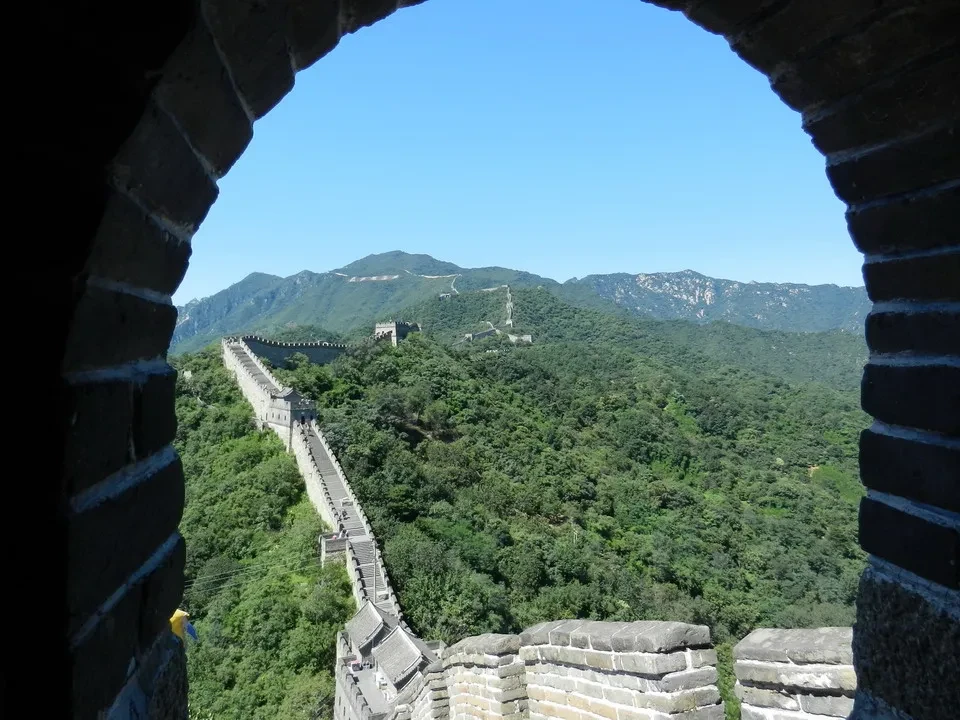
In about an hour by car, through green hills, you arrive at the Great Wall, a Mutianyu, 90 km northeast of the capital, in an area further from the capital and less frequented by Chinese tourists. Shortly before arriving at the Great Wall, we have lunch at a local that also sells trout, which may be similar to our own or white-grey in color with a tendency towards yellow. We climb up the Wall. to room 8 to go on the 6th floor, which represents the limit of the renovated section: we continue further on an area where vegetation has now grown and on the path, it's barely possible to make out a trail. We return to reach tower 14 and rejoin at tower 8, where we pick up the path leading to the south entrance parking lot, which is bustling with souvenir vendors but also offers a wide variety of dried fruits, including kiwis. Throughout the entire route, you can hear the buzzing of cicadas, a constant sound that accompanies the whole hike, so much so that it seems like it's coming from an electronic device. In town, however, you can hear the chirping of crickets, another animal believed to bring good luck: here, it has become a sound that is difficult to hear even in the countryside. Some shops sell them inside special cages.
As the road winds back, it passes through vegetation and various crops. The wheat stands out, and it's amazing how even small terraces, created in just a few square meters, can be used for cultivation. The walls that surround them are made of beautiful red bricks that perfectly complement the green surroundings.
We returned to Beijing and had dinner at the restaurant in the Xi Zhan station (the largest railway terminal in Asia), where we... We are waiting for the train. at 20:02, which will take us to Xi'an. Taking the train in China requires certain security measures that are not present here, as we need to have our luggage scanned and show our tickets and passports, with the number of which is indicated on the ticket. We share a cabin with two Chinese people, with whom we cannot communicate without a common language. One of them is friendly, and we manage to communicate through gestures.