Day 6
Bukhara
Visit to Bukhara, abundance of mosques, schools and towers.
Amidst Kalon, bazaars, and tombs.
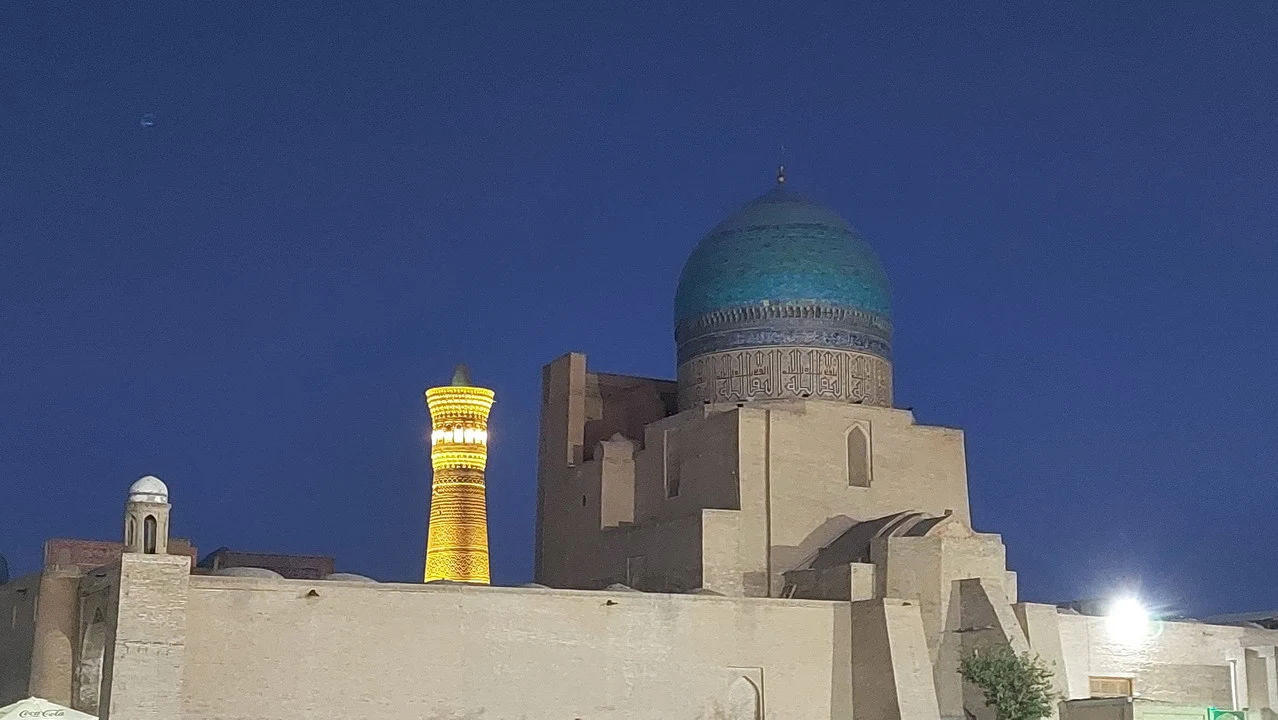
After recovering the credit card that was stolen from the ATM yesterday, we try to withdraw money using a Visa at another contactless ATM, in order not to risk it again, but the 5-digit PIN is not accepted: maximum 4. We then go to the Central Asian Hotel, which has a reasonably convenient exchange office, and obtain what we need. Thus, we prepare for another day dedicated to visiting the beauty of Bukhara: we start with the Hoja Zayniddin Mosque, but above all, we are impressed by the view of the bell tower and the Kalon mosque On a morning when there are still few people around; the sun beginning to illuminate the monuments creates an even more majestic image. We visit the interiors, which are similar in structure here as well as in Khiva and Samarkand, but different in their decorations, and we don't get tired of admiring them in their grandeur. Compared to what was seen in Iran, the designs are less refined, more geometric, but they take on a grand scale thanks to the large size of the ivans and portals, the pishtak. The Arab influences are only felt up to a certain point; the rest is characterized by an essential simplicity that we attribute to the character of the steppe people. In reality, those who have not seen the Persian mosques would probably not notice this simplicity in the designs, which is not present everywhere: consider for example some mausoleums of the Zand dynasty or Gur-e Amir in Samarkand. As in a sort of appetizer of what we will see at the Registan Square in Samarkand, on the other side of the square stands the Mir-i-Arab mosque. We continue our walk towards the outside where the old walls are undergoing restoration; nearby is the fruit and vegetable market, the real one, as the historical bazaar divided into three arches located close to each other in the Kalon area is exclusively for tourist clients, where the colorful merchandise on display has nothing to do with its historical past. Here you can find a great variety of vegetation neatly arranged on the stalls, behind which polite vendors try to attract attention without shouting. Of course, there are also... nuts, we stock up on red grapes, dates and nuts, and spices. These last ones are everywhere in pastel colors that are simply enchanting. Between the walls and the market, we see a fire truck that must be at least 50 years old and would fit perfectly in a museum, just as the friendly elderly gentleman with a hat and white beard who offers us some candies while we photograph the vehicle seems to have just come out of an Asian Central anthropology museum; his appearance and the cordial way he approaches us will undoubtedly be one of the iconic images of our trip.
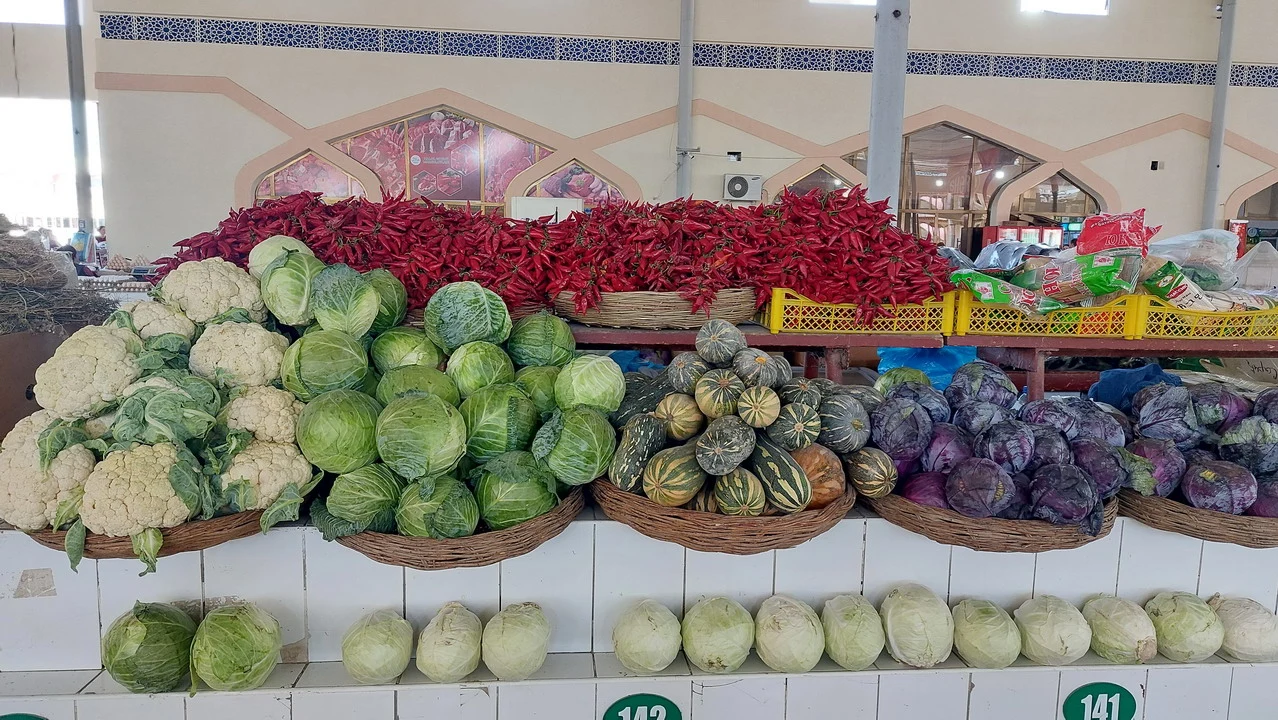
Large, impressive statues display radiant smiles from behind the market stalls, thanks to their golden teeth; they sometimes completely block the row, indicating that dental technology in Uzbekistan still needs improvement. It's hot, but there are still many places to visit: after a short stop to taste the local sweets sold in an area of the bazaar dedicated to baked goods and confectionery, we enter Saman Park, where you can find the magnificent Ismail Samani mausoleum, dating back almost a thousand years and built with intricately carved bricks that make it look like a knitted fabric: essentially, a cube of pure art. Even when it's not about historical monuments or prestige, the doors are always carved in a delicate style and with meticulous attention to detail. Sometimes you can see very simple houses, but the doors enhance the entire building. On the other hand, the style of the decorations is more suited for viewing the complex from a distance: the rectangular tiles arranged like dominoes are quite simple and don't make much impression when viewed up close; however, moving away, the perception changes radically due to the grandeur of the monuments in which they are embedded. As already mentioned, the comparison always leads to the Iranian experience, which is much more refined but smaller in scale; here, the ivans of the madrase are truly enormous. Less remarkable externally but interesting if visited inside is the Chashma Ayub mausoleum, Source of Jobbe, which houses an interesting museum where the reasons for the abundance of water in this largely arid region are explained, as well as panels illustrating the suffering of Lake Aral, which is geographically distant but concerningly close to the country's economy. After the Soviet-era abuses, when the waters of the Amu Darya and Syr Darya rivers were diverted to irrigate vast cotton fields within a system where one produced for all, subsequent governments have even worsened the situation by building a dam upstream on the Amu Darya and reducing the basin from 40% in the 1980s to its current 10%. It also appears that the Taliban in Afghanistan are significantly exploiting the river's flow within their territory. The museum also features a source believed to have special properties; some elderly people pray, singing psalms whose notes echo through the low arches, creating a particular atmosphere. In reality, in the Central Asian republics, faith in Islam has animistic connotations typical of sparsely populated and nomadic regions: while Buddhism has incorporated them into a defined tantric doctrine in Tibet and Mongolia, here they manifest as marginal deviations when not in contrast with the faith that arrived from the West 1200 years ago. A spiritual focus on natural elements and a prayer system also directed towards non-strictly religious subjects; two examples of this can be seen in Samarkand, at the tombs of Tamerlane and the more recent one of Karimov. Leaving the shaded paths of the park, we see from the outside another two beautiful mosques that are likely to be next to receive restoration, those of Abdullakhan and also Modari Khan The Uzbek artistic heritage is extensive, and the condition in which it was found was very poor, despite interventions having already been carried out during the Soviet era; currently, work is proceeding quickly, with full awareness that restored works attract tourists, creating a positive and beneficial effect on the economy. In some cases, there are also doubts from UNESCO regarding work done too quickly at the expense of respecting the original line.
Between Bolo-Hauz and The Ark
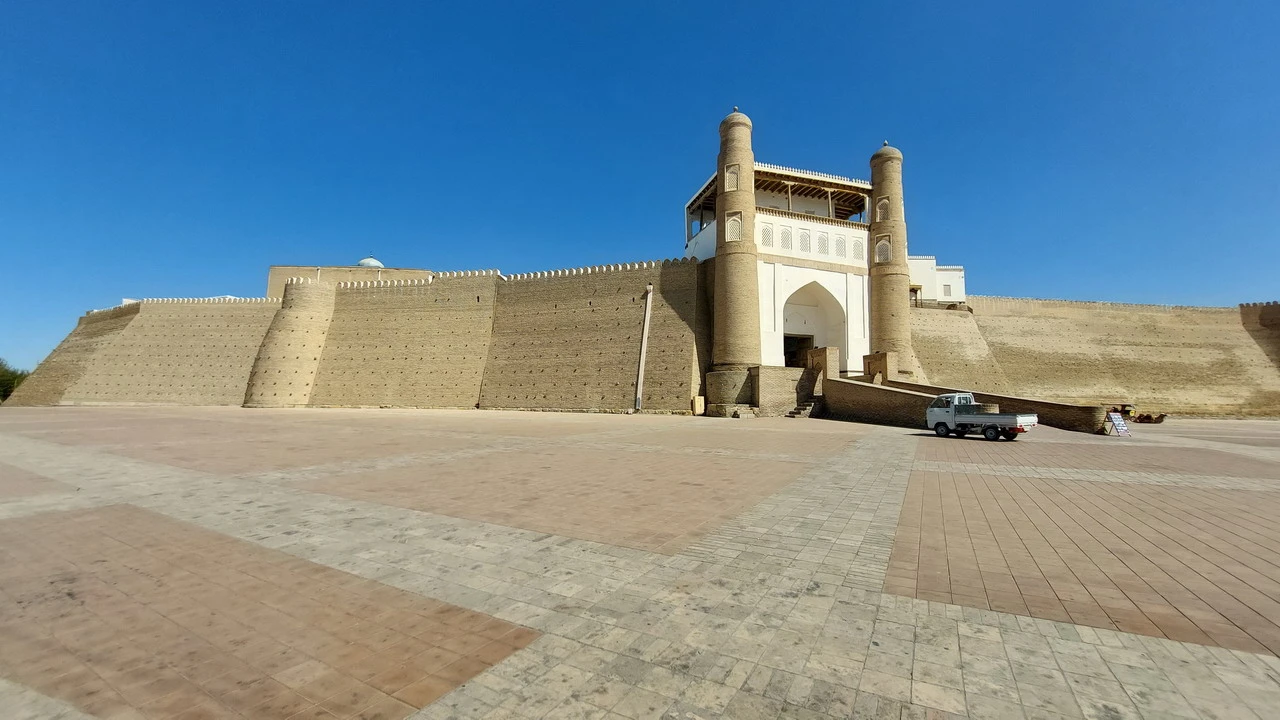
The Bolo-Hauz Mosque It is instead a mosque with high wooden columns, typical of the local artistic style, finely carved over the centuries by skilled artisans. It cannot be visited as religious ceremonies are held there, but simply viewing the exterior with its large pool in front, bordered by trees to cool down the residents during the day, is enough. Nearby is a tower that served as a water reservoir, now a panoramic viewpoint on the city with an elevator and a spectacular nighttime illumination. We exit from the shadows to face The Ark, the fortress where until a century ago the Emir of Bukhara lived with his family and court. The thick clay walls seem to support the internal structures, which are raised above the entrance on the square. There are also mosques, schools, a beautiful museum, and royal rooms here, some of which have been damaged by bombings that in 1920 convinced the Emir to flee; you can also see the cell located at the bottom of a well where the Emir himself forced two English emissaries into terrible imprisonment for years, before executing them in the mid-nineteenth century. The fatigue caused by the sun's heat above 30°C, combined with the long walk, begins to set in, but there is not much left to see. We return to the Kalon Square, near which are still Ulug Beg's Madrasas and Abdul Aziz Khan.
The incredible density of Quranic schools reveals the importance that the city must have held in the past from an educational and religious perspective. Initially, students studied religious or theological subjects, then some would go on to become imams, while others chose secular disciplines and were taught mathematics, philosophy, astronomy, at a level comparable to universities in Europe and the Middle East.
Synagogue, Maghok-i-Attar and daily life.
After purchasing a good amount of halva, a dry sweet made with vanilla and pistachios typical of Uzbekistan that can be taken home, we also visit the local synagogue in the simple Jewish quarter, which has modest features and is frequented by several people preparing for a celebration. Finally, we see the Maghok-i-Attar, the oldest mosque in Central Asia, which is lower than the street level, while the sun begins to set.
Evening in Bukhara
The day is coming to an end and our appetite reaches its peak: not far from where we had dinner last night, there's a lovely restaurant called Art. It's a beautifully renovated traditional house, with tables and sofas with low coffee tables in the courtyard under shady trees that seem to transport us back in time. We choose to sit at one of these, making a single gesture with our arms, legs, and knees, but with great satisfaction for both our taste buds and our spirits. Refreshed, we set out to find... illuminated monuments at night finding the peak at Kalon bell tower: by highlighting the lights, they emphasize and give three-dimensionality to the complex decorations, making them appear as living elements; at the same time, the impressive madrases on the side offer a preview of what we will see tomorrow in the Registan Square of Samarkand. Also The Ark shines. like a huge sandcastle that has emerged from a child's imagination on the beach. For today, it might be enough; tomorrow we have an early train to Samarkand, and it is best to rest after a long and hot day.
Bukhara had already won us over before our departure, and we can honestly say that it did not disappoint. As in any situation or case in life, human interaction plays an important role: we observed a certain coldness in their behavior, which is not very Asian. Despite the difficulties of communication, the 70 years of Soviet rule that have shaped people into being indifferent to life, and other general mitigating factors, we noticed almost complete lack of formalities even among themselves. Greetings and farewells seem superfluous and unnecessary in this area. We are told that it is mainly inhabited by Tajiks, a friendly but not very formal people. In reality, Samarkand is also of Tajik culture, but the feeling we get is different. From an urban planning perspective, the most important monuments are at some distance from each other, and to reach them you have to cross residential areas, where you can observe people in their daily lives.