Day 16
Skazka Canyon
The warm colors of the Fairy Canyon, the backdrop of Lake Issyk, and returning to Bishkek.
Along the south shore of Issyk Lake
It rained almost all night, which made sleeping inside the yurt very comfortable; the mountains to the south are covered with a light layer of snow, and this helps us understand why the Tosor Pass is constantly at risk of closure. Breakfast at 8 am, and then we left immediately. Today we had planned a hike to Köl-Tor Lake, but the schedule was already quite tight. We decided instead to go further east on the road that runs along the southern coast of the Issyk Lake. Located on two lanes, it's so wide that planes could land here, unfortunately it's a single construction site with detours around bridges under construction and unpaved roads that don't finish. Not much different from what I drove yesterday to get to Bokonbaevo. There is something to discuss about how public works are organized and managed in Kyrgyzstan: instead of renovating the roads on various sections of variable length but based on a few kilometers, here the work involves the entire road at once, which ultimately creates great inconvenience both in terms of time and physical space. The vehicles are forced to make continuous zigzags, raising clouds of dust, not to mention those who live nearby. On the construction lane, where traffic is prohibited, large rocks are placed every few meters. For example Soviet man decides impulsively, but also endures without complaining.
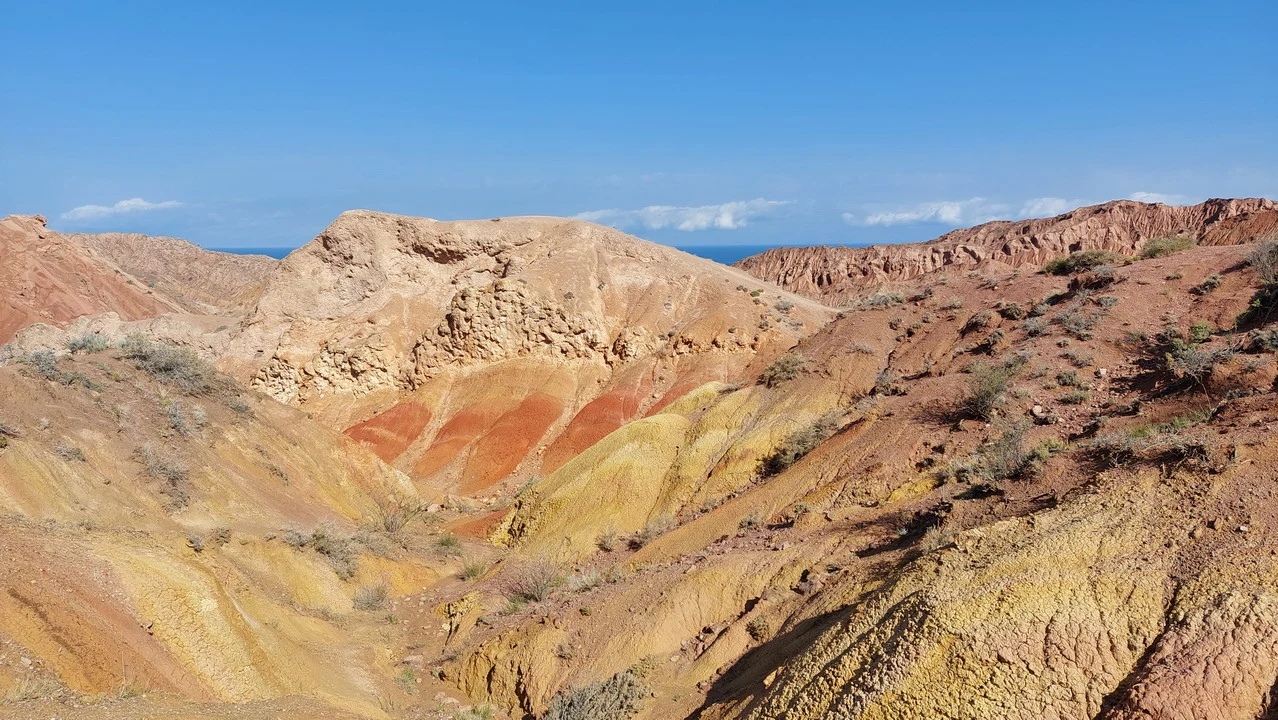
The colors of the Skazka Canyon
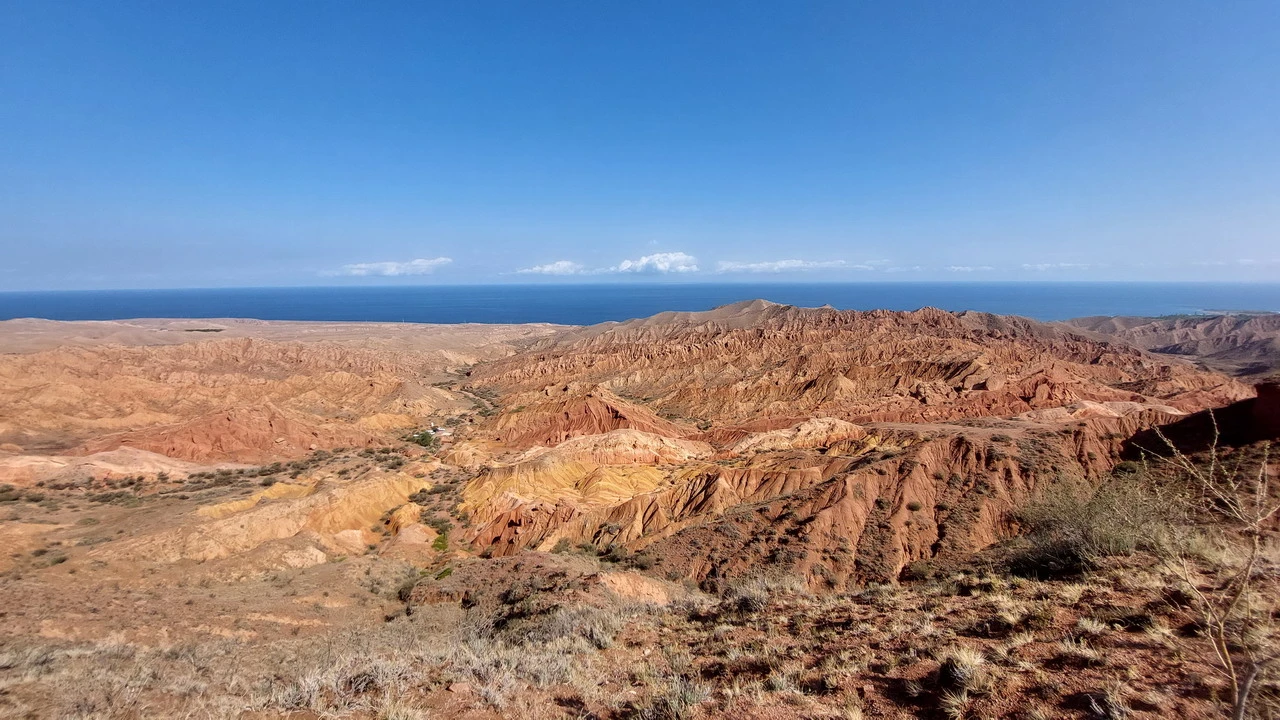
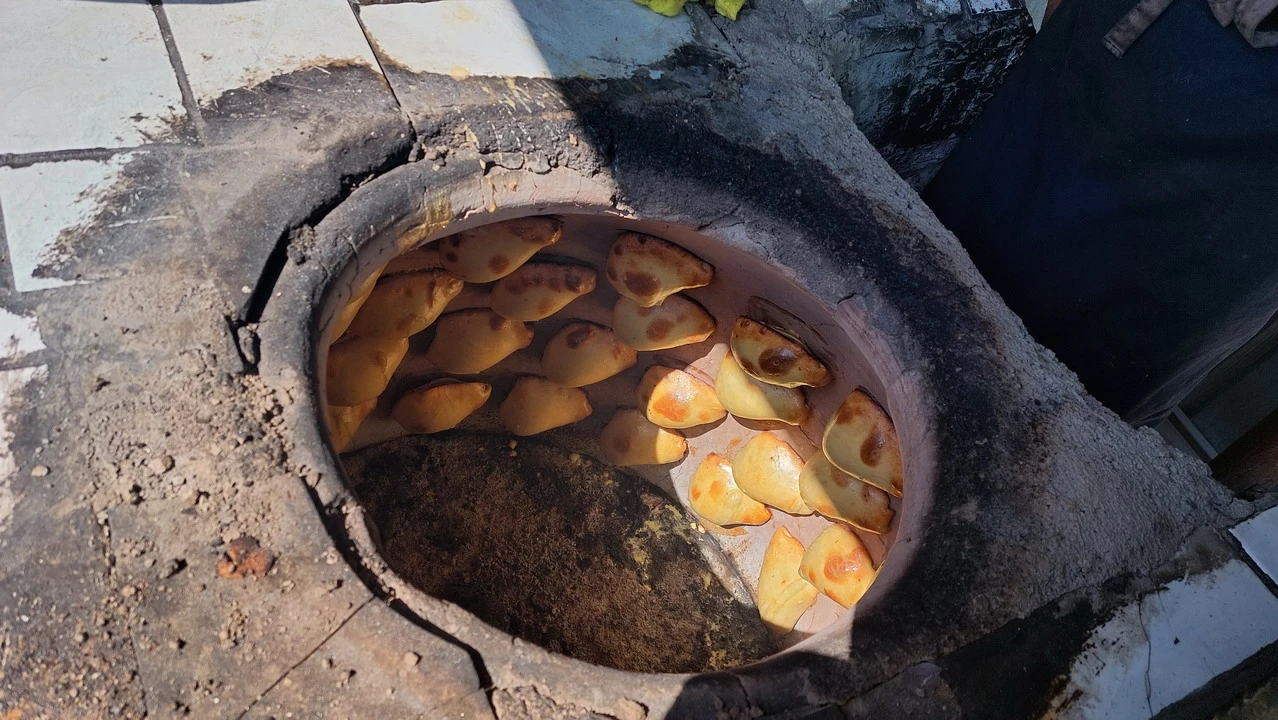
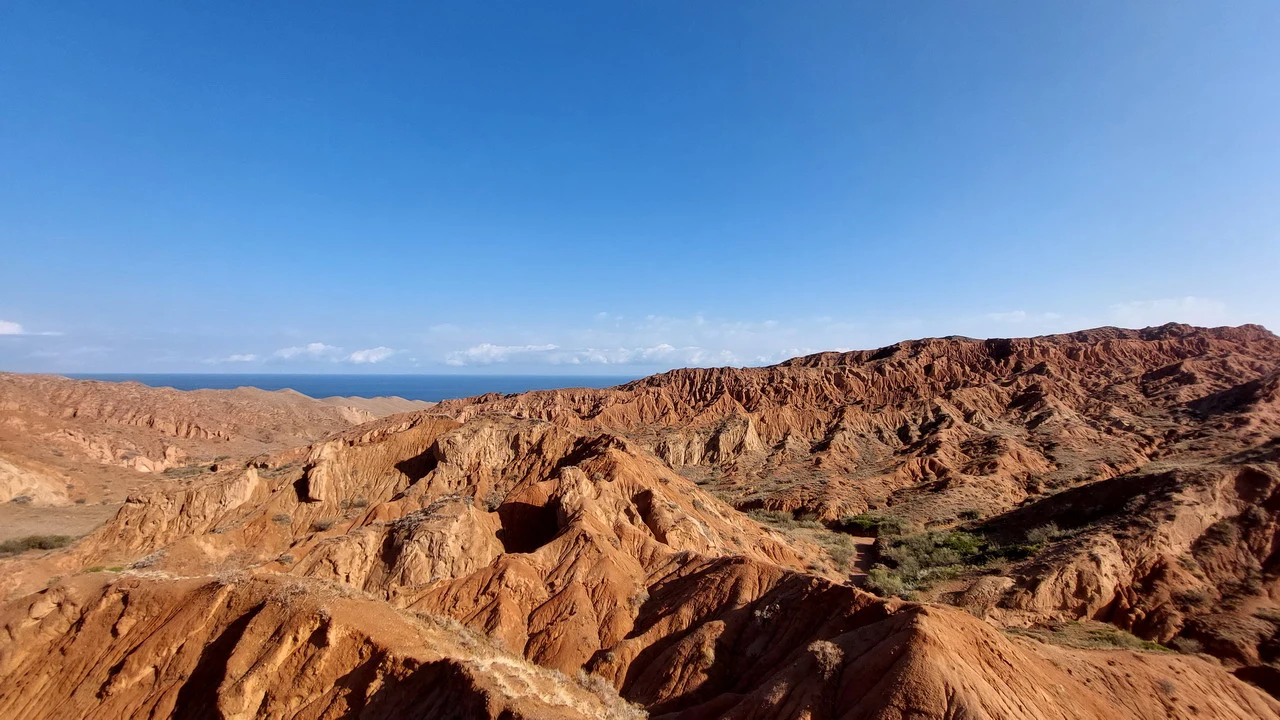
Today's choice turned out to be a winner: the rain gives way to clear skies, and as soon as we arrive at the Skazka Canyon, in English Fairy Tale Canyon, the Italian translation canyon from fairy tale, mixes blue and red of the rocks. It is a real work of art created by nature, where stone and earth blend together to create a every warm tone, from yellow to intense red. A the colors are rarely seen elsewhere; the Zion Park in Utah comes to mind, but perhaps it's different now. Unfortunately, there are no real trails, and it's not difficult to get lost, but it's also easy to wander off the beaten path by walking on earthen ridges that produce small landslides. Arriving early gives us the privilege of a visit where we are alone in front of the immense beauty that surrounds us. It's not just about having clean photos, but about being able to appreciate the silence, nature, and even the spirituality that only certain places can emanate. There are three paths that require respectively 5, 15 and 25 minutes of walking, and we complete all three with great satisfaction. The longest one leads up a hill from the top of which I can see the lake's coastline. Not far away. Even today, with the clear sky, the view of the northern coast of Lake Issyk can only be glimpsed, and we are talking about the shorter side. After an hour, some cars arrive while from above, harmless clouds begin to cover the vibrant colors of the canyon. At this point, we can continue our journey, which will take us a long way to the capital. We are in the middle of Lake Issyk, but the length should not be calculated solely on distance, but on the time we need to spend traveling along the dilapidated road along the southern shore of the lake. Like a mirage at the top of a small hill overlooking the lake, the statue of what could be defined as a Kyrgyz-style Buddha with its typical crossed legs appears, while further down, on a large poster, human figures ride a dragon, all overshadowed by the unmistakable Zoroastrian symbol of the eagle with its wide wings open; on the other side of the road, a long, enigmatic wall decorated with something that we cannot see in front of the lake. In Bokonbaevo, we stop for lunch at a local restaurant where they prepare generous portions. samsa cooked in a traditional tandir oven, I have two filled sandwiches with lamb meat and I'm full until dinner. When the lake ends, we finally find decent asphalt and can go faster; the road, even when it crosses mountainous areas, is not bad because it is the main route between Bishkek and the heart of Kyrgyzstan, as well as towards China. We see arid landscapes alternating with cultivated ones, the mountains become less dense, leaving space for high plateaus where we increasingly encounter more and more urban centers. In the afternoon, we make a short stop to visit the Burana Tower, an ancient minaret, a significant symbol of local history.
The next stop is the hotel, but traffic around the capital is increasing and we arrive at 6 p.m. At some point, the road runs parallel to the Kazakh border, and we can see a couple of checkpoints; the rest is a continuous network designed to prevent illegal crossings. We learn that there has recently been a crisis between Kazakhstan and Kyrgyzstan, where the former, permanently thirsty due to almost entirely desert territory, demand supplies of this precious liquid in exchange for the transit of Kyrgyz trucks through their territory, which is essentially the only route out, towards Russia, Europe, etc. The recent blockade has strained relations, apparently now recovering with the resumption of supplies. They are still complaining about problems at the border crossings, which we hope will not hinder our planned transit tomorrow. The interdependence between the Republics, combined with ethnic tensions, prevents true cooperation in a context where unity would be strength; conversely, it inevitably leads to poverty for those who lack resources. The paradox is that Kyrgyzstan provides water to the Kazakhs, who grow cereals and then resell them to the Kyrgyz.
The hotel is the same one where we previously stayed upon our arrival in the country, exactly a week ago. We change restaurants, not so much because we didn't find the Plov Center to our liking, but to have another experience. It was okay, but the atmosphere is cold, even though it’s frequented by locals on Saturday evenings when families go out, in an environment that starts to resemble a bourgeois setting.