

Day 9
From Uzbekistan to Kyrgyzstan
Breakfast in Samarkand, lunch in Tashkent and dinner in Bishkek, Kyrgyzstan.
From Samarkand to Bishkek
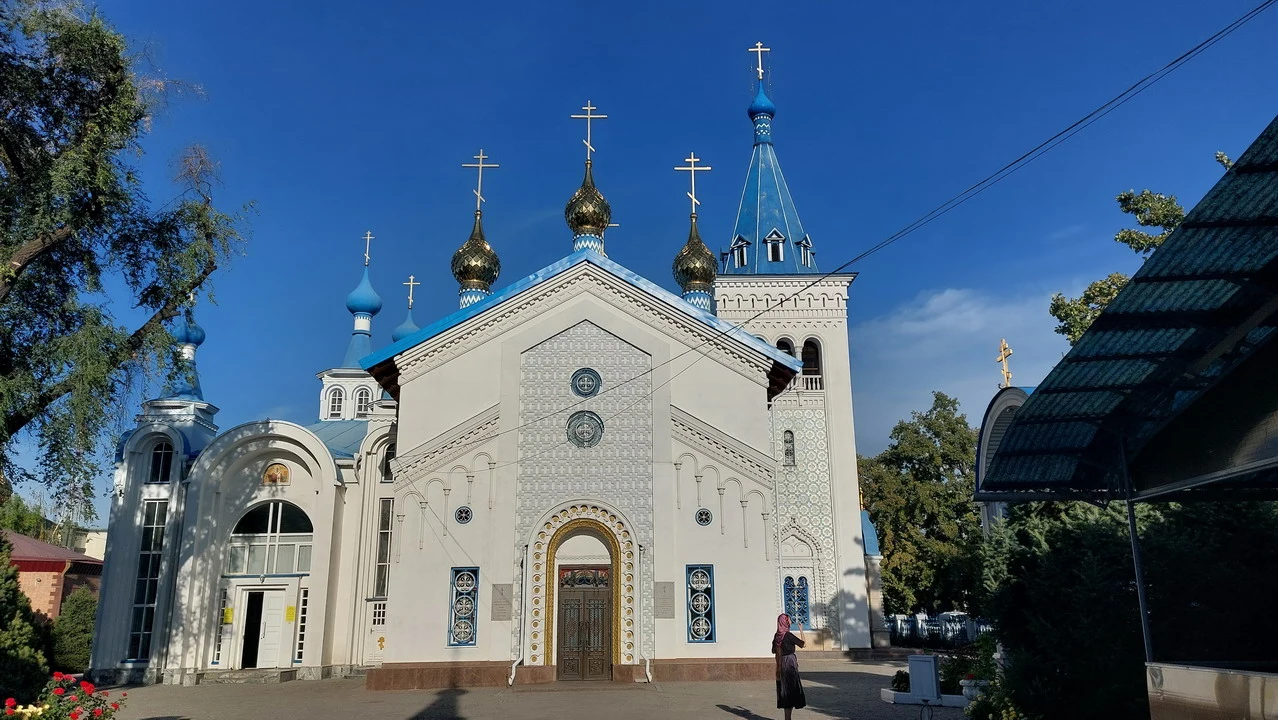
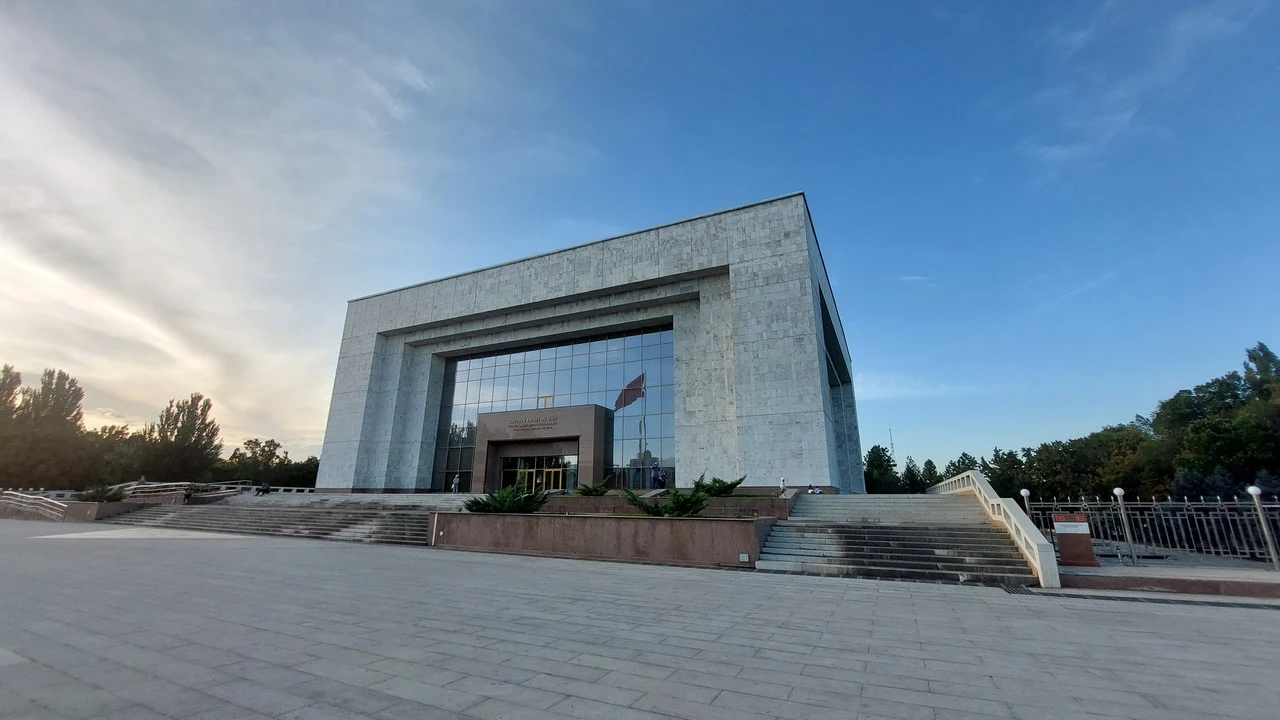
On time, as always. The Afrosyab, high-speed train, departs from Samarkand station at 6:13 with destination Tashkent, running along a plain that was always the same but never boring. In Tashkent, we had left to see the Orthodox cathedral of the Assumption, as it is located near the station. Its golden onion-shaped domes manage to shine under a sky with some cloud cover; the building is a tangible sign of the now historic Russian presence and we also consider it architecturally well integrated into the surroundings. A couple of photos and then we continue by taxi to the airport, from where we will depart for Bishkek on a flight with Uzbekistan Airways. There are three sets of checks upon departure, but nothing as alarming as what was feared regarding the currency exchanged or registration card, simply a symbol of a parasitic and useless bureaucracy. Shortly after takeoff, you can clearly see the distinction between the fertile and cultivated area and the desert area, passing through a yellow landscape in just a few kilometers: houses disappear and the real steppe begins. We see the same change upon arrival in Bishkek. All boarding and onboard procedures proceed in order and punctuality, which we could define as Uzbek, and we arrive at the chaotic Kyrgyz transit point. Here, the environment is more confusing; we find ourselves facing long queues at passport control that we only manage to avoid by jumping ahead when a new counter opens. We change clothes, buy a local SIM card, and look for a taxi: the usual one, in short. There's a customer broker who speaks English with whom we negotiate the price of the taxi; he takes us outside to meet a friendly elderly gentleman with a hat driving a small Japanese car with right-hand drive. In Kyrgyzstan, you drive on the other side, but apparently not very carefully; as long as the cars move freely. Our driver sets off like a rocket down the very long avenue leading to the city; from the airport it's about 35 km, except he skillfully slows down near frequent speed checks. He avoids traffic by finding improbable shortcuts and takes us safely to our destination, which we initially didn't think was possible. The Freedom Hotel opened less than a month ago and smells of newness; when we arrive, they are hanging paintings in the hallways and breakfast is not yet ready, but knowing this beforehand, we organize ourselves. We take possession of a bright room and are ready to discover the capital of Kyrgyzstan. The faces of the inhabitants clearly show their belonging to another ethnic group: the Mongolian somatotype begins to prevail over round faces and typical Asian eyes; Central Asian features gradually disappear. Conversely, we see fewer women wearing veils and more girls dressed in Western style, but with less elegance than Uzbeks. This is a sign of psychological dependence on foreign culture, which gives honor to the neighboring country in a theoretical challenge regarding modern customs. As always, we like to walk along the avenues to get closer to the places of interest and see the everyday life that presents itself before us. It's Saturday afternoon; we are an hour ahead of Uzbekistan; young people and families can be seen strolling, while workers continue their work on the construction sites. Compared to other cities, Bishkek has little to show, but it is still worth seeing some beautiful gardens mixed with the inevitable Soviet-era buildings, which are more prevalent here than elsewhere. We first notice that the signs are in Cyrillic and Latin characters are almost completely absent, while in Uzbekistan there was a mix. Kyrgyzstan is definitely a less rich country, although not necessarily poor; this seems to be due to its less glorious history and the nomadic nature of its population, as well as the mountainous terrain which has always favored urbanization. A short distance from the hotel we meet the Orthodox cathedral, we enter the moment when there is a celebration and we have the opportunity to listen to the beautiful chants; the voices of the priests rise up and echo against the interior arches, while the faithful continue to make the sign of the cross with a rhythm that we cannot understand. The Victory Square showcases a slender monument representing the stylized form of a yurt, under which a fire burns. eternal flame as a reminder of those who fell in the wars. Symbolisms that tend to highlight the union of local culture with Soviet communist dogma. Many Russians still live in the capital, although most have left the country after independence, and it is the city with the most European imprint; the common language is also Russian. As you move towards the countryside and mountains, Kyrgyz influence becomes dominant, and almost all physical characteristics are of Mongolian origin. The exception is the southwestern area around Osh, where the population is mainly Uzbek, and there are coexistence issues, as well as various irredentist sentiments with the Tajiks. A complex situation, deliberately created by Stalin to divide and rule: on one side, ethnic and ideological issues clash, while on the other, there is a need to cooperate in order to survive in a region of the world where friendly countries are scarce, and when they do exist, they harbor hegemonic ambitions. Crossing a park and passing in front of the Opera House leads you to the imposing National Museum of History, where the Lenin statue... which has been moved to this more secluded location in recent years but is still facing the Government Palace, serving as a reminder of the past that struggles to become history. The most prominent feature within the urban landscape belongs to a equestrian statue of Manas, the local hero. On the same square, the national flag is flying, guarded by two guards in high uniform. On the other side of the wide Chue Avenue, you can see the Ala Too Square… surrounded by beautiful colonnades along which panels depict national heroes: August 31st was Independence Day, but upon closer inspection, it seems like a purely formal occasion, given the recurring sense of nostalgia for the past. Everything still smells of the Soviet regime: from street names to monuments and public buildings, and finally, the apathetic attitude of the people. The small size of the country and its geographical features, combined with the scarcity of natural resources (excluding water), have made it difficult to break away from what was once the homeland. Finally, we see the parliament, in its solid and monolithic structure.
Bishkek between secularism, nostalgia and daily life
In the city, we encountered a few mosques, which is a sign of the greater secularism of the Kyrgyz people; we will see more inside the small towns in the following days, where rural life opens up more to traditional aspects. Two women recognized us as foreigners and approached us speaking English; we discovered that they were Jehovah's Witnesses, but their primary goal was to practice exchanging a few words in discreet English. They also confirmed that things weren't so bad in the Soviet context, with greater guarantees for the present and future, which was sufficient for them; therefore, reintegration into the Russian world would be a protective convenience that their current geographical-economic isolation does not allow; this is not about seeking revenge, as they explicitly stated at the beginning of the conversation that Kyrgyzstan was a colony of the Soviet Union, but it's better to have some assistance rather than the present uncertainties. The decentralized location, the terrain configuration, the low population density and the scarcity of natural resources provide a logical counterweight to independence pride.
In Bishkek, winter temperatures reach -20°C, while elsewhere they drop to -40°C and it snows heavily.
Let's see if this is enough, as the evening is falling and what we have seen represents an interesting, although not particularly exciting, urban center: of course, waking up in Samarkand and going to sleep in Bishkek means experiencing two completely different worlds within the same day. Luckily, a restaurant specializing in rice pilaf and we shouldn't miss it. We should also try the lagman, a type of large, slightly spiced noodles served with meat, chili sauce and garlic. Finally, let's explore the cities; tomorrow we will move on to a more natural setting in the famous mountains of Kyrgyzstan.


