

Day 7
From Bukhara to Samarkand
Fast train to Samarkand, and finally my dream comes true.
Arrival in Samarkand
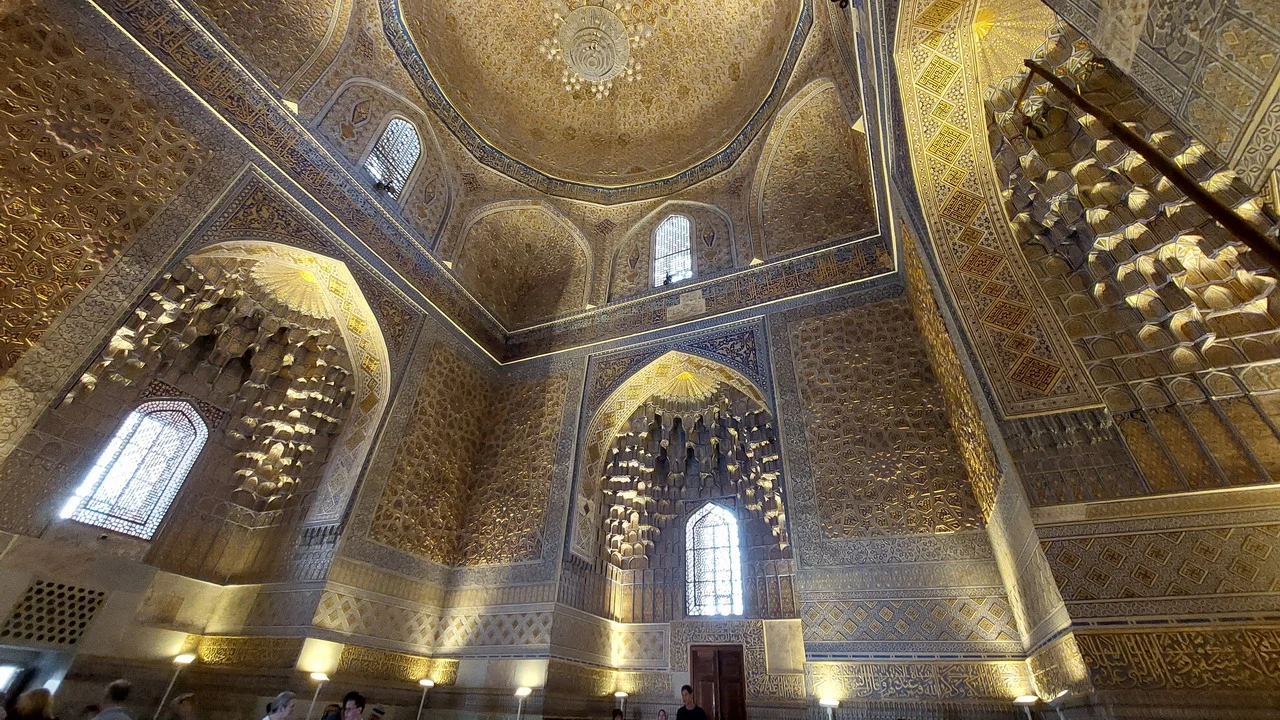
With a taxi ordered through the hotel at 4:30 am, we set off at full speed towards the station: red lights are crossed by accelerating and roundabouts are passed as if they don't exist, without any urgency or fear of missing the train. Apparently, the driver wants to take advantage of the light traffic to release the frustration of urban traffic, which will soon clog the city streets. In just 15 minutes, we arrived, well ahead of schedule, and that's fine; Soviet-style imperial station It is modern and well-organized: after the check-in at the scanner, we enter the lobby and try to figure out which platform the train departs from; this is made easy by the few trains present at this time. A short breakfast in the station's café, and we are ready for the experience on the Shark, the fast train that will cover the 270 km to Samarkand in a couple of hours; Vecchioni’s song, in the verse where he sings about the journey to Samarkand, would fit perfectly here; all for just €7. Comfortable economy seats, polite and quiet passengers; there's even time to close your eyes for a few minutes while it's dark outside. When the steppe begins to turn color and the horizon to the east turns red, you can’t take your eyes off the window to observe this monotonous, yet fascinating view The train sped us along at high speed, where bushes alternate with sand without any breaks. As with the arrival in Bukhara, here too, the city is preceded by a cultivated green area, where individual farms alternate with small villages that don't seem much different from the Po Valley, becoming increasingly dense as we approach the city. The arrival is punctual to the minute; we negotiate a taxi ride to the hotel. Unfortunately, taxi drivers have the bad habit of being particularly expensive when departing from airports or train stations, and we begin to get our first impression of this excellent Uzbek city, this time through the windows of a car. The traffic is heavy but the driver is friendly, and with him we are able to communicate in a few words in the little Russian that we know, or via Google Translator to express concepts beyond our limited vocabulary. Thanks to the local SIM card, we don't feel isolated and can translate effectively. We pass through the Russian quarter and realize that it is not a nostalgic of the Union; he is of Tajik ethnicity. We ask if he is doing well in Uzbekistan and receive a firm "no". He shows us the mountains and explains that they mark the border with his homeland, saying that Tajikistan is only 30 km away and Afghanistan just over 50. The Mohina hotel surprises us positively: in addition to almost touching kindness, we are assigned a quiet room overlooking the courtyard and are provided with tea and biscuits in our room, which are particularly appreciated after waking up early in Bukhara. A quick wash and refresh restore our energy, and despite the early wake-up call at 4 am, we are ready to explore the legendary city that we have dreamed of so much. The hotel is located in an ideal location, just a few dozen meters from Gur-e Amir where Timur rested. We will be able to say that we are literally next door to the great commander for two nights. And this is the first destination, where we encounter a type of tourism mainly local; it seems that the Uzbeks are trying to get to know better the beauties of their country and they cannot be wrong. You see massive women with elegant colorful clothes, normally with a headscarf and accompanied by husbands with a friendly appearance, with hats, vests, white lace and always ready smiles. The impressive mausoleum represents one of the highlights; both the exterior and the interior deserve careful and attentive visits. Shortly after entering, some panels explain in detail the life and conquests of the Timurid ruler, then you move to the area where you find the royal tomb and some close relatives. The whole experience is topped off by a dome and decorated walls With exquisite detail, they are a sight to behold. Careless tourists mingle with others eager to listen to the guides' stories, while local visitors admire their surroundings as some elderly people pray as if they were in a mosque. The back side offers an excellent view of the dome, which rises high into the blue sky.
From Gur-e Amir to Registan
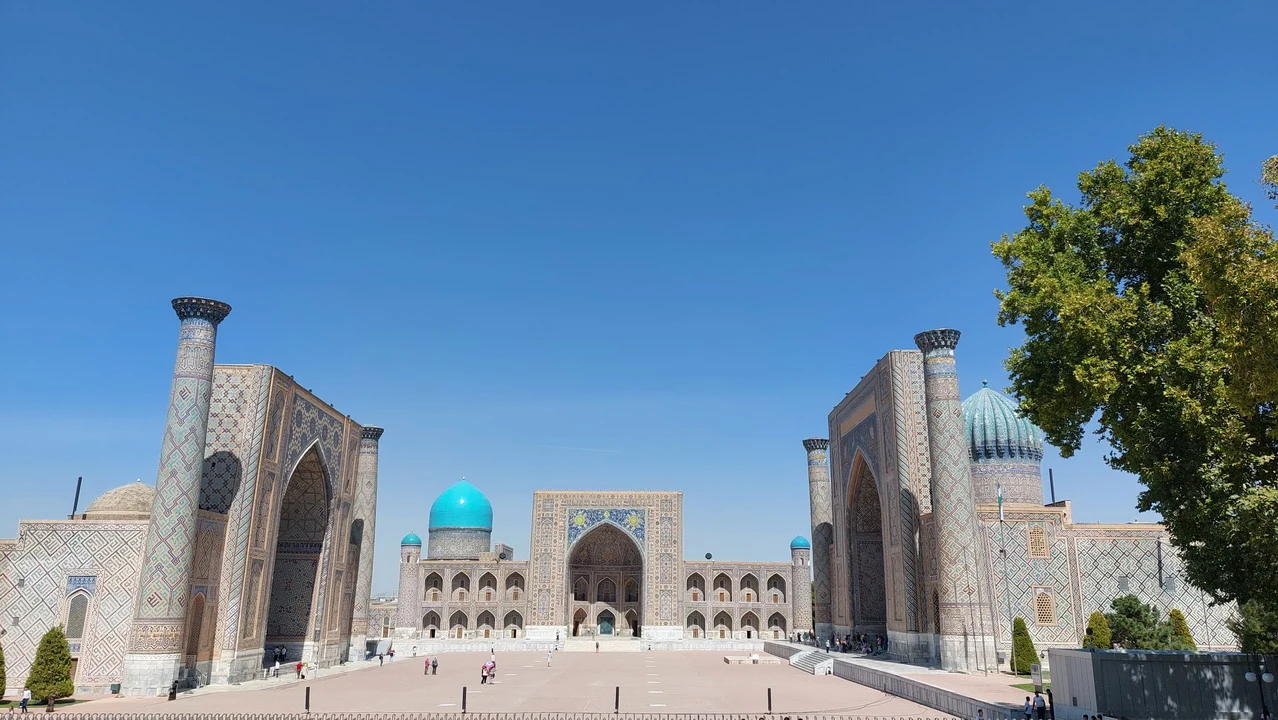
Nearby is another mausoleum, that of Ak Saray: much quieter, and the silence is particularly appreciated after visiting the nearby building; we meet a guard who also works as a ticket seller, who kindly transforms into a guide and even asks us to borrow our smartphone to take some photos of the dome and other details from angles that a typical visitor might not notice. The avenue full of green lawns and flowerbeds in front of Gur-e Amir leads to another mausoleum and a roundabout where there is a Statue of a Timurid ruler, serious and attentive, sitting on the throne to observe the traffic. In recent years, the city center has been renovated to make it attractive to tourists. Along with the restoration of monuments and the creation of aesthetically pleasing gardens or parks, urban planners have also separated purely tourist areas from residential areas by erecting high walls that evoke an ancient style. Certainly, the background for the photos benefits, but it gives the impression that the "ugly" or simply popular neighborhoods have been segregated, which nevertheless represent the reality of the historic center; in fact, they are not even very ugly, especially when compared to certain Soviet-era buildings, but they remain obviously more modest when compared to the surrounding sites. The true heart of Samarkand is actually a few kilometers north, at Registan Square. We walk there, visiting a modern mosque that requires only a short detour: almost unrecognizable from the outside, once inside it presents a modern beauty and it's also pleasant to see a place of worship frequented not purely for tourist reasons. With the exception of when religious services are held, mosques are open to the public, non-Muslims just need to remove their shoes, wear headscarves for women, and dress modestly. It is surprising that in the mosques visited, almost all the worshippers were male and of a relatively young age. While walking along the road leading to Registan Square, we happen to come across a baker with the typical tandir oven outdoors, in front of the shop; together with his children, he is preparing some wonderful samsas, pastry rolls filled with minced meat and rice. Freshly baked, still hot, they are a real delight for the palate. The regret? Having only bought one. But another sense, sight, is about to experience a memorable moment: the moment when we see… Registan, a complex of three magnificent madrassas, on three sides and beautifully restored. The layout seems deliberately designed to impress the visitor approaching it from above, observing them from the top of a staircase. We enter after passing through the ticket office and access the courtyard surrounding which are the monuments. The entrance to the Sherdor madrasa, on the right, highlights a particular detail: two tigers surmounted by a human-faced sun. As seen in Bukhara, these images are prohibited by Islamic doctrine and represent a less restrictive interpretation of the rules; within the courtyard, some notable features include tapchan, typical sofas with a central table where you can sit around and cross your legs. But the Tilla-Kari madrasa The trip itself is worth the visit: the ceiling is flat but so well-made that it creates the illusion of depth and appears to be a dome; your eye would confirm this, if not for the guide's clear explanation to the contrary. The walls, the mihrab, and all other works shine with an abundance of golden and blue decorations of great quality. Finally, the magnificent Ulugbek Madrasa, dedicated to the eponymous ruler, grandson of Timur, who was passionate about astronomy and even became a scientist himself. At that time, the emirate possessed such expertise that part of it is still valid today, despite having other research means available. Some settings depict scientists discussing amongst themselves, and you can almost participate by listening to the results of their discoveries. After leaving, we cannot help but adopt Tiziano Terzani's words: "Now that I have seen Samarkand, I will never be able to dream about it again." Although this interpretation does not exactly correspond to his, it is a dream that is emerging from the drawer to take shape in another place of the mind, the one that received input from sight, the experience. We walk along the Sherdor Madrasa, just beyond the statue dedicated to Karimov, and following the eponymous tree-lined avenue, the unmistakable Rooftop restaurant at the Registan Square, commissioned by Tamerlane's wife and one of the most impressive in the country. Continuing north, we find a secular stop at the Bazar Siob... where we once again see neatly arranged rows of fruits and vegetables on display, like in a museum. The image of two shop assistants chatting behind the counter also seems like a perfect painting. After this secular section, continuing north, a modern pedestrian bridge crosses a fast-flowing road to access a hilly area where the Hazrat-Hizr Mosque, from which they enjoy wonderful views thanks to its elevated position, and the Karimov Mausoleum, recently built as the Uzbek leader died in 2016; this one features a small cubic building where the tomb is located, surrounded by a portico supported by the unmistakable and marvelous wooden columns. Sitting in the shade on benches, the faithful pray as if we were in a sanctuary. Further on, we find another highlight of Samarkand: the Shah-i-Zinda It's a boulevard with a series of mausoleums on either side, belonging to nobles and historical figures. The complex is unique in its kind, but there are some buildings whose interior surpasses all others and doesn't shy away from comparison with Persian decorations. It would be more peaceful if there were no visitors, but even then, it's possible to capture its spirit and meaning. It was after these intense hours spent visiting Samarkand that the idea of how unknown this part of the world still is became stronger in us; although it has only recently been opened, it contains images and sensations of art rarely found elsewhere, in a civil and safe setting. As if we hadn't walked enough, we tackled the 3 km leading out of town towards the Tomb of the Prophet Daniel Here, history blends with legend and imagination: the aim is for the body of the prophet, including those in Susa, Iran, to grow by one centimetre a year, so that the coffin covered in velvet and black fabric measures 18 meters long. This curious and unforgettable site is located in a beautiful green setting; we take a taxi that stops nearby, and after agreeing on the price, we go to the Russian quarter south of the hotel, where we spot a restaurant that can satisfy our interest in local cuisine. Without too much imagination, it's called Samarkand, but the food is also appropriate, even though the waiters don't speak English very well, perhaps not Uzbek either. We finally enjoy the cherry on top after taking another taxi to return to the Registan, meanwhile illuminated after sunset. Apparently, we are not the only ones who aspire to such an impressive nighttime view; the lights gently caress the decorations, creating a luminous veil that gives them three-dimensionality; the colors are subdued, they do not try to impress with their brilliance to attract attention, but rather invite moderate observation, attention to detail, and reflection. A walk through the peaceful urban parks leads us to our current accommodation, and the fact that it is located nearby to the Gur-e Amir requires a stop near another residence, that of Timur (Tamerlano). This one too, illuminated with sensitivity and wisdom.
We don't know how many kilometers we have traveled in these days and we haven't counted how many madrases or mosques we have visited. All similar, never identical, and always impressive, symbols of a faith imported and sometimes imposed that has been able to express high forms of art.


