Day 11
High pastures and herds
Amidst the black of coal, the white of sheep, and the blue of Lake Song Köl.
From the Kara-Keche mine to Song Köl
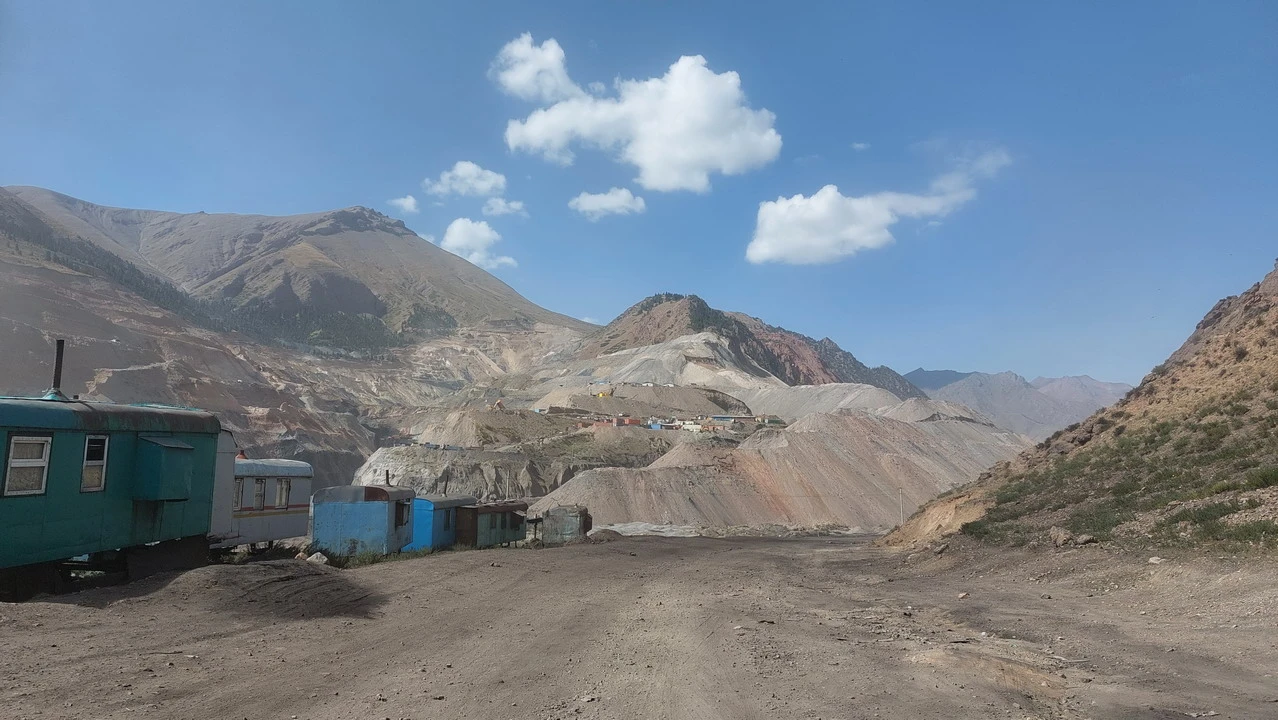
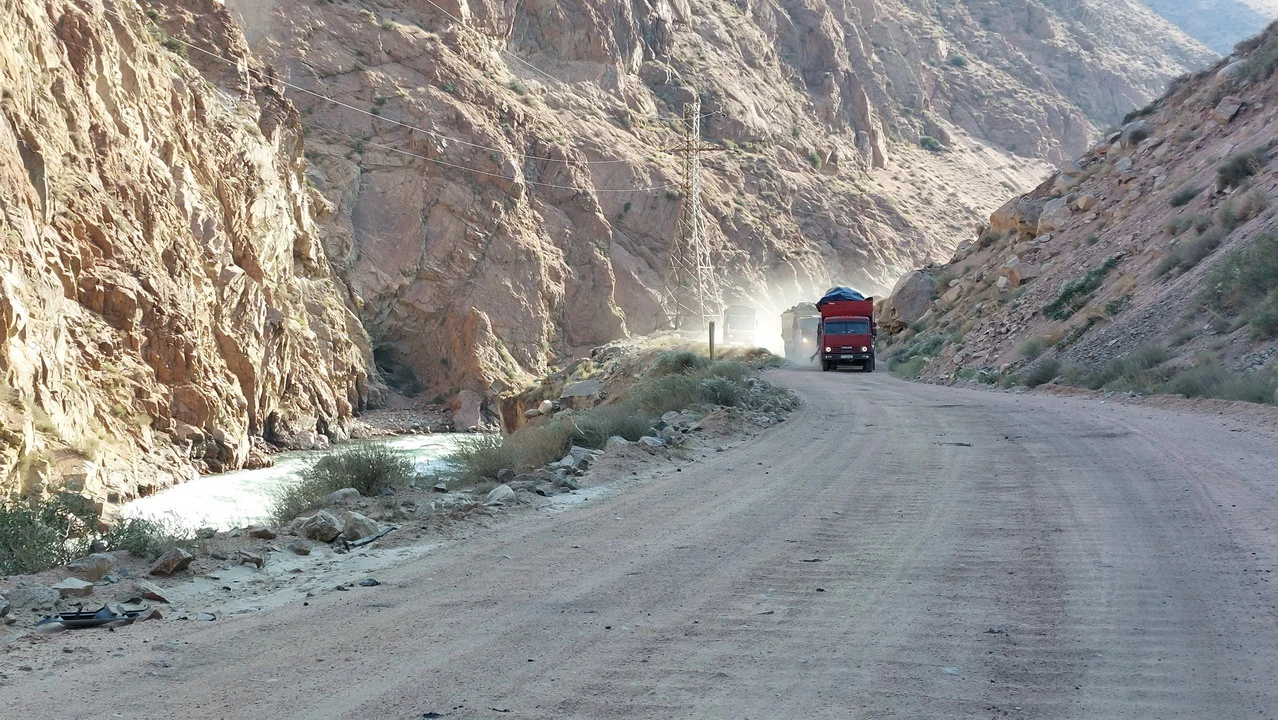
Starting today, we will discover how the Kyrgyz breakfasts are served: cookies, delicious jams of various types, and dried fruits remain on the table at all times. While not ideal from an hygiene perspective due to the omnipresent flies, it's not necessary to be overly formal. At the time, some slices of sausage, scrambled eggs, and other items are also brought out depending on the situation. It is normally a good start to the day. Breakfast at 8 am, departure at 8:30 am; it seems that in case of rain, the roads become particularly dangerous, but this is not an issue due to the cobalt-colored sky. We set off along the Djumgal Valley on a dirt road that runs parallel to the powerful Kokemeren River, crossing it from time to time. It doesn't rise very high but is constant, offering a beautiful view of mountains that are now turning yellow, in contrast with the blue of the river and the horizon. Trucks loaded with Black, noisy trucks move very slowly; we will discover that coal is being transported after seeing how much is lost along the way: large blocks of mineral fall from the wagons and remain there in the middle, posing a risk of accidents for other vehicles. Hopefully, they will be collected by the locals and can at least be used as a source of heating. Like Pinocchio, we could follow the traces of coal on the ground to reach the mine, and eventually find ourselves… opposite a quarry, where trucks and excavators move like worms across the mountain's body, apparently without direction or destination. It is likely that the intense traffic we see is only the surface layer; the real construction site must be underground. It is amazing: as you climb through the valley, you notice nothing at first, then a small town appears in the middle of nowhere with carts that might seem like an evolution of those used in the Wild West, serving as simple dwellings. Life here must be very difficult; we can only imagine how it is in winter when the temperatures are extremely cold. In addition to the fact that extracting coal is not a healthy profession, hard work and weather conditions make the situation even worse. But this is their life; we stop for a moment to take pictures, they are not beautiful, there is nothing beautiful here, perhaps only the moment of departure, even though all around there are stunning mountains. documentary photos to remember what we saw, not the ones that are published to show how good you are at visiting a particular place – those places where everyone can go. We start again, knowing that those lives will remain here until the end, their own.
As we ascend, the mine appears in its full extent, and it's amazing how the trucks manage to climb up, along the road leading to the Kara-Keche peak (3,384 m), where we are headed. Here, the slope is much steeper and the vehicles are heavily loaded; furthermore, they are older European or Chinese models whose safety is highly questionable. We walk slowly to avoid using the brakes too much on the descents, but if something breaks, they become dangerous projectiles.
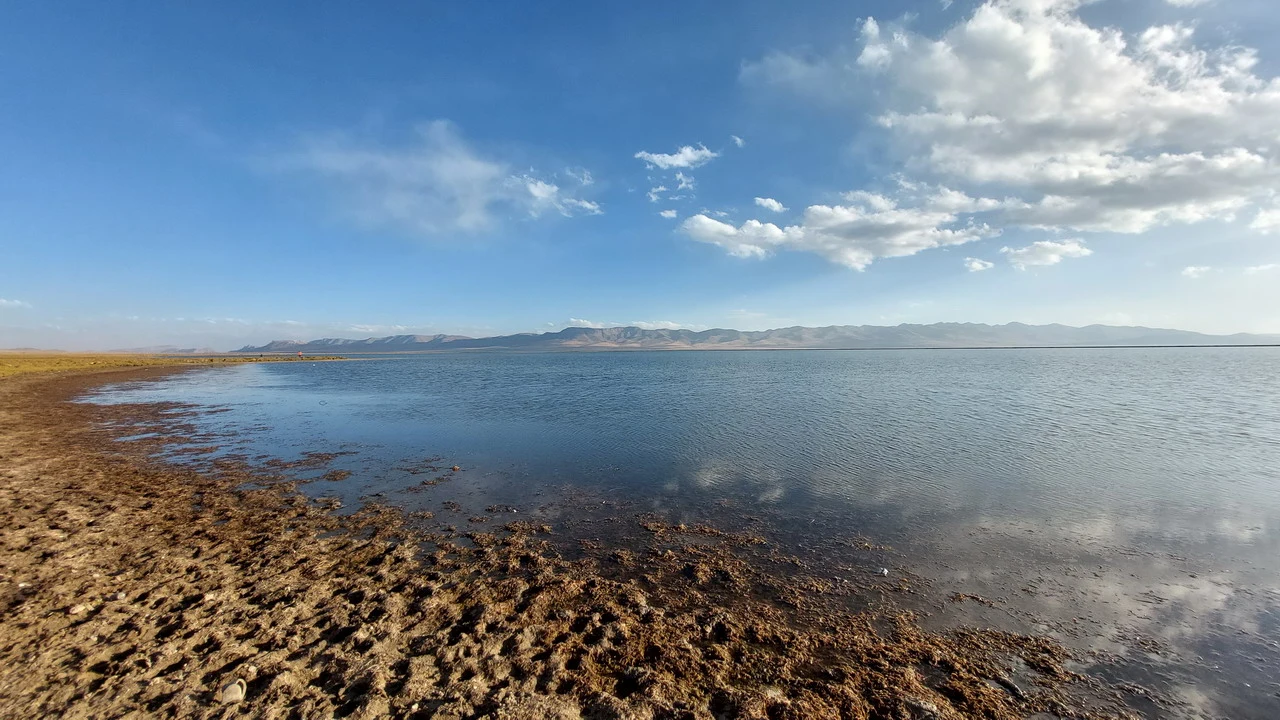
The hill offers silence and serenity that only a mountain can provide. On the opposite side, some high plateaus and meadows are visible, which locals call... jailoo. Always from the higher plateaus, we start to see the large Song Lake, Cologne, our destination for today, but there are still dozens of kilometers on rough, difficult terrain to cover. We are approaching the southern shore, following it along while crossing various streams that descend from the surrounding mountains to replenish its water supply, in a landscape of vast pastures, with an infinite number of animals and punctuated by unmistakable white yurts, sometimes single or in pairs, usually with a small truck parked nearby. There are also small metal structures, perhaps the only element not particularly suited to the natural environment. Horses and cattle graze peacefully, but there are also flocks of sheep and goats, although in smaller numbers. It is surprising to see such a large number of horses, used for transport, meat production, and milking. The cowboy image The sight of people moving from one yurt to another or herding livestock is a bright symbol of freedom. Every view could be worth a poster, with the soft mountains in the background and a clear sky that evokes infinity. When we reach the small yurt camp Located on the northern shore of the lake, it is now 3:30 PM; despite the time, we are offered lunch, which we enjoy together with the ubiquitous tea. An exploratory walk. along the lake which, given its vastness, creates cloud cover that affects the quality of the photos. Sometimes it's necessary to turn away from the lake to... explore the inland area, admiring the everyday life of the herders; some of them are bringing in their livestock as the sun sets. Some horses graze with a rope that connects both front legs to prevent them from running away. The grass is short, we wonder how they manage to feed, but the animals don't seem at all malnourished. Now the season is coming to an end, the yurts are starting to dismantle their tents and within about fifteen days, the livestock will also begin their transhumance towards the Kochkor plains and beyond, with similar methods and timings to what happens in our mountains. Depending on the snowfall, they climb from mid-May to early June, as this is an area where there is a lot of snow. Compared to Mongolia, the yurts are simpler but larger, accommodating up to 5 or 6 beds; the same construction method, much less decorated and without a real door, just a thick tent that is unrolled downwards. In return the stove that burns manure send a less pungent smell, probably because we are not yet in the area where yaks live. Yurts and generally yurt camps do not have energy sources through generators; they rely on solar panels connected to a battery and only use minimal lighting from early evening.
Sunset and night in a yurt at Song Köl
The unpaved roads don't allow for high speeds, but you can get around using any means, preferably a 4x4 vehicle. However, patience is required because the distances are considerable. When the sun disappears on the horizon The temperatures are dropping; we're at 3,000 meters. At 7 PM, it's time for a nice dinner after watching a magical sunset: the shadows lengthen and the freshly mown fields seem like endless golf courses. Then it's time to head back to our our yurt for sleeping. The silence is complete and envelops us, as does the cold: you need to bury your head under the duvet.