Day 5
From Khiva to Bukhara
Endless steppe between Khiva and Bukhara, then the religious gem of Uzbekistan.
From Khiva to Bukhara
The development of Uzbekistan also depends on the constantly evolving railway network. Long distances are being shortened thanks to punctual, reliable and fast trains. And they're also affordable: for example, a 300 km route at over 200 km/h costs just €7. But from Khiva you still need to get to Urgench and from there to Bukhara; we opt for a taxi booked through the hotel, leaving early and covering the 450 km in just over 6 hours with a couple of stops at significant points. As soon as we leave Khiva, we pass through a green area. cotton cultivation, rice, fruit fields and greenhouses. As we move further away, we discover how Khiva and its surroundings depend entirely on Amu Darya River, whose waters flow from the border mountains, along with Tajikistan and Afghanistan. We cross the river. on a metal bridge, the road shares the route, overlapping with the local traffic railway, and a few kilometers later, it enters the desert where only the paved road It manages to break the monotony. At least until the landscape is unexpectedly interrupted by aquifers likely formed by the river itself, near the border with Turkmenistan. They appear almost like a mirage in an area where only bushes grow; it is scenically interesting that the dominant position from the top of a hill offers a panoramic view. Along the route, one encounters many ongoing works for widening, the inconveniences are evident but they are also a clear sign of the country's development. We also encounter frequent checkpoints: we are stopped every time, no agent approaches and after about a minute we continue as if nothing happened. We have lunch at one of the rare roadside restaurants present in this remote and wild area, finally arriving in Bukhara in the early afternoon. A few dozen kilometers before, we start to see cultivated fields, mainly cotton. The land is being watered. as if it were rice; let's get to know this familiar product for the first time, although we had never seen the plant before. We can also see some companies with a double Turkish and Uzbek flag, which signifies the close collaboration between Turkic countries. Furthermore, we can see fields of cereals, orchards, and vegetable gardens, in a setting made lush by the abundance of water.
Arrival in the Lyabi-Hauz neighborhood
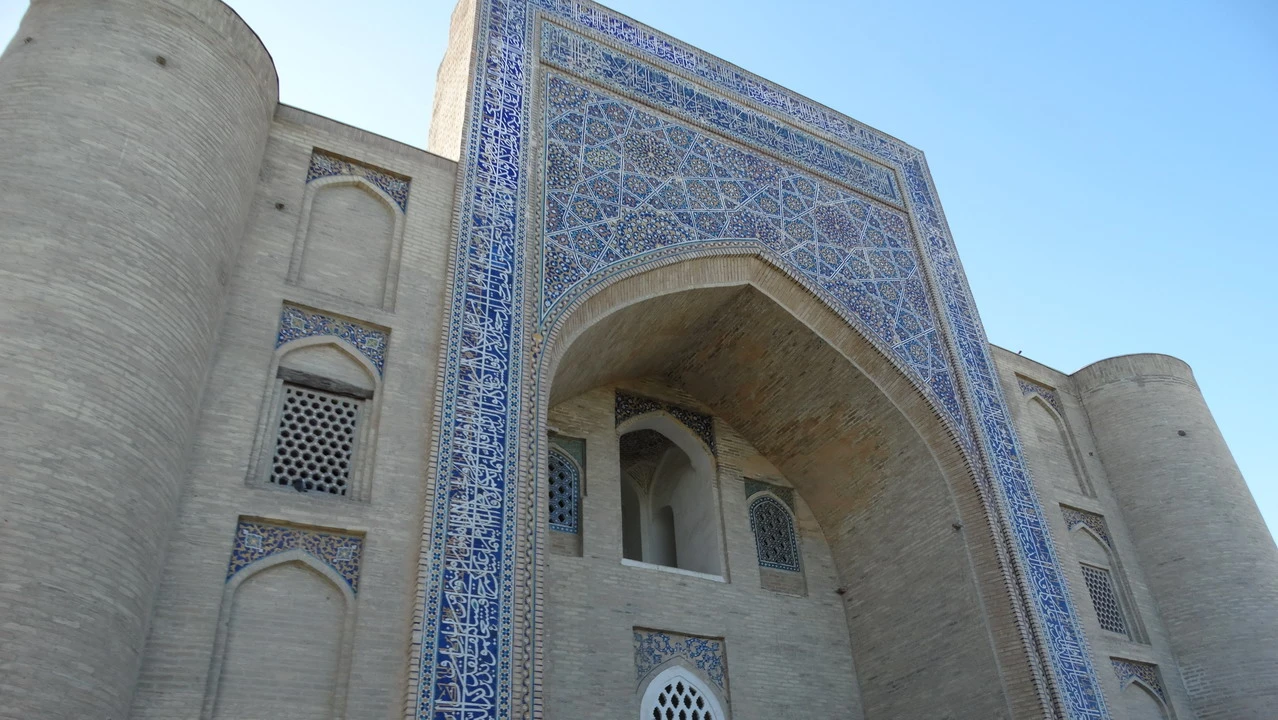
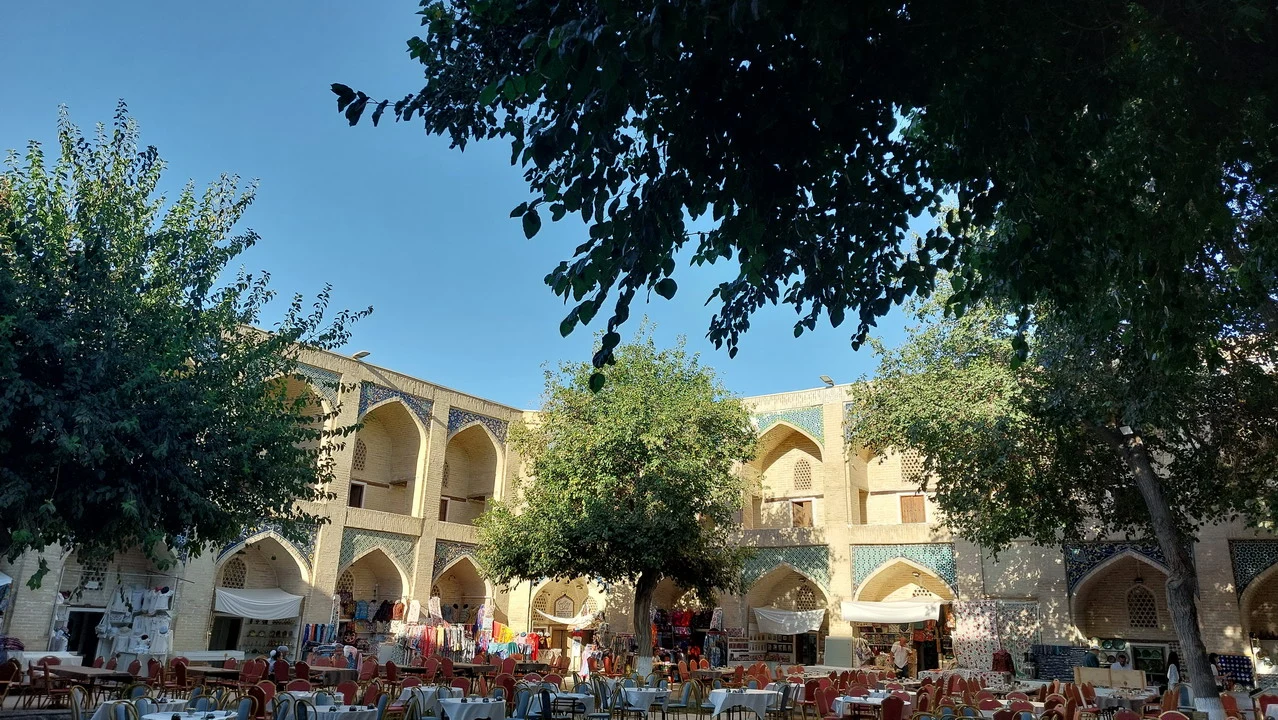
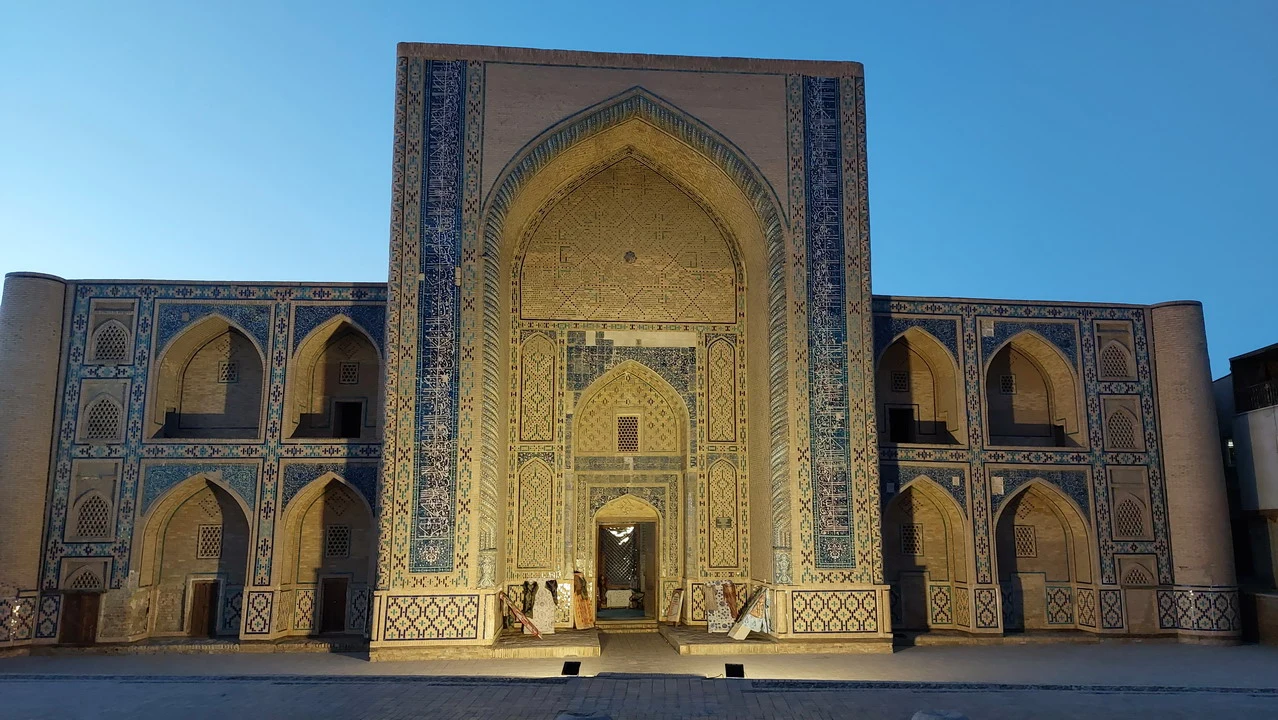
Initially, the hotel seems closed; the curtains are drawn to block out sunlight, and there's no one at the reception desk. Eventually, a young woman arrives who we can't understand – she might be mute or simply doesn't speak English: using gestures, she hands us the keys, and we go to our room. beautifully furnished in a local style It feels like being in a small museum, with a raised bed under a canopy, carpets, and a wall covered in decorative ceramics. We are ready to explore this city, the capital of the eponymous emirate until the Russian conquest which occurred in the second half of the nineteenth century. It is also a treasure trove of Islamic religious artifacts, well-restored but less prominent than those in Khiva or Samarkand. With a 15-minute walk, we reach the urban center where on one side there is Khanaka of Nadir Divanbegi overlooking the Lyabi-Hauz, one of the few pools that survived the burial that took place in the middle of the century to reduce the frequent illnesses caused by the unsanitary air resulting from stagnant water. Currently, bars and restaurants of all kinds are located along its edges, disturbing the peaceful shade it provides. On the opposite side stands instead the Madrasa Nadir Divanbegi, a feature for the two peacocks depicted, whose beaks converge towards the apex of the arch, are prohibited by Islamic doctrine which does not allow representations of humans or animals. However, the Islam of Central Asia is not interpreted literally and this is confirmed by the passion of its inhabitants for vodka. Just crossing the street leads you to another beautiful madrasa, that of Kukeldash, which has some nice displays of carpets for sale. At this point, we go to an ATM kiosk to withdraw local currency, but we find that they don't accept Mastercard (or perhaps they do too much), and they keep it. With some apprehension, we call the numbers indicated near the screen, not sure if anyone will answer and in what language. Instead, we find a kind lady who provides useful instructions for calling another number from which we will confirm that tomorrow morning we can pick it up: we just need to agree on the time. Having done everything possible, confident but without any certainty, we temporarily block the card and continue on foot to visit the photographer. Char Minar Madrasa, a bit off the beaten path and accessible by crossing a residential area: the four minarets are actually towers, on one of which is located a stork nest – a clever idea to combine art with a connection to nature. Underneath the nearby portico, there's a small bazaar selling Soviet-era antiques: uniforms, paintings by famous figures from the USSR, brooches and photos of all kinds. Things for those nostalgic for the regime, but also for enthusiasts looking for unusual items.
We return to the city center for dinner, so we're already in the area to see the nighttime illumination, which is nice but we were expecting something more impressive in this part of town. Another thing will be tomorrow evening with the Kalon area. Tired, we return to the beautiful room reserved for the boutique hotel, which we will remember fondly for this reason alone, as the staff could use some improvement.