Day 4
Khiva
Khiva, in a key oasis on the Silk Road.
Khiva, a museum city in the desert.
A full and intense day dedicated to visiting Khiva, and it's worth every minute spent there. This ancient city museum, hidden deep in the desert, is authentic, even though it doesn't immediately appear that way, and truly spectacular.
Morning in Khiva
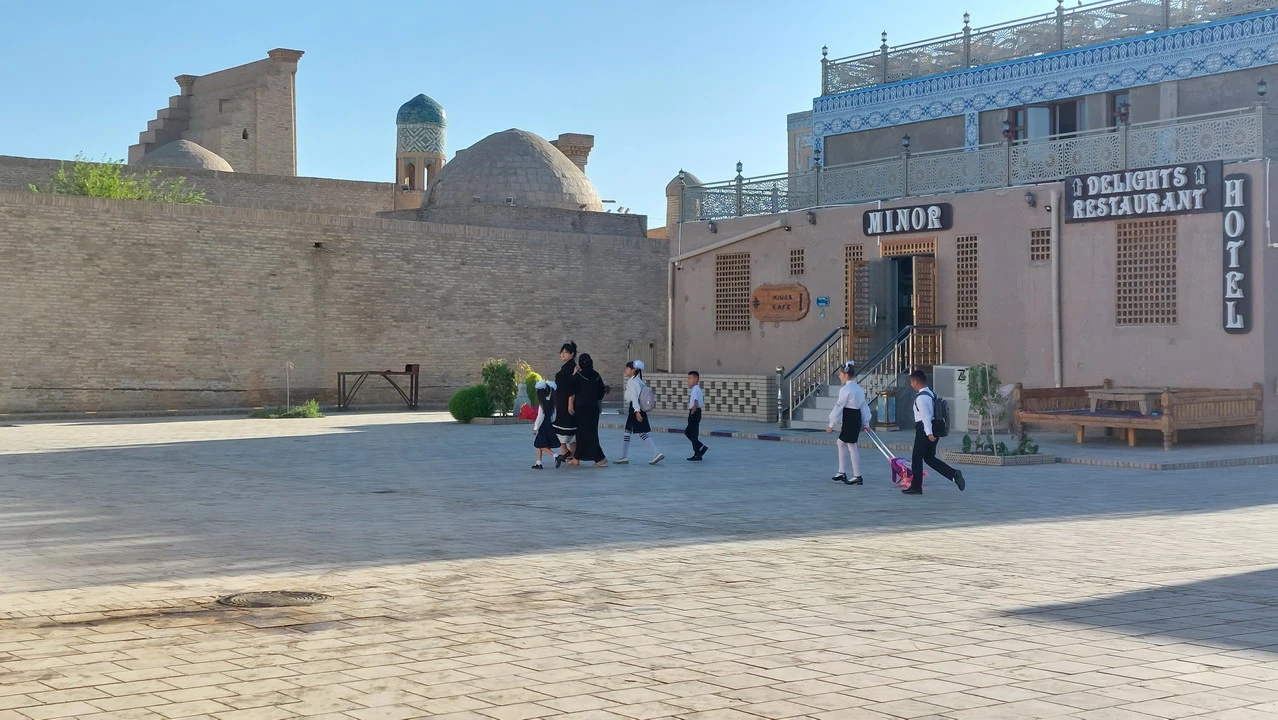
Before breakfast at 8:30, where we will try the "gham," a type of crepe, let's go for a photographic reconnaissance while the sun is just beginning to illuminate the monuments and there are still no crowds of tourists around. children in uniform We visit the school, which is really beautiful from both a visual and stylistic perspective; actually, during the day we will be pleasantly surprised not to encounter the overcrowding we feared: the visitors are mainly Uzbeks, who enjoy taking photos with us and demonstrate a sense of friendliness despite the difficulties in communication due to the lack of a common language. We also see Russians, people from other Central Asian republics, and, to a lesser extent, Europeans. Since the school is located within its walls, the distance to cover on foot is not particularly long, but there are many sites to visit. In fact, after going to the western entrance to purchase tickets valid for most of the monuments, we go outside to see the walls from the outside and something worthwhile that is nearby. Returning inside, we review a large number of madrases and... Juma Mosque... or on Friday, with the 213 wooden pillars supporting the ceiling: all of different make and age, they strikingly resemble the Alcázar of Cordoba, although in a less ostentatious form. Creating the wooden base of a pillar takes sixteen years: oak wood is used, which is quite common in this area and used for a series of operations. The first 5 years it is left to soak in a substance, then in cow manure and finally in linseed oil. This is to achieve a certain resistance against bacteria and to obtain an ant-termite function that allows them to last over time.
During the day, despite temperatures ranging from around 30°C or slightly higher, we visited the following monuments:
- Kalta Minor Minaret
- Kuhna Ark
- Pahlavon Mahmud Mausoleum
- Palazzo Tosh-Hovli
- Islom Hoja Minaret
- Juma Mosque
- Juma Minaret
- Khorezm Memorial
- Kutlugmurad Madrasa
- Hojamberdibai Madrasa
- Ak Mosque
- Tosh Hovli Palace
- Tosh Darvoza
- Abdul Khan Madrasa
While exploring Ichon-Qala, we came across a a couple of newlyweds with guests accompanying them; we will also see others posing in front of historical monuments in the following days, it seems to be a tradition. The newly-married women wear the white dress similar to what is used here, their faces are covered with white wax to make them look pale, bright lipstick and they always have a serious, almost austere attitude, even when photos are taken of them. To a mischievous eye, it might seem like forced weddings, we hope it's not the case because the mood is always the same.
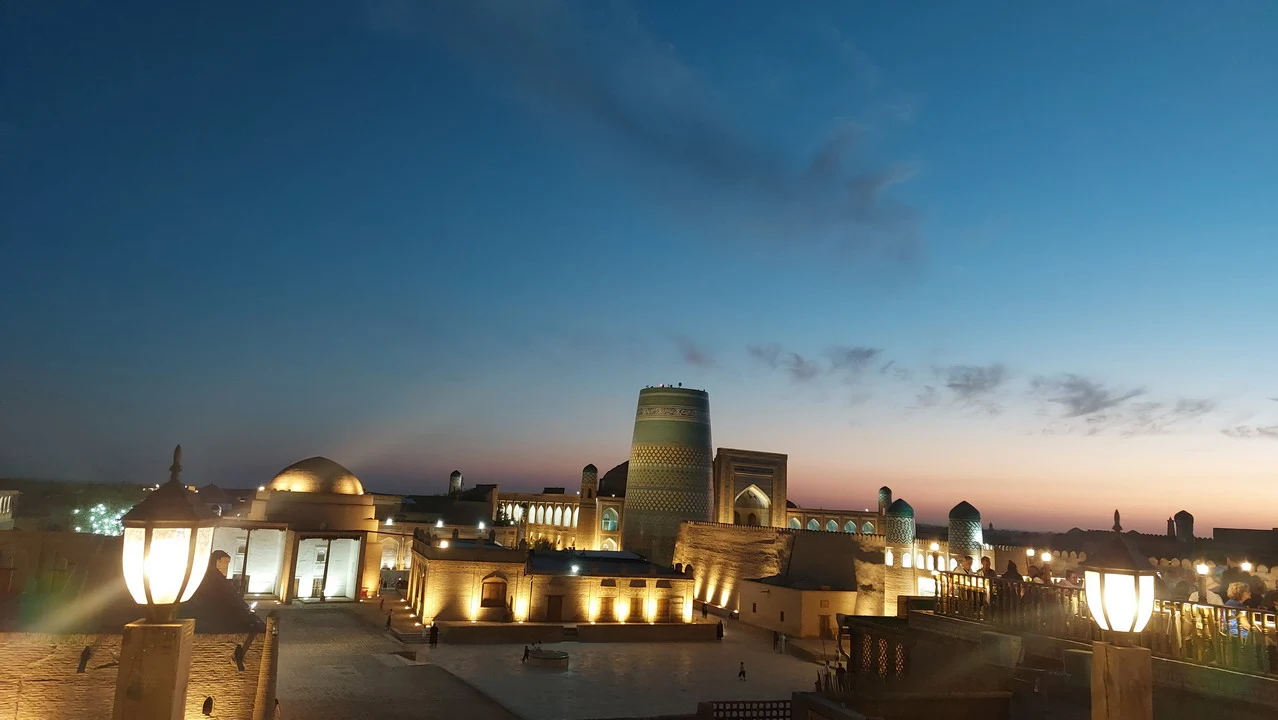
Let's meet a friendly and young guide who notices we speak Italian and offers to take us to see a couple of sites and provide helpful explanations in our language. In the evening, we climb up to the walls for a walk with a panoramic view: the sun tends to leave sandy-colored buildings, but before saying goodbye, it illuminates them with its warmth, enhancing their color.
Evening in Khiva
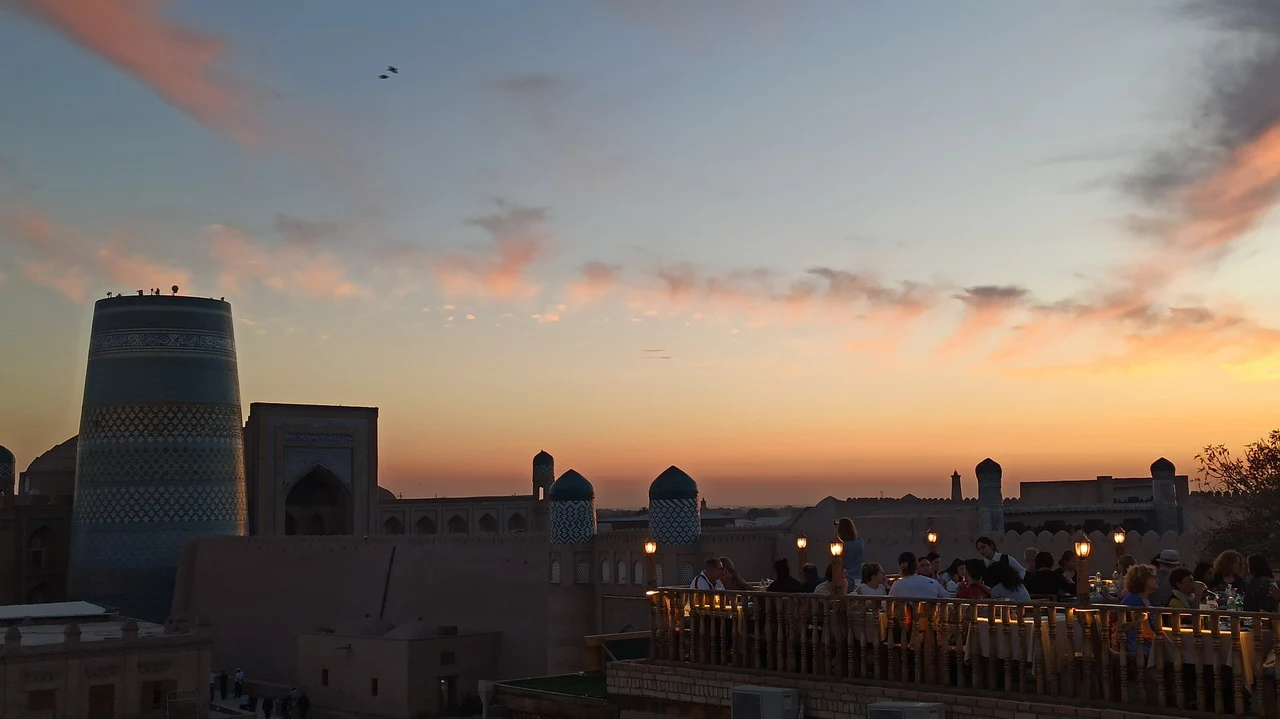
Now all that's left is to go out for dinner at the restaurant Carefully booked this afternoon: what better combination of space and time than to watch the sunset while enjoying a delicious shashlik on the terrace overlooking the venue? The only drawback is the conflicting sensory experience: sight and taste compete for attention with rare images and flavors, rarely experienced together. As night falls, the monuments return to their former glory. revealed just like last night, and the plates are empty. Nothing better than a walk to see this wonderful city, not even slightly tired of repetition. Let's see some interesting decorative ceramic candies on the walls, we find them arranged vertically: they symbolize family unity and originate from Zoroastrian culture.
To prevent the clay and straw-based structures from becoming damp and crumbling, wooden supports are used to prevent the soil's salinity from affecting their stability. The temperatures in winter can drop below -25°C, and it rarely rains; as a result, water is considered a precious resource that comes from channels leading to the Amu Darya river. To optimize this resource, or rather, they were previously used, are cisterns on which sacks were placed so that, especially at night, they produced condensation, which would then collect at the bottom, forming a small basin.
Like all other rulers, the Khan had four wives and forty concubines: the first wife was chosen by the family, the second and third by prominent figures and ambassadors, while only the fourth was chosen by the Khan himself, and it is easy to understand why this one would be his favorite. The children of the wives became rulers or at least held a noble title, while the children born to the concubines went on to study in religious schools to achieve an important position, even outside the royal family. To gain access to an audience with the Khan of Khiva, it was necessary to wait for two or three years; this allowed the guest to learn the proper etiquette for approaching the ruler and to purchase the appropriate attire for the meeting.
Khiva, restored and suspended in the desert.
Khiva is one of those cities that you can't easily forget: nestled within its thick walls, far from everything, historic like few others, legendary for the Silk Road and the slave trade, and there's more to say about it. The restoration has made it better than new, which might be the only drawback. One could argue that the work was done more for the benefit of tourists than as a true representation of historical Khiva. Compromises are always difficult to find, and in this case, the eye is definitely the deciding factor.
We discover that the region to the north, Karakalpakstan, is inhabited by a different ethnic group and that the law allows residents to hold a referendum, where an absolute majority would grant independence. To avoid this possibility, the government offers very advantageous conditions to those who want to move elsewhere, and at the same time does not discourage Uzbeks from moving into the region.