

Day 5
Tour of the Upper Guajira – 3
Still in the desert, and a moment of suspense after the rain.
Morning in Bahia Honda
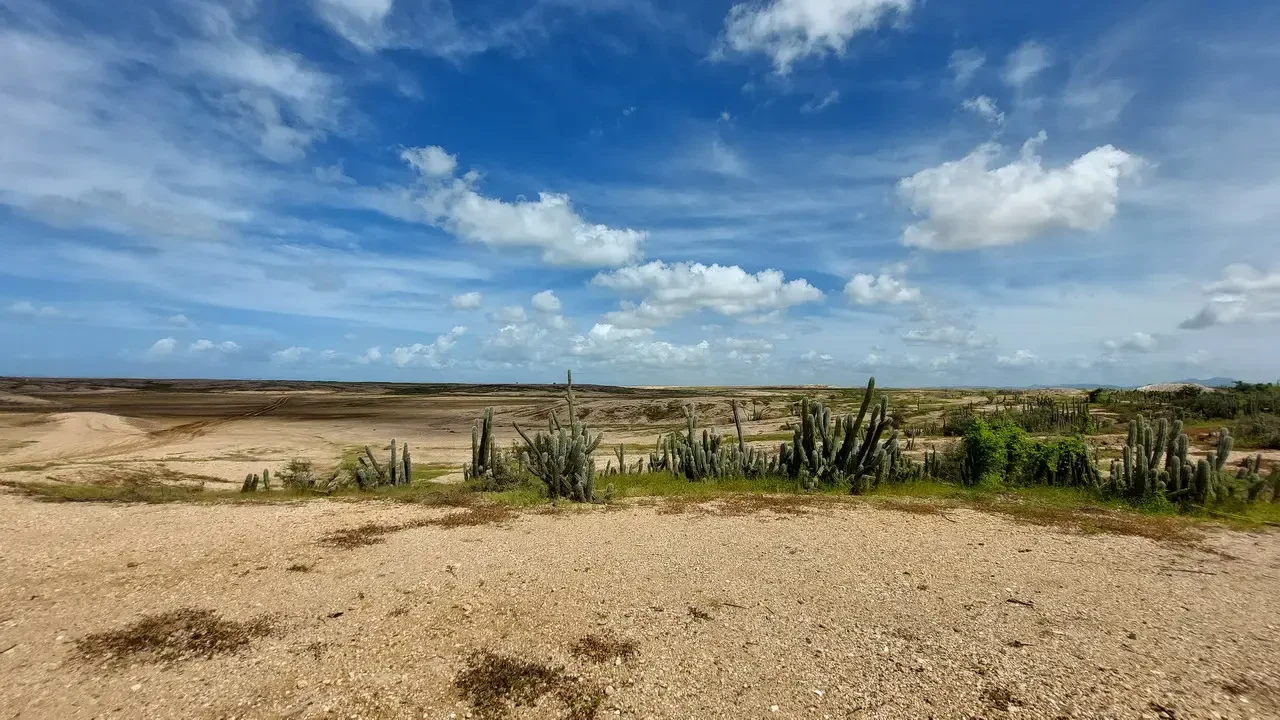
Feeling refreshed like never before, we are ready for breakfast where hot chocolate with goat's milk is the highlight, and then to continue our journey, forgetting that the rain falling on the desert sand does not represent the best way back, as there are no tracks that have anything to do with a well-worn road. Even though the first few minutes seem comforting, we quickly realize how the sand under the wheels turns into a treacherous sludge, and these sinking rotate around themselves. We stop for a moment to take some photos from a scenic viewpoint. Bahia Hondita and we quickly get back on track, knowing that the day ahead is full of challenges. We don't have to wait long before encountering our first one: a jeep that left at 5:00 AM, knowing it didn't have an engine particularly suited for the day's activities is installed in the upward flow of an empty stream bed The mud is now reaching the level of the platform, and if the vehicle cannot move, we will also be unable to pass through. Other off-road vehicles are already ready with cables to pull it out, but this one remains immobile despite the engine's frantic attempts to get it moving. Our return to Riohacha is scheduled for around 15:00, but at 16:30 we have a bus to Cartagena; missing it would not be a disaster, but it would force us to recalculate our schedule and visits in one of the most beautiful cities in all of Colombia. However, we need to get out of this mud, knowing that we are at least 250 km from our destination; hopefully, after about ten kilometers, there will be no more traces of rain and the ground will not present any obstacles worse than those we saw yesterday. In the meantime, after several unsuccessful attempts, they finally manage to free the jeep, but unfortunately, at the cost of damage to the rescuer's engine. Once the "road" is cleared, our driver's skill allows us to overcome the obstacle with ease; he has an incredible ability to interpret the terrain and, observing him closely, when someone in front makes a mistake, he makes a grimace with his lips. In total, there will be 5 or 6 jeeps. But the surprises are not over: a vehicle that was traveling alongside us (the drivers are friends) flat a tire, our guy replaces it because the other one's size doesn't allow for particularly athletic movements, and we get back on track. There are still a couple of dangerous crossings that we manage to cross despite the water level rising, thanks to a man who tries to level out the riverbed with his legs submerged. Unfortunately, the spare tire is partially deflated but our friend manages to reach Bahia Portete where, in addition to a wonderful view, there's also a bicycle pump at a Spartan rest stop. In two check the tire pressure enough to get to Riohacha. The view from here is wonderful, both towards the lagoon and on the cacti that extend to the other side.
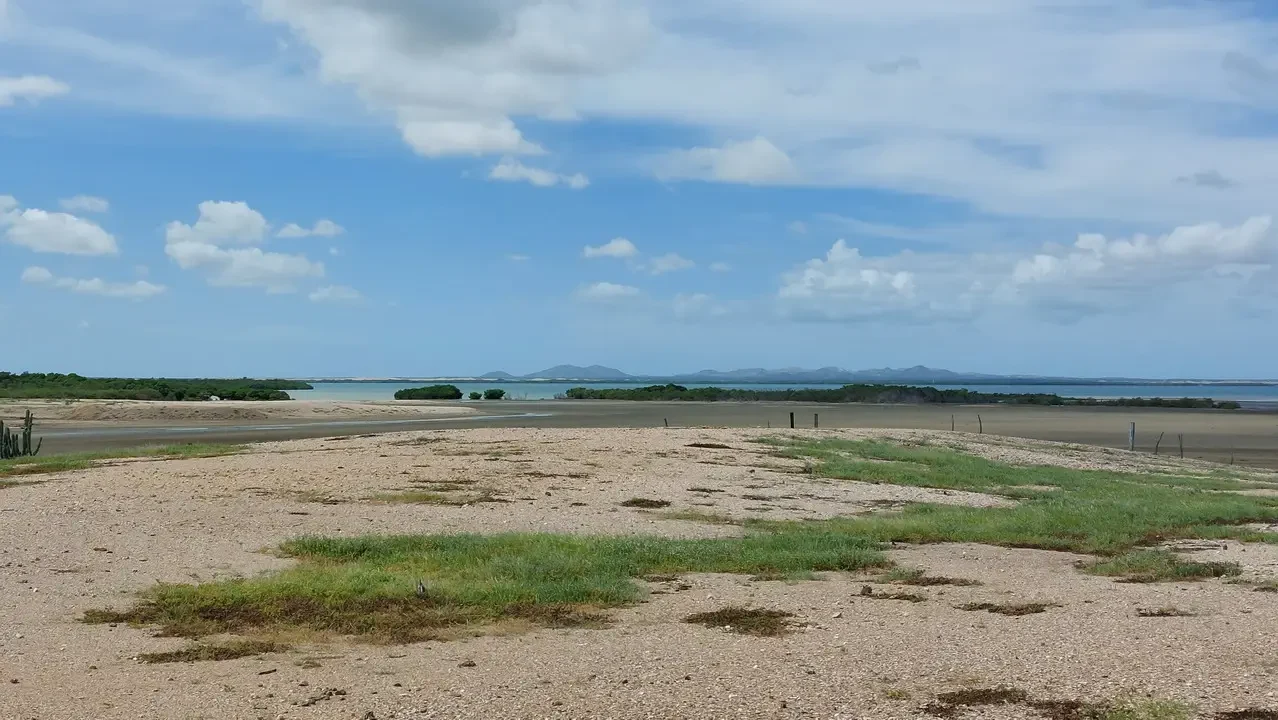
Arrival in Bahia Hondita
A train pulls a countless number of carriages towards the coal mine, while yesterday we met with tankers for transporting water in the most affected areas. We also saw some abandoned vehicles on sandy ground, made muddy by the leopard-spotted rain, and finally arrived at Uribia for lunch, from where we immediately departed. Luckily, the Wayuu union members didn't anticipate any blockades, and even with a few lingering raindrops, we arrived at the agency headquarters and then to the bus terminal of this Caribbean town just half an hour before the departure of the booked vehicle. Expresso Brasília We already had experience with South American terminals; they are very busy, and there are people who could take advantage of the chaotic situation. However, both our first and subsequent experiences will be positive: punctual bus service, no risk, and good organization. We already had the voucher that we exchanged for the ticket at the designated desk. The journey starts essentially on time, but traffic and the need to stop at terminals in relatively central areas of Barranquilla, Santa Marta, etc., make the trip last 9 hours instead of the planned 7 to cover the 400 km distance. Once we arrived at the now empty terminal in Cartagena when it's 1:30 AM, we call Uber; strangely, the indication on the app is not particularly precise, and we find ourselves dangerously navigating among homeless people sleeping on the ground or on benches. In the end, we manage to have our apartment delivered, even though fate doesn’t want us to sleep early, and shortly after getting into the car, we encounter maintenance work that forces us to wait for another ten minutes. At 2:20 AM, we finally arrive at our destination for a well-deserved rest. Fortunately, the reception is open 24 hours, and the man is also awake. We check in and finally go to sleep after a long day that started early in the humid atmosphere of a chinchorro, in the most northern part of South America.


