

Day 9
Guatapé and Comuna 13
The natural beauty of the Piedra del Peñol and my experience in Medellín, in the neighborhood that has become a symbol of renewal.
Guatapé and Comuna 13
Knowing that the time available in Medellín would be very limited, we had already booked an early morning bus to Guatapé, covering the approximately 100 km in about 2 hours and visiting the nearby Piedra del Peñol. We booked a ride via Uber the night before, departing at 5 am towards the Medellín Norte bus terminal. Seeing the hustle and bustle around the terminals is always an enriching experience, while being mindful of not being suddenly robbed by someone who tries to snatch your wallet. Unlike airports, this is where you see real people, and it's easy to imagine their stories – these individuals or families traveling for work or to visit relatives, often struggling to make ends meet. With the voucher downloaded via the web, we check in and head to the boarding point With the airline Sotrasanvicente, we depart at 6 am. The aircraft can accommodate around twenty seated passengers plus an indefinite number standing. It's quite old, but this adds to the charm of the journey. along the road We stop an uncountable number of times to pick up and drop off passengers going to work or school, with each person paying the driver in cash for the journey, obviously there are no subscription forms and the driver is able to both drive and manage the accounting aspects, perhaps exchanging a few words with regular customers. We appreciate the cordiality in interactions ranging from simple greetings towards strangers to quiet conversations among friends. The road has some toll sections that we could consider as state roads; at the toll booths there is a lane for motorcycles, exempt from tolls.
With unusual punctuality, we reach the stop that leads to Piedra; there is no one here, which already represents a positive element, even though the sky is gray with clouds, fortunately we won't have to deal with rain. We climb the long staircase leading to the parking lot and then to the ticket office. From here begins the real ascent with its 675 steps of a staircase built into a large crevice in this mountain that so closely resembles the sugarloaf of Rio de Janeiro. It is a rocky formation, a towering volcanic monolith reaching 220 meters. We make several stops to rest, but mainly to... see the landscape which gradually becomes increasingly vast and spectacular. The artificial basin formed after the construction of a dam in the 1970s, it extends for 74 square kilometers between hills and narrow valleys. blue and green pieces The vegetation extends beyond a certain level, creating an irregular archipelago that adapts to the topography. Coffee plantations alternate with villages and forests.
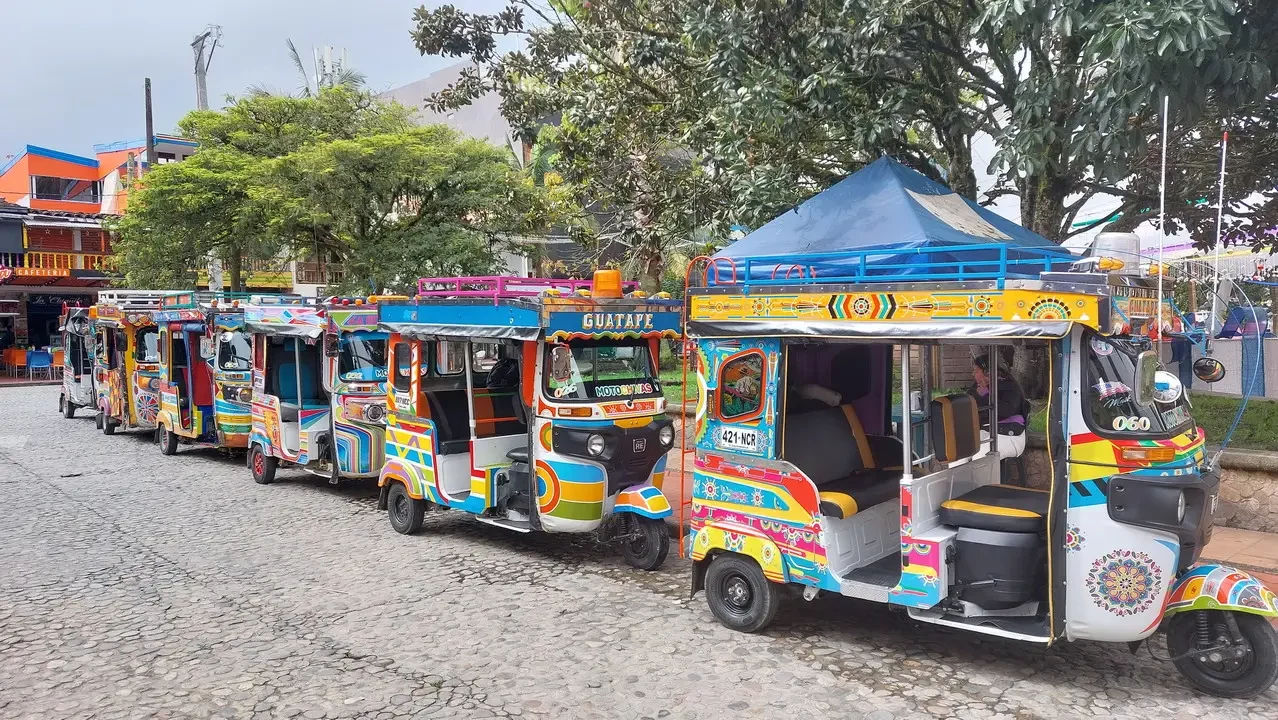
We arrived at the top among the first, and in addition to the panoramic view of 360 degrees, we also enjoy the silence emanating from this privileged natural observation tower. We stay on top for almost an hour. We descend along the same path but using another one-way staircase that crosses the ascending staircase, and then we go to visit... Guatapé (1,900 meters) just 4 km away, reachable by motorcycle taxi, which are affectionately called MotoChivas, where "chiva" is the Colombian name for goat. The village revolves entirely around the Stone but has some unique features that make it worth visiting. Especially the colors are a major attraction, enhanced by... colorful mosaic tiles created by local artisans who decorate the facades of the buildings The lower parts are actually made of brick and then painted with scenes of daily life or various depictions, for example related to the owner's profession rather than religious, historical, or Paisa cultural themes, or simply referencing geometric shapes with colors and figures. Originally, they were used to protect the walls from moisture, but they have now become a folkloric decoration that particularly distinguishes Guatapé, and not just it. The chromatic creativity continues with the upper parts of the facades, from open umbrellas that serve as "roofs" for the streets to motorcycle taxis. The church, of course, is also more modest and features a beautiful nativity scene.
The visit was of great interest and it would be nice to sit at a table to better enjoy the daily life of a small town where life still flows peacefully despite its proximity to one of the wonders that characterize Colombia. But during our tour of La Guajira, we met a young man who told us about the possibility of having a unique experience in Communal area 13 of Medellin, where we had planned to go but feared being stuck in one of the many tourist traps that only showcase the sweet side of the neighborhood, which has become famous in recent years and is now considered a must-see destination by many guides, almost like a theme park. On the same day, we contacted each other via WhatsApp ( https://wa.me/message/KB5ZW7OAHIWJB1) and we set the appointment for today at 3 pm, although we were worried about arriving late. Today, thanks to the typical Colombian flexibility and by changing our bus ticket (there are buses every half hour, and we had booked one for 12:30), we depart towards the north terminal of Medellín. The journey is not just a transfer; it allows us to see agricultural areas (cabbage, tomatoes, and flower greenhouses), daily life, and finally, a first-hand view of the city from above. When we arrive, shortly after the terminal, we experience the efficient elevated metro line for a short return to our hotel in the Poblado neighborhood. Using the same means of transport, changing at San Antonio station at 3 pm, we are at San Javier station, at the foot of Comuna 13. Here, we meet Onofrio and his colleague Cecilia, who manage an unusual agency to show the present and past face of the neighborhood, an experience that opens our eyes and leaves a lasting impression; definitely one of the most intense and interesting moments of the entire trip. Comuna 13 was the base for guerrilla warfare in the 80s and beyond, a sort of impenetrable fortress both for police forces and other residents of Medellín. Its negative reputation in recent years has turned it into an attraction with stalls, souvenir vendors, and everything that interests tourism, especially distracted tourists looking for gadgets: definitely useful to offer alternatives and support the fragile local economy. In the first section, we will visit these interesting colorful streets, but at some point we will venture off the beaten path; here, we will try to understand the harsh reality that characterized the neighborhood, its rules, its life, and above all, how the nightmare could have ended and how a positive revolution could have occurred. The good news of triumph over evil usually prevents us from seeking its reasons, investigating why a transition was possible, whether everything is as it seems, and what the future prospects are, if there are still embers under the ashes. In conclusion, if the sad, raw reality of a criminal Medellín (and Colombia) is a page definitively closed in history or a resurgence due to economic and political reasons could push us back into the darkest night.
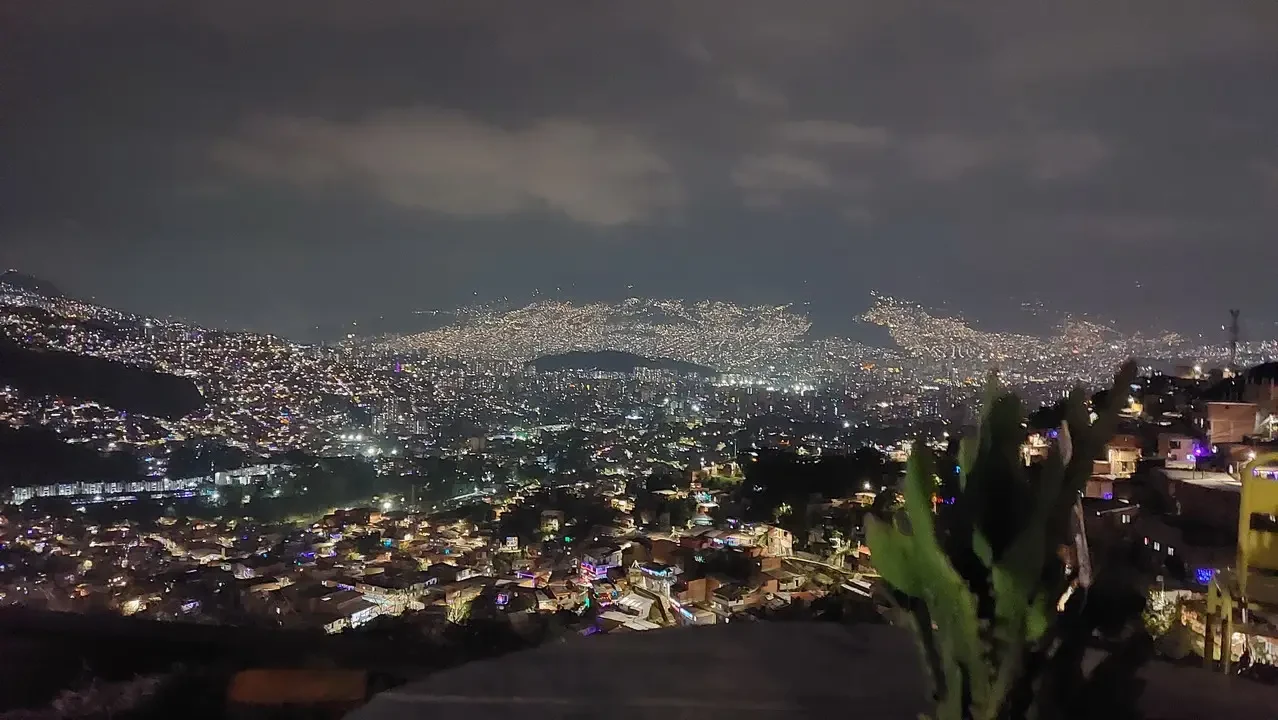
Let's start the tour by visiting a group of young dancers (some of them are Venezuelan) who performs in a short but significant show due to its athletic aspects and deserves a small financial support; these are informal jobs, but these young people earn an honest living. A few more brief stops to try out... big ants... the ants, common food in the northern regions, and a glass of coca tea. The tour was punctuated by beer and some sausages cooked on the street, eventually arriving at a a viewpoint to wait for sunset gazing from above at the enormous basin below, I could feel the darkness approaching. It looked like a grand nativity scene, with some houses decorated for Christmas and the eye wandering along the mountain illuminated by the lights of the houses; it's amazing to see how, despite a poverty situation, where one can clearly sense the upcoming Christmas festivities and decorations are put up. lights around the windows. In the distance, in the central part, you can see the core of lower Medellin, and further east, another popular area with houses. ascend towards the top of the hill The Comuna 13 is further divided into 33 barrios (neighborhoods). It's called the 13 because in the past each area was identified with a number (for example, the one in Poblado was the Comuna 14); the 13, which is the one in San Javier, is the only one that has retained its original name.
The metro of Guatapé
We return to the subway station, which is now after 8 pm, and head home, full of a truly formative experience.


