Day 14
Zipaquirá and Villa de Leyva
Weekend with rental car: The Wonder of Colombia and the exclusive rural town.
Morning in Zipaquirá
Woke up shortly after 6 am, even though we had gone to bed at midnight. Breakfast in the hotel, usual Uber to the airport but this time not to take a flight: we go to the rental agency where we booked the car, and are directed to an electric minibus, which takes us a couple of kilometers away to their pick-up terminal. There is some bureaucracy involved in completing the paperwork, but everything happens smoothly and with cutting-edge computer methods, including taking front and profile photos as if we were new prisoners in order to authorize subsequent signatures. In doubt about possible inconveniences while traveling in an unknown country, we had opted for a comprehensive insurance policy, but strangely they point out that cleaning is never included, for which we add 4€ and avoid complications. Once we have possession of the car (which runs on both petrol and gas), we perform a thorough check since we had to confirm its perfect functionality: we check for the spare tire, headlight function, and other removable accessories, but it's difficult to prove that the brakes, levels, etc., are in good condition. Trusting the rental company, we head to the entrance gate where a guard asks us to show our documents: I turn off the engine, take out what is needed, and get his approval. I try to start the car again, but it doesn't want to. The guard notices this, and contacts the desk nearby. An operator arrives, and even with his help, the car refuses to start. This negative event suddenly turns into good luck because the car is replaced by a Kia that has been in use for over 1000 km and comes with all the options. If I hadn't put the documents in the back seat, which required turning off the vehicle, we would probably have been stuck somewhere, wasting valuable time.
Now we are ready to tackle the complex traffic of the capital, heading north towards the Boyaca department. We set up Waze (many people use this navigation system) on the screen via Bluetooth and, with maximum attention – and a bit of tension – we immerse ourselves in the urban traffic that is beginning to intensify, well aware that Bogotá had the dubious distinction of being the most chaotic city in the world in 2017. But we enjoy challenges and will do everything to make it a great experience. We head towards the Norte Highway, with three lanes per carriageway plus two reserved for Transmilenio, the 24-meter articulated bus with three modules connected by two flexible devices; these bi-articulated vehicles represent the pinnacle of public transport in the capital, although they are not sufficient to move the large number of people who travel from one side to the other of the city every day.
Adapting to the heavy traffic, we arrive at the cathedral of Zipaquirá in about an hour. Carved into a salt mine, it is Colombia's first major attraction. The area was known for the production of sodium chloride in ancient times, and today it still provides 40% of the country's resources of this valuable element. We are about to visit a true masterpiece of art and architecture, one of the most important Catholic shrines in the country. Given that mining activity is particularly dangerous, a religious building was decided to be built inside a mine that is 190 meters deep, on three levels, where the finest salt is found in the lower layer. Now it is brightly illuminated (sometimes even a bit too flashy for a place of worship) and equipped with a truly unique symbolism. When they say appearances can be deceiving, the case of the Cathedral is perfectly fitting: we had seen the colorful interior photos online and were not particularly impressed, almost as if it were a Hollywood-style attraction to attract tourists. But it was only after entering and listening to the historical and religious narration of the guide that we realized we were in an essential site when visiting South America, and it will certainly be in our top 3 destinations. From the entrance (costs about €24 but is worth it), you can appreciate the careful and well-organized setting, starting with the young staff members who are responsible for guiding visitors without wasting time and providing all kinds of information.
The metro of Zipaquirá
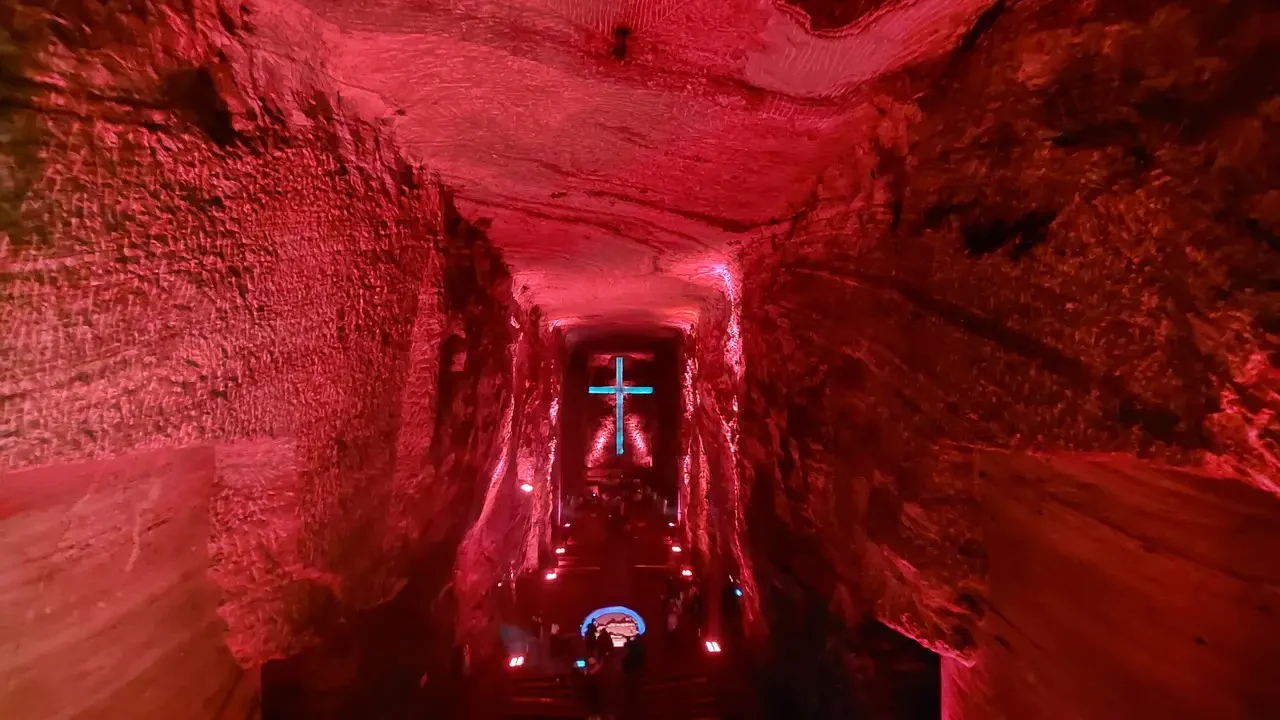
The long access tunnel leads into a wide corridor, with stations for the Stations of the Cross on either side. Even the most secular visitors can appreciate the artistic expressions that depict the subjects of each station in front of these stations. The niches are simply the first part of the tunnels from which the mineral was extracted (amounting to 3,500 tons of material for each), reaching depths of 80 to 100 meters. Only 5% of the salt extracted is added with iodine and another element, used for human consumption; the rest is provided in its raw state for industrial uses.
It should be noted that the miners were not artists or sculptors, so the works are simple (crosses, altars or other square-shaped objects), there are no human figures, and the few that exist were added later. However, they tried to create a symbolism, to provide reasons for what they were building. For example, as Jesus fell, the cross was depicted more prominently... therefore heavier and more difficult to carry on the back, making it a better representation of greater effort and sacrifice. Similarly, the cracks in the floor symbolize pain and widen as the stations progress.
At one time, weddings were also celebrated here, but the current bishop does not allow its use for that purpose: the priest will be replaced soon, and we'll see if the next one is more accommodating. From a formal perspective, it is a cathedral as it meets the three necessary criteria to hold this title:
- the dome: due to its size, it's only 8 meters high, but it was designed so that the lighting creates an optical illusion, making it appear much more impressive.
- main entrance: since it was impossible to build doors, three entrances were constructed to represent the Holy Trinity. The one on the left was intended for those with more sins to atone for, while the one on the right was for people who were more devout, of course, this is just a legend. The three large aisles depict
- the birth of Jesus, with the baptismal font (also made of salt and therefore cannot hold fresh water), while on the back wall, a flow of... beautiful cascade of salt crystallized, signifying the baptismal water. Saltwater was poured repeatedly, and once it had solidified, this work of art was created, whose merits should be divided between the creativity of nature and that of man.
- his life – you will find it there the largest altar with a cross in the background, with low relief details, illuminated by changing colors, but it impresses as the point of intersection between the horizontal and vertical axes is highlighted by a slow red flash to symbolize Jesus's heart that beat. The columns in the hall and concrete are enormous cylinders and stand at represent the evangelists, through which the Church is governed. Further back, there is a depiction of Creation of Man by Leonardo; the artist's free interpretation also shows here a symbolism where the human hand is a third compared to that of God. At the same time, the face of God is not depicted in such a way that everyone (believer, non-believer, belonging to other religions) can identify with it as they see fit. Since it was impossible to find a piece of Colombian marble large enough to depict creation, six fragments were joined together to ideally represent the six continents.
- his death – a disc depicting death and resurrection; simpler and less brightly lit, encourages more reflection on the future.
- the cross – represented in the central nave
Traditions and spirituality
From an administrative point of view, the cathedral does not appear as such because there is no bishop appointed to preside over it. It should be noted that tourism is much more prevalent than religious activities; although liturgical services are held, it is essentially visited by those who want to appreciate its history, construction features, and beauty.
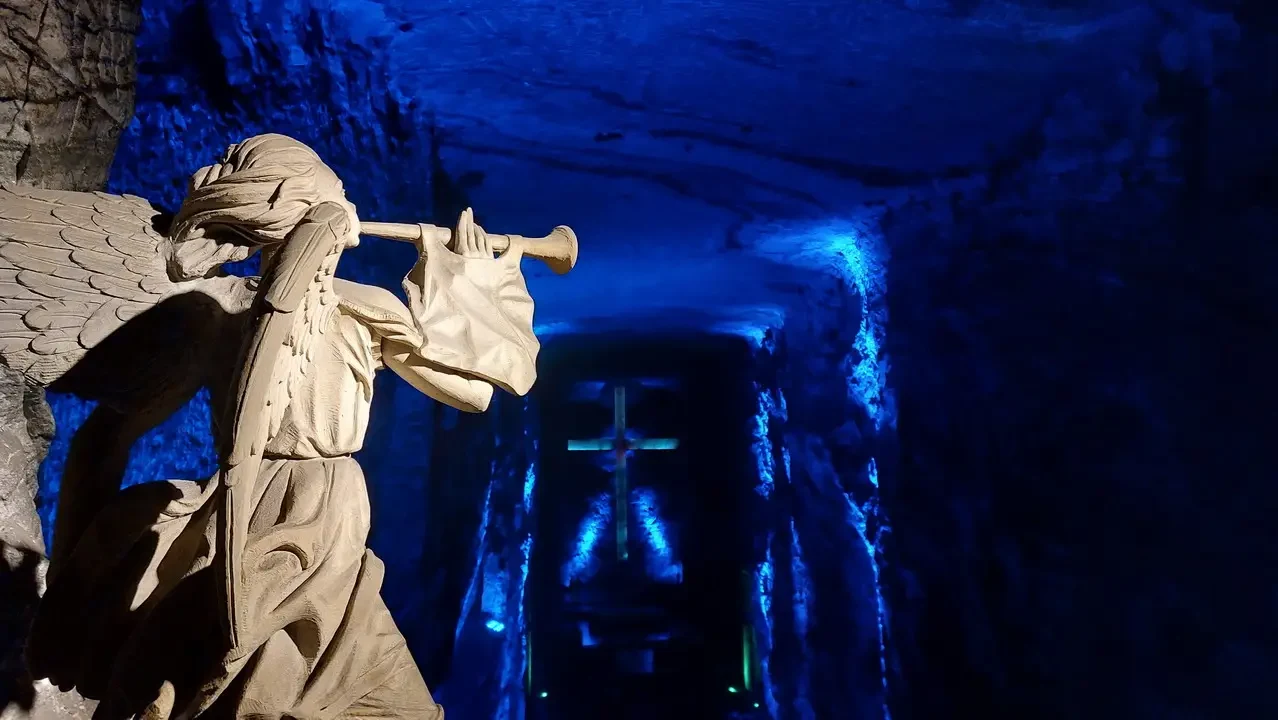
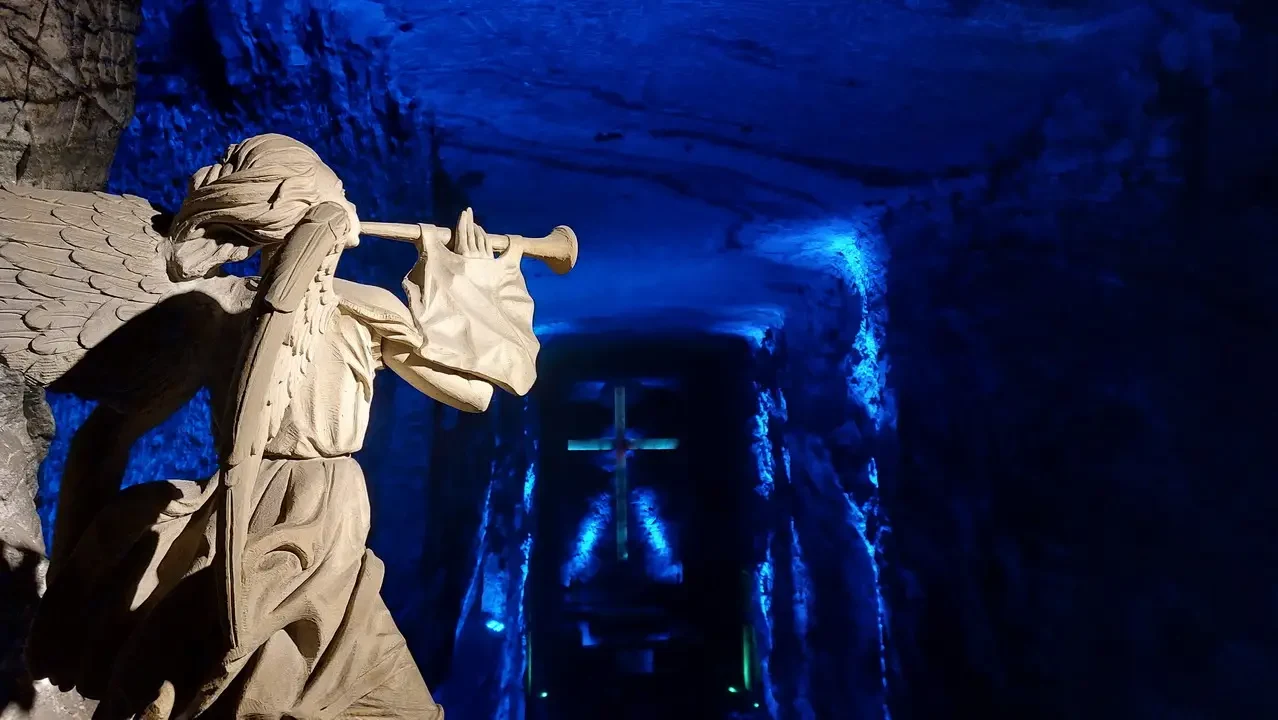
Once you've walked through the Via Dolorosa gallery, you'll find the choir, located on its side. an angel seems to be announcing the most sacred spot, visible from the balcony that offers a view of the nave. Just before, a grate simply indicates the point where salt was unloaded and loaded onto transport vehicles to leave the mine.
Virgin's Chapel
On the left side, opposite the aisles, there is the Virgin's Chapel, where services are usually held during the off-season when there are fewer people; otherwise, one moves to the larger central nave.
Continuing, we came across...
- one cave carved into the rock;
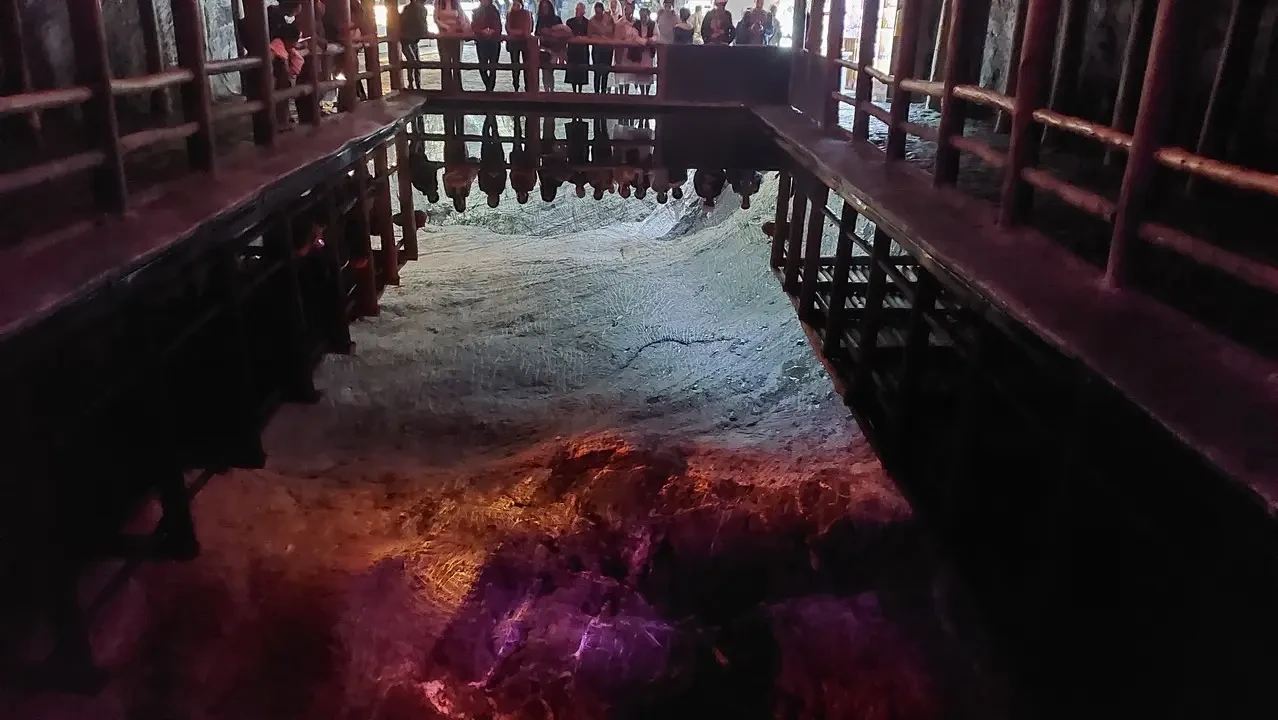
- a mirror that faithfully reflects the ceiling in the dark, but then you realize it's a clear and shallow body of water. As soon as you blow on it, it creates small waves, revealing the trick;
- an interesting museum of works in sodium chloride created by artists from all over the world (three-dimensional and bas-relief);
- the fiction of an emerald mine (Colombia is one of the world's largest producers), although there are none here. Emerald is a type of quartz that requires extremely high temperatures underground to form, which are not present in this area because the eastern Andes are not volcanic terrain;
- the representation of a huge family tree of creation, if we were in a place of worship for another religion, we could call it the tree of life. It's remarkable to see the spider, which symbolizes industry and hard work.
- the museum dedicated to Tutankhamun, due to the fact that the ancient Egyptians used salt to embalm the pharaohs;
- the depiction of the Zipa (the local ruler), whom we are honored to meet as our host.
During peak season, we reach 8,000 visitors per day, while now there are approximately 3,000. These figures are also important to ensure proper ventilation: the large number of people inside may require forced rather than natural ventilation. In this case, large openings at the bottom are used, allowing warm air to rise upwards. Oxygen, carbon dioxide, and other gas levels are measured multiple times each day; if they deviate from the prescribed limits, automatic fans are activated to restore good living conditions. It is worth noting that in the past (and even today), many access points for air circulation could not be opened because the humidity present would cause the salt to dissolve, making the entire mine more fragile.
To ensure the structure's stability, stainless steel and eucalyptus wood were used, which, when in contact with salt (and water), becomes resistant and achieves a strength similar to that of steel. At the same time, electrical cables are carefully insulated with plastic tubes to prevent contact with salt.
There are also emergency generators to ensure lighting in case of a power outage: the guide reminds us that until recently, we had to wait for the lights to come back on since it was impossible to create flames. Another interesting fact (we had never been in a salt mine) is due to the hardness of the mineral, just like a stone; however, it has the characteristic of allowing light to pass through it, while real stones containing other minerals block the passage of the beam of light.
Of course, salt is afraid of fresh water, the only element capable of dissolving it, and to prevent leaks from underground sources, the exterior is constantly monitored; when you see white deposits along the walls, it indicates a worrying sign, meaning that there are water infiltrations.
There is an old cathedral nearby, but it has been closed due to the risk of collapse. The new one was inaugurated in 1991. There are 360 galleries in the mine, but only 20 are used for tourist and religious purposes.
There are three ways to exit: a simple one, by train for those who don't have the means to return, a ramp and a staircase. The latter is said to be for serial offenders who need to atone for their misdeeds; it is obvious that we will take this route. But it is also true that those who struggle are particularly burdened with sins. We manage to climb without any problems, therefore we tend to believe that it concerns trivial matters and the penance is lighter. Shortly before exiting, we notice an unpleasant smell of hydrogen sulfide (rotten eggs) due to the interaction between "salty air" and other chemical elements.
The urban face of Zipaquirá
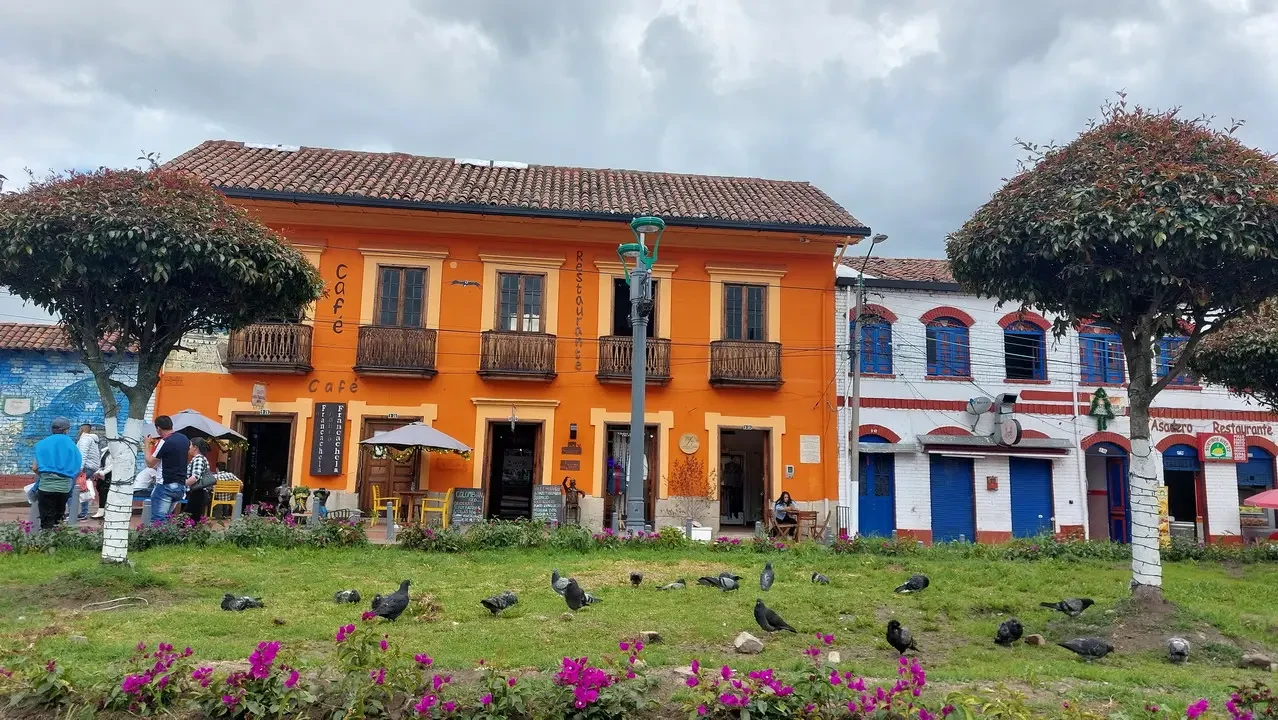
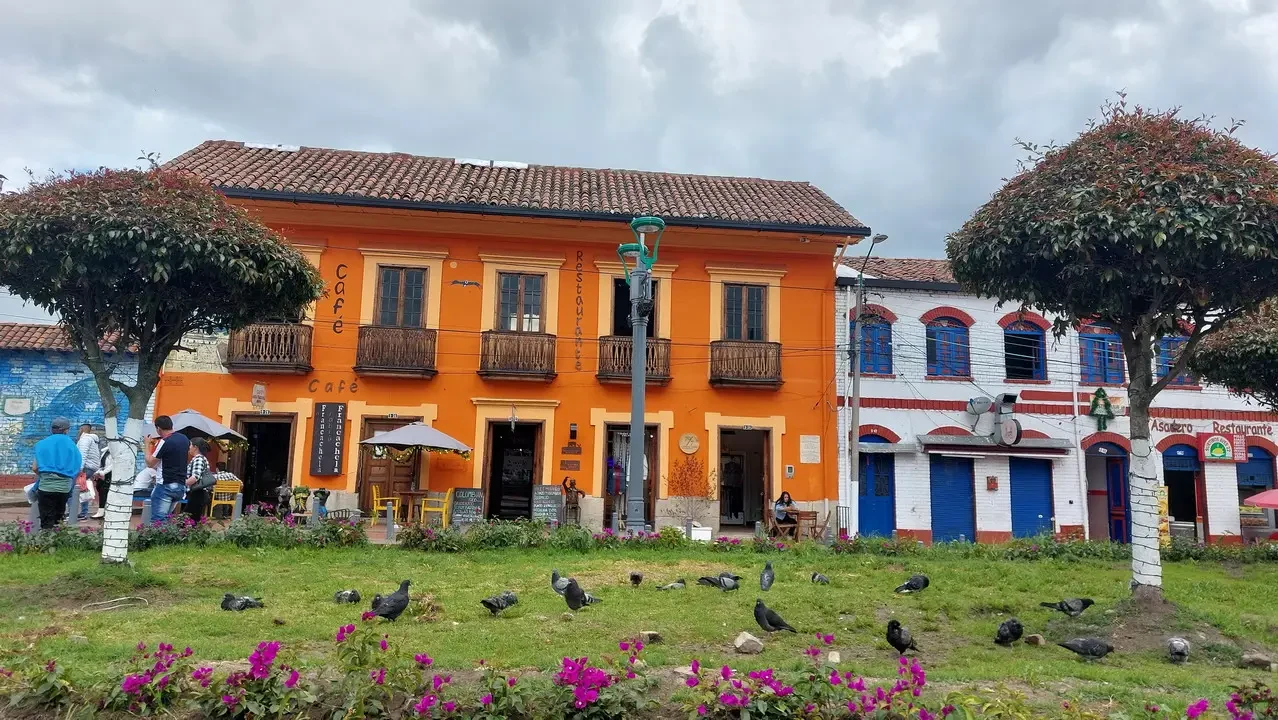
It's now 1 PM when we finally get to see natural light again. We eat a couple of arepas at the small restaurant near the exit, and then take a walk. centre in Zipaquirá, definitely worth a visit.
We continue our journey towards Guatavit, but we encounter two inconveniences: after a few kilometers, it starts to rain and a traffic jam forms on the highway, causing us to lose at least half an hour. Fortunately, nothing serious happens; it's just a narrowing of the road near the Sisga dam bridge. We decide to give up visiting Lake Guatavit, hoping for better luck tomorrow, and head directly to Villa de Leyva, where we arrive around 18:30; exiting the highway Just before Tunja We drive along a beautiful, winding road with many potholes (sometimes we need to slow down, navigate around the pothole, and then continue), so the cruising speed cannot be very high due to the slow local traffic. The vegetation is similar to that found in the Andalusian hills or even parts of the Ligurian coast, with coniferous trees and beautiful bougainvillea flowers and crops.
We reached our destination when it was dark for about half an hour. We parked the car in a courtyard affiliated with the hotel, took possession of the room, and went to dinner at a quiet restaurant where we tasted... veal with red wine and Ajaco(local specialty, a rich soup made with chicken pulp). The temperatures are not particularly high, let's take a short trip to the huge central square (120 meters on each side) paved with stones and surrounded by the church and other buildings painted white; during this period everything (including the roofs) is decorated with decorations and lights. It's another city that thrives on tourism, many families from the upper middle class or very wealthy are traveling here from the capital, where they have a second home, especially now that we are in the pre-Christmas season. In fact, it's a form of predominantly Spanish-speaking tourism, although foreign voices can occasionally be heard.
Local wildlife
The area has a mild and consistent climate where well-being has become the defining characteristic and a mark of quality. It is also the preferred playground for cyclists; we see them numerous times both on the main road and along the hilly routes. The value of the bikes (especially gravel bikes with relatively wide wheels) and the clothing worn exceeds the annual income of many Colombian families, which shows that cycling is a passion and there are those who have interest and funds to pursue it. It's a shame that the risks on the road are so high and that people breathe in smog at full capacity. However, it should be noted that there is great respect for those who cycle; in addition to the presence of bike lanes, overtaking is done while maintaining a safe distance.