

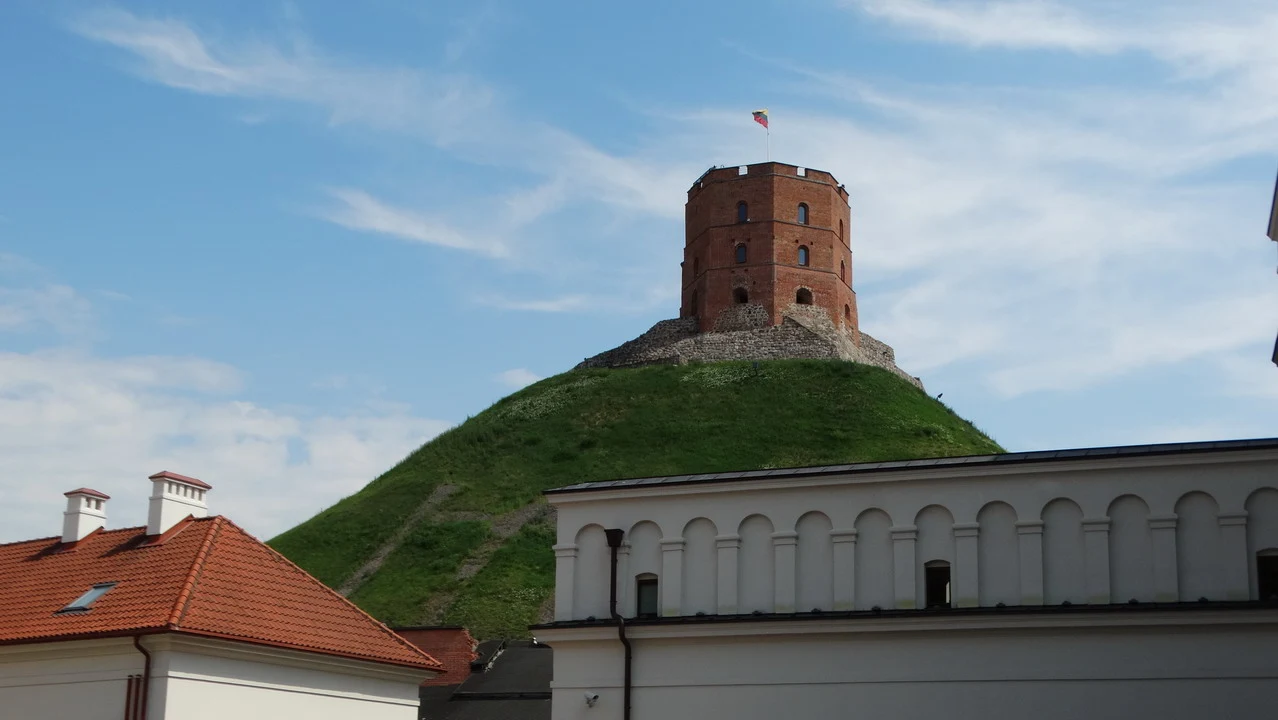
Algeria
Two hours by air from Rome, one lands in a country little talked about and even less known, yet one hiding immense treasures above and below the surface: more than a quarter of the world's largest desert, historical remains recalling prehistory and successive civilisations, and vast hydrocarbon reserves.
Map
Algeria map - complete itinerary
YOU DO NOT NEED TO GO FAR TO FEEL FAR AWAY - Two hours by air from Rome, one lands in a country little talked about and even less known, yet one hiding immense treasures above and below the surface: more than a quarter of the world's largest desert, historical remains recalling prehistory and successive civilisations, and vast hydrocarbon reserves.
Learn to write your wounds in the sand and your joys in the rock
Tuareg proverb
My comment on the country's geopolitical situation on:
Read the in-depth article on Aliseo Editoriale
COUNTRY PROFILE: The suffering of history still casts its shadows today. A power structure committed to preserving the regime and its own independence does not favour development, while also trying not to be drawn into the confusion hanging over many parts of the globe. Remaining on the margins of both evolution and involution, Algeria does not disdain a prudent attitude towards planetary disorder, while proving to be an important actor when its interests are involved.
With full marks in history and geography, it boasts Roman sites rivalled only by the former headquarters of the empire, Italy, together with a vast collection of prehistoric engravings and finds testifying to life before the arrival of the desert. That arrival is relatively recent, since until 4,000 years ago grasslands and forests still covered the Sahara and were inhabited by the whole animal chain, primitive humans included. Yet the desert itself is now one of the country's finest attractions, in variety, charm and extent.
Its history is marked by dominations lasting more than two thousand years. Before 1962, the last truly independent period may be traced back to the Numidian kingdoms, limited to the north-east of the country. The invasions of the Carthaginians, from present-day Tunisia, were followed by Roman rule for four centuries, then the Vandals, the Byzantine Empire and the Arabs, who changed the country's social and religious structure by introducing Islam. In recent centuries the Ottomans ruled, and finally the French for 132 years. Only after the bloody war of independence against the former colonial empire did Algeria return to being an independent country, which is not the same as calling it free.
The Roman Empire, however, represented an inclusive form of domination and stood apart from Vandal raids, Arab impositions and French oppression. For example, Rome's policy made the inhabitants of conquered lands citizens, except slaves, whereas the French formally considered Algeria an integral part of their territory and not a colony, as Morocco and Tunisia were. They granted citizenship only on condition, among other things, of substantially renouncing one's own culture, adopting French behavioural norms, the so-called civilisation, and religion, abandoning Quranic status. As a result, only 2,500 Algerians became French citizens between 1866 and 1934.
The current phase is characterised by a silent attitude, far from the spotlight, with politicians not eager for protagonism aimed at international front pages. It is a monolith with cracks, but one that holds despite the times and what happens beyond its hot, porous borders. If neighbouring Libya, at the time of the Italian conquest in 1911, was dismissed as a box of sand, Algeria could by extension be called the closed box of sand. Knowing full well that there is not only sand.
The military have never managed power directly, but have always done so by effectively appointing the presidents who have succeeded one another. It is hard to imagine otherwise: independence obtained through war left the army with a dominant position, formally dependent on the President of the Republic but in practice with the balance of power substantially reversed. In this respect politicians and the executive generally act as lightning rods to be sacrificed in emergencies. National rhetoric needs figures to refer to, interpreting their biographies in ways useful to the cause of unity.
Abd el-Kader was a nineteenth-century political and military figure, after whom important streets are named in every city. He is considered the father of the nation and is represented as an essential reference point for today's Algeria. He began his career in 1830 by sharing northern Algeria with the recently landed French; current hagiography claims this was a tactic to oppose them later, when settlers stabilised territorial possession and he was considered a clientes, to remain close to Roman history, to be disposed of, ending his days in a golden exile between Paris and Damascus. It must nevertheless be acknowledged that Abdelkader was the cornerstone in the foundations of a united Algeria and a symbol of national pride still alive today.
President Boumedienne, in office from 1965 until his death in 1978, was elevated to the figure embodying national unity after the liberation war, perhaps for lack of other deserving politicians and certainly in part for his merits in the field. The official narrative says he was so humble that his mother, who lived in a provincial region, did not even know he was President of the Republic. Algiers international airport was named after him, and the construction of a man capable of building the foundations of modern Algeria, even after overthrowing the first president Ben Bella, is useful as a reference figure during celebrations and as a national binder. Such figures are abundant further back in the war of independence, evoked above all in human and military terms as martyrs.
President Bouteflika was another civilian emanation of military power. Here too the story goes that he had a good-natured character, but one of his many brothers took advantage of the surname for misappropriations and illicit enrichment. If one wants to believe the official version, a functionary close to the president found the courage to tell him of his brother's misdeeds, and the brother suffered a heart attack from which he never recovered.
INTERNATIONAL RELATIONS:
BALANCE IN FOREIGN POLICY - The enemies, of variable intensity and whose order may change according to moment and situation, are Morocco, France and Israel. The neighbouring country represents the enemy Algeria needs in order to rally nationalism around itself. The borders have been closed since 1994 and relations are tense mainly because of the conflict over Western Sahara's sovereignty. More generally, Muhammad VI's kingdom is spoken of badly at every possible opportunity, even in the smallest disputes over the origin of rai music or the primacy of certain ceramics.
Although more than 60 years have passed, French colonialism is not easy to forget. Independence cost hundreds of thousands of lives; practically no Algerian family escaped mourning, and the treaty that sanctioned it is considered profoundly unequal. As a result, post-independence governments have found it easy to denigrate France for what it did even after 1962, in the name of national unity. Even positive actions, few but present, are steered in a negative direction: for example, the French did contribute to rediscovering excavations in Roman cities, but they took substantial treasures home. Even if certain arguments are accentuated deliberately, on some points one cannot say they are wrong.
Finally Israel, sworn enemy of peoples of Islamic faith from a pro-Palestinian perspective, though less so of their governments, is further criticised for having signed the Abraham Accords with none other than Morocco: two enemies for the price of one. In market stalls one finds pendants and keyrings with the Palestinian flag, and murals praising the cause dictated by religious brotherhood are abundant.
Italy is historically seen as a friendly country. Those who remember less recent history recall how Mattei provided valuable technical advice during the Evian negotiations that led to Algeria's independence. More recently, Italians are credited with not leaving Algerians alone during the civil war of the 1990s, while in the near past, after the war in Ukraine, we became excellent customers for gas extracted under the Sahara sands, increasing already good relations. This despite Italy belonging to that Western world in which Algeria sees not an enemy, but not a model to imitate either.
Tunisia has scarce hydrocarbon resources and essentially lives from tourism, so here too the narrative is strong, telling how Algeria helps it, perhaps cancelling debts or subsidising it in some way so that it can live decently and maintain good relations, also because ties with the other neighbouring countries are at least difficult.
The figure of de Gaulle is not well regarded because it reflects the image of the enemy counterpart, especially since the Evian agreements that led to independence were unfavourable to Algeria. In this way the French statesman who enabled independence ended up disliked both by Algerians and by the French, who contested his signing of the treaty. In reality he understood from the start that the era of colonialism was over and that the colonial system could not last. The problem is that he had been called back to be president precisely to safeguard what he later dismantled, forcing many pieds-noirs, French residents in Algeria, to leave the country, along with homes and businesses, often the fruit of investments made over generations.
Algerians contest the fact that their country is rich, among the continent's economic Big Five, while most of the population is poor and dreams only of emigrating abroad. Hydrocarbon revenues are enormous and have increased further in recent years. One cannot expect a standard of living like that of Middle Eastern petro-monarchies, since Algerians number 45 million and it would be impossible to guarantee well-being through tax exemption or other advantages. Yet one might expect greater investment in infrastructure and education, as well as openness to external investment by exploiting the country's position at the centre of the Mediterranean. It should not be forgotten that governments have as their primary objective the maintenance of a profitable status quo and do not intend to take risks by creating self-awareness among the population.
Algiers is very different from the other cities seen so far, regardless of its size. It is rich in elegant colonial-style quarters, at least in the central colonial area. Many shop signs also show French besides Arabic and sometimes Berber. Street signs themselves are bilingual French-Arabic. Apart from the monuments, the buildings on the main streets provide the real touch of class, although some are in a state of pure decay. By contrast, a form of institutional nationalism remains, with flags everywhere, partly because of the recent November 1 holiday. Large police deployments testify that the pouvoir still fears revolts, which this time could come directly from civil society and no longer from parties or Islamist fringes. It remains to be seen whether the glue of rhetoric will continue to take hold, supported by the endless number of public employees tied to the state and therefore to the status quo, also for work reasons and consequently with limited room to manoeuvre against the regime itself.
The concept of state has been imposed coercively on populations inclined to pride but not to nationhood. Islam and Arab culture in general historically do not include a concept of territorial state, something that prevented Algeria for a long time from uniting as it did after independence. Only Abdelkader partly managed to express and root the idea of a united, cohesive country. The fragmentation of the population into tribes and the difficulty of penetration linked to a hostile desert territory meant that the successive empires almost never managed to gather Algeria into a single territory.
It is interesting to note the existence of a Ministry of Religious Affairs, which essentially defines the themes of Friday sermons in mosques and the general guidelines to follow. For example, given the period in which it was written, the Quran could not provide directives on abortion. That practice was later banned by virtue of what is called "Quranic interpretation" by the relevant authorities operating within the ministry; an interpretation not by chance described as political-religious.
National character
Religion
Algerians are almost entirely Sunni Muslims, except for the Mozabites of Ghardaia and its surroundings, who follow the Ibadite current, tolerant outwardly but conservative in discipline and traditions. We had already encountered it some years ago in Oman, where however a more liberal attitude prevails in formal aspects. The distance, not only geographical, of the Algerian centre probably plays a significant role in customs.
The minarets have a square or sometimes hexagonal plan, occasionally tapering upward according to the Maghrebi style, while the more classic round-plan ones are called Ottoman and are prevalent in the Middle East. They look, and in fact are, real towers at whose top there are openings on all four sides, where loudspeakers are now placed. Once the muezzin was the person who climbed the minaret to call the faithful to prayer at the five daily times prescribed by the Quran; today he performs the same act through loudspeakers usually seen protruding from the minaret windows. It is still a live invocation, not recorded as it may first appear.
Unlike in other Islamic countries, in Algeria marabouts have considerable importance: people who lived long ago and are indicated as examples of adherence to the principles and teachings of Islam. Broadly speaking, they may be compared to saints in the Catholic religion. Their tombs are small arched pyramid-shaped mausoleums, whitewashed with lime, standing out amid the ochre colour of the clay with which the houses are built.
The zawiya indicates a religious school; in Arabic the word means "corner". In the colonial era the French tried to assimilate Algeria entirely according to their culture and Christian religion, attempting to prevent the practice of Islam. This meant Muslims had to live their religion almost clandestinely, and especially Quranic schools, madrasas, had to remain in what was called the zawiya, that is, in a corner.
This allowed doctrinal coherence to be maintained, guaranteeing homogeneity between previous and later generations. At liberation, when it could re-emerge, Algerian Islam could count on the same precepts in line with past tradition. Today the zawiya should be considered more as a political-religious lobby capable of influencing even central power. We will see that of Tidjania exercising great soft power thanks to the authority of its members. Further confirmation, if any were needed, that religious life in the country can exert significant political influence, though without dictating its rhythms as happens in the presence of theocratic regimes.
The Hand of Fatima derives from the fact that every sura has five verses, so having the pendant of a hand hanging from the car's internal mirror offers a kind of divine protection for those on board.
Dogs are not well accepted in the Islamic world because they somehow represent impurity; their saliva is considered such, and if one is licked by a dog one cannot go to prayer, even though the animal is not considered unclean like the pig. They are encountered, but in very small numbers, and in no case is the dog treated as a companion animal. By contrast, many cats are seen, both in cities and villages, considered cleaner animals.
Funeral procedures follow an Islamic ritual based on respect for the deceased, hygiene and their destiny in the afterlife. When someone dies, before burial in the cemetery the body is taken to a kind of mortuary room where it is washed an odd number of times: three times on the right side and as many on the left. It is then wrapped in a white cloth, the imam holds a ceremony with the deceased on one side and relatives or friends on the other, and finally the body is buried lying on the right side with the head towards Mecca. Only earth burial is provided, not cremation, and stones are planted vertically on the surface of the grave at the height of the feet and head so relatives can recognise where their loved one rests. There are no plaques with names or anything else. It is possible to understand whether the body is male or female because for women an additional row of upright stones is placed at abdomen height. The rocky ground makes burials difficult, so they often take place in the same pits years apart among relatives, avoiding the need to dig new ones. There is no colour of mourning. According to Islam, one must accept Allah's will: one may cry before the loss of a loved one, because even the Prophet held his son and cried when he lost him, but one must not exceed in sadness or despair, because evidently this is Allah's will.
In Islam inshallah expresses the idea that everything is in God's hands. This does not mean an invitation not to act, an attitude that could lead to laziness. For any action, if it succeeds one thanks God; if it fails, the failure should be understood as a lesson, a higher plan that prevented the attempt from succeeding, whose true reason may be discovered in the future. One can speak of fatalism taught by almost all religions, the instinct to abandon oneself to divine will, a feeling that in Islam has ended up permeating civil society, or perhaps the reverse, to the point of institutionalising it.
The local interpretation of Islam holds that women may not be photographed and, if they are, the images should not be distributed or published. In confirmation, we notice how on social media women cover at least their eyes if not their whole face. They agree to be portrayed only if with other women from our group and on condition that the photo remains strictly private. We find this attitude everywhere, not only in the more remote conservative areas. The Prophet is said to have prescribed that women's faces should not be shown, but this is a situation not found in other Islamic countries previously visited, not even Iran, in the spirit of "different country, different Islam".
- The Berbers are the native population whose presence extends from Morocco to Libya. From an ethnic point of view one can quite safely speak of homogeneity among the Algerian people, also because the Arab ethnic group has nothing to do with these regions. At the time of the Arab conquest, around 650 AD, with the introduction of Islam, the first differences began to emerge: some more refractory or remote areas embraced the new religion but preserved pre-existing culture, language and traditions. The process of Arabisation involved the more populous areas and eventually prevailed in almost the whole country, while pockets of proud resistance survived, leading in recent times to the official recognition of Tamazight, or Berber, as the second national language after Arabic. Difficult to interpret, it has an aesthetically fascinating alphabet.
- From a religious point of view there are no differences: Algerians are all Sunnis except for the Mozabites of Ghardaia, who are Ibadites. It even seems that in matters of doctrine the Kabyles boast better qualified imams than the rest of the country. Numerically, Berbers were and remain the almost total ethnic component of Algeria, just as neighbouring countries may be considered Berber too, Morocco, Tunisia and northern Libya. Successive civilisations did not advance everywhere at the same pace, above all because of the country's vastness and the great differences between the densely inhabited north and the desert centre-south. Today many Algerians define themselves as Berbers of Arab culture, but intransigent enclaves with independence-leaning veins remain in the mountains of Kabylia and among the Tuareg tribes, who range across the south heedless of official borders with Niger, Mali and Libya, following their instincts and traditions.
- Languages: classical Arabic is taught at school, but the spoken language is a kind of Algerian Arabic that differs from the written form because it includes terms of Berber and especially French origin, as well as a different accent from the official language. This is apart from the idioms spoken in Kabylia or the region inhabited by the Tuareg. With a script recalling the stylistic forms of ancient South American empires, Berber has a totally different phonetic and grammatical root. Almost all Algerians can say at least a few words in French, while many elderly people speak it well because they learned it at school. Even after independence, French was taught as a second local language, useful also for the still intense relations the young nation maintained with France. With worsening relations and a minimum opening to the outside, English is prevailing among language-study subjects, so anyone travelling in Algeria today, also for reasons of tact, should address younger generations in English and older ones in French. Starting a conversation in the wrong language can create some initial unease; it is enough to specify that one is Italian and the misunderstanding usually disappears immediately.
- The school system substantially mirrors the Italian one. Children start school at six; school is compulsory, although attendance is not enforced with particular rigour. Algerian Arabic, normally spoken at home, is the first language studied, while classical Arabic is considered the first foreign language. Before entering high school, pupils begin studying a "real" foreign language, usually English and possibly later French. At present French begins in the fourth year of high school, but it seems it will gradually be excluded altogether. There is instead increasing possibility of studying other languages such as Italian, with four lectureships in the whole country, and Spanish.
- Marriages: in Algeria too times are changing and marriages arranged by parents are disappearing, although significant differences remain between cities and remote areas. The impression is that regardless of rules set by civil authorities or Quranic interpretation, there remains a strong social attachment to traditions which, though unwritten, continue to have great influence in civil society. This particularly involves women, though it is increasingly less relevant in Algiers and the main centres.
- It is still customary before marriage for the bride to live for a year in the house of her future in-laws and promised husband, to begin learning the habits of the new family and of what will be her future life. At the end of this period the official marriage celebration takes place, preceded by ceremonies that formalise the engagement through the exchange of rings. In the past these celebrations were more heartfelt and lavish; now rising costs and the preference to spend money elsewhere have reduced budgets. Until recently, wedding parties also served to introduce the bride to the family and neighbourhood circle, thereby officialising the couple's union so that if the woman was seen around with a man, he would immediately be recognised as her husband, confirming that they were a regular couple.
- Families rarely stop at one child; the usual rule for offspring is between two and four. More is rarer because economic conditions seldom allow it. Cohabitation outside marriage is not officially admitted, and the woman is expected to arrive at marriage untouched. Obviously, the closer one gets to the city, the less this rule is observed.
- For women in Algeria, one might say there is a kind of conditional freedom in matters of clothing. Foreign women have a margin to wear clothes commonly used in their countries, provided arms and legs are covered and necklines avoided, a rule valid for men too. Local women usually wear long garments that Islam requires to hide the curves of the body, with the head covered by a veil, hijab, that also wraps the chin, hiding the hair and leaving only the oval of the face visible. Others wear the niqab: a black garment and veil leaving only the eyes visible, with a vertical strip of fabric at nose height connecting the upper and lower parts of the face veil. Some burqas are also seen, while Western-style clothes are completely absent in peripheral areas, except for several girls in jeans in Algiers. This shows how tradition and religion are inseparable and how much the latter permeates civil society.
- A separate discussion concerns the Mozabite women of Ghardaia and surroundings, who wear a white tunic covering head and face, leaving only one eye unsettlingly visible. They slip through the narrow streets of the old city trying not to be seen, embarrassed when crossing a man to the point of passing close to the wall with their gaze strictly lowered, and the man should do the same. On a couple of occasions I found myself before girls who, taken by curiosity, used that uncovered eye to size up the foreigner with genuine curiosity. Others stop or even turn back; there are even niches in the external walls of houses, similar to guard posts, where men are supposed to withdraw when crossing a woman. Obviously I am nobody to judge, and if I wished to moralise about their society I would have to do the same about ours, perhaps with unexpected results. Maybe after hearing Algerians' opinions.
- Just as there are women who, having some economic autonomy, remain single by choice, most married women do not work, having to look after the home and children. Recently, especially in cities, although still not significant in percentage terms, more women with stable jobs can be found, but this should not be misunderstood as an attempt at Westernisation by local society. Outside the main centres few women are seen around, mostly in the morning to shop and/or take children to school; the rest of the day they spend within the home or with other women. Even when groups of school-age girls and boys are seen, they are always divided by sex. From the earliest years there is no promiscuity, as if it were unnatural. Under civil-religious rules, a man may still have up to four wives, but if he does he must legally undertake to support them; therefore polygamy belongs only to a few men with substantial finances.
- The Western view of women's condition in Muslim countries is often the child of preconceptions that risk going beyond the concepts and principles themselves, and above all does not take into account the actual feeling of societies based on foundations not always shareable at our latitudes, which one must make the effort to understand and analyse while living in a different reality. In some respects, in Islamic countries women are less harassed than in so-called "complete democracies", so femicide rates are considerably lower. It remains true that they play a different role, according to a conception rooted in religious doctrine that subordinates them to men in social reality, not necessarily within the family. The insurmountable barrier for our eyes remains that they usually cannot decide the direction of their own lives, ending up leading a quiet life, yes, but at home raising children in the shadow of a husband who only in rare cases is nevertheless their master.
- Health system: basically free, with payment of a small fee, 50 dinars, about 0.25 euros, but the level of healthcare services is far from excellent, even if available to all.
SAFETY: the alerts on Viaggiare Sicuri are evidently not particularly up to date and spread a basic pessimism that may lead one to underestimate real danger situations in the future or in other countries. The impression gained in Algeria is that we were never in danger, provided one keeps one's eyes open and avoids huge, potentially fatal mistakes: wandering around at night is not recommended, and certain regions are entirely inadvisable. Because of porous borders with Libya, Niger and Mali, through which human, drug and arms trafficking passes, the south is not especially recommended, despite some tourism returning to visit the splendid regions of Tassili and Tamanrasset. These are areas where Islamist presences have appeared because of infiltrations from the south, where groups linked to Al Qaeda and ISIS stretch their tentacles and move freely.
THE TRIP: Tourism in Algeria is still in its most embryonic form, and the beauty of this journey lies precisely in its originality. Several important but not particularly known sites are completely absent from the internet or present with only a few notes, and research is not helped by Arabic, which leads to sometimes divergent transliterations. While the major cities and most important historical sites are well documented in guides and websites, finding information on petroglyphs, cave paintings or smaller centres, even with a historically important ksar, is more complex if not impossible. This further proves how even the web has not yet deeply discovered Algeria.
Restaurants in the central part of the country are almost absent, and the services provided have wide room for improvement, although staff do what they can to meet guests' simple needs. One cannot say Algeria is ready to open to mass tourism, and perhaps it is not truly interested. The peaceful invasion of wealthy guests, compared with the local average, would over time risk undermining a social stability governments particularly value, and also, at least to our eyes, polluting the genuineness of relations between people. Even in Algiers one does not see the international-brand shops found almost everywhere.
As further confirmation, consider the hotels: on a couple of occasions we entered four-star establishments where the last guests had evidently stayed months earlier, otherwise the serial malfunctions and disservices encountered would not be justified. Taken in the right spirit, they can even enrich the journey with a little hilarity.
In villages one feels observed, more out of curiosity than hostility, a sign that foreigners are rarely seen. We saw few too: in two weeks we did not hear a language other than Arabic or French, the latter also thanks to Algerian tourists who emigrated to France and take the opportunity to visit the land of their ancestors, perhaps with relatives on holiday for the November 1 celebration. The only exception was a lone American, who seemed to be on a tourist digression around a work period.
Before travelling to Algeria one must define the route and sites to visit exactly. The package is then submitted to local Security, which may order an escort for the group. A police car indeed took charge of us from the first day, after leaving the Tiddis site, and was our faithful companion for the first week until Ghardaia. In reality these are relay cars changing every 40 or 50 km, opening the road and waiting during stops for lunches, service areas and so on. It is difficult to understand the real reasons for the escort: officially it seems a precautionary measure to protect us, since Algeria wants to increase the tourism industry and intends to prevent incidents caused by wrongdoers. Beyond protecting us, maliciously one may suspect they want to keep foreign movements under control, or give work to the mass of public employees paid by central power. Spies would hardly fail to notice a car preceding them, but in Beni Abbes, when we move alone through town streets, we see a fine mosque and ask a passer-by whether we can enter to visit it. At once the car materialises with the man who that morning had introduced himself as guarantor of our safety, more likely of the safety that we had not had suspicious contacts. We take it as folklore, aware that in Paris the risks would have been far higher than in the villages or semi-desert lands we crossed. In the end we returned convinced that we had been the active rather than passive part of police attention.
Along the road there are frequent checkpoints, some fixed, where the police, responsible for urban areas, or the gendarmerie, in outside zones, carry out controls. Raised machine guns and spike strips are clear witnesses of an era that would seem to have passed. Leaving aside significant problems requiring attention, in reality we always met people welcoming us, a hospitality that without rhetoric can be defined as that of a friendly people. Travellers are very few, especially outside the capital. When people saw us, along with a cordial soyez les bienvenus, they asked where we came from. When we answered Italy, they began lavish praise for our country, stressing good food, above all pizza and pasta, and good football: international trademarks especially valid among simple people in poor countries. Responding to so much benevolence and returning it with sincere praise for Algeria, it was easy to make inroads into interlocutors' hearts, and many were pleased we were not French: those, in their words, are the real unpleasant ones. Only, so to speak, a legacy of colonisation and the bloody war of independence that younger generations have merely heard about from grandparents, or the effect of renewed disagreements and recent tensions? The regime is certainly rubbing salt into wounds never fully healed, and at this moment being a citizen of France is not the best calling card for being welcome in Algerian land. In the two weeks spent there, the only not entirely friendly exchange came when some boys approached us, pointing out that we in France live well while they in Algeria live precariously. Even telling them we were friends from Italy did not change their calm complaints. Evidently they do not love pizza and are not football fanatics.
VISIT PERIOD / CLIMATE: the time of the visit proved ideal from this point of view. In the desert centre daytime temperatures reached and sometimes exceeded 30 degrees, then fell quickly after sunset, but in the shade it was very pleasant and humidity was absent. Curious sensations came from walking barefoot on the dunes: on the sun-exposed side the feet sink pleasantly into warm sand, sometimes too warm; immediately beyond the ridge line, on the shaded side, the sensation becomes cooler.
At the start of the tour the north was around 25 degrees, falling to 18 when we returned at the end of the two weeks. We had only one cloudy half-day at Timgad and in Ghardaia, for a few minutes, a lazy rain even fell: a few drops immediately evaporating when they touched the arid ground.
PRICES: given that petrol costs around 0.13 euros per litre and would be a fine souvenir to take home, the rest is not expensive either. The hotels where we stayed serve foreign customers, when present, or local businessmen, so prices are in line with Western equivalents despite medium-level accommodation. Tickets for tourist monuments are truly modest, so visiting the most important Roman sites costs only a few tenths of a dinar. Unlike in other "poor" countries, fees do not distinguish between local and foreign visitors to the detriment of the latter.
CREDIT CARDS: a perfectly useless tool. Everything runs on cash and it is worth finding a reliable source, not on the street, to buy dinars at far more favourable conditions. We did so at 220 against the official rate of around 150 dinars per euro.
CUISINE: in Algeria one eats well, but the variety of recipes is not outstanding. We arrived expecting to eat only lamb and mutton; instead chickens suffered most, and on three occasions camel, whose meat is tasty and tender. Couscous is the basic dish, served with meat and vegetables. Further information on culinary aspects appears in the report.
Although foreigners are not forbidden to drink alcohol, wine or beer is difficult to find, and in no case did we see bottles or cans on display. During meals one fills up on water and towards the end on tea. The latter is prepared according to a particular and aesthetically interesting ritual: the drink is mixed with sugar by pouring it from one container to another. The art lies in letting the tea fall from above, creating a scenic cascade that forms a dense whitish foam. The flavour is aromatic and appealing.
CURIOSITY: Perhaps it may not seem the best comparison when speaking of an Islamic country, but dates are a little like pigs for us: nothing is thrown away. After eating them as harvested, making jams or syrups, the stones are placed in water for a few days so they soften, then ground and fed to animals, which apparently produce much more protein-rich milk. Whole date stones are also used for exterior building paint: placed in a bucket and mixed with white, they are splashed against the wall. In this way the walls are not smooth and the corrugation, after the solids are removed, creates tiny shadow zones that help avoid overheating inside the house: not exactly air conditioning, but still a natural way to reduce heat. Mixed with milk they serve as a beauty mask for the skin, while powdered they are used to make a hot coffee substitute. All these properties and applications make the date the national fruit, yet they must be eaten in odd numbers, at least three in the morning, to guarantee the desired effect.
DESERT AND OASES: even if not entirely new, the trip helped dispel the myth of the Sahara as iconography represents it, one single expanse of sandy hills, the dunes, and oases as nothing more than a few palms around a well or lake patch. The desert presents incredible variety, whose only common denominator is the aridity of the ecosystem: plains of dried earth with stones and scattered bushes alternate with cliffs or mountain reliefs that break the landscape's monotony. From time to time the classic dunes appear, making the view less dramatic. One happens upon true works of natural art where the various forms of desert merge under a single gaze, one palette of warm colours. Another curiosity is that where today only a few plants struggle, adapted to absorbing water from scarce night dew, in a past not so remote, a few thousand years ago, there were forests and prairies allowing every kind of life. This is now testified by rock engravings which, besides proving human presence, depict even large animals.
Oases, instead, may reach the size of small towns with 20,000 inhabitants, their characteristic being that they are several hours by car from the next inhabited centre, with only desert in between. Paradoxically, nature has endowed arid expanses with real underground seas, from which the precious liquid springs spontaneously or can be extracted through wells of variable depth, from a couple of metres to several hundred. Inhabited centres display gardens and flowers in sharp chromatic contrast with the background views; every economic activity can flourish, and at times it seems to be in a place with regular rainfall, when in reality this does not exceed a few millimetres per year. It is not rare for deposits of white gold, water, to be joined by others of black gold, hydrocarbons, creating conditions of potential prosperity.
On a lighter note, young people who go to nightclubs often pay the local singer to perform a song dedicated to a girlfriend, wife or the woman they want to impress. If someone else offers more, in a kind of competition among Algerian machos, the singer stops and starts another tune at the second bidder's request. It is said that a young man from a good Biskra family, and above all with good finances, squandered the equivalent of 140,000 euros in one night on this activity, ending up in the newspapers and becoming Algeria's most famous idiot. Later he apparently repented, claiming he had drunk too much that evening, but neither the expense nor the figure he cut could be erased.
Itinerary
Travel days
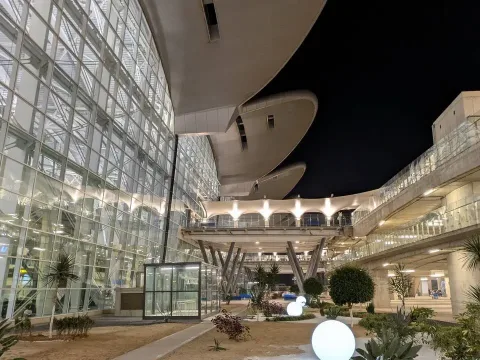
Landing and overnight stay in Algiers
The capital between the Mediterranean and Africa
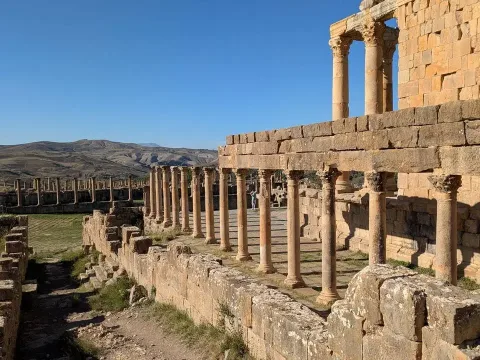
From Algiers to Constantine via Djemila
A return to Rome, the ancient one at Djemila, crossing the mountains of Kabylia
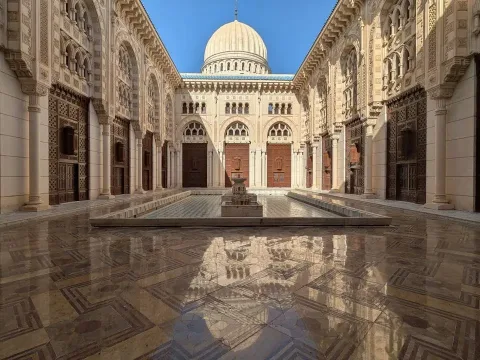
In the heart of Numidia
The Roman site of Tiddis, Constantine with its bridges, and the mausoleum of Medracen
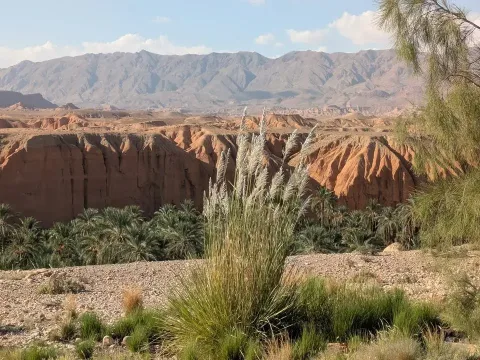
Timgad and El Ghoufi: between history and geography
The home of Roman legionaries and the beginning of the desert regions
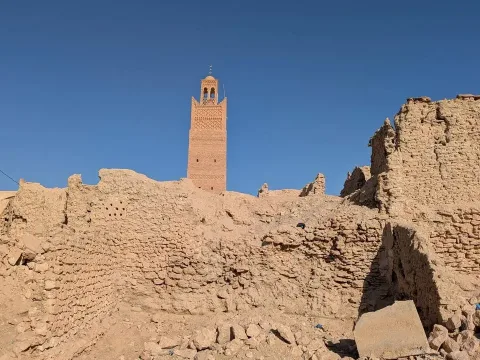
Southwards, the first oasis towns
Sand, aridity, small towns, Touggourt and Tamacine, and a beautiful mosque
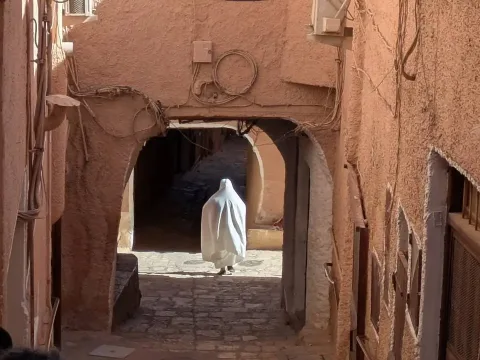
Ghardaia I
The Ibadite pentapolis: charm, mystery and a sense of tradition
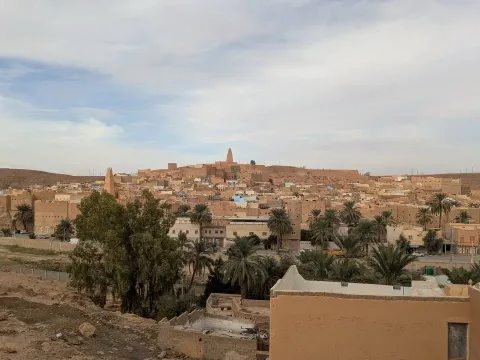
Ghardaia II
Five towns with their palm groves. Around them, nothingness
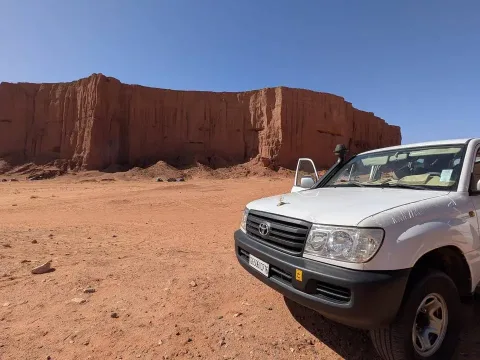
Adventure in the Sahara
Natural monuments at El Gour, rock engravings and dinosaur footprints
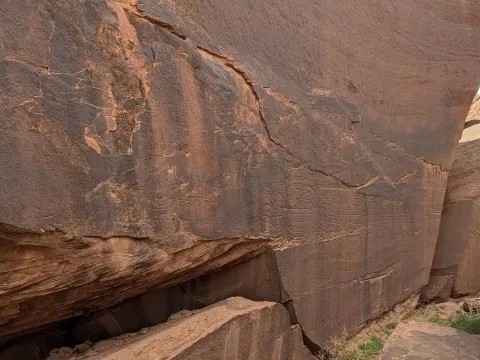
The desert, images from when it did not exist
More rock engravings and ksour, fortresses, in the Grand Erg Occidental
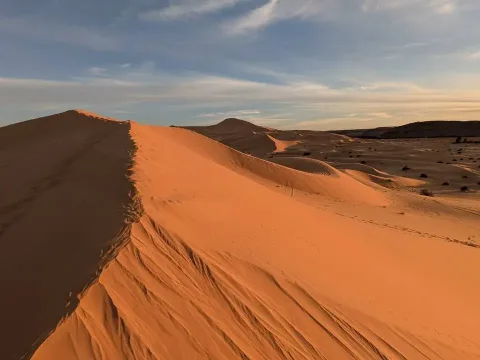
Towards the border with Morocco
The dunes of Taghit, the Sahara as it appears in brochures
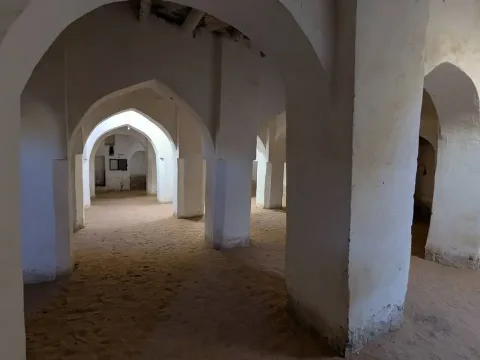
Beni Abbes: the dunes as next-door neighbours
The hermitage of de Foucauld, a grain of Christian sand in the Islamic desert
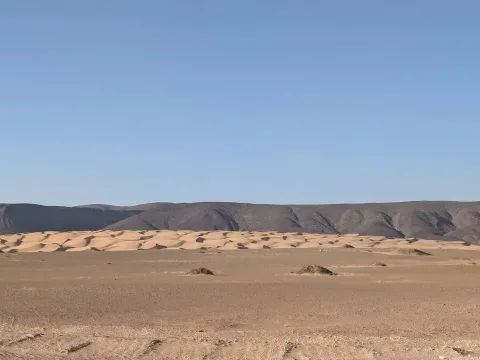
Timimoun: the last oasis
A Sudanese-style town, crossroads of history and trade
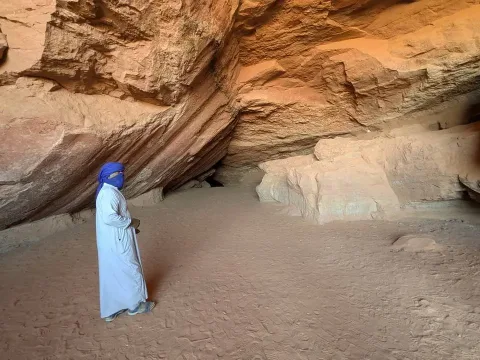
Oases and ksour around Timimoun
Nowhere is water a source of life as clearly as in the desert
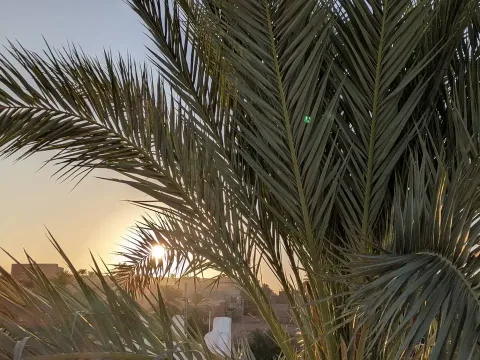
Farewell Timimoun, good evening Algiers
From the bazaar of the oasis town in the desert to the chaos of the Algerian capital
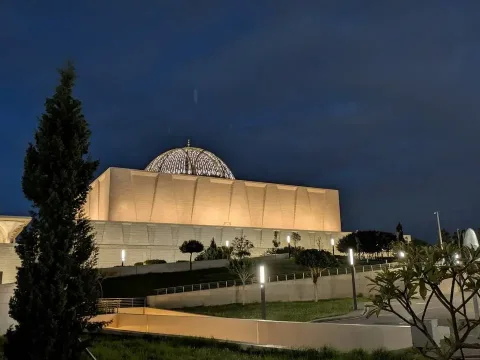
Roman sites on the Mediterranean and Algiers
Tipaza and Cherchell: Roman "dwellings of the gods"; Algiers between Islamic and colonial architecture