

Day 11
Beni Abbes: the dunes as next-door neighbours
The hermitage of de Foucauld, a grain of Christian sand in the Islamic desert
From Taghit to Beni Abbes
We leave at eight. Today's destination is Beni Abbes, 140 km away on a fairly smooth road. First, however, we visit the ksar of Taghit, about 700 years old, and the local market, where our attention is especially drawn by a shop selling spices and herbs dried in every possible form: it must have hundreds, a pity we do not know their properties or how they should be used. We limit ourselves to buying cinnamon sticks and raisins. Camel-hump fat is also sold, but we are not tempted. The rest of the market has features similar to ours in the variety of fruit and vegetable products displayed. In several villages we have seen prickly pear plants growing almost like shrubs, with fruit hanging from them, but we have not found them on the stalls of the markets visited.


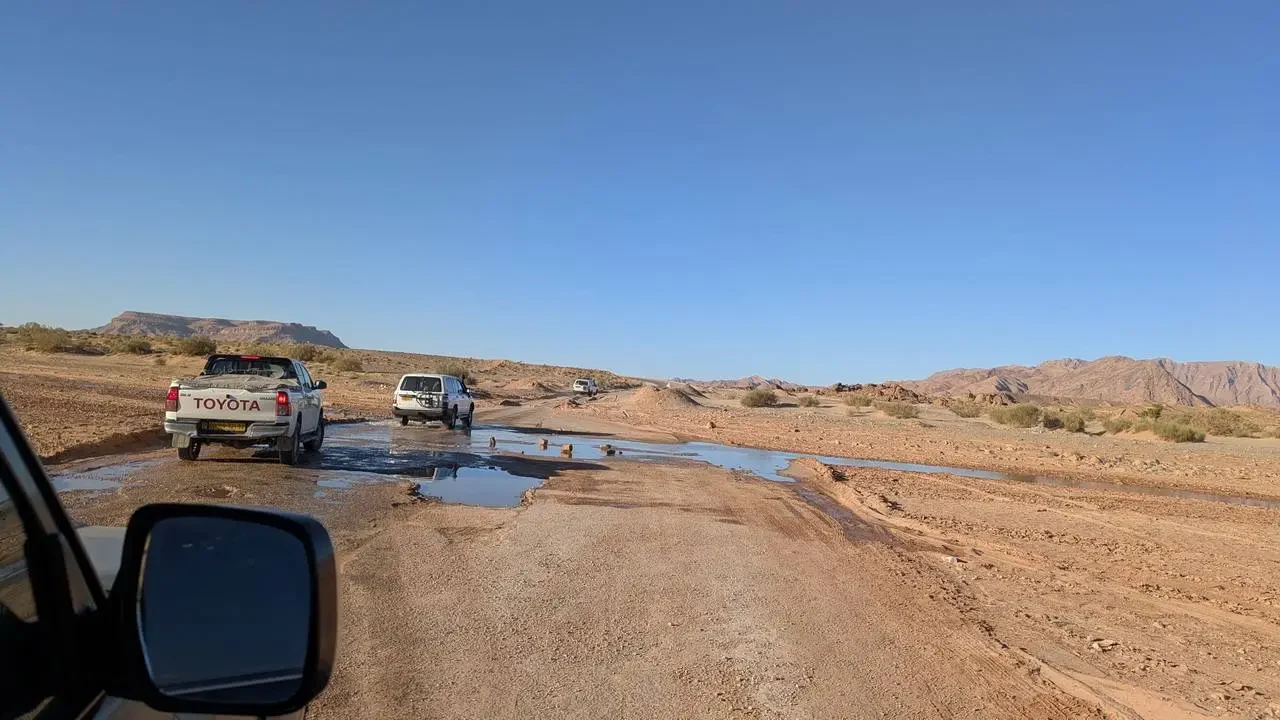
The route is linear as always; today's desert offers a variety of landscapes between stony ground and arid earth mixed with gravel. A few dromedaries stand out on the horizon now and then, while in the background the faint colour of sand appears, hills breaking the line of the plain with a sharp boundary. Fourteen kilometres before the junction leading to Beni Abbes, a plateau rises and later allows a view over the infinite desert. We make the last fuel stop in a service area as arid as the surroundings: a couple of petrol pumps, the manager's battered little office, a workshop space and a shop with nobody inside. It is rare to find a bar or place to drink coffee or stock up on cold drinks, pleasures one can easily give up. In some cases we have seen new and even advanced service stations, but closed while waiting to fall apart. The new, and not only here, is often already ruined by time and neglect before it is even put into operation; as if forever waiting for an inauguration ceremony, it remains there, useless and unused.
Charles de Foucauld's Hermitage
Late in the morning we reach Beni Abbes, another town located where one would never think human life could coexist with the surrounding environment. The bridge over the dry river, though we will see photos of how fierce it can become on the rare occasions when it rains, leads to the majestic entrance arch to the town, and from there in a few minutes we are at Charles de Foucauld's Hermitage. We are welcomed by an elderly man dressed in a tunic, as many wear, with sparse white hair and beard. At the same time, a still quite young man introduces himself, announcing that he will be concerned with our safety during our stay in town, a statement open to various interpretations, and then leaves us to the guide. During the tour the guide will reveal that he is a priest and has spent the last twenty years as the "guardian" of this outpost of Christianity in the middle of Islam. But his mission is precisely to stand on the front line, to serve as a bridge of dialogue between religions. He does not tell us, nor do we ask, but it would not be surprising if over the years he had received threats or intimidation from those who interpret the Quran according to the liturgy of the Kalashnikov, a form of exegesis practised at different times by many religions, although the area seems anything but an Islamist stronghold. He knows very well his role and the risks it entails; the mere fact of accepting them does him credit, whether one is a believer or not, and of whatever religion. He has excellent oratory, very spiritual at times, as he explains the life and works of de Foucauld. We enter the church with its sand floor, oriented east-west as often happens, and with the transept consequently north-south. He explains how the latter symbolises the meeting of human beings converging towards God, identified in the east with the birth of the sun, thus forming a cross. On the wall where the apse would be in more complex churches is a painting of Jesus Christ with open arms, in a sign of welcome; on one side of the small side nave is the scene of the Visitation, when Mary went to see Elizabeth and the latter felt a jolt in her womb on hearing the words of the Virgin, who was pregnant. He concludes that we too should feel the same jolt whenever we meet our neighbour, with the sole aim of fraternising. Alongside him lives another priest, representing the successors to de Foucauld's sowing. More cannot arrive because of government restrictions in issuing visas. It is hard to believe in a form of ostracism towards Christianity; more likely, the authorities prefer to keep the presence of foreign religious figures limited, avoiding potential local misunderstandings that would resonate far beyond the oasis. In short: a representation in the saint's name is fine, but without excess.


The monastery was built precisely here because the place is not far from the Moroccan border, a country with which de Foucauld was fascinated after visiting it several times and to which he had planned to return. Destiny instead made him remain in this hermitage for three years, in a condition that was not easy, as the only Catholic among Muslims whose doctrine was not extremist but still conservative, given the remote position of the place. He managed to integrate well, respecting and being respected in turn. He then went on foot to Tamanrasset, in southern Algeria, where he joined a group of Berbers, set aside the tunic with the cross in favour of Berber clothing so as not to stand out, but above all so as not to appear partisan, since his ecumenical preaching went beyond the fences set by individual confessions. There he helped the local population, living a life of fraternity and charity. He was nevertheless killed in 1916 during an assault by other Berber tribes. At this point the narratives divide: some argue that the attack and his murder were premeditated, because the militias came from Libya, then occupied by the Italians, in a kind of proxy war, seeing de Foucauld as a French spy. It should be remembered that the French had not yet consolidated their presence in southern Algeria. Others instead favour accident, within rivalries between opposing factions forever fighting one another. Neither his figure nor his life point towards a double-dealer, but these are the versions.
His own life was dramatic and adventurous from the start. He lost his father at around four years old, and shortly afterwards his mother also died of illness. His grandfather was wealthy and had him begin a military career, from which he was discharged a few years later because he was not particularly suited to discipline. His main literary work remains the creation of a Berber-French dictionary that apparently has not yet been equalled today. Named a saint in 2022, something the priest in his modesty does not even mention, as a symbol of a Church that tries to look beyond its own horizons but does so respectfully, on tiptoe, he converted to a simple life marked by altruism after intense experiences of worldly life.
The ksar of Beni Abbes
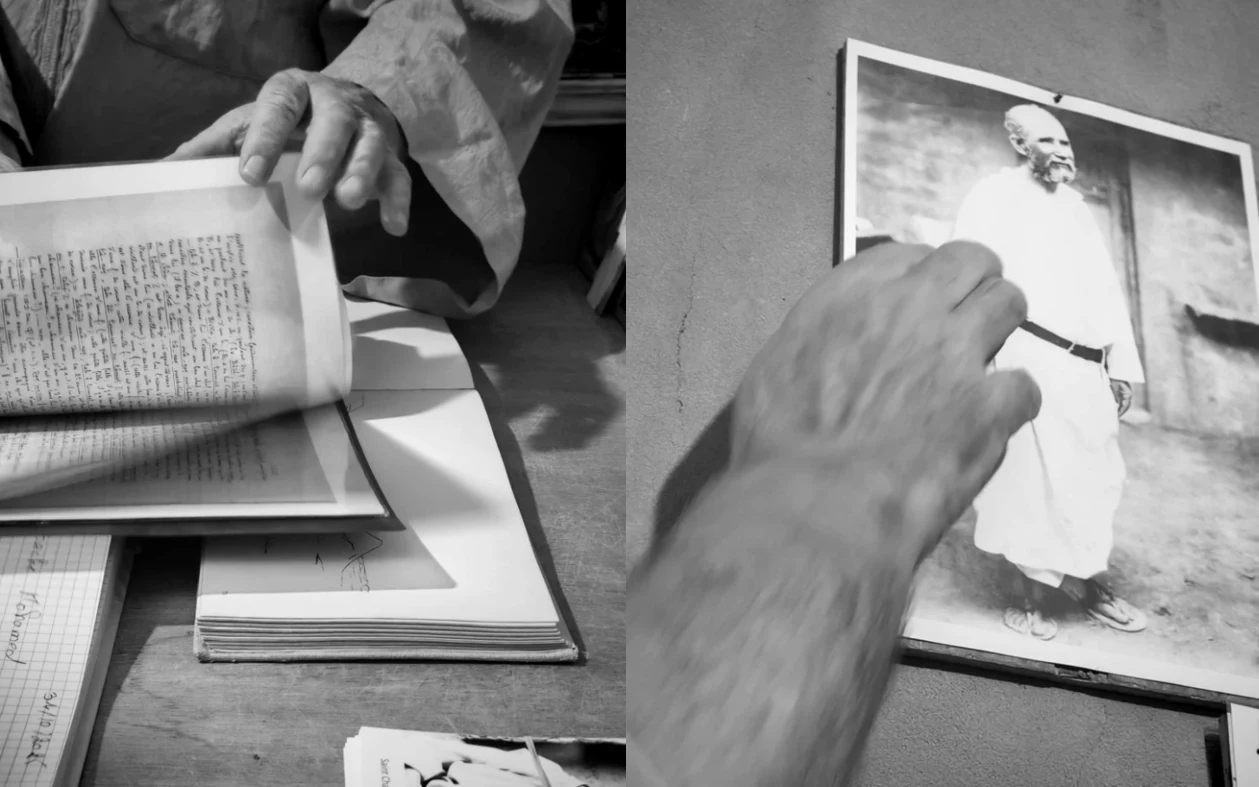
Next to the church is a small museum collecting books, photos and memories of the Father. When we leave, we cannot help wondering what life the two priests of the Hermitage lead: when they celebrate Mass, who attends if they are the only two Christians in the area? Is there mistrust from the population, or have they managed to make inroads by assimilating to them and their culture? It should be remembered that the two not only profess a religion without faithful, but come from other countries and cultures, usually France. Moreover, the precepts of Christianity would require proselytising, but we strongly doubt that they succeed, or even that they try. They are the flag floating on a buoy in the oceanic desert of Islam, in memory of a figure to whom Algeria itself recognises merits. The exit from the monastery opens onto a courtyard surrounded by a wall. In one corner are three tombs, one of a nun who died in 2009 and the one beside it of a priest in 2013, probably the predecessor of our guide. In the past the nuns were numerous, coming mainly from Italy but even from Vietnam.
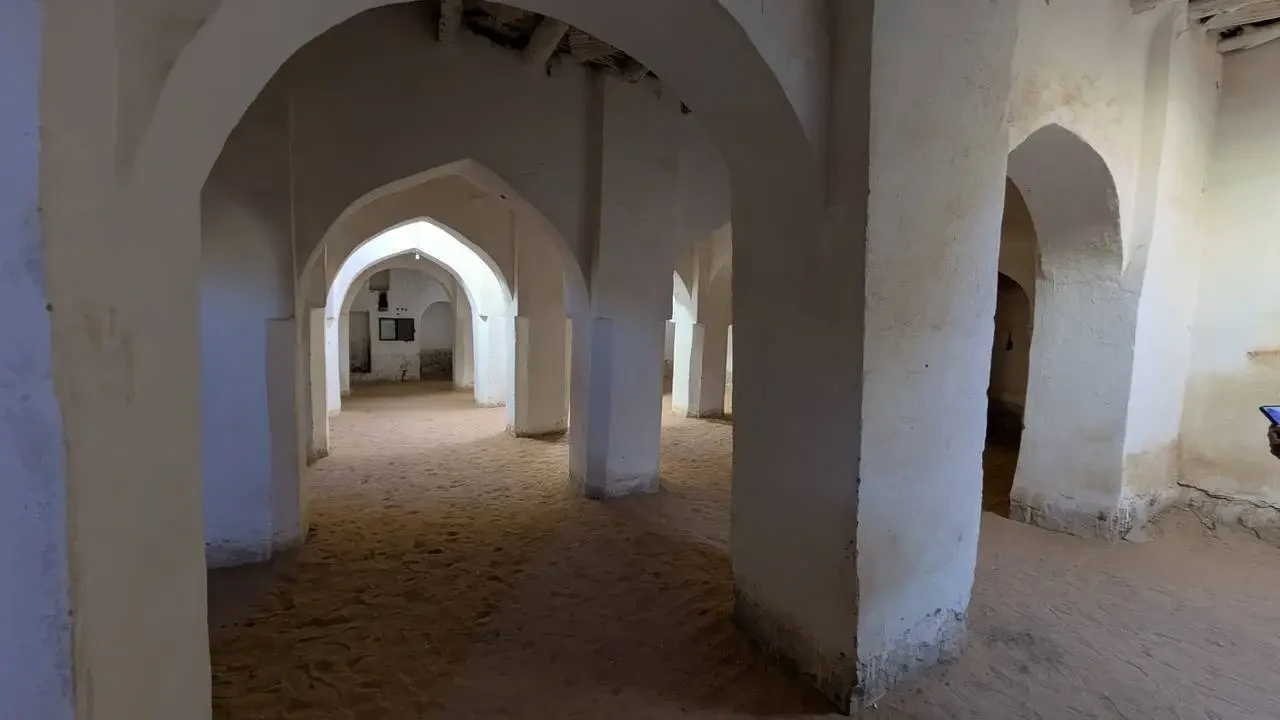
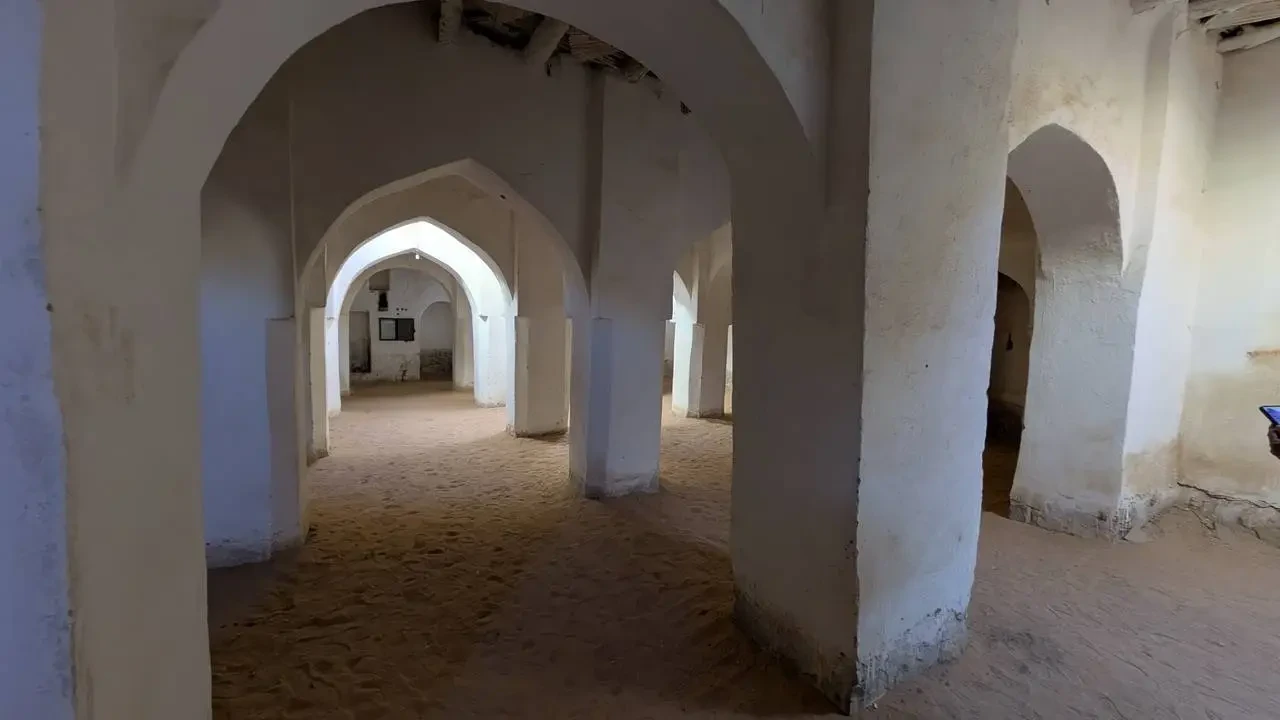
We go to the hotel. It is beautiful, with a modern structure and an inner garden; the swimming pool is obviously empty, though what surprises is not so much that it is empty as that it exists, since we are in the middle of the desert. Water is not lacking thanks to underground springs, but it cannot be wasted either. We have lunch in a traditional restaurant with a single dish called berbl, a kind of lasagna made with round filo-like bread, small crepes mixed with what seems to be tomato sauce, spices and plenty of onions, topped with meatballs and a green pepper. It is already spicy enough not to encourage us to taste the pepper too. We walk to visit the local ksar, about 800 years old. Originally five groups of inhabitants from different areas settled there. Its history can be divided into two periods: the prehistoric one, with several engravings testifying to human passage in the most remote antiquity, the Upper Paleolithic, around 12,000 BC; and the more recent one, in which each group built its own ksar. It appears that around 1400 there were between five and eight ksour, plural of ksar, depending on the inhabitants' origins. At a certain point, a mixture of history and legend says that a marabout arrived and proposed unifying the ksour into one in order to improve defensive possibilities. Defence, among other things, must have been limited to raids by bands and predators, since it does not seem plausible that an army, or even a well-structured militia, could have come here in force with cannons and artillery. First because there was no interest, and also because distance made it inconvenient compared with the effort. Ksour, precisely fortresses inside which people lived even in peacetime, did not necessarily need imposing fortifications. What mattered was that they be built near water sources, or where water could be brought, therefore low compared with the hills, although from the most basic notions of military strategy it would have been more convenient to erect them higher. In this area water can be found just one metre underground, which is why villages were often founded in oueds, the lowest zone where water is found or even flows, in a position that would have been hard to defend against massive attacks. To disorient the enemy if he managed to enter, the alleys were narrow, non-linear and covered, a kind of labyrinth giving the impression of being in an underground city. By preventing orientation, darkness left even well-armed enemies at the mercy of defenders who knew the place. In recent times openings have been made in the roof to let light through and avoid accidents.


Returning to the unification of the ksour, the conditions set by the marabout for building a single ksar useful to the common defensive strategy were basically three. The first was that he would choose the place where it should be built. The second concerned disputes between inhabitants, which could not last more than 24 hours so that people returning to their homes would not continue the argument. The third was that any caravans crossing the desert and stopping nearby had to be hosted inside the ksar free of charge and eat together with the inhabitants. This was to prevent caravans from camping outside and attracting the attention of thieves or attackers, with blame then implicitly placed on the inhabitants of Beni Abbes. The stop inside this caravanserai was both free and mandatory. In case of attack, the last place enemies would have managed to reach was the mosque, so women and children remained inside while men and youths took care of defence. Inside the mosque there was also a collective storehouse where each family, according to its production, had to store part of the harvest, so that in times of difficulty there would be enough for everyone from the accumulated reserve. In addition, each house had a private storehouse managed by a woman.

Palm grove and sunset in Beni Abbes
Today Beni Abbes, where Beni means "son of", has about 15,000 inhabitants. Weddings are still celebrated in the mosque and it is a place of pilgrimage, or as they say, of passage or transit by the faithful, but no services or Friday prayers are held there. The easy availability of water just beneath the surface probably gave rise to another story about the village's foundation, whose boundary between history and legend is hard to establish. The first marabout, arriving from Egypt with a companion, after some time felt that his moment to die had come and complained to his friend that there would be no water for the ritual washing of the body and no way to call friends to attend the funeral prayer. He therefore planted his staff in the ground, saying that when his time came a spring would be born there and news of his presence would spread, so people could come to his funeral. Beyond the epic aspects, the legend may have a real basis, since water lies just below the surface.
In Beni Abbes there are as many as 34 different types of dates, while cultivation follows three layers according to height: at the base are spices and herbs such as parsley; at the middle level are fruit trees; and at the upper level date palms provide sufficient shade for the two lower layers. Unfortunately the palms are declining because water availability has decreased due to overpopulation. The flow remains 30 litres per second, but while it was once used exclusively for the palm grove, only six litres now remain for that use, because the rest goes to the inhabitants' consumption. There is also a plant-health problem, since a fungus attacks this type of palm in particular and resists every treatment. The only way to save them is to use branches from palms that remain healthy and replant them. But in the whole life of a palm there are only four or five such branches, so few cuttings are available for the operation, and palms grow very slowly anyway. In the past the palm groves belonged to certain families whose members multiplied over generations, only to be scattered by emigration. The result is fragmented ownership that in substance interests nobody. In fact, it is the ugliest palm grove we see, because besides receiving little water the palms are not even pruned, giving an uncultivated impression, so much so that they no longer grow and in some cases we can even pick dates directly by hand. The guides are usually elderly locals, well prepared and helpful, able to answer a whole series of questions and curiosities put to them.
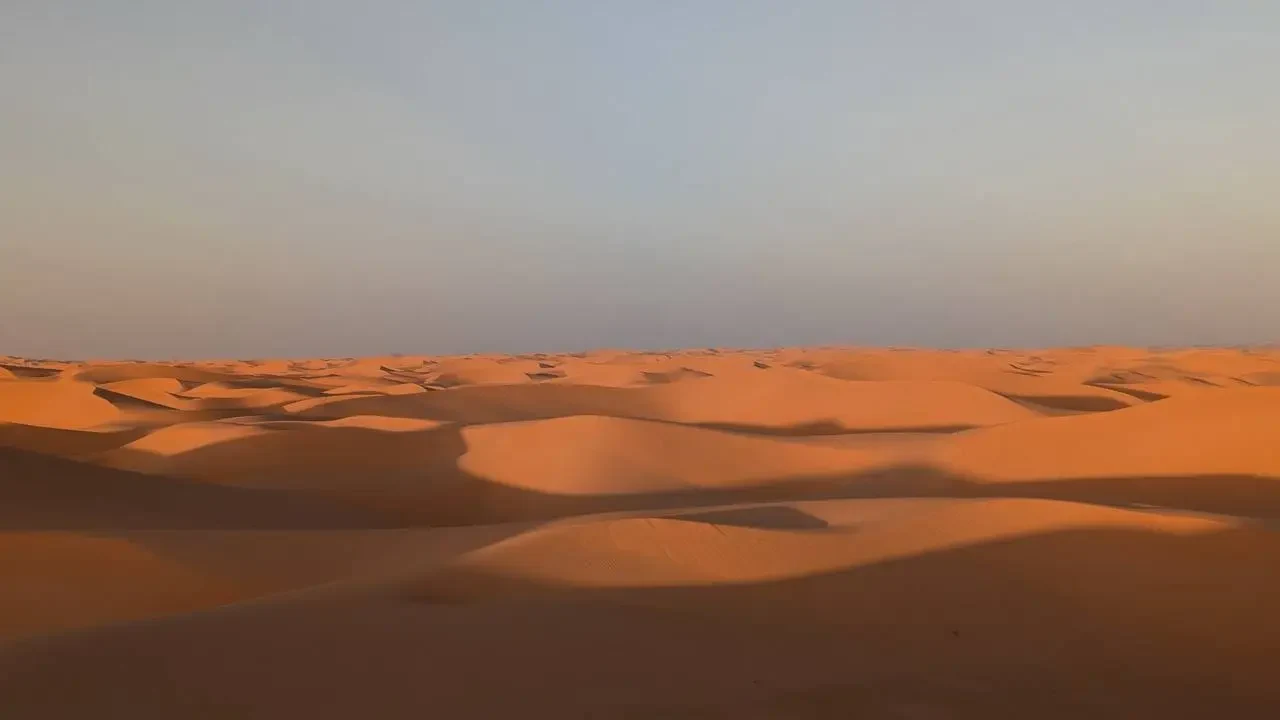
At this point we return to the hotel, only to leave shortly afterwards for an independent walk to observe the town's daily life. When we are near the mosque and approach some passers-by to ask whether we can enter and visit it, the "guardian of our safety" materialises from nowhere and politely informs us that prayer is under way and we cannot enter. Surprised by such speed and with the strong feeling that we have been followed until that moment, we end the afternoon on the dunes to enjoy the sunset. Here we meet a strange elderly character who seems to have come to capture the magic of the moment, joined shortly afterwards by a boy. Evidently even local people do not tire of seeing the incandescent sphere slip beneath the golden mantle of the Sahara. Today's particularity is that the desert reaches right up to the town, looming over it with its sandy mass. In Beni Abbes too we will not identify any foreign tourists. Dinner is once again under the tents, similar to the others and still good: tonight, camel.


