Day 3
In the heart of Numidia
The Roman site of Tiddis, Constantine with its bridges, and the mausoleum of Medracen
In the heart of Numidia
Another morning devoted to Roman history: a visit to Tiddis, not far from Constantine. It is less important than Djemila or Timgad, which we will see tomorrow, but still very interesting. It lies among gentle hills, protected here too by reliefs on one side and canyons on the other two, forming a kind of naturally sheltered triangle. There is practically nobody there, and the silence helps bring the site to life through imagination, picturing the daily life of the legionaries inside the walls. Some details are well preserved, including the latrines, which are especially interesting: the "seats" used by visitors stood side by side with little regard for privacy, but what is surprising is that they were preheated by slaves, who sat on the stone shortly before the master arrived to attend to his needs. In front there was a narrow channel of running water from which one could draw water to wash with a wad. After all, washing was one of the principles written down within that community: "Venari, lavari, ludere, ridere, hoc est vivere" - to hunt, to wash, to play, to laugh: this is to live. The urine that flowed away was in turn recovered as ammonia for leather-working processes. There was of course running water in the latrines too, destined to flow into the main sewer system under the cardo, whose stone manholes can still be seen.

The sun, not yet high in the sky, lights the ancient stones diagonally with warm colours that only sunset could equal. Tiddis is compact; the little road begins with an arch that is extraordinarily intact and climbs following the ground until it reaches another finely made arch. When visiting the site, one must remember that it was much larger, as was Djemila, but excavation work was interrupted and now awaits government funding.


The beginning of many excavations is due to the French, who sent archaeologists and began the research in an organised way. Independence marked a slowdown, if not the end, of the work, and today many works of art still lie buried, while others remain unguarded and at risk of decay or vandalism; we saw some mutilated finds among the petroglyphs. It should also be remembered that the implicit commission demanded by the French consisted of taking treasures back home, as a visit to the Louvre or other museums is enough to show. According to the governed themselves, the various Algerian governments prefer organising celebrations and populist occasions - a modern and adapted version of circus games, to remain in Roman language - rather than investing in culture, which in this case would also mean encouraging tourism. Yet these would be long-term investments, while politicians prefer to secure straightforward rents, to put it in French, that bring immediate consent among the population.
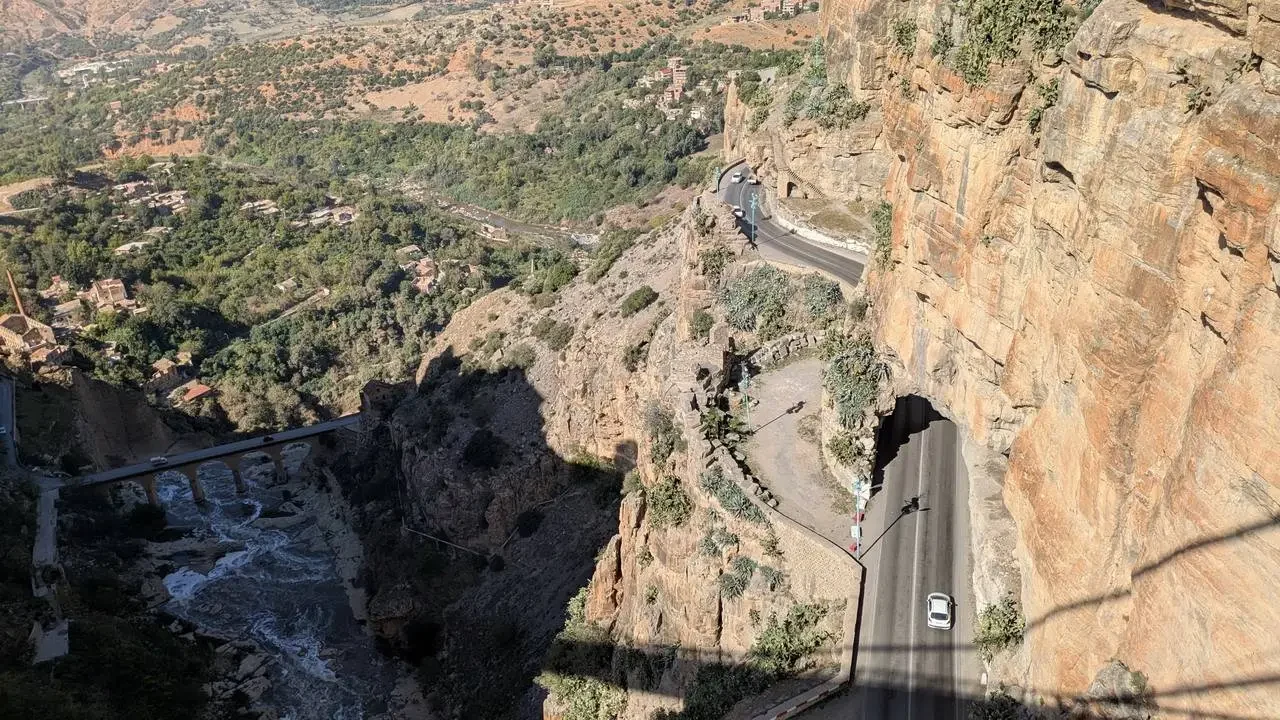
On the way back we are taken under police escort, and from this moment they will be our guardian angels for the first week, until Ghardaia. We return to visit Constantine, which we find more welcoming than expected. We begin at the monument to the martyrs of the First World War, set on a rocky podium with a magnificent view. Inside the arch is the list of the fallen, whose names suggest more French than Algerian origins. Crossing the Sidi M'Cid bridge, above the Rhummel River 175 metres below, we reach the centre, what we might call the Casbah, and go for a walk through the souk, the local market. As always, scenes of daily life are the most interesting, with the curiosity of finding ourselves in a cultural setting very different from ours, Arab and North African, while not at all far away geographically, a detail easily seen in the fruit and vegetables on display. Being not far from the Italian coasts, the stalls basically offer what grows in the Mediterranean area. Dates stand out, present at different stages of ageing, as date paste and as a kind of syrup. Amid the smoke and smell of roasted chestnuts and skewers, we prepare for a light lunch followed by a walk in the area overlooking the highest canyon, with a view of the hill in the background where the war memorial visited earlier stands. We continue walking through the casbah along the market street to the square in front of the El Bey mosque, where we have a brief lunch, then cross a second bridge, the Mellah Slimane, exclusively pedestrian. This constant crossing of bridges, like a passage between different platforms and perspectives, the last even with stairs and a lift descending to the bridge itself, makes Constantine a unique and attractive city.


Constantine, between mosques and memory
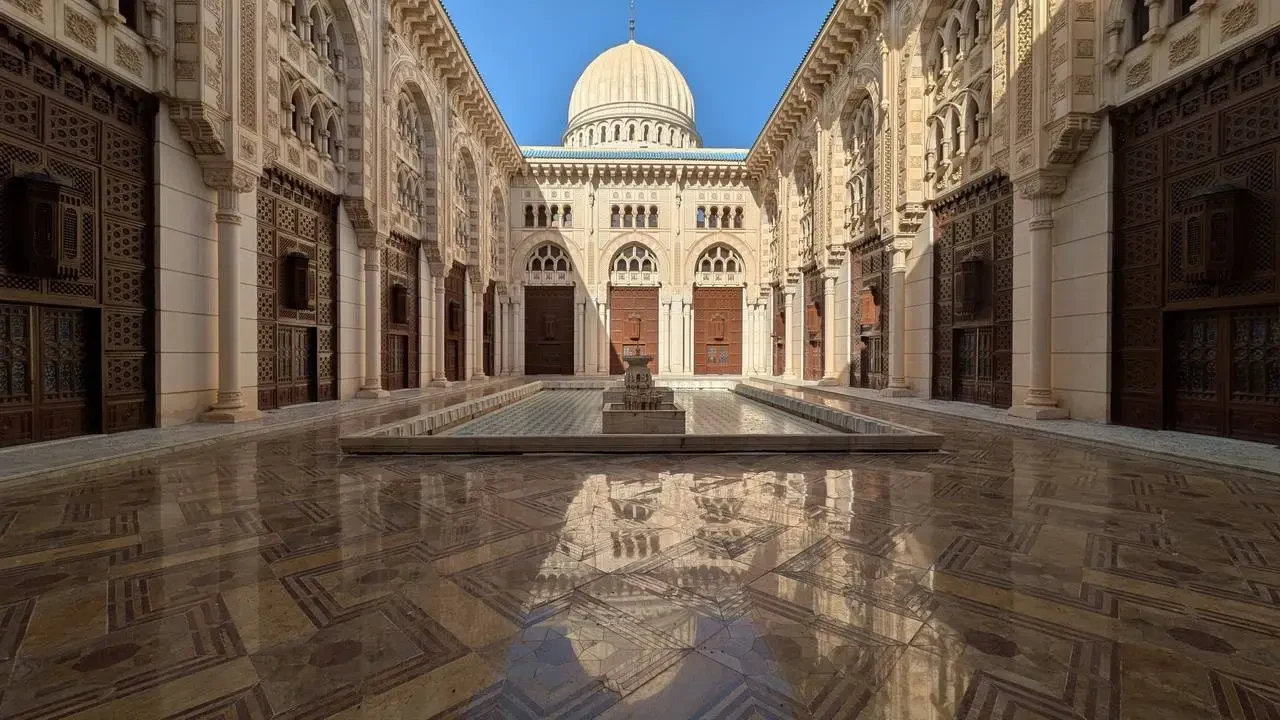
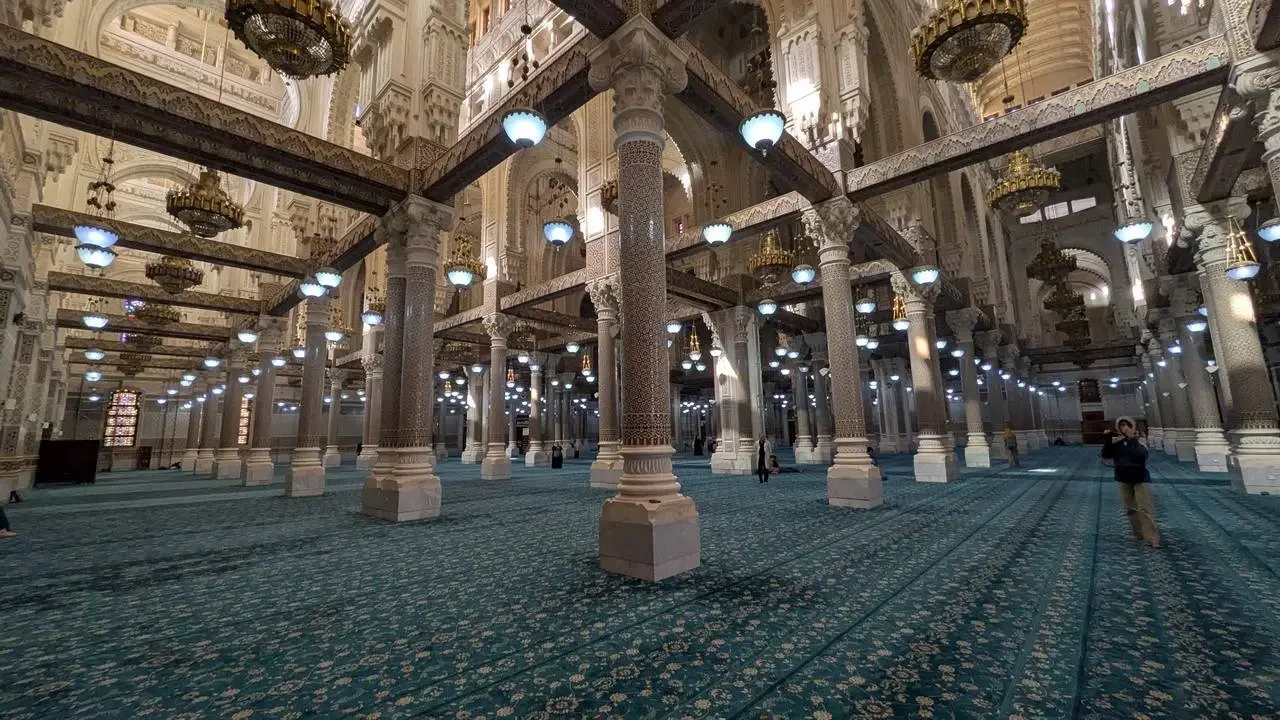
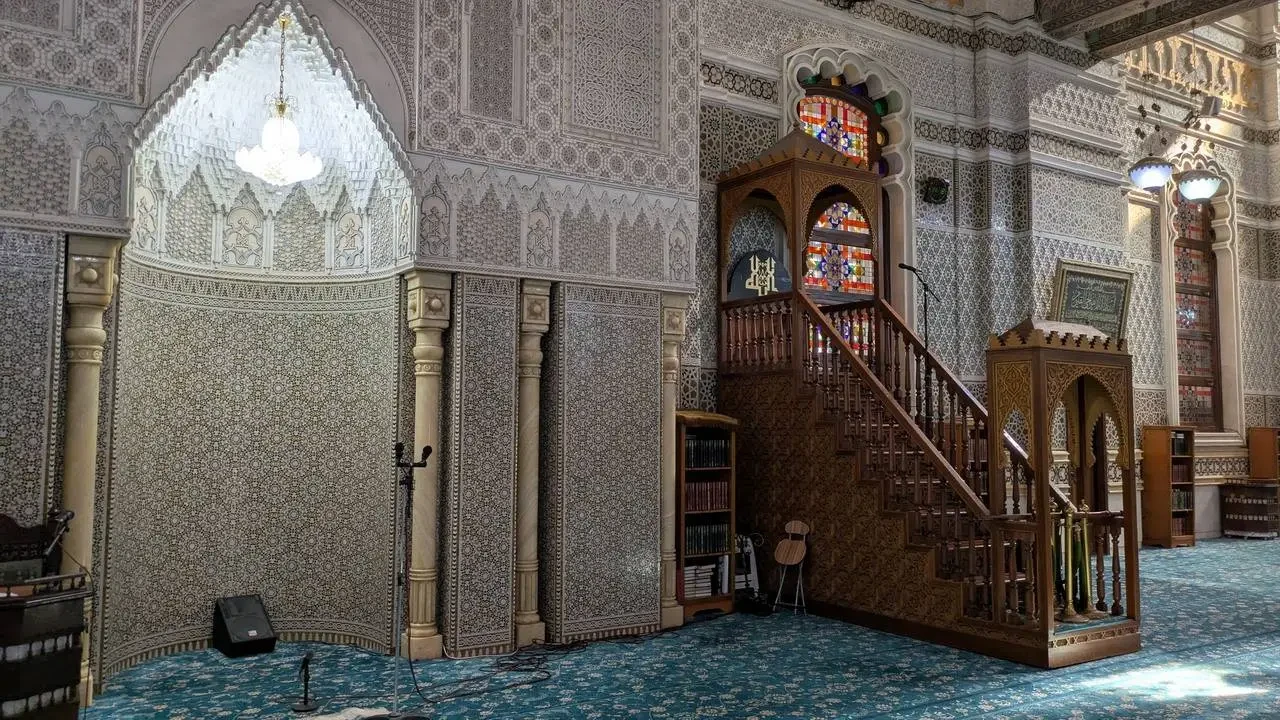
It is rather hot, and in a dry, clear climate we get back on the coach towards the Abdelkader mosque, a work of art in whose inner silence one can experience the full spirituality of Islam. After leaving our shoes in the appropriate compartments, we enter the large building, where the columns are connected by thick beams with an anti-seismic function. Like all mosques, it is bare of furnishings but rich in floral decorations on the walls and columns, while the carpet repeats the same motifs, enlarging the feeling of grandeur. Huge, elaborate chandeliers descend to illuminate the space, interpreting divine light upon human beings. At the far end, opposite the entrance, is the mihrab, the niche marking the direction of Mecca, and the minbar, the pulpit from which the imam delivers the sermon. We also visit the inner courtyard, where the dome is reflected in a sheet of water. At a certain point the chanting of verses from the Quran telling the story of Mary, if proof were needed of the close kinship between Islam and Christianity, spreads through the air. It is in Arabic, we do not understand a word, but we grasp its mystical meaning. It adds the one sensory element still missing: sound, breaking a silence that was itself expressive. A couple more photos from outside, admiring the majestic architecture, bring this experience to a close.



After 3 p.m. we leave Constantine, still escorted by the faithful police, who by now precede us on every move, patiently waiting in the shade of the sparse trees while we visited the mosque. Along the road many lamp posts hold stork nests; the birds come here to rest or pause before resuming the Mediterranean crossing to or from Europe. As daylight begins to fade, Medracen comes into view, a mausoleum from the pre-Roman period, fourth century BC, where a notable of the Kingdom of Numidia was buried. At this moment, aesthetically enriched by the setting sun and the first lights illuminating it, its circular shape allows us to walk around and admire the ancient stones, some displaced, that form it. A monument that even the Romans must have considered ancient.


Along the road between Constantine and Medracen, escort cars and vans alternate every few dozen kilometres, stopping on one side to talk among themselves and with the driver, then we continue. When we leave Medracen it is getting dark, and the blue flashing lights ahead of us illuminate the darkness. If we wanted to joke about it, we cannot decide whether we look more like a coach of VIPs or of prisoners; perhaps we are only passive actors in a bureaucratic farce.
We have now passed beyond the Tell Atlas, where Kabylia lies, and are in the eastern edge of the Saharan plateau, thus skirting the Saharan Atlas. The Atlases are two mountain chains running from the west in Morocco and fading into Tunisia, crossing all northern Algeria. Further south there is only the immensity of the Sahara, in its section of the Grand Erg Occidental: an ocean of aridity rarely interrupted by that natural miracle which water allows to emerge under the name of oasis, and with it life.
Batna and daily life
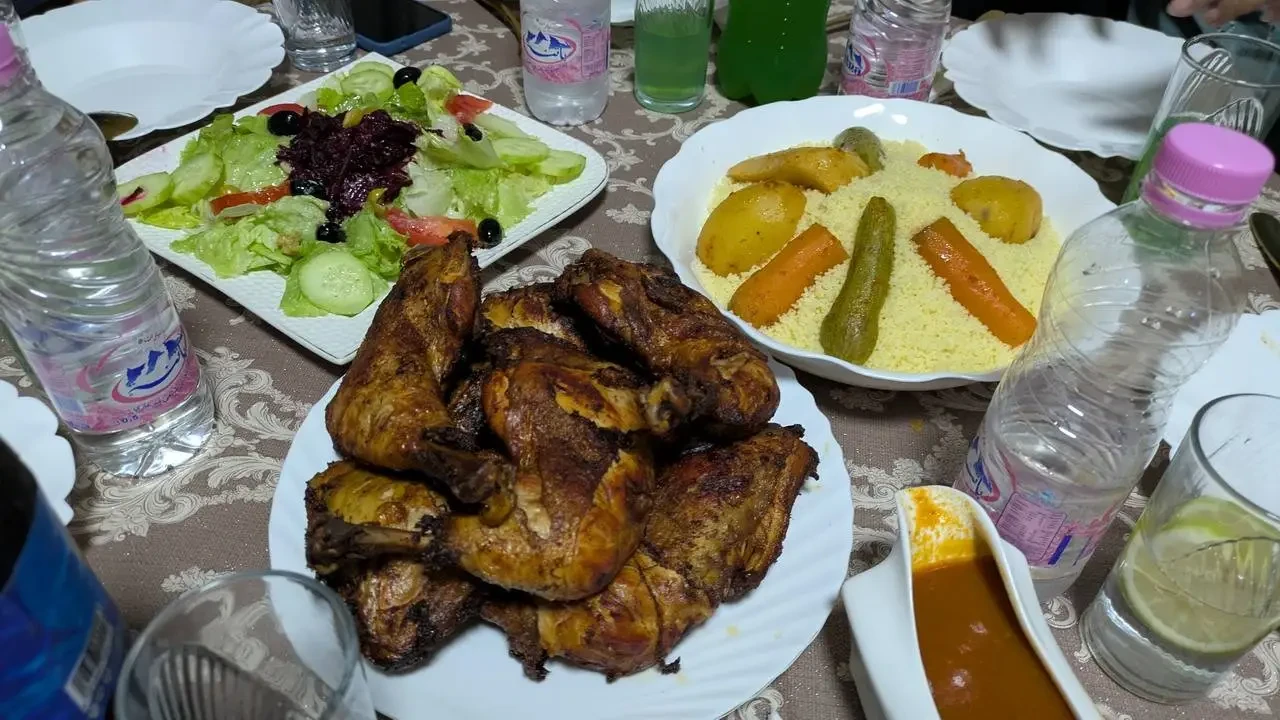
We reach Batna, tonight's destination, a city of 300,000 inhabitants at 1,050 metres above sea level. In winter it snows here and the layer can reach 20 or 30 cm. From a tourist point of view, the place does not have much to say, but it is a good meeting point between routes east and west, and between desert and sea. Dinner is chez l'habitant, a formula that means eating with a private family organised to host groups of some size too; a way to taste local cooking, glimpse their daily life and support a healthy grassroots economy. Besides eating well, tonight we will have the chance to exchange a few words with the friendly daughters of the owner: one is 19, the other 18, and both study at the local university.
The hotel looks beautiful from the outside but is very battered inside. In short: everything is there, but nothing works. Above all it gives the impression that the rooms have not seen guests for some time; otherwise the widespread and above all unusual malfunctions would be hard to explain, such as opening the sink tap and finding one's feet wet because the drain pipe is broken. If further proof were needed, it is another warning that tourism in Algeria has not yet taken root. Before going to sleep we take a walk. There are few people around, some LEDs light the streets and a few cars move along the avenues. We exchange a few words with the hotel receptionist, who speaks good Italian after working for several years in the province of Brescia, and his accent announces it before he does. He tells us that life in Algeria is not easy because opportunities are scarce; wives usually do not work and the man must take responsibility for all family income. In his case he has four children, so he cannot afford mistakes. He probably managed to put some money aside during his stay in our country, but did not want to move his family there because he did not want to uproot what represents his origins.