Day 2
From Algiers to Constantine via Djemila
A return to Rome, the ancient one at Djemila, crossing the mountains of Kabylia
From Algiers towards Djemila
Not many hours have passed since we went to bed, but enough to allow the minimum rest and be ready to begin the adventure. The sky is clear and the temperature very pleasant; after breakfast we leave the city heading east, crossing it on a semi-holiday: in Algeria Friday is a holiday like our Sunday, while Saturday is like our... Saturday. It should also be said that November 1 will be a national holiday, marking the date when the uprising against the French occupier began. Taking advantage of the season, with mild temperatures and schools closed for a week, several Algerians allow themselves a few days of holiday to visit their own country, in an ideal period when the heat has passed and the cold months have not yet arrived. It is a sign that a small but growing part of the population is moving towards the middle class and has enough means to travel.
We will visit Algiers in the final days, with the good fortune of returning during their weekend. It is a chaotic city and difficult to manage in traffic terms because of its hilly shape facing the sea. That does not mean it lacks charm; on the contrary, it contains real treasures that we will discover in two weeks. Some years ago there was a proposal to move the administrative capital about 200 km away to make the city less congested, but the rulers then decided to leave it where it is, apparently mainly for reasons linked to personal convenience. Once we leave Algiers, the landscape soon becomes mountainous. We are in legendary Kabylia, a region of proud Berber traditions and combative towards every presumed usurpation, whether external, French, or internal: the so-called pouvoir of the dominant Arab-culture elite ruling the whole of Algeria from the capital. Conquered well after 1830, the year of the French landing and conquest of Algiers, at enormous cost to the settlers, this area gave rise to movements and uprisings against occupiers both before and after national independence in 1962, in pursuit of a new form of independence with a clear Berber character. Until a few years ago it was not recommended to travel the nearby roads; now there do not appear to be particular problems, but Kabylia's pride remains like a fire burning under the ashes. Even in times closer to our own, foreign actors, from Morocco to France, who aim to divide Algeria and open cracks in the regime have not hesitated to leverage ancient internal divisions, rubbing salt into the wound and putting pressure on the government and the delicate balances that sustain it.

On this stretch, and generally throughout the trip, we will come across houses that are inhabited but not fully finished. We are told that in this way the evil eye is kept away, whereas if they were completed they might attract the attention of malign spirits. In some cases the owners even place a tyre nearby so that passers-by are distracted and do not notice that the house has been completed. We believe this story only up to a point; more realistically, there are concrete tax advantages behind it, as well as a building approach designed for family growth through marriages and so on. Finally, given average economic conditions, one can imagine that when the owner has a little money saved he buys a batch of bricks and uses it to put up a wall. The road winds between modest mountain reliefs on two carriageways; traffic, not especially heavy, is fairly orderly.

Lower hills replace the reliefs as we move east, eventually giving way to cultivated plains where several small towns have taken root. From them, curiously, rise relatively tall apartment blocks, sometimes even in semi-desert areas. It is true that one sees a few factories, some producing porcelain stoneware, but the faint beginnings of industry do not seem enough to justify such an abundance of flats. Along the road from Algiers to Constantine, or rather to Djemila, we cross areas with little vegetation, sometimes almost desert-like, broken up by olive groves. When we stop for a break at El Eulma, some sellers offer fresh apples and pomegranates by the roadside; not far away are more intensive crops, green patches confirming that water has been found underground, as shown by wells. Other fields have been harrowed and the soil seems to be waiting for sowing, probably cereals to be harvested in late spring, given the presence of silos in the area. Rural scenes follow one another as far as Djemila, which lies at about 1,000 metres above sea level and whose name in Arabic means "beautiful", clearly justified by its position on a protected slope at the confluence of the canyons carved by two streams and with the mountain behind it. Founded by the Berbers during the era of the small kingdom of Numidia, and therefore pre-Roman, it later became a residence for "retired" legionaries.


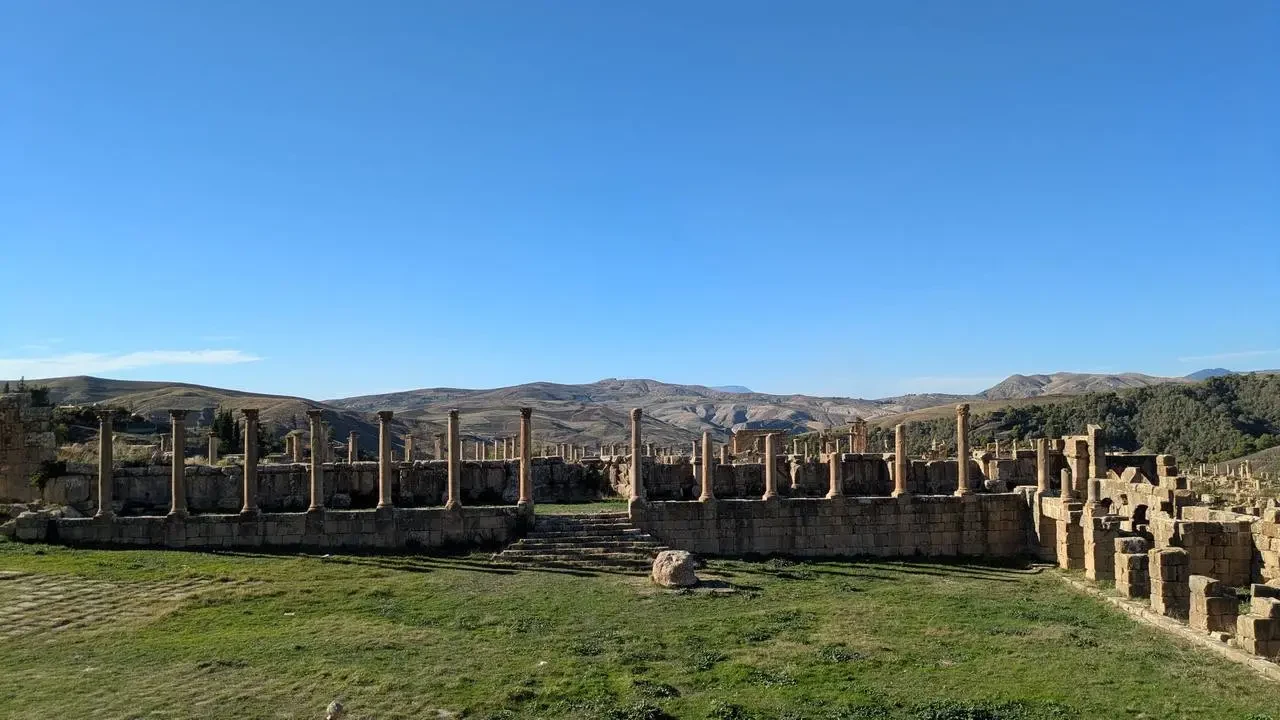
Given that the area is certainly not fertile, the surroundings nevertheless appear covered in lively green; autumn has been decidedly rainy and even summer was not particularly hot, acceptable for the latitude. Although we are in Africa, winter does bring cold areas: along the road we see signs warning of black ice, and here in Djemila it also snows quite a lot. In the past a decent layer would remain for over a month; in recent years snowfall has been occasional, but still enough to disrupt traffic.
Djemila, mosaics and Roman ruins
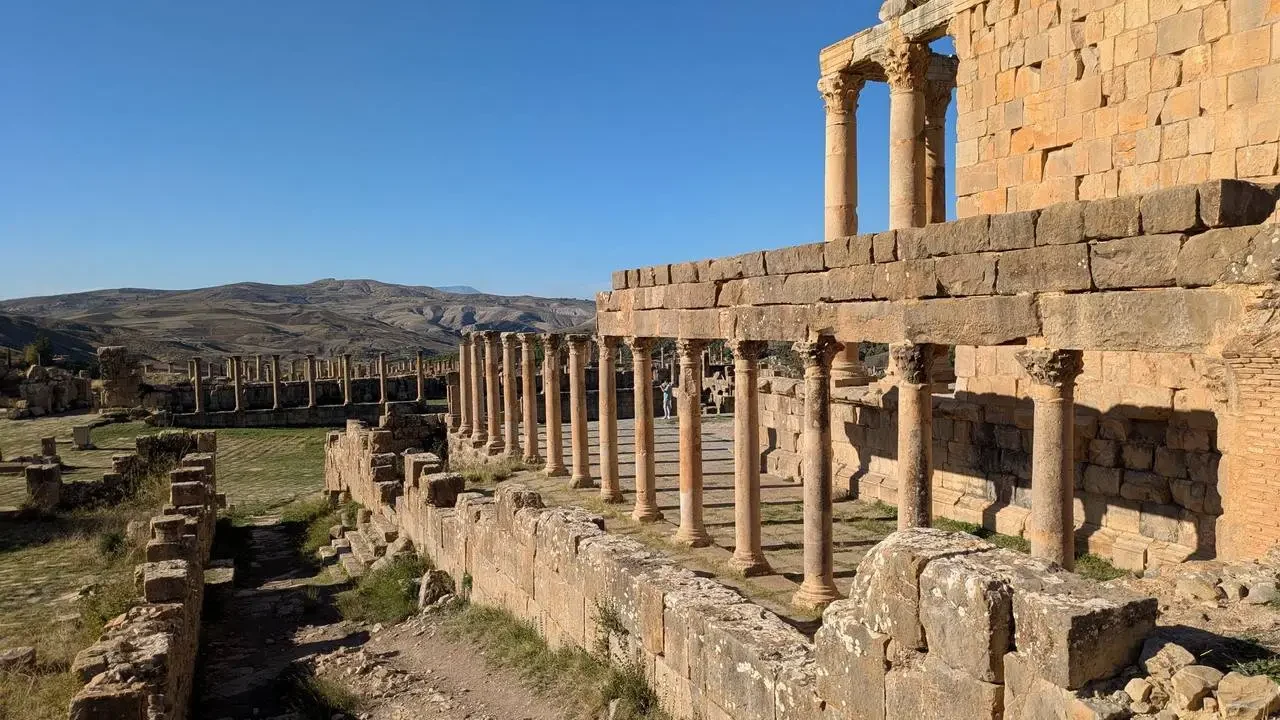
Djemila is an essential stop for visiting the first Roman site on our tour. A well-prepared guide welcomes us and describes the artefacts in the museum, where, in addition to a series of Roman-era finds, there are also walls of mosaics rescued from the weather outside. The sight of lions, tigers and large felines in general is peculiar: these animals once roamed North Africa before climate change, not yet caused by human activity, pushed them south of what we now call the Sahel. The uniqueness of the designs and the precision of the inlays are astonishing. The information about life in the town when it was inhabited is valuable: like Timgad and Tiddis, it was home to veterans who had fought in the pay of the empire and then retired, leading a quiet life not without comforts, as shown by the many baths, amphitheatres and pleasure houses. The explanations do not merely clarify the meaning of the ancient stones in front of us; they also offer a useful history review, reminding us, for example, that in ancient Rome Jesus was symbolically represented by a fish because the acronym of the name in Greek means Jesus Christ, Son of God, Saviour. This representation can also be linked to the evangelical idea of Christianisation and of the fish, humanity, gathered into the net, faith, through the symbolic figure of Peter the fisherman. In Roman times, when the Christian religion was banned, believers drew a fish on house walls in order to recognise one another; the same happened between people, if one drew half a fish on the ground and the other completed it, it was a sign of mutual understanding and shared faith, and therefore of trust.


That the Romans had an inclination towards aesthetics and loved the good life is also confirmed by the baths, arches and decorations, all witnesses to the opulence that characterised their cities. Walking beyond the residential area, the theatre is also present. It is so called because it forms half an ellipse, with the spectators all on one side facing the stage, unlike the amphitheatre where the ellipse of seating is complete and the action takes place in the middle. Estimating the number of people who could sit there gives fairly precise indications of the city's total population, using a multiplier of three or at most four. Therefore, with 3,500 seats, one can think that around the second century AD about 12,000 to 14,000 people lived in Djemila.
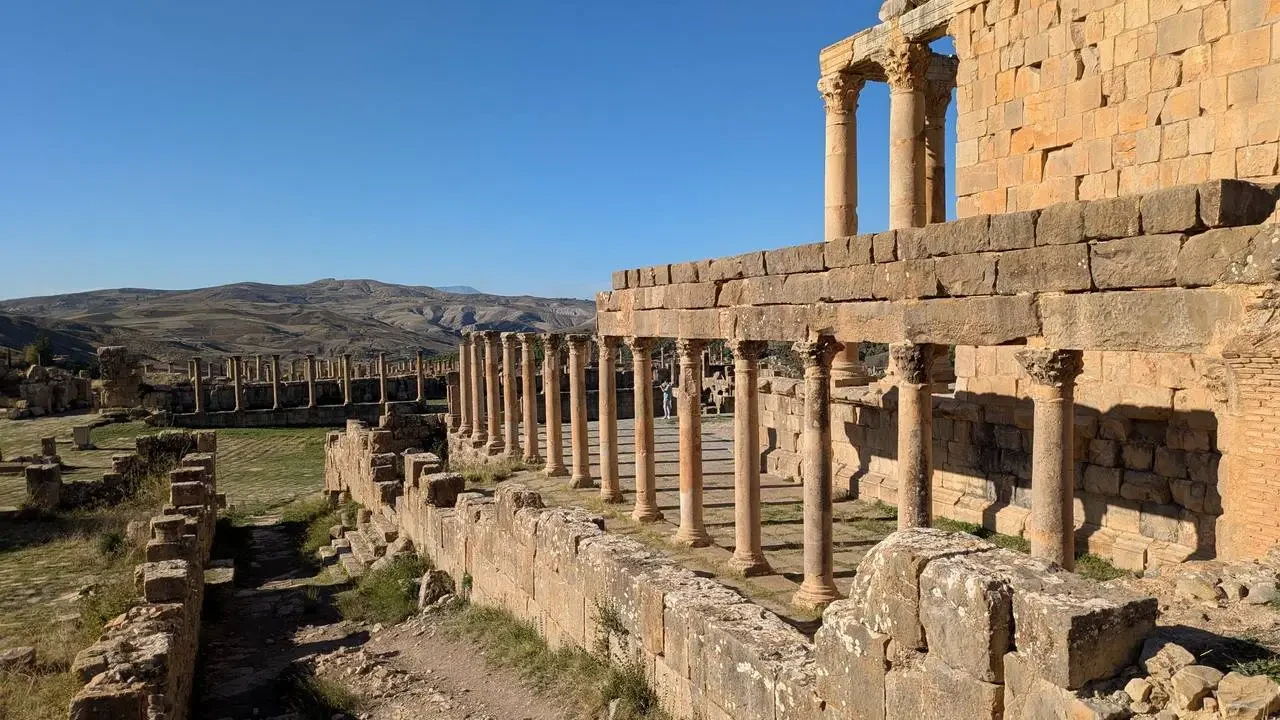

If the baths provided comfort for the city's inhabitants, the role of the slaves should not be forgotten. Near the pools they burned wood, deforesting and thus causing one of the first documented environmental damages, in harsh conditions, in order to heat the water by channelling hot air under the calidarium and the tepidarium. The former reached as much as 80 degrees, the equivalent of our sauna, followed by the latter at 50 degrees. The frigidarium, instead, consisted of a pool of running water placed in a shaded area. Completing the ruins are the temple, the forum and the Arch of Caracalla, son of Septimius Severus, from a line of emperors originating in Leptis Magna in neighbouring Libya, as well as an interesting series of residential buildings.


The city is divided across at least three levels: a classical Roman one, a Christian Roman one and a final Byzantine one, also signalling the sedimentation of colonisations over time, interrupted by the Vandals after the fall of Rome, who left no signs of their passage other than some destruction. Confirming what we saw along the route to Djemila, the guide emphasises good production of wheat and barley, a tradition dating back to ancient Rome, when North Africa was considered the empire's granary. At the time, flour was used to make the bread distributed to the population, a practice paired with the circus games used by power then to maintain the so-called pax romana, whose correct translation is not so much peace as established order.
An absolutely rewarding visit, going far beyond the admittedly interesting "piled-up stones", however well preserved. The mosaics depicting lions and panthers are particularly striking in a region that is now semi-desert and at increasing risk of aridity. The presence of the felines says a great deal about what this land must have been like only two thousand years ago, when tall trees provided shade and meadows where gazelles and antelopes grazed covered the hills, in turn justifying the presence of carnivores. After all, without stretching the imagination too far, the lions used in circus games surely did not come from Central Africa, their current habitat, where the Romans never arrived.
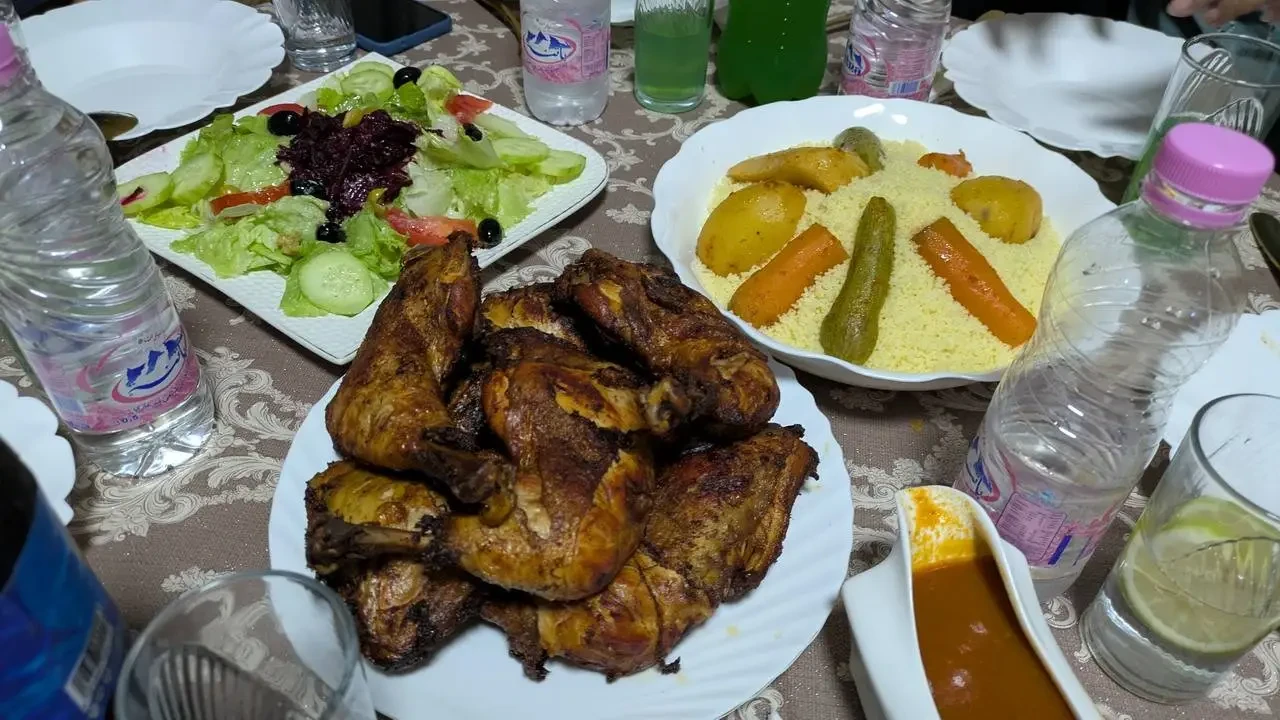
We continue towards Constantine, a city unique of its kind, built on a plateau cut by deep and steep canyons above which elegant bridges have been built to connect the centre with the residential areas. We see them only in passing, when darkness has already fallen. We go directly to the hotel, the Ibis, where at the entrance our luggage has to pass through a metal detector barely watched by a listless attendant. The building is completely isolated from the rest of the city by high railings and two gates guarded by armed men. All reminders of a recent but not yet remote past, which seems to be moving further away from the present, and hopefully from the future as well. The advice is not to go out at night; one probably could, but we are tired enough not to seek further emotions in this long day. We only go out for dinner in a restaurant about half an hour away by coach, perhaps because walking through the central streets in the evening was not the safest option; but the gastronomic experience will be positive.