Day 7
Ghardaia II
Five towns with their palm groves. Around them, nothingness
The water of Ghardaia
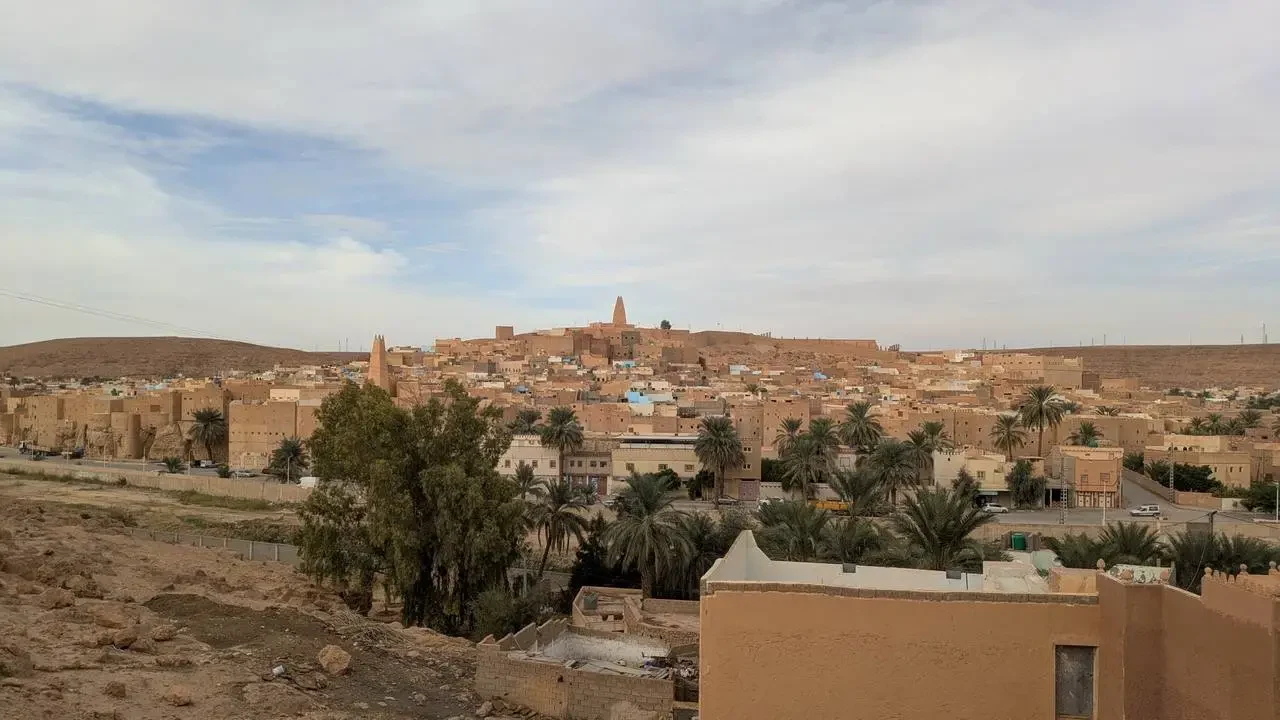
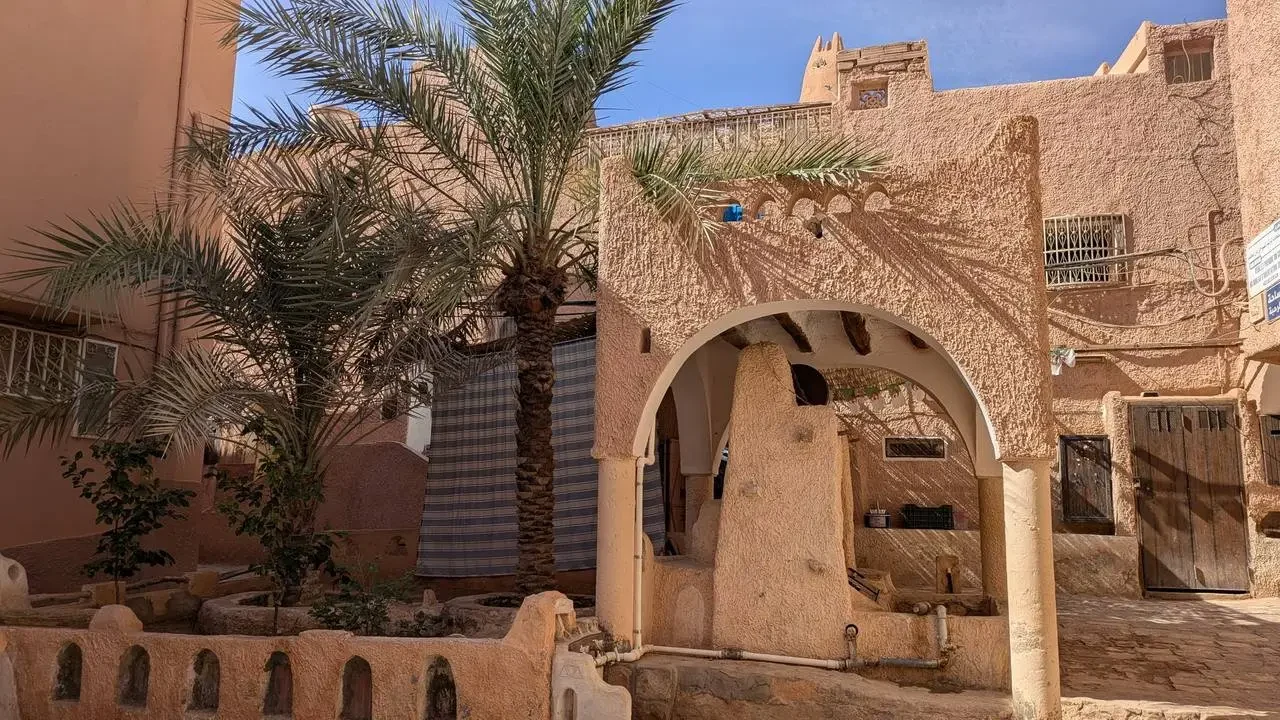
We continue our visit to Ghardaia, going deeper into the details of its urban life and trying to understand how so many people can live in what is, and can only be considered, an oasis, however large. We are in the middle of the desert; to reach it one must drive for hours through the flattened nothingness of the Saharan lands, and then, like a mirage, the first palm groves begin to appear. The answer to the miracle, not mirage, of so many people existing in such a hostile environment is water. The next questions are how this source of life arrives and how it is distributed. The first answer is that the water does not arrive: it is already underground. It is a disarming statement, since rainfall is truly scarce, but it is supported by the fact that under the desert there are large reserves; the point is to divide them wisely according to need. To do this the system of the foggara, or qanat, was adopted, carrying water to the town from the spring where it emerges or from the well from which it is pumped. Underground channels, sometimes several kilometres long, prevent evaporation and are interrupted by manholes used for inspection and cleaning. In what we might call the distribution centre, holes of variable size and absolute precision regulate the flow so that each neighbourhood or palm grove receives the water it needs, without wasting this resource capable of deciding the life and death of people, animals and plants. We visit the place where the main channel arrived and branched out; today it seems to have been replaced by more efficient ones, but it is a useful example of how the system works and can be reactivated at any time. The operating principle remains the same.

Melika and Bou Noura
Next we go to Melika, whose cemetery lies in the upper part of the town, and continue to the Mausoleum of Sheikh Sidi Aissa. Here too we see some women shielding themselves and turning their backs as we pass by in the coach, although they are not the object of any particular attention from us. Even the curiosity of seeing veiled women eventually fades after seeing a few and after the surprise of their dress has worn off.


Bou Noura is the last visit in the Ghardaia area. There used to be five watchtowers here, but only three remain. Once they communicated with one another by explosive signals during the day or by burning palm leaves at night. They were not used only to warn of the arrival of possible enemies, but also to alert people in case of floods, which did not necessarily arrive with rain falling in town. The rain could fall dozens of kilometres away and suddenly the river would arrive in flood, without people being prepared.

Near the mosque, on the top of the hill along which the town stretches, a wedding is being celebrated today. Mutual curiosity leads us to meet and exchange a couple of photos with the groom, visibly tense, though we do not think because of his meeting with a group of Italian tourists. His friends are more uninhibited and do not miss the chance to add more cheer to the event. The bride will be somewhere, but we are not allowed to see her. In the same way, we settle for seeing the mosque from outside. Here too the minaret has a square plan, starting squat at the base and tapering towards the sky, which today is rather grey. We also get a little rain, with large drops, never enough to dampen the ground, drying immediately once they reach the surface.

In Ghardaia one nevertheless has the impression of living in a calmer social model. We can walk without police supervision and the only looks we receive are of curiosity towards the foreigner, never with a tone of challenge or provocation. For the rest, when people see us they greet us, and being Italian once again helps break the ice with a joke about football, music or cooking. In all five towns of the pentapolis one may move freely only in the lower, commercial part; climbing towards the residential areas and the top, where the mosque always stands, is not allowed without a companion. This is not for security reasons but for privacy, especially towards the women who live there and pass through the streets. It is a completely different culture; even if one does not share it, it must be understood and respected. The guided visit adds value thanks to the precious information on history and the present.
Free afternoon in Ghardaia
Lunch is in the same restaurant as yesterday, packed as if it were the only one in all Ghardaia, and the fact that we returned despite not being in the area suggests it may be so. The food is good, but even if one manages to get through the queue at the counter, where interesting dishes are displayed, there is then nowhere to sit. We take a short walk under the arcade between a phone shop and a tyre dealer and find a small place where we enjoy a light but good kebab, called something else here. When managers and guests see us, they go out of their way to make our stay as easy as possible within a not particularly comfortable establishment, as if we were important visitors. In reality it is simple, polite hospitality, which we return as best we can with the only means available: a smile.
The free afternoon allows us to see Ghardaia from another angle, less touristy and more tied to daily reality, although in Algeria these two dimensions mix very well. The centre of the lower town is emptying out, the market is almost over and vendors are closing up; some linger, allowing us to capture a few more impressions. Even the sellers of local crafts have gone for a short lunch break, leaving carpets and traditional clothes under the mild sun, with only a stick placed diagonally to indicate that the owner is absent. Some neighbour will surely keep an eye out, but there is a clear feeling that in Ghardaia theft is not an activity contemplated. We then leave the centre for a walk in the residential quarter, aware that there are no dangers, even in the side lanes. Well before dinner time we start looking for a restaurant with the help of Maps; it will not be simple, since one does not exist, another exists but is closed, and another still has yet to open, who knows when, all while using a good dose of intuition because signs are not much used. In the end we find a promising place judging by the smell coming out of it. We climb the stairs and are pleased to see that it is indeed a restaurant, but there is nobody there. After a moment the cook comes out and tells us dinner cannot be served before six; half an hour remains. We thank him and start down the stairs, when he turns back, calls us and invites us to come up again. He has changed his mind. We sit in the empty but richly furnished room and he brings the menu: it will be a positive experience, a mixture of taste, friendliness and atmosphere.

On leaving, we take a taxi back to Hotel Belvedere, trying to book it with a local app, Yassir, similar to Uber but without credit cards, which in Algeria are almost a useless piece of plastic. The request works, but at a certain point the assigned driver seems to cancel it. Nearby there is a taxi stand, so we get into one without technological help. The sun is setting and from above we enjoy one last fine view of the day. We return early because tomorrow morning the meeting point is at exactly four o'clock to leave by 4x4 towards Brezina.

Ghardaia is the only area where one can sense even a minimal air of tourism, though limited and local. Restaurants are few and one ends up seeing the same people already met in the souk or along the streets of the old city: Algerians who often live in France and come here to rediscover the beauties of their country and their origins. The same applies to hotels. The Belvedere where we stay can be called an architectural eyesore perched on the hill, but with a fine panoramic view over the city; the image of the building from below is much less pleasant. Here too visitors are channelled into one or a few sites dedicated to tourists, a feature that translates into easier surveillance if necessary. But the interior is pleasant, everything works and there is a good view of Bou Noura.