Day 12
Timimoun: the last oasis
A Sudanese-style town, crossroads of history and trade
Fossils and arrival in Timimoun
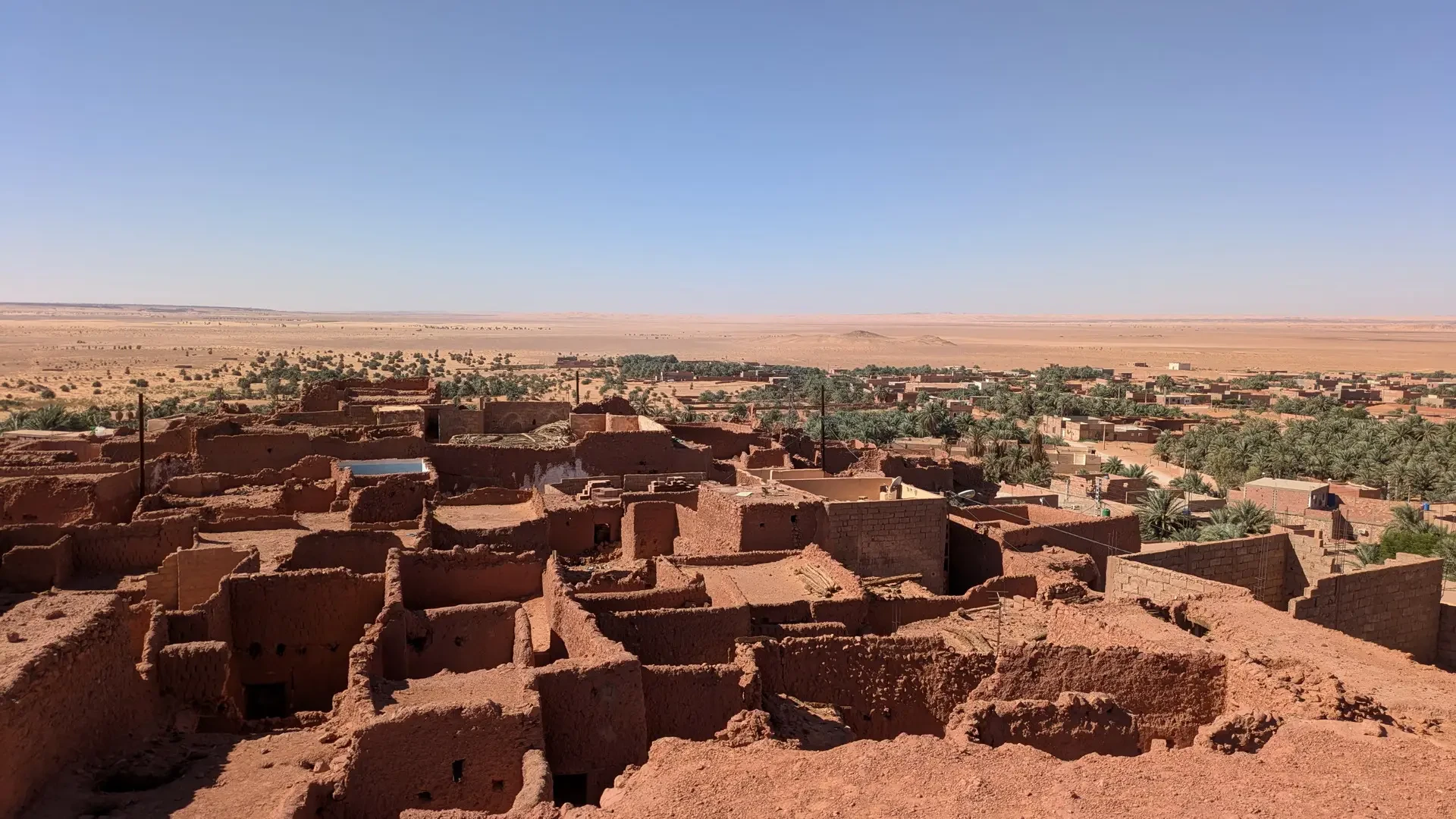
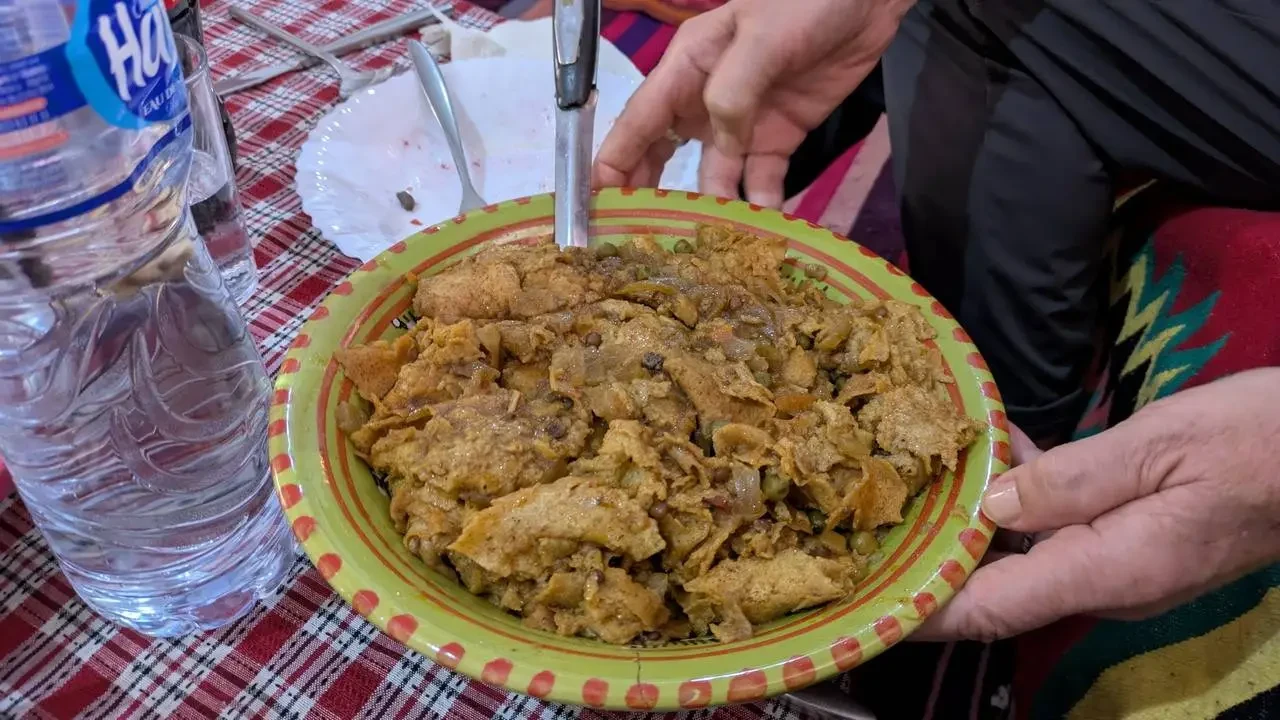
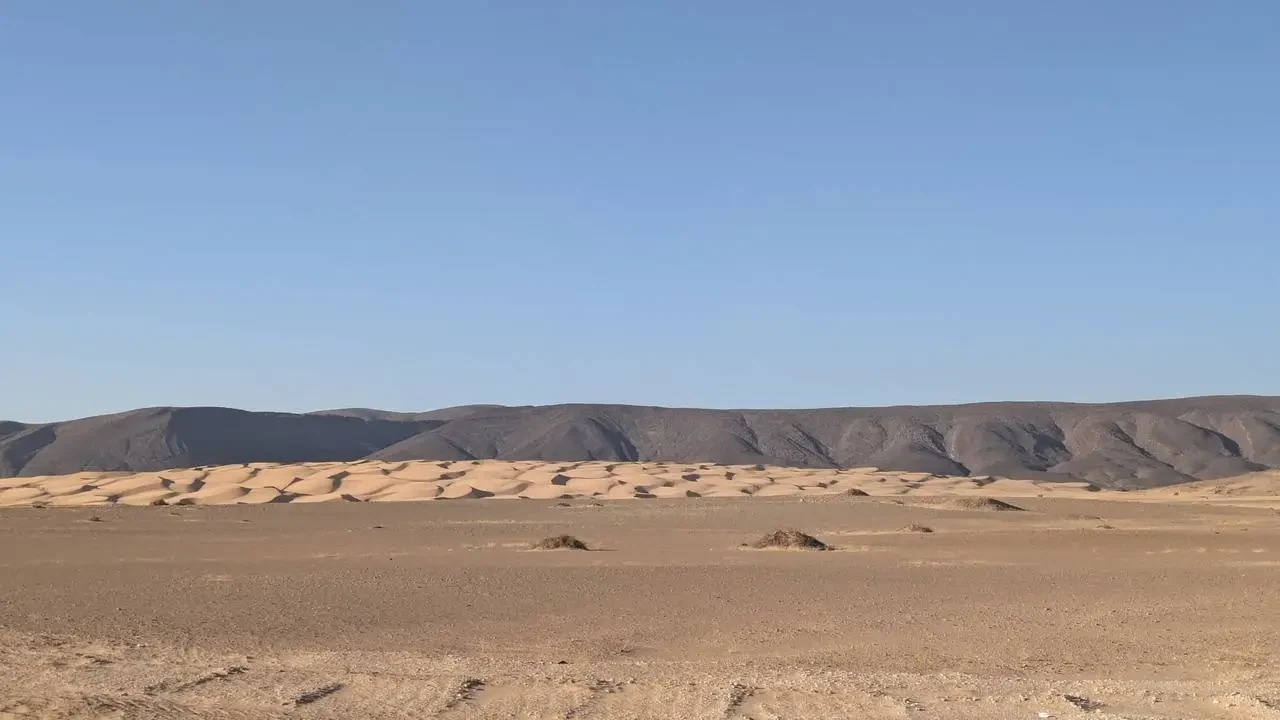
Around 7:30 we leave Beni Abbes to visit a site where fossil fish shapes can be found. There are no protections; we walk among large stones serving as a floor and bearing these very ancient casts, left long before prehistoric humans arrived, when today's Sahara was a seabed. Moving on, the landscape alternates between desert expanses and short mountain reliefs, as well as sandy areas ending in stony plains. With a couple of brief stops we reach the junction, a T-shaped road drawn on the sand, which in 90 km takes us to Timimoun; today's total will be 350 km. On this last stretch we see several trucks; we cannot explain their presence in such an almost uninhabited area. A couple of villages built inside the oueds hide from the summer heat, heedless of the military logic that would instead have placed them on more defensible heights. The entrance to Timimoun, now in the centre of Algeria by every orientation, immediately reveals the characteristic beauty of its Sudanese style: white decorations on an intense red background and a series of arches. Arcades and porticoes, already seen yesterday in Beni Abbes, are useful for bringing shade along pavements, but also serve ornamentally to divide one carriageway from another in the centre of the main streets. Lunch is in a fast-consumption restaurant: one orders the hot dish from the counter display and eats it at the table amid the understandable bustle of mealtime. Although we see excellent skewers, we take a kind of ratatouille and a mixture of potatoes, bechamel and other ingredients that would make fast food in our latitudes deeply envious. We take possession of the rooms inside the guest house run by a man with long hair and an even longer beard, as courteous as he is shady. The temperature is around 30 degrees, but the heat is sufficiently ventilated to be pleasant, helped by the absence of humidity. We meet the local guide, proudly Berber in his Tuareg form, with the inevitable deep blue turban. We go to visit the ksar, 700 years old but abandoned in 2004 because of an extreme weather event with intense rain lasting more than 15 consecutive hours. A real flood was not even necessary to make the fragile clay houses collapse; they melted like ice in the sun and imploded. The village was destroyed, a woman died and the site was abandoned; now it is a destination for the few tourists wanting to see the old housing modules of Timimoun. The mosque is still there, as are some sanctuaries dedicated to marabouts, a sort of saints in local Islamic interpretation, painted white and therefore in sharp contrast with the clay houses. On feast days, village families gather around them to eat and picnic.


Ksar, palm groves and life in the desert
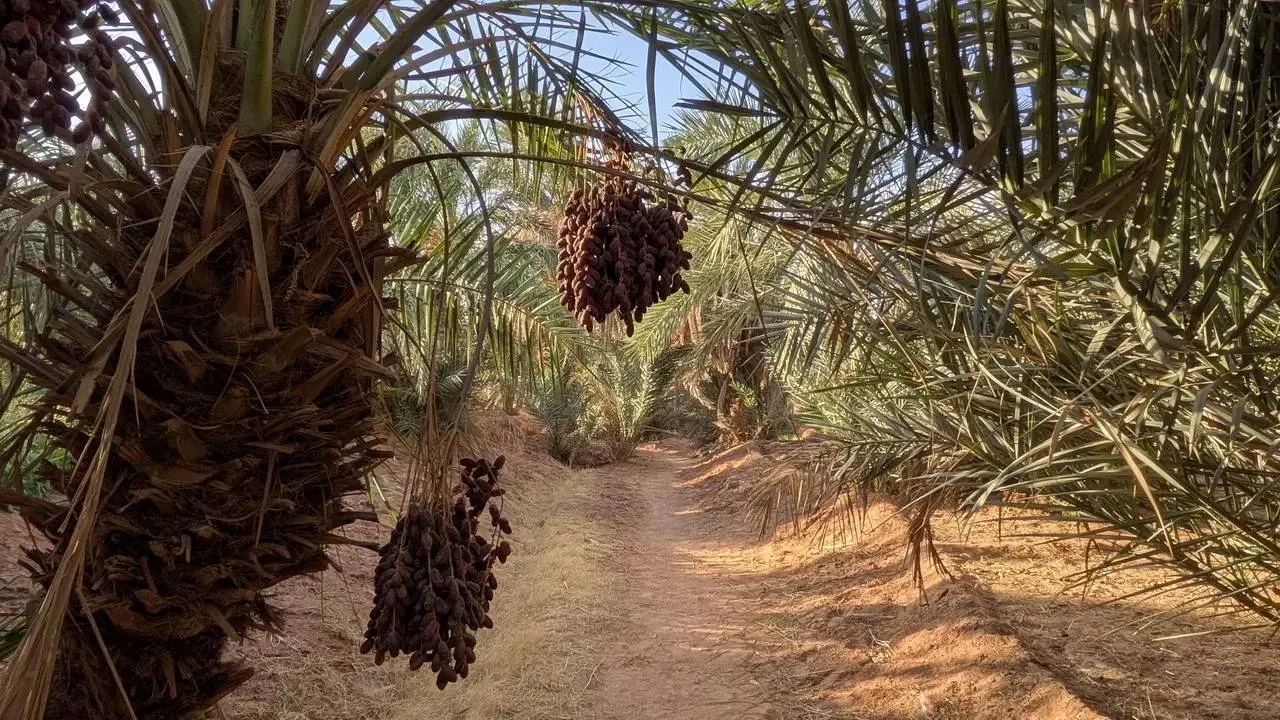
Contrary to what one might think, although we are in a desert area, rain is seriously feared because it brings damage far greater than constant drought. It should be said that the rarity of the event discourages the local population from building houses and embankments strong enough to prevent misfortune. After the tragic events, the government encouraged construction with cement blocks, less effective in terms of thermal protection but more resistant in case of rain. Not far away is the garden, covered and protected by palms, a true Eden where fruit trees and vegetable gardens grow and proliferate, with small channels skilfully created and divided among them to satisfy everyone's needs without wasting that precious transparent liquid substance of which the subsoil is rich.


In Timimoun winter temperatures can reach zero, when water drawn from wells forms a thin layer of ice, while in summer 40 degrees are the rule of the day and even 50 can be reached. In winter inhabitants tend to heat themselves with gas, coal or palm wood. The first two can in some cases create carbon monoxide saturation with lethal consequences; palm wood is a safer method and the raw material collected in the palm groves seems not to be lacking. The tourist season begins now and ends in March, considering that the winter months are decidedly colder. The city has about 40,000 inhabitants and lives from agriculture, dates, and indirectly from the oil industry. In the centre we see the branches of several banks, a sign that hydrocarbons already leave a fair amount of wealth at their point of origin, where they are extracted. We exchange a few words with a technician who arrived in Timimoun in the evening from an oil field 300 km away. He will sleep here tonight and tomorrow has a flight home, near Batna, where he will stay for four weeks after the same number of weeks of continuous work. Besides oil wells, gas wells abound, though many have been closed to avoid inflating the market. Evidently the recent contracts with Italy and Europe in general, intended to replace Russian gas, are still not enough compared with the enormous availability held in the Algerian subsoil. We are told that many coyotes live in the desert, there is a fair population of fennecs, desert foxes, and some gazelles. There are few scorpions in the area. The most dangerous are black, while yellow ones are not particularly so. They are the size of a palm and in this period hibernate, as do snakes, which around here do not seem especially dangerous, whereas in the south of the country and in the Sahel, which they curiously call Africa, there are far more venomous species.
Sunset and daily life in Timimoun
The inhabitants of this area are Berbers, of ancient Moroccan origin, with a language similar to that of the Tuareg of the south and of Kabylia, though with differences. City signs are bilingual, Arabic and Berber, the latter standing out for the geometric character of its alphabet. Tonight too we watch the sunset from a pulpit located on the top of a dune. There is no lack of choice, and the sand wraps its warmth around bare feet as they climb the slopes. Perhaps the chromatic expectation of the sandy desert of Timimoun was so high that we do not notice particular differences compared with previous days; the fact is that by now we are well used to this golden monochrome tending towards peach and are a little spoiled by it. The other positive aspect is that there is nobody there, so letting oneself be wrapped in nature and silence will be anything but difficult. The only unpleasant note is the large amount of rubbish abandoned on the dunes: plastic stands out in its bright colours, showing visitors a truly ugly side. Once again the skilled drivers prepare tea with their traditional method, while the violet horizon is leading the way for the approaching night.


Even in Timimoun there are no foreigners, only a few Algerian businessmen probably linked to the oil world or its supply chain. Despite efforts, reception capacity is limited and the useful season is not particularly long. It even happens that, because of the limited offer, hotels and guest houses hold the stronger hand in negotiations with agencies. Tonight too we eat couscous, usually served with camel meat or chicken, sometimes with slightly spicy seasonings; further north, camel is replaced by lamb.