

Day 9
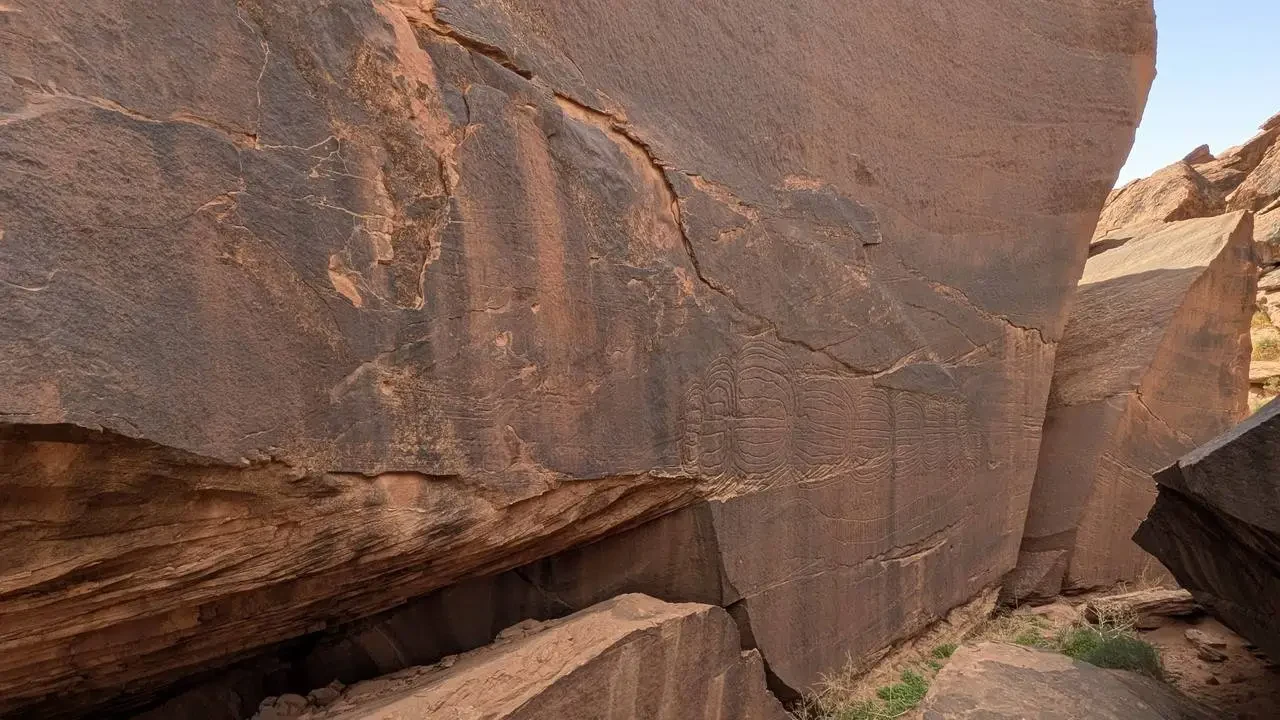
The desert, images from when it did not exist
More rock engravings and ksour, fortresses, in the Grand Erg Occidental
From Brezina towards Arbouat
We leave Brezina, where we had lunch, dinner and breakfast in the same house belonging to Ahmed, the driver. The women - his wife, three daughters and someone else - took part in preparing succulent meals, albeit within the Algerian tradition, which does not include many variations. They are gathered behind a curtain that serves as the kitchen, but we men have no way of seeing them for reasons of privacy. It is a peculiar feeling, because where we come from, leaving someone's house without saying goodbye seems rude. Here it is exactly the opposite: seeing them and greeting them would have been rude. And yet we would really have liked to thank them for the care shown to us; "our" women will do it for us too.

In Brezina nationalist, or patriotic, rhetoric appears more marked than elsewhere. Many murals praise defence of the homeland and some more recent ones the resistance of Palestine. Propaganda does its work in an anti-Israel, anti-Morocco and anti-France function, forming the ideal triptych of enemies. This does not mean the population's solidarity is weak or superficial; on the contrary, the subject is felt and widely discussed. There is no doubt that, together with other murals, independence monuments and images praising the armed forces, the whole forms a system that binds the country around a concept of unity pleasing to those who govern, particularly useful for holding together a varied population living in the largest African country, and therefore one not easy to control.
A brief stop in the town centre in front of the bakery lets us watch the morning coming and going of people who go to buy bread, breaking baguettes in two to fit them into the rack of a moped or walking away with a bag. The ones we usually find on the table are fresh baguettes or, during yesterday's meals and also this morning at breakfast, homemade unleavened bread similar to matzo. Even better, as we experienced a little while ago, with date cream or jam spread on top.

Ksar Arbouat and Garet El Taleb
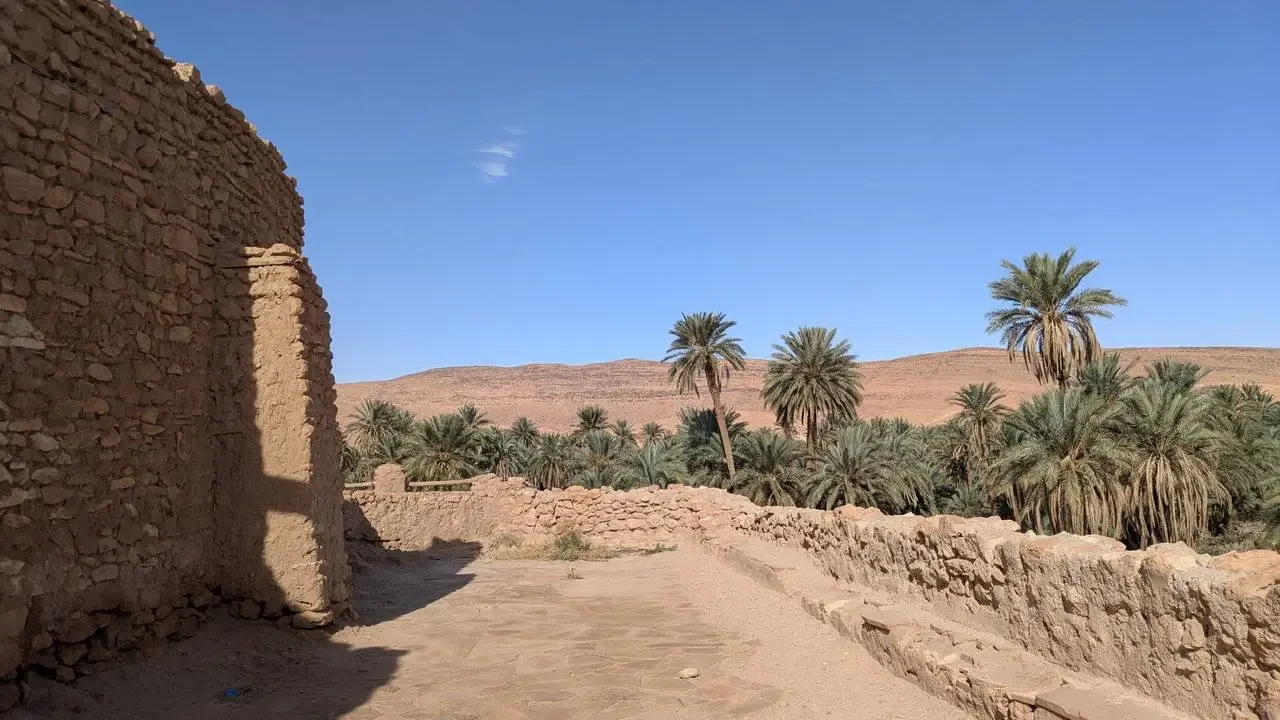
We go to see Ksar Arbouat, which has four gates oriented according to the cardinal points and contains a mosque where the details of the rites practised are explained to us. It has a minaret destroyed by the French because it was considered too close to one of their military posts, whose activities could be spied on from above. About 500 people lived in the ksar, and it remained inhabited until after independence; the last residents left in the early 1990s. In the meantime the local government has rebuilt the minaret. A beautiful palm grove completes the setting.

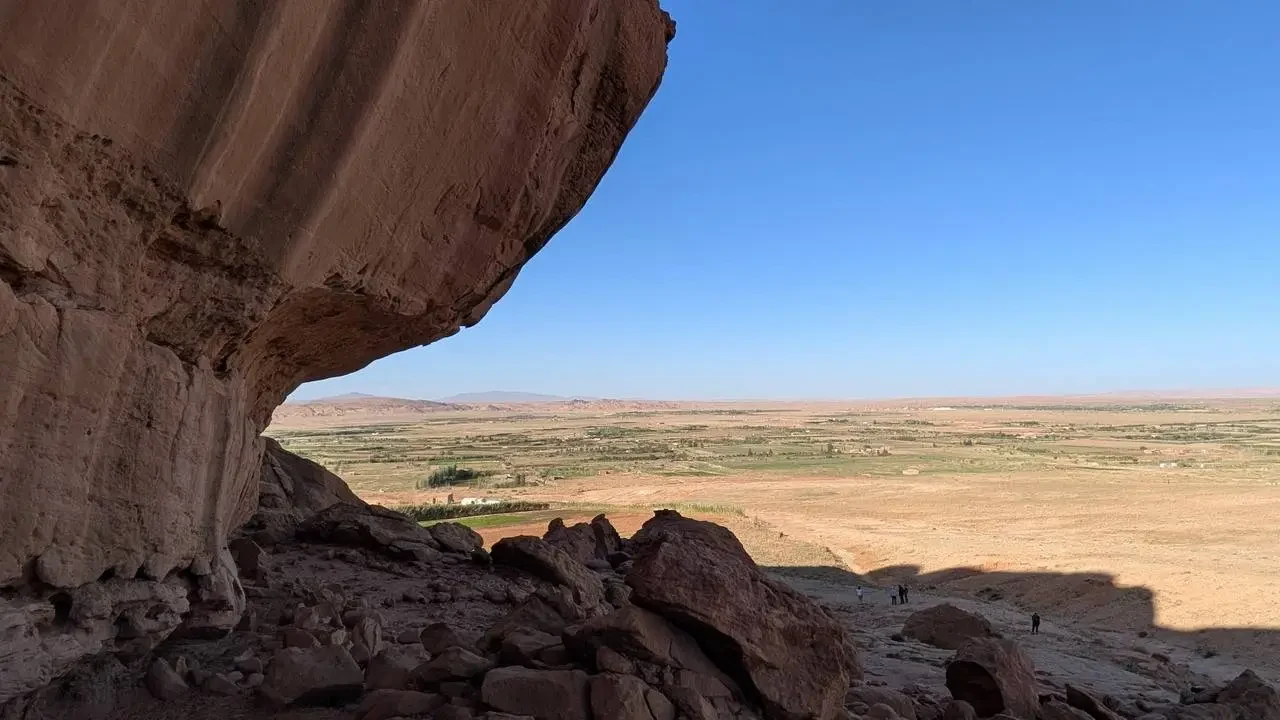
The next stop is the petroglyphs of Garet El Taleb in the Arbouat area. The site is reached by driving twenty minutes along a dirt road that in places becomes barely a trace in the desert, with sand well attached to the ground; a few bushes break the visual silence. The petroglyphs date to about 7,000 BC. Animals can be seen that once lived regularly in the region but are now thousands of kilometres away. It is hard to grasp how this area was once anything but desert, even hosting forests and prairies where both humans and animals lived, while now it is totally inhospitable. Among the drawings two scorpions stand out; probably the smaller was the sketch from which the ancient artist derived the larger one, six metres long. The other animals represented are panthers, snakes, gazelles, mammoths and even a large bird that could easily be the ancestor of an ostrich. The walk lasts an hour and a half. When we reach the vehicles, which in the meantime are waiting at the agreed point, we eat our picnic lunch in the shade of a projecting stone, which would even serve as a roof in case of rain. The rock is made of good sandstone, ideal for hosting caves useful as dwellings for ancient people and for giving shoe soles a good grip. Some wolf droppings, pigeon feathers and holes in the ground probably made by mouse-like animals confirm how much life is possible even in arid and difficult places. We leave this area, whose sky is decidedly busy with airliners, at least according to the simple method reported by the local guide, and resume the journey by 4x4. At a certain point cultivated fields appear, the usual miracle made possible by water, while others have just been ploughed. Seeing such images in an arid setting creates visual and mental contrasts whose only explanation lies in the ability to irrigate the land. It seems unthinkable that so much water can be stored in the bowels of the Sahara, or the Grand Erg Occidental in this area. The rest is desolate land, the only exception being thin blades of grass on which sparse flocks of sheep graze, not even very thin ones. Long and straight runs the road, to paraphrase the singer-songwriter, so much so that on several occasions we reach 130 km/h. As always there is little movement, except for a couple of dogs and some termite mounds.


Boussemghoun
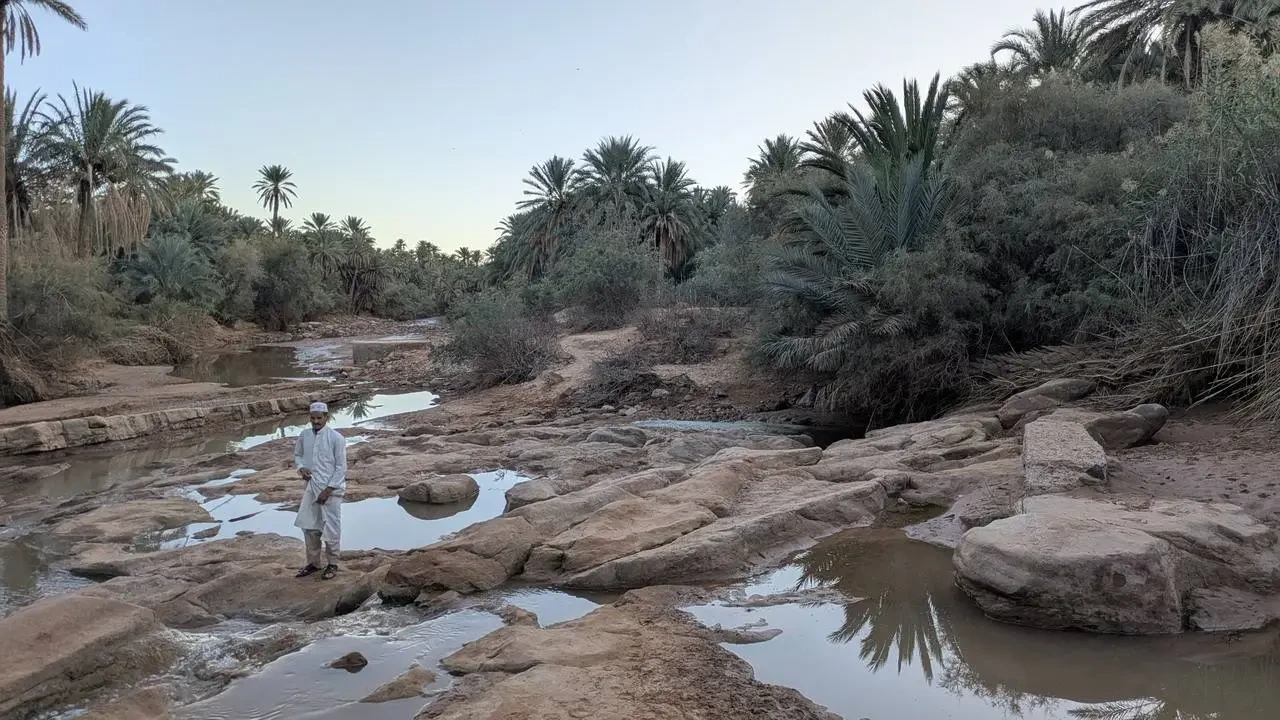
Boussemghoun is today's last interesting visit. It is a quiet little town where broad avenues decorated with greenery intersect; medium-sized trees, the most that can grow under the scorching summer sun even with good irrigation possibilities. For a change, it is a ksar built inside an oasis around the 1300s, now in vogue because it is the birthplace of the current President of the Republic, Tebboune, whose family is affiliated with the local zawiya, a detail that allowed him to begin a brilliant political career. In the town there are 44 wells from which water is drawn to keep the oasis flourishing and green. The last inhabitants left the ksar in 1986, but everything is well maintained, with small museums created in houses that would otherwise be abandoned, shedding light on past life. We learn another term, twyza, what in our Occitan valleys is known as rueido: the union of a village's inhabitants to carry out work useful to the whole community. The lights on the village, though abandoned and with decaying walls, return a variety of warm colours at this hour close to sunset; the palm grove is splendid thanks to the stream that springs nearby and runs through it, keeping the oasis lively.


Arrival in Ain Ouarka
With one last half hour on the road we reach Ain Ouarka, in front of a beautiful lake and surrounded by relatively high mountains. It feels like Mars. We are almost in the centre of Algeria, between sandy desert and stony desert, where bright green oases barely wedge themselves in. Tonight's accommodation also appears to be a spa centre: there are no signs and nothing suggests one can take hot baths, only a terrible smell of hydrogen sulphide, rotten eggs, coming from the lake. During a short walk after dinner we meet only two couples of Algerians who emigrated to France and are currently visiting their country. Beyond that it is not worth going, not because it is risky, simply because there is only darkness and the nothingness of the desert. A garden with an attached children's playground should represent the meeting point for holidaymakers, but in reality the works have been stopped for who knows how long and the promenade pavement already has cracks requiring maintenance. On the other side rises a steep, wrinkled cliff, not far from the car park. Tonight's hotel does not even offer the illusion of being beautiful from the outside: simple rooms, narrow beds but with a good mattress, the toilet flush replaced by a builder's bucket that can be filled from the tap at mid-height. Two boys taken from who knows what other job do their utmost to find unlikely solutions to the shortcomings. There is nothing else, except the muezzin calling to prayer and therefore to sleep. Dinner, however, holds a surprise, since the chicken is seasoned with aromatic herbs that make it the best tasted so far. Natural beauty alternates with civil ugliness; an appetising dinner improves the stay amid the disorganisation.


