Day 4
Timgad and El Ghoufi: between history and geography
The home of Roman legionaries and the beginning of the desert regions
Lambaesis and Timgad
This morning the sky is covered by extremely low clouds; later the windscreen will even be dampened by a couple of drops of water. Nothing serious, but enough to force the coach's lazy wipers into action, a far from obvious operation given its general condition. It may seem strange at these latitudes but, if we want to put it that way, this is the "rainy season", when a few millimetres can fall and grey occasionally replaces the clear blue that normally covers these lands. In half an hour we are at Lambaesis, not an essential site but one that can be visited without a detour. A bare remnant of a Roman city that housed veteran legionaries, it is actually of some interest thanks to the Arch of Commodus and a kind of palace. The rest was removed in later periods, especially during the French occupation, when its stones were used to build a maximum-security prison where every successive regime lavished deprivation and torture. Even today the name alone evokes terror, so much so that badly behaved children are threatened with being taken to Lambaesis. As children the risk does not exist; with time and growing up, however, its doors can open wide, sometimes even only for ideological faults or opposition to the mainstream thought dictated by the pouvoir. Even fairly prominent politicians have been its guests, as happened to the brother of former president Bouteflika, imprisoned for corruption and illicit dealings he probably had committed. Certainly because he had fallen from grace.

Another half hour away, instead, lies one of the most beautiful and best-preserved Roman cities: Timgad. Among the ruins and ancient walls blows a breeze that is anything but invigorating, but the site is extremely interesting and well preserved. The museum offers a tempting appetiser, but finding oneself in the town where retired legionaries lived for generations is an emotion apart. When speaking of pensioners one must not misunderstand the concept: the soldiers "worked" for 25 years and at around 40 or 45 could retire and enjoy a landed income, which today we would call a pension. They could also count on a series of benefits that allowed them to live comfortably; clearly the hard work was done by slaves. The guide takes us with passion along the cardo and decumanus, highlighting the features of the buildings and narrating interesting scenes of daily life two thousand years ago. Among the legionaries there were three social classes, with corresponding dwellings according to rank: the standard one was a kind of condominium, though made of houses of only two floors; those we might call non-commissioned officers or middle ranks had an 8,000-square-metre domus; while the upper ranks, only a few individuals, could count on a villa with 25,000 square metres of surface. Men could marry, which was forbidden during service, and came from all over the empire: inscriptions have confirmed presences from Carthage, Palmyra, and in Gallic, therefore from present-day France. The common denominator was the use of Latin, whose study was compulsory for a career. Among the city streets stands the library, which inhabitants could use to perfect the language and refine the mind.

To obtain Roman citizenship, Caracalla, son of Septimius Severus and therefore of African lineage, decreed that it could be acquired simply by what today we might call ius soli, being born in the lands of the empire. This right, however, applied only to free men and in no way concerned the enslaved population. Before Caracalla's decree, residents of colonised countries could obtain citizenship only after 25 years of military service. The same period was also the length of military service; at the end of it the legionaries were entitled to a pension, formed a family and came to live in these cities. With the extension of the right granted by Caracalla, the Roman Empire came to count a population of 65 million inhabitants, when Rome alone exceeded 2 million and Carthage more than 300,000.
The site of Timgad extends over 84 hectares, of which at least 25% still has to be uncovered, unlike Djemila, where there are about 35 hectares and only seven have been brought to light. The French began the archaeological excavations, while in recent decades everything has stood still. Among the most valuable buildings are the amphitheatre, which has an interesting system for carrying the voice at a distance so that the prompter could act without being heard by the public, the forum and the Arch of Trajan. A little further on is what has been identified as the brothel, easily recognisable by the high relief of a phallus on the stone at the entrance: clear evidence that signs already existed in an era before the invention of LEDs. The guide tells us that the house was inhabited by prostitutes, who, when available, used a horn to call clients, producing a sound similar to a howl; hence the term lupanar, first understood as a verb and later as a noun indicating the prostitutes themselves. The subject is in truth debated, since some historians argue that the phallic form represented an index of fertility and therefore an auspicious symbol of prosperity and well-being.


Towards the Sahara
Time flies and it is time to end the visit and continue south. Here, as elsewhere, we encounter towns that have sprung up in the middle of nowhere, with large buildings rising from them for no apparent reason; parallelepipeds we would call subsidised housing, without balconies, in a semi-desert environment where only sparse agriculture, some barracks, and no factories are visible, and where it is hard to understand what services could require enough labour to justify a settlement of several thousand inhabitants. We arrive on a hill close to 2,000 metres in altitude, where it apparently snows quite a lot in winter. Around us are apple orchards covered with what look like our anti-hail nets, though in fact they are shade cloths for the summer season. Nearby we will also see a large cedar wood. The sky improves in tone, making room for blue with rare veils. We proceed towards the Sahara, and what we are crossing is the Aures, a spur of the Saharan Atlas. It is another mountainous region, a stronghold of the mujahideen during the war of independence and also during the Islamist civil war of the 1990s. The landscape becomes barren again; some villages blend into the slopes where ochre forms a single whole joining human settlements to the natural scenery.
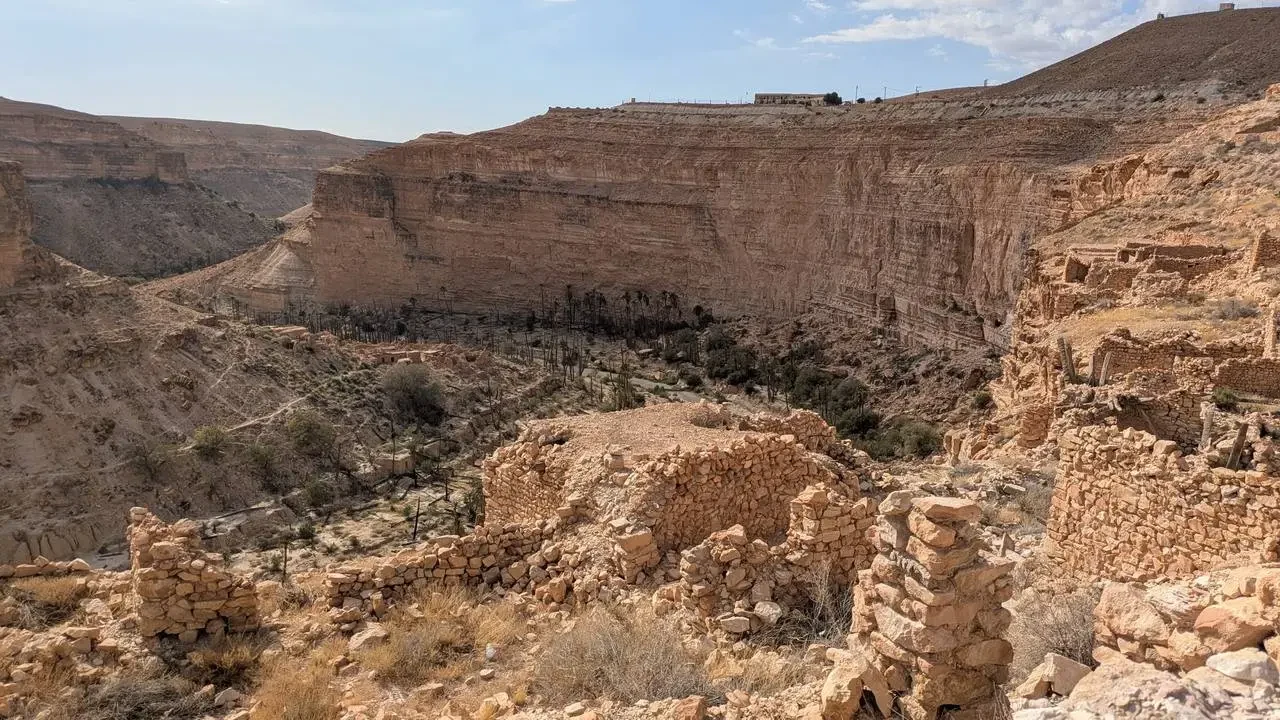
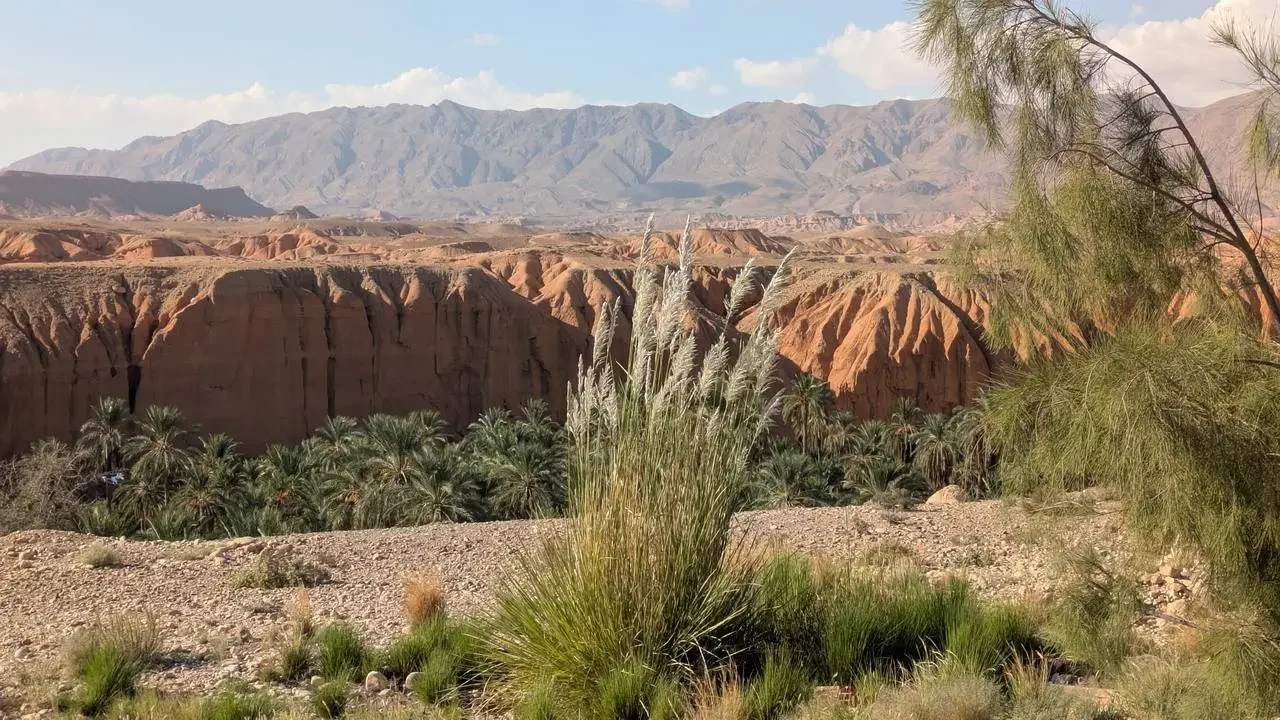
Today too we are accompanied by a police vehicle; said ironically, we would feel decidedly unsafe knowing it was absent. An interesting stop is the visit to the El Ghoufi canyon: a wide crack in the earth's crust, reaching a depth of 200 metres and about four kilometres long. At the bottom flows the timid Abiod stream, which now and then disappears underground before returning to the light as puddles or a trickle. On its sides palm groves absorb water from the earth's belly, lush sparkling green patches in the middle of arid ground. There is also a small mosque, while the houses clinging to the steep slope have long been abandoned, an evident sign that uncertain rainfall tends to undermine the stability of human presence. The view from above recalls distant Deadhorse Point or Gooseneck in American memory. We take a walk without reaching the bottom, but enough to gain a couple of different viewpoints. The setting is softened by flowering shrubs, whose bright inflorescences contrast with the dark background of the sky and the warm colour of the rock in a silent and idyllic context. As we climb back up we meet two girls who speak good French: they are Algerians living in France, perhaps already second generation, who have come to Algeria to discover the country from which their origins come. During the trip we will meet many other Franco-Algerian tourists, recognisable above all by their less modest clothing and more European lines. Today's lunch will be extremely frugal: a couple of biscuits to keep the stomach busy, then we slowly set off again, skirting a landscape that could easily be the set of a science-fiction film set on Mars. Reddish rocks dominate everywhere above the strip of asphalt, and for several hours now the sun has taken its stable place in the sky; after all, the Sahara is now at the gates. The landscape follows on, never quite the same. It is not the desert proposed by iconography or agency brochures: arid earth alternates with stones, sometimes becoming rocks that break the monotony; scattered bushes try to offer a hint of life. By colour and touch they seem dry, but they are alive and thriving; nature created them to survive in this environment, where calling it hostile would be a compliment. And to think that a few thousand years ago there were forests and prairies here: only they have managed to resist, or perhaps have genetically transformed themselves to absorb the little moisture that air and earth can provide. Iron trees emerge from the sand to carry electricity in every direction: a sparse forest without leaves, which if possible adds further desolation and aridity to the scene before our eyes. There is a power plant in the area, hence the presence of these skeletal human-made pyramidal trees.


Sidi Okba and arrival in Biskra
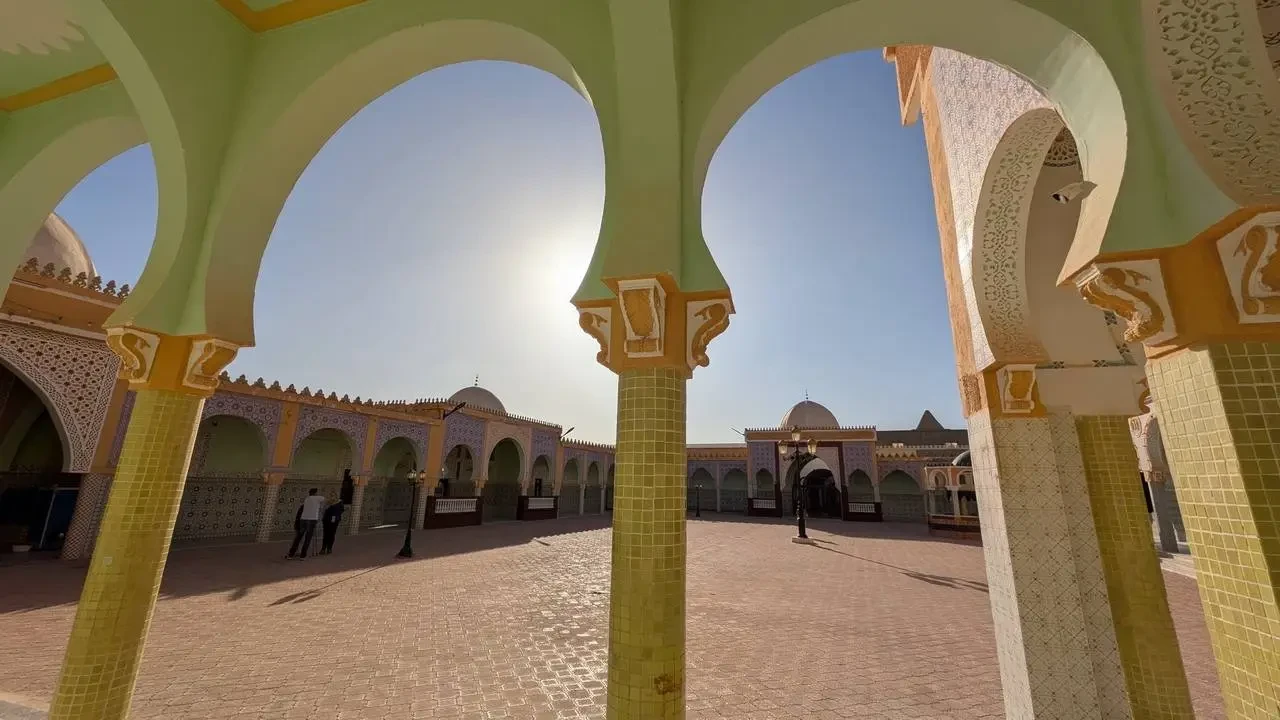
One last stop at the Sidi Okba mosque, beautiful more for its originality than for splendour. Small and at the same time intimate, it contains the mausoleum of the same name, dedicated to an Arab commander who arrived around 680 bringing the Islamic faith and was killed in this very area. Some boys have finished catechism in the adjacent madrasa, remove their shoes for a quick prayer inside the building and fly away to return to playing. The coach sometimes struggles to start, but perhaps thanks to the mosques visited so far, after a few coughs it always manages to continue its journey.


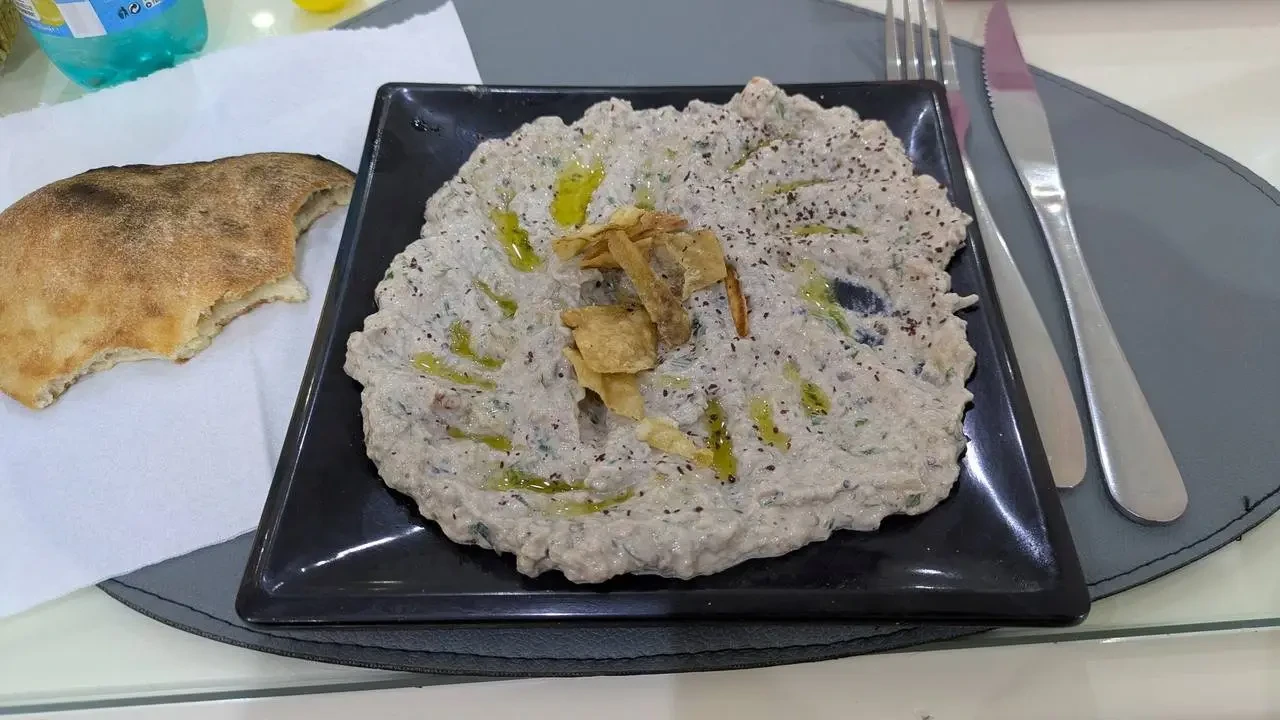
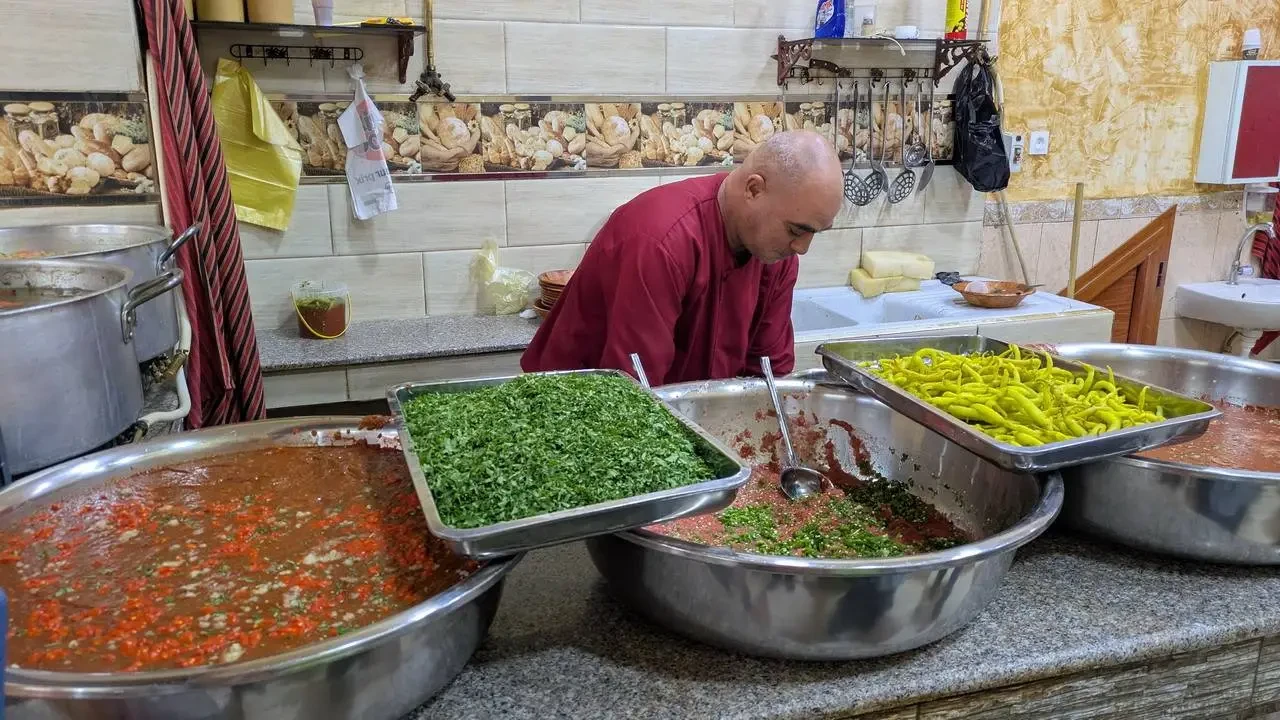
Tonight we sleep in Biskra, another city placed on the boundary between the mountain reliefs and the arid desert. It appears like an oasis crossed by a broad dry river, which fills immediately and descends torrentially in case of rain. Around it lie expanses of palm groves in a substantially arid setting. It seems to be a fairly wealthy site, whose main economic source is precisely dates. The hotel has features similar to the previous one: a four-star entrance, two-star services if all goes well. But one must find something interesting even in this experience, so a touch of naive originality can only help in such a context. An alternative experience is the hammam with scrub and regenerating massage, though we found ourselves rather tight for time. Dinner is in a Syrian restaurant with good Middle Eastern-inspired dishes: aubergine dip as only that area can offer, and kebab skewered on the classic spits. Service is fast and efficient, the staff entirely male, and that is nothing new, in a cheerful setting frequented both by local families and by young people.